Budget Cap Impact: Small vs. Large Team Development
F1 budget cap reshapes development: pre-cap investments favor big teams, smaller teams face slower upgrades and 2026 changes.
Formula 1's budget cap, introduced in 2021, limits team spending to create a more balanced competition. Initially set at $145 million, it dropped to $135 million by 2023. This change forced larger teams like Mercedes and Red Bull to cut costs, while smaller teams like Haas and Williams faced challenges upgrading outdated facilities. By 2026, the cap will increase to $215 million due to added categories like driver salaries and power unit costs.
Key takeaways:
- Larger teams benefit from pre-cap investments (advanced tools, facilities) and can run multiple development projects efficiently.
- Smaller teams struggle with limited resources, slower upgrades, and outdated infrastructure despite tiered capital expenditure allowances.
- The cap excludes certain expenses like driver salaries and marketing, allowing teams to allocate funds strategically.
- Enforcement includes strict penalties, as seen with Red Bull's 2021 breach.
While the cap has leveled the playing field in some areas, disparities in pre-cap investments and resources remain a challenge for smaller teams.
How F1 Teams ACTUALLY Spend $350M a Year (ft. Guenther Steiner)
How Small Teams Handle the Budget Cap
For smaller teams like Williams and Haas, the $135 million budget cap doesn't create a level playing field. Years of under-investment have left these teams struggling to catch up. Williams, for example, has been likened to having infrastructure from the "Ming Dynasty", a nod to just how outdated their facilities are compared to their competitors. Between 2012 and 2022, Williams spent roughly $140 million less than Red Bull and $165 million less than Mercedes on capital expenditures. Teams like Haas have operated with budgets so far below the cap that the limit feels more like a distant goal than a restriction.
The cap itself is divided into two categories: operational expenditure (opex) and capital expenditure (capex). Opex covers car building and racing, while capex focuses on long-term investments, such as simulators and advanced machinery like carbon fiber curing equipment. As James Vowles explained:
"Operational is basically the bits you see appearing on the car... Your capital expenditure side is actually, I need machines that are, for example, curing the carbon fiber"
. This structure forces smaller teams to make tough choices - invest in immediate car upgrades or modernize outdated facilities. The result? Delayed development and slower progress.
Limited Resources and Development Speed
Smaller teams face additional hurdles, including fewer engineers, limited wind tunnel time, and slower upgrade cycles compared to wealthier teams. The budget cap accounts for about half of a smaller team's total budget, while it only represents about a third for top-tier teams. This leaves smaller outfits with less flexibility to cover non-capped expenses like driver salaries and marketing.
To address this disparity, Formula 1 introduced tiered capex limits. Under the updated 2024–2028 rules, "Tier 3" teams like Williams can spend up to $65 million on capital expenditures by the end of 2024, compared to $45 million for top teams. This adjustment gives smaller teams around $28 million more to "catch up." However, James Vowles remains doubtful of its impact:
"If you didn't happen to have the money just prior to 2020, you're now with exactly what you had at that time... It's not enough to change where we are"
. These constraints push smaller teams to find innovative, cost-effective ways to compete.
Budget-Friendly Development Methods
To stretch their resources, smaller teams lean on customer parts and technical partnerships. For example, Haas relies on Ferrari for power units, allowing them to avoid the steep R&D costs of engine development - a cost managed under a separate cap. By sourcing components like engines, gearboxes, and suspensions from established manufacturers, teams can focus their limited budgets on performance-critical upgrades.
Additionally, smaller teams must invest wisely in modern, efficient technologies instead of sticking with outdated systems. Haas, for instance, began allocating resources to the 2026 regulation changes as early as mid-2024. A small team was tasked with exploring future concepts, while the rest concentrated on the 2025 car. This careful prioritization reflects the reality for smaller teams: they can't afford to run multiple large-scale development programs at once. Instead, they focus on areas where they can make the most impact and gain a competitive edge.
How Large Teams Work Within the Budget Cap
Using Existing Facilities and Tools
Large teams like Red Bull, Ferrari, and Mercedes have a significant advantage under the budget cap, thanks to their investments before the cap's introduction. Back when budgets exceeded $400 million per season, these teams built state-of-the-art wind tunnels, simulators, and curing machines. These tools continue to deliver high efficiency without adding to current operational costs.
Under the budget cap rules, teams have a capital expenditure allowance of $36 million to $45 million spread over four years. For smaller teams, this budget often goes toward building essential infrastructure. In contrast, large teams use it to maintain and refine their already advanced facilities. This creates a reinforcing advantage: better tools lead to faster and more cost-effective production, helping large teams stretch their budgets further.
Additionally, large organizations find creative ways to retain top talent. For example, they assign specialized staff to non-F1 projects, like road car development, ensuring their expertise remains in-house while keeping their salaries outside the F1 budget cap. This setup not only supports efficient operations but also allows these teams to explore multiple development strategies simultaneously.
Running Multiple Development Programs
Large teams have the capacity to run several development programs at once, something smaller teams can't afford. While smaller outfits often focus all their resources on a single upgrade, top teams can divide their efforts across multiple projects. Dedicated groups work on different upgrade packages, test various aerodynamic concepts, and explore parallel development paths - all while staying within the $135 million budget cap.
This approach translates into more frequent and impactful upgrades. Large teams carefully evaluate the cost-to-performance ratio of each component they produce. With advanced manufacturing tools and streamlined processes, they can create and test more iterations of parts than their competitors. This faster development cycle leads to consistent performance improvements throughout the season. By reinvesting in their existing assets and leveraging their scale, large teams maintain a distinct edge over smaller outfits, who face far greater limitations in their development scope.
Small Teams vs. Large Teams: Side-by-Side Comparison
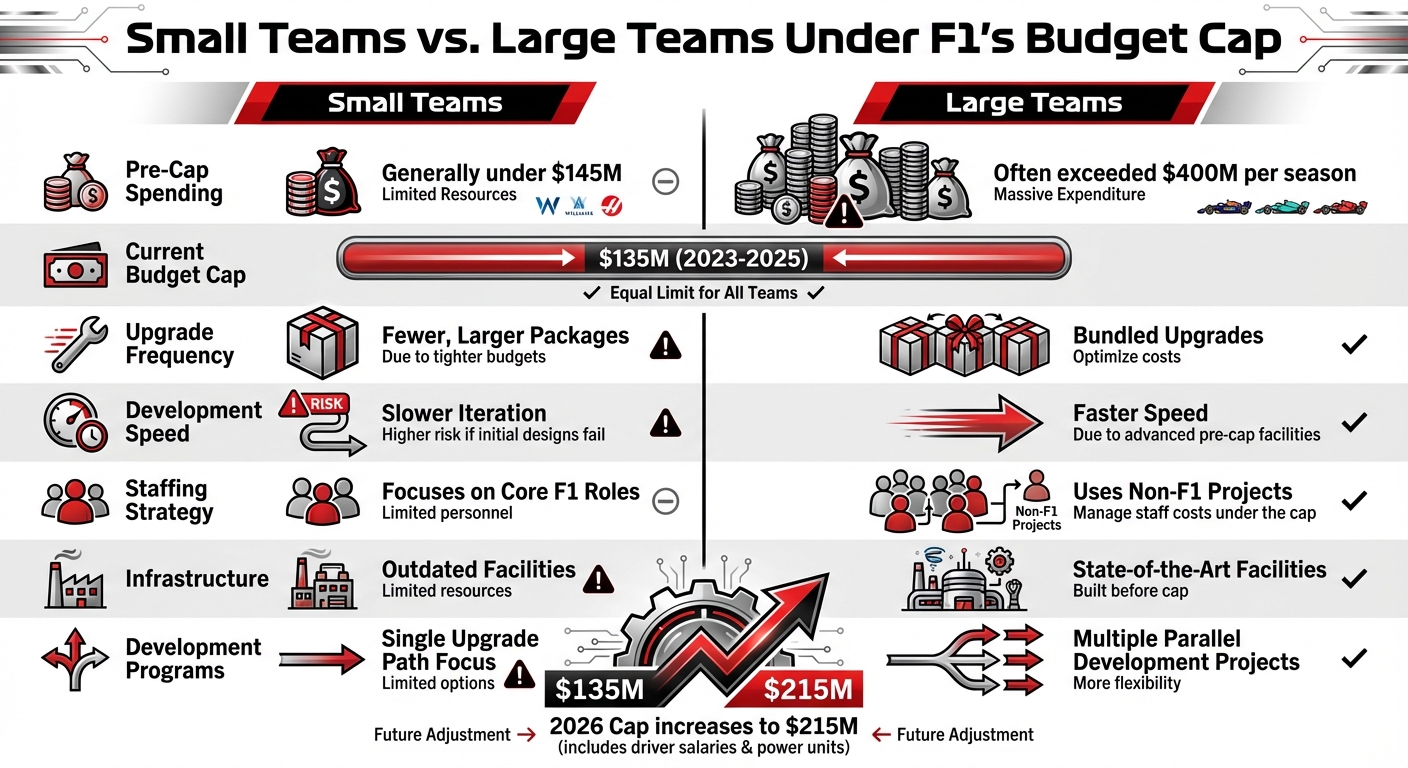
F1 Budget Cap Impact: Small vs Large Teams Comparison
Upgrade Frequency and Development Speed
The budget cap has reshaped how teams approach car development. In the past, large teams operated with much higher budgets, enabling constant upgrades. Now, they must carefully evaluate the cost of producing each part versus its potential performance boost. This has led to bundled upgrades, where multiple changes are introduced together rather than at every race. On the other hand, small teams often bring fewer but larger upgrade packages, as their limited resources restrict production volume.
When it comes to development speed, cost efficiency plays a key role. Large teams benefit from state-of-the-art facilities built before the cap, letting them move quickly during the design phase. While both large and small teams face the same manufacturing limits, wealthier teams can test multiple ideas at once, whereas smaller teams usually focus on a single upgrade path.
| Feature | Small Teams | Large Teams |
|---|---|---|
| Pre-Cap Spending | Generally under $145M | Often exceeded $400M per season |
| Upgrade Frequency | Fewer, larger packages due to tighter budgets | Bundled upgrades to optimize costs |
| Development Speed | Slower iteration; higher risk if initial designs fail | Faster due to advanced pre-cap facilities |
| Staffing Strategy | Focuses on core F1 roles | Uses non-F1 projects to manage staff costs under the cap |
These operational contrasts highlight how team size and resources shape their approach to both immediate performance and long-term planning.
Short-Term Performance vs. Long-Term Planning
The differences in upgrade strategies also extend to broader team philosophies. Small teams have shifted their focus from mere survival to long-term profitability, benefiting from the rising value of F1 franchises. For instance, McLaren's valuation reached $4.1 billion in September 2025, showcasing the financial growth within the sport. As a result, smaller teams often prioritize sustainability and franchise value over chasing short-term results.
Meanwhile, large teams aim to maintain their technical dominance while working within the constraints of the budget cap. They leverage their existing infrastructure to stay competitive and find creative ways to retain top talent. For example, assigning staff to non-F1 projects, such as hypercar or road car development, helps them navigate the cap's restrictions. Former Alpine Team Principal Otmar Szafnauer remarked:
"teams may be exploiting this loophole [part-time projects] without full transparency"
. This strategy allows large teams to safeguard their competitive edge in the present while preparing for future regulatory changes.
What's Next for F1's Budget Cap
2026 Budget Cap Changes and New Power Unit Rules
Big changes are coming to Formula 1's financial structure in 2026. The base budget cap will jump from $135 million (2023–2025) to $215 million, thanks to a reorganization that brings previously excluded costs under the cap, like driver salaries and power unit expenses. With these additions, the total cap will rise to $375 million.
On the technical side, the 2026 power unit regulations are set to make things simpler while encouraging new manufacturers like Audi to join the grid. The most notable change? The elimination of the MGU-H (Motor Generator Unit-Heat), a notoriously complex component. However, the 1.6-liter V6 turbo-hybrid engine format will remain, with electrical power output increasing to about 350kW (roughly 470 horsepower).
To address economic disparities, the FIA has introduced a salary adjustment specifically for Sauber (soon to become Audi's works team). This adjustment uses OECD data to account for the higher wage levels in Switzerland compared to countries like the UK or Italy.
Possible Future Adjustments to the Cap
Even after the 2026 changes, the budget cap will likely continue evolving to meet new challenges. Inflation is a major factor, and the current system already includes an automatic adjustment if inflation exceeds 3%.
Another area under scrutiny is how teams navigate around the cap. Some have shifted F1 personnel to non-F1 projects, like hypercar programs or America's Cup campaigns, to reduce salary expenses. To counter these tactics, the FIA is expanding the scope of the cap to cover more activities and costs. Nikolas Tombazis, FIA Head of Single Seater Technical Matters, highlighted the importance of these measures:
"The fundamental point of all of this is that we are trying to reduce the losses that the following car would face"
.
The ultimate goal remains clear: closing loopholes, ensuring fairness, and promoting sustainable competition across the grid.
Conclusion: Finding the Right Balance
The introduction of the budget cap has undeniably changed the landscape of F1, impacting teams of varying sizes in unique ways. For the sport's giants - like Mercedes, Ferrari, and Red Bull - it meant slashing annual expenditures by about 66%, from over $400 million to a $135 million base cap . On the flip side, smaller teams have found greater financial stability, with McLaren's rising valuation serving as a notable example.
The real challenge lies in ensuring the cap doesn't cement early competitive advantages. Teams that achieved technical breakthroughs early on are now reaping benefits that money alone can't erase. As Scott Mansell from Fluid Jobs aptly put it:
"The FIA faces the ongoing challenge of balancing cost control with the sport's need for continued investment and growth".
The upcoming 2026 regulations highlight how this system continues to evolve. The cap will increase to $215 million, with adjustments for factors like regional salary differences for teams such as Swiss-based Sauber . At the same time, the FIA is working to close loopholes, including stricter oversight of part-time project allocations and expanding what falls under the cap. These measures reflect the constant effort to balance cost control with the sport's demand for innovation.
F1's shift from a high-spending model to one focused on efficiency has leveled the playing field in many ways. Smaller teams now have a genuine shot at competing, while larger teams must excel through smarter resource management rather than sheer financial power. Striking the right balance between fiscal discipline and technical progress remains the ultimate goal, requiring ongoing adjustments as the sport continues to grow.
FAQs
Why do big teams still have an edge under the budget cap?
Big teams maintain an advantage under the budget cap because of their well-established infrastructure, years of experience, and advanced resources. Their prior investments in research and development give them the ability to push boundaries efficiently, even within financial restrictions. Plus, with access to top-tier talent and state-of-the-art tools, they can optimize performance and remain highly competitive, despite the cap's aim to create a more balanced playing field.
How do small teams choose between upgrades and facility spending?
Small teams in Formula 1 face tough decisions when it comes to allocating their limited budgets under the sport's cost cap. More often than not, they choose to channel resources into car upgrades rather than investing in facilities like wind tunnels or simulators. Why? Because upgrades have a direct and immediate impact on performance, which is crucial for staying competitive on the track.
While facility improvements are important for long-term growth and development, smaller teams have to focus on what brings results in the short term. By carefully prioritizing upgrades that offer the most noticeable performance gains, they aim to strike a balance between achieving immediate success and planning for future progress - all within the tight financial boundaries they operate under.
What changes in 2026 will reshape team development plans?
In 2026, Formula 1 will implement an updated annual cost cap of $375 million, which is set to reshape how teams approach their development strategies. This cap encompasses a wide range of expenses, including facilities, research and development (R&D), personnel, driver salaries, and chassis manufacturing.
However, there are some exclusions that offer teams a bit of breathing room. For instance, employee benefits during personal hardships are not counted within the cap. Even with these exceptions, teams will need to carefully adjust their plans to strike the right balance between pushing for innovation and staying efficient. The challenge lies in maintaining competitiveness while operating within these tighter financial limits.