Correlation Between Rule Changes and Constructors' Wins
Analysis of how major F1 rule changes historically shifted constructor dominance and what the 2026 technical reset might mean.
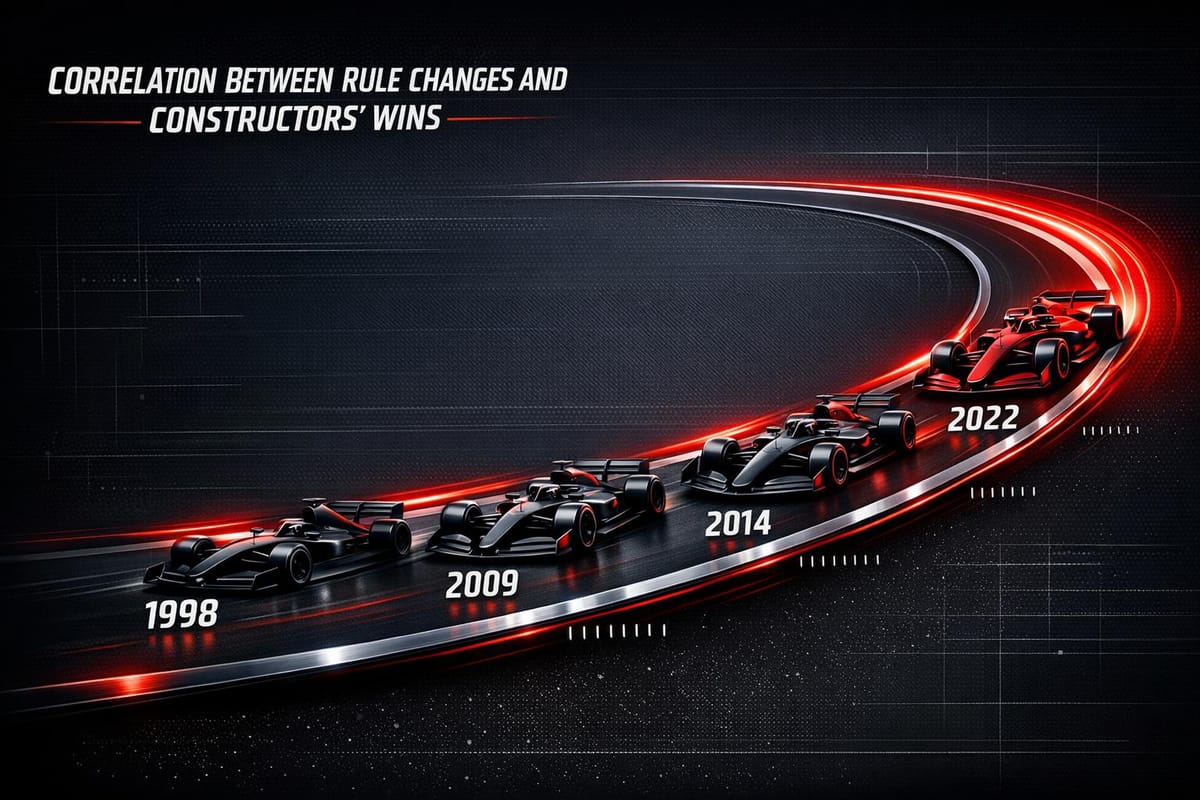
In Formula 1, major rule changes often disrupt the competitive balance, reshaping the dominance of constructors. Historical shifts like Ferrari's rise in 1961, Mercedes' hybrid-era dominance starting in 2014, and Red Bull's surge in 2022 demonstrate how new regulations reward teams that anticipate and prepare effectively.
Key takeaways:
- Success hinges on early preparation: Teams like Mercedes in 2014 and Red Bull in 2022 thrived by investing ahead of rule changes.
- 2026 regulations will be transformative: A 50/50 power split between combustion and electric systems, active aerodynamics, and lighter cars will demand entirely new approaches.
- Past trends suggest uncertainty: While 56% of major regulation changes have led to new champions, 44% saw reigning teams retain their dominance.
For McLaren, the reigning champion of 2024 and 2025, 2026 will test their engineering and strategic prowess against rivals like Red Bull, Ferrari, and Mercedes. The upcoming reset could redefine Formula 1’s competitive order.
F1 2026 Changes Everything: The Biggest Rule Change in a Decade
Historical Analysis: Rule Changes and Constructor Dominance
Looking back at Formula 1's history, one thing becomes clear: teams that invest early in new technologies tend to enjoy a lasting competitive edge. A solid initial concept can set the stage for years of dominance. Let’s dive into two key regulation eras to see how this has played out.
The 2014 Turbo-Hybrid Era and Mercedes' Dominance
The 2014 shift to V6 turbo-hybrid power units was one of the most impactful regulation changes in recent F1 history. Mercedes-AMG Petronas prepared well in advance, developing their PU106A hybrid engine years before the rules officially changed. This foresight paid off big time, as Mercedes went on to claim 8 consecutive constructors' championships from 2014 to 2021.
In contrast, Red Bull, the dominant team of the previous era, struggled with their Renault-supplied engines. Renault faced difficulties adapting to the hybrid technology, leaving Red Bull and other teams with less competitive power units scrambling to catch up.
The 2022 Ground-Effect Regulations and Competitive Shifts
Fast forward to 2022, the reintroduction of ground-effect aerodynamics - banned since 1983 - shook up the grid once again. This time, Oracle Red Bull Racing seized the moment. With Adrian Newey's deep understanding of ground-effect design, they developed the RB18, a car that dominated the new era. Between 2022 and 2025, Red Bull racked up 55 Grand Prix wins and 46 pole positions.
Mercedes, however, struggled to adapt to the new rules. Their "zero-pod" W13 concept fell short, resulting in just 7 wins and 8 pole positions over four seasons. Ferrari, while securing an impressive 24 pole positions, only converted those into 10 race victories, proving that qualifying speed alone isn’t enough to dominate. Meanwhile, McLaren made a remarkable turnaround midway through 2023. A major aerodynamic overhaul, featuring a redesigned floor and sidepods, transformed them into serious contenders. By the end of 2025, McLaren had achieved 20 wins and 21 pole positions.
| Team | Wins (2022-2025) | Poles (2022-2025) | Total Points (2022-2025) |
|---|---|---|---|
| Red Bull Racing | 55 | 46 | 2,659 |
| McLaren | 20 | 21 | 1,960 |
| Mercedes | 7 | 8 | 1,861 |
| Ferrari | 10 | 24 | Not Specified |
The difference between these two regulation shifts highlights how success depends on where the focus lies. The 2014 changes rewarded teams with superior engine integration, while the 2022 rules favored those with expertise in aerodynamics, particularly underfloor airflow. In both cases, having the right concept from the start proved to be the key to long-term success. These examples underline that in F1, early technical insight under new regulations can make all the difference.
Case Studies: Teams That Succeeded Under New Regulations
Examining specific teams' journeys reveals how they adjusted to and thrived under changing regulations, turning challenges into opportunities for success.
McLaren's 2024–2025 Championship Triumphs
McLaren's back-to-back championships in 2024 and 2025 highlight the power of perseverance and technical precision. After Red Bull's dominance during the early years of the ground-effect era (2022–2023), McLaren committed to an intensive development process. Their focus? Perfecting the complex underbody floors and tunnels that are the cornerstone of the ground-effect regulations.
Through relentless refinement, McLaren's engineering team developed an aerodynamic package that eventually outperformed Red Bull's early lead. By 2024, their innovative approach paid off, securing their first championship under this framework. They followed it up with another victory in 2025, proving their mastery of the regulations. This momentum positions McLaren as a strong contender for the upcoming technical reset.
Red Bull's Success Across Regulation Changes
Red Bull's ability to adapt across different regulation eras showcases their strategic foresight and engineering excellence. When the 2022 ground-effect rules were introduced, their technical team quickly identified key aerodynamic solutions for underbody designs and cooling systems, giving them a competitive edge. The results spoke volumes: Max Verstappen dominated the 2025 season with 421 points, while his teammate Yuki Tsunoda scored just 33 points. Notably, the last time Verstappen lost to a teammate in a race was during the Azerbaijan Grand Prix in April 2023, where Sergio Pérez took the win.
Looking ahead, Red Bull is gearing up for the 2026 regulations by developing its own power units in collaboration with Ford. Verstappen offered his take on the upcoming changes, describing them as:
"Like Formula E on steroids"
- a nod to the intricate energy management systems that will define the next era of racing.
The 2026 Regulatory Changes: Technical Reset and Implications
Technical Details of the 2026 Regulations
The 2026 Formula 1 season marks a major turning point with sweeping technical changes that aim to redefine the sport. Cars will undergo significant alterations, including a reduction in wheelbase to 3,400 mm (down from 3,600 mm) and a narrower width of 1,900 mm (previously 2,000 mm). On top of that, cars will shed 30 kg, bringing the minimum weight down to 770 kg from 800 kg. This "nimble car concept" is a deliberate shift away from the heavier designs of recent years.
Perhaps the most striking change lies in the power units. The elimination of the MGU-H (Motor Generator Unit - Heat) simplifies engine design, making it more appealing for new manufacturers to join the grid. The power balance between the internal combustion engine and the electric battery will also see a dramatic shift, moving from an 80:20 ratio to approximately 50:50. The MGU-K’s electric output will nearly triple, leaping from 120 kW to 350 kW. Additionally, energy recovery during braking will double, enabling teams to harvest much more energy per lap.
Another groundbreaking change is the introduction of active aerodynamics, replacing the traditional DRS system. Drivers will now have the ability to switch between "X-mode" for high downforce in corners and "Z-mode" for low drag on straights. An "Overtake Mode" adds an extra layer of strategy, giving trailing cars within one second of the leader a temporary electrical boost. While the leading car’s energy deployment tapers off at 181 mph (290 km/h), the pursuing car retains full 350 kW power up to 209 mph (337 km/h). In addition, F1 will fully adopt advanced sustainable fuels made from carbon capture or non-food biomass, marking a significant step toward environmental responsibility.
Seven-time World Champion Lewis Hamilton summed up the enormity of these changes:
"The 2026 season represents a huge challenge for everyone, probably the biggest regulation change I have experienced in my career."
These updates promise to redefine how teams approach car design and race strategy, while setting the stage for a fresh competitive landscape.
How 2026 Rules Affect Constructor Competitiveness
The technical overhaul in 2026 is expected to shake up the competitive hierarchy among F1 constructors. The new regulations emphasize a delicate balance between active aerodynamics and power unit architecture, forcing teams to innovate and adapt quickly. Unlike previous rule changes that often rewarded teams with the deepest pockets, the 2026 reset could favor those with the ability to adapt efficiently.
Mastering energy management will be critical. Drivers and teams must navigate what Hamilton described as "ridiculously complex" systems. The removal of ground-effect tunnels in favor of flatter floors and extended diffusers will also demand entirely new mechanical setups. Mercedes' Deputy Technical Director Simone Resta highlighted the challenge:
"It's going to be quite different... every driver will be running moveable front and rear wings together, at many points in the lap, and they will be using the energy to help overtaking."
Heading into 2026, McLaren is the team to beat, having secured back-to-back constructor championships in 2024 and 2025. Ferrari, known for thriving during engine-related resets, is banking on its acquisition of Lewis Hamilton to regain its edge. Meanwhile, Red Bull is developing its own power units in collaboration with Ford, positioning itself as a contender in the sport's electrification era. Mercedes, leveraging its hybrid-era expertise, enters the season with George Russell and rookie Kimi Antonelli leading its charge.
Reliability issues surfaced during early testing in Bahrain, signaling that only the most adaptable teams will thrive in this new era. The 2026 regulations are not just a technical reset - they’re a test of ingenuity and resilience for every constructor on the grid.
Data Analysis: Rule Changes and Future Constructor Performance
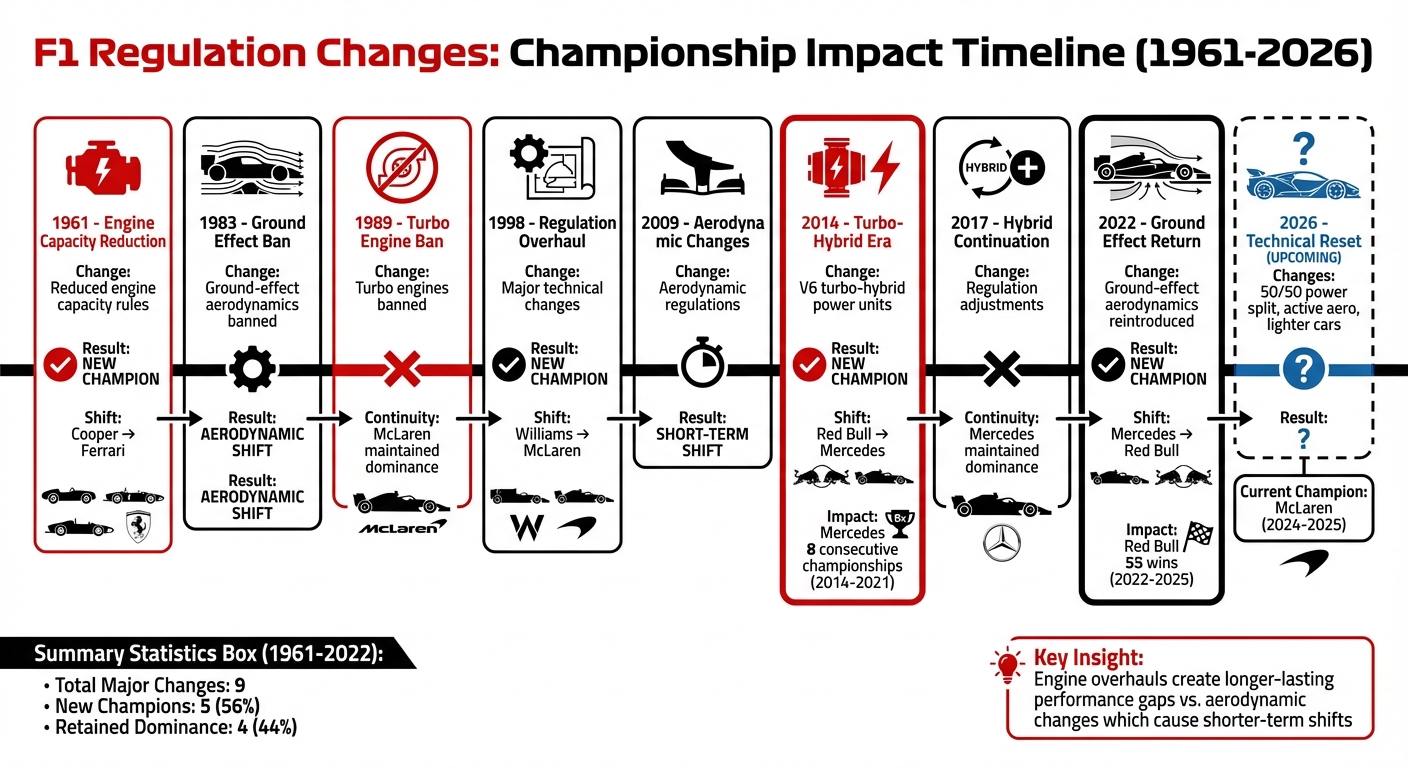
F1 Major Regulation Changes and Constructor Dominance 1961-2026
Do Rule Changes Create Parity or Reinforce Dominance?
The upcoming 2026 regulations are a blend of lessons from the past and forward-looking innovation, aiming to reshape Formula 1's competitive landscape.
Looking back at major regulation changes between 1961 and 2022, the results are a mixed bag. Out of nine significant overhauls, five resulted in a shift in championship dominance - such as Cooper to Ferrari in 1961, Williams to McLaren in 1998, and Mercedes to Red Bull in 2022. However, in four instances, the reigning champions retained their titles, as seen with McLaren in 1989 and Mercedes in 2017. That’s a 56% chance of a championship shake-up versus a 44% likelihood of continuity, suggesting that while rule changes can disrupt, they don’t guarantee a full reset.
One of the most striking examples of a competitive shift came with the 2014 hybrid engine regulations. Mercedes, having heavily invested in hybrid power unit development early on, ended Red Bull’s V8-era dominance and began a historic championship streak. On the flip side, McLaren’s response to the 1989 turbo engine ban showed how strong engineering can keep a team in the game despite regulatory upheaval. These examples highlight that success during rule changes often depends more on technical foresight and innovation than on sheer financial resources.
"History shows that rule changes can be a great equalizer, and the crown is often up for grabs." – Saturnina Altenwerth DVM
Interestingly, the type of regulation change matters. Engine overhauls (e.g., 1989, 2014) tend to create longer-lasting performance gaps, while aerodynamic adjustments (e.g., 1983, 2009, 2022) often lead to shorter-term shifts in competitiveness. This duality is especially relevant as the 2026 regulations introduce sweeping changes to both power units and chassis design. These patterns provide a framework for understanding how teams might prepare for the challenges ahead.
Critical Factors for Success Under 2026 Regulations
Historical trends point to three main factors that teams must master to thrive under the 2026 rules.
- Early Investment in Technology: Teams that invest early in new technologies often gain a lasting edge. Mercedes’ early focus on hybrid power units ahead of 2014 is a prime example of this. Falling behind in the initial stages can leave teams struggling to catch up.
- Exploiting Technical Loopholes: Identifying and leveraging regulatory gray areas has historically proven decisive. Ferrari’s innovative "Sharknose" 156 in 1961 disrupted the competitive order by taking advantage of reduced engine capacity rules.
- Integrated Development: The ability to seamlessly align chassis and power unit design is becoming increasingly critical. The 2026 regulations, with their emphasis on both powertrain and aerodynamic changes, will likely reward teams with strong collaboration between their engineering departments.
McLaren, aiming for a third consecutive title in 2026, faces the same pressures that have historically tested teams during regulatory resets. However, history suggests that adaptability and forward-thinking development strategies - not just current dominance - will determine which team comes out on top in this new era of Formula 1.
Conclusion: What the Data Shows About Rule Changes and Constructor Success
F1 rule changes have a way of shaking up the established championship order, but they rarely deliver complete equality across the grid. These regulatory shifts can disrupt dominant streaks - like Red Bull's V8-era dominance in 2014 or Mercedes' hybrid-era supremacy - but they don't necessarily level the playing field entirely.
What truly determines success during these transitions isn’t just the size of a team’s budget or its storied history. Instead, it’s about having the right strategy and the ability to anticipate opportunities. For example, early investments in hybrid technology proved to be a game-changer in the past, showing that teams with forward-thinking development plans can overcome even the strongest historical advantages. Those who excel at identifying technical opportunities early and ensuring seamless integration between chassis and power unit development tend to leave their competitors behind.
The 2026 season will once again put these principles to the test. Teams like McLaren, coming off back-to-back championships in 2024 and 2025, will face the challenge of adapting to new regulations. However, history suggests that reigning champions often stumble during major resets. Ferrari’s success with the 1961 "Sharknose" 156 and Red Bull’s mastery of the 2022 ground-effect regulations highlight how challengers can seize their moment when the rulebook resets.
FAQs
Which 2026 change will matter most: power units or aero?
The 2026 power unit overhaul is set to be a game-changer, representing the first significant update in over ten years. While updates to aerodynamics - like lighter and narrower cars - promise better responsiveness and more dynamic racing, it's the power unit changes that are expected to have a broader impact on performance and strategy. Combined, these adjustments are designed to elevate competition and make the racing experience more thrilling for everyone.
Do rule changes usually create new champions?
Rule changes in Formula 1 have a knack for shaking things up in the championship. They can disrupt the dominance of leading teams, giving others a chance to shine. When the playing field gets leveled, it often opens the door for fresh contenders to step up, and sometimes, entirely new champions are crowned after these significant updates.
What should fans watch in early 2026 to spot the top team?
Fans should pay close attention to the early races of the 2026 season to spot which teams handle the latest rule changes most effectively. These updates tend to favor teams that excel in technical creativity and strategic adaptability, offering a glimpse into who might emerge as championship frontrunners.