How F1 Teams Coordinate Air, Sea, and Land Freight
How Formula 1 teams move 50 tons per race using chartered air cargo for critical kit, rotating sea freight for bulky items, and truck convoys in Europe.

Formula 1 teams face one of the toughest logistics challenges in sports. Moving 50 tons of equipment per race across 24 events on five continents requires precise planning and execution. Here's how they do it:
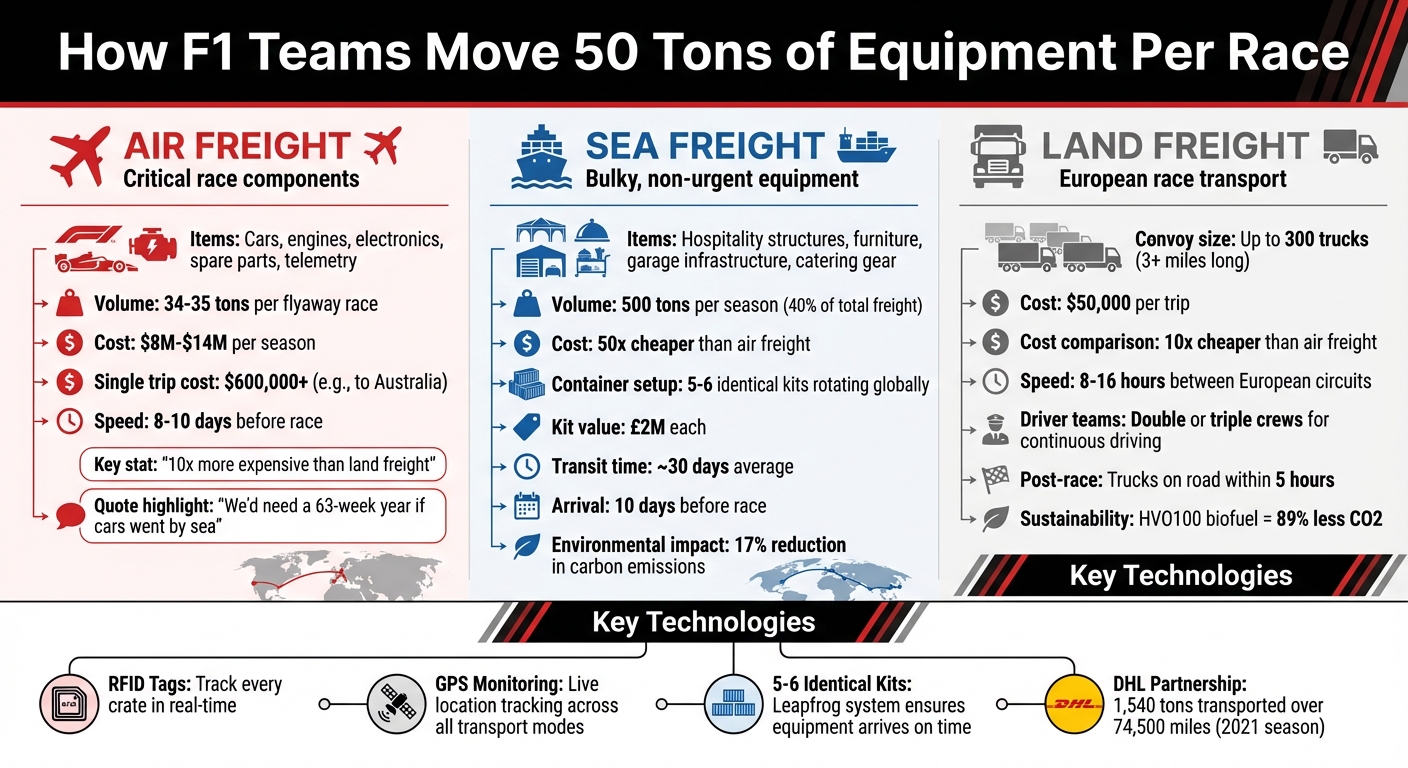
- Air Freight: For critical items like cars, engines, and electronics, teams use chartered cargo planes. These shipments arrive quickly but cost between $8M–$14M per season.
- Sea Freight: Non-urgent, bulky items like hospitality gear are shipped months in advance. This method is 50x cheaper than air freight and reduces costs significantly.
- Land Freight: For European races, teams rely on truck convoys, which are 10x cheaper than air freight. Double or triple driver teams ensure tight deadlines are met.
Teams use advanced tracking (RFID, GPS) and maintain multiple identical kits to ensure smooth operations. Despite tight schedules and customs hurdles, their coordination keeps the races running smoothly.
F1 Freight Transport Methods: Cost, Speed, and Usage Comparison
How Formula 1 Travels Across The World | F1 Logistics Explained | DHL

Pre-Race Planning and Packing
When the FIA releases the season calendar, logistics teams kick off a year-long global operation, managing the movement of 40–50 tons of cargo per race. The challenge? Balancing speed and cost.
The Packing Matrix: Organizing Equipment by Priority
To keep things running smoothly, teams sort their equipment into three categories based on how critical it is:
- Critical tier: This includes race-essential components like the chassis, power units, gearboxes, and wings. These items always travel by air since they’re needed immediately for car assembly and scrutineering.
- Priority tier: This covers essential support systems like IT infrastructure, garage walls, and telemetry equipment.
- Sea Freight tier: Bulky, non-critical items - such as hospitality structures, furniture, and catering gear - fall into this category and are shipped well in advance by sea.
To manage costs, teams use a clever "leapfrog" system. They maintain five to six identical sets of non-critical sea freight equipment that rotate globally during the season. This ensures bulky items arrive on time without relying on expensive air freight.
Each team also prepares about three pallets of "priority cargo." These pallets - loaded with essentials like IT racks, communication systems, and garage walls - arrive at the track by Tuesday of race week. This early delivery is vital, especially when a single race weekend can involve 60 computer screens and 400 miles of wiring.
With the equipment sorted, teams then create detailed shipping schedules to ensure everything arrives when and where it’s needed.
Packing and Preparation Timeline
Different transport modes mean different preparation timelines. For sea freight, shipments for the season’s opening races often leave as early as January, long before the first race. For example, containers heading to the Canadian Grand Prix might leave the UK six weeks in advance to account for ocean transit and customs clearance.
Sergio Bondi, Ferrari’s Head of Logistics, highlights the importance of this phase:
"At the start of the season, the most important phase is preparing the sea freight shipments of the structures we'll use at the various Grands Prix."
Air freight, on the other hand, operates on a much tighter timeline. Critical components like chassis and engines are packed just days before a race to allow for maximum development time at the factory. For flyaway races, air freight typically arrives 8 to 10 days before the event. Priority pallets reach the circuit by Tuesday, followed by the cars on Wednesday.
Back-to-back race weekends add another layer of complexity. In these cases, teams have less than 48 hours to dismantle, transport, and rebuild their entire operations. It’s a logistical race within the race.
Air Freight: Fast Transport for Critical Equipment
When seconds matter, Formula One teams rely on air freight to move their most important and time-sensitive equipment. This method is reserved for items that can’t afford the delays of sea freight, ensuring race preparation stays on track. It works hand-in-hand with earlier packing strategies, filling the gaps where speed is crucial.
What Gets Shipped by Air: Cars, Spare Parts, and High-Value Equipment
Air freight is the lifeline for essential race components. For every flyaway race, each team ships around 34–35 tons of equipment. This includes two race-ready chassis, a spare for each driver, power units, gearboxes, aerodynamic parts, and critical electronics like telemetry systems, data servers, pit-wall stations, and IT racks. Add to that 40 sets of tires, 2,500 liters of fuel, and key spare parts like replacement floors or wings - bringing the total to roughly 5,000 individual parts per car.
To make the most of the aircraft’s space, teams partially disassemble their cars, removing wings, nose cones, and suspension arms. The carbon fiber chassis is secured in shock-absorbing frames, while delicate components are packed in foam-lined cases to prevent damage during transit. Each crate is equipped with an RFID tag, making it easy to track and identify parts quickly.
This precision doesn’t come cheap. A single trip, such as flying equipment to Australia, can cost over $600,000. Over a season, air freight expenses can range between $8 million and $14 million per team. As Geoff Simmonds, Race Team Coordinator at Haas F1 Team, aptly said:
"We'd need a 63-week year if cars went by sea".
Air Freight Operations in Practice
The operational side of air freight showcases the incredible efficiency behind F1 logistics. DHL, the official logistics partner of Formula One, charters six to seven Boeing 747 or 777 cargo planes for each event to move the grid’s critical equipment all at once. These aircraft are chosen for their capacity - one Boeing 747-8 freighter can carry a 34-ton kit, including two cars and spares, over 12,000 miles to destinations like the Australian Grand Prix. Meanwhile, the Boeing 777F is becoming a favorite due to its 18% better fuel efficiency.
A great example of air freight’s precision was seen in November 2023, during the logistics operation between Las Vegas and Abu Dhabi. Teams managed a 20-hour flight covering 8,200 miles and crossing an 11-hour time difference. Cargo planes landed on Monday, leaving crews only 48 hours to set up before the race weekend began.
For the March 2025 Australian Grand Prix, DHL used Boeing 747-8 freighters to transport 34-ton kits from hubs in London and Milan to Avalon Airport. The Australian Border Force cleared the cargo in just 12 hours, ensuring the $270 million event ran smoothly. Customs processes, like ATA Carnets, streamline these critical shipments.
To ensure fairness, the FIA enforces strict rules: crates can be placed in the pit lane but must remain sealed until every team’s cargo has arrived at the circuit. Paul Fowler, Vice President of Global Motorsport at DHL, summed it up well:
"Last-minute demands can sway a race - we're always ready".
While air freight ensures the timely delivery of critical components, bulkier, less urgent items are transported using more cost-effective methods.
Sea Freight: Cost-Effective Long-Distance Shipping
Air freight may be the go-to for urgent deliveries, but when it comes to transporting heavy, less time-sensitive equipment, sea freight takes the wheel. It’s a much cheaper option and aligns with sustainability efforts, though it does require detailed, long-term planning.
How Sea Freight Fits into F1 Logistics
Sea freight plays a critical role in Formula 1 logistics, handling items that don’t need to arrive within a 48-hour window. Each season, teams ship around 500 tons of equipment via sea freight - roughly 40% of their total freight volume. This includes garage infrastructure like paneling, timing stands, and air conditioning units, as well as hospitality essentials such as furniture, kitchen appliances, and tools.
Franco Massaro, Aston Martin F1 Team’s Head of Race and Trackside Logistics, highlighted the financial advantage:
"Say a timing stand weighs 1,000kg, it saves us nearly £250,000 over a season by putting it into sea freight. Obviously, you've then got to produce more of them to cover the season, but you're looking at payback within one to two years."
To avoid the high costs of air freight, teams rely on five to six identical kits. Each kit consists of five 40-foot containers for garage equipment (about 40 tons) and two 40-foot containers for hospitality items (10–12 tons). These kits, valued at roughly £2 million each, rotate globally throughout the season in a leapfrog system. For instance, while one set is being used at a race in Bahrain, another might be en route to Singapore, and a third could be heading to Miami.
Sergio Bondi, Head of Logistics at Scuderia Ferrari, explained:
"We buy multiple examples of the relatively low-value material, creating five identical kits that travel by sea according to a journey plan."
This coordinated system ensures that sea freight complements air transport, keeping everything on schedule without breaking the bank.
Sea Freight Timeline and Planning
Sea freight’s success hinges on precise, long-term planning. Logistics teams begin organizing shipments as soon as the FIA calendar is released, typically in July of the previous year. For early-season races like the Australian Grand Prix, containers often set sail as early as January - months before the first race.
On average, sea freight transit takes about 30 days, so building in extra time is essential. As Massaro explained:
"Shipping lines aren't like airlines: you have to build in a lot of extra time to make sure your sea freight arrives on schedule because they can suddenly change plans."
To streamline operations, teams use regional storage hubs in key locations such as Florida, Singapore, and the Middle East. For example, after a race in China, equipment might be sent directly to Miami via rail connections rather than returning to Europe. Typically, containers arrive at the circuit about 10 days before the race weekend begins.
This strategic reliance on sea freight not only slashes costs but also plays a part in reducing F1’s environmental footprint. By shifting more freight from air to sea, the sport has cut its total carbon emissions by 17%, bringing it closer to its goal of reaching net-zero emissions by 2030.
Land Freight: Moving Equipment Between Races
Truck Transport for European Races
When Formula 1 races take place across Europe, land freight becomes the backbone of logistics. Why? Road transport is about 10 times cheaper than air freight - costing approximately $50,000 compared to $500,000 for air transport.
The numbers involved are mind-blowing. An F1 convoy can include up to 300 trucks, stretching over three miles in length. Teams maintain hybrid fleets to manage costs. For example, larger teams like Mercedes-AMG Petronas operate eight custom-designed trucks, each worth around $600,000. Mid-sized teams, on the other hand, manage with four or five trucks and rely on rented rigs from logistics partners like DHL to fill the gap.
Timing is everything, especially during back-to-back or triple-header race weekends. Teams often have just three days to dismantle, transport, and rebuild their entire paddock. To meet these tight deadlines, trucks are staffed with double or triple driver teams, allowing nearly continuous driving. European regulations limit two drivers to 21 hours of driving before requiring a nine-hour rest, but adding a third driver helps circumvent this restriction.
Karl Fanson, Head of Race Team Logistics at Mercedes, shared insights on how Brexit has complicated operations:
"Because of the customs process we go through now, we have to triple man the trucks to guarantee that we're going to get back. Sometimes you clear customs within an hour, sometimes you'll be waiting two or three hours."
Despite these challenges, teams have streamlined their routes. For example, the 776-mile journey from Spa-Francorchamps to the Hungaroring usually takes 14 to 16 hours, while shorter trips, like the 500 miles between Italy and Austria, can be done in as little as eight hours. Reducing emissions is also a focus. Teams like Mercedes and McLaren now fuel their European fleets with HVO100 biofuel, cutting carbon emissions by up to 89% compared to diesel.
Once the trucks arrive, the race against time continues with post-race loading operations.
Post-Race Loading and On-Site Operations
The logistics frenzy doesn’t end with the checkered flag. After a race, teams aim to have their trucks on the road within five hours. To make this happen, preparation starts well before the race ends - non-essential equipment is pre-packed on Saturday, and items no longer needed during the race, like spare wings or backup electronics, are boxed up while the cars are still on the track.
Once the FIA gives the green light, mechanics take apart the cars into approximately 5,000 individual components, carefully packing them into foam-lined crates. Incredibly, most teams can clear their entire circuit setup within eight hours of the race’s conclusion.
Some circuits bring unique challenges. Monaco, for example, has such limited space that trucks must enter the pit lane one at a time, following a strict sequence. Mark Norris, McLaren's Director of Race Operations, described the complexity:
"Monaco was a bit of a challenge for a few teams this year... once you've got one truck in, you've got to wait for that other truck so it's a bit tetris-y."
Logistical hiccups can ripple through the schedule. In May 2024, delays during the move from Imola to Monaco caused a domino effect - McLaren’s delayed motorhome departure held up Alpine’s setup as well.
Sven Smeets, Sporting Director at Williams Racing, captured the relentless nature of F1 logistics perfectly:
"It's constant motion - trucks roll while we race."
Technology and Coordination in F1 Freight
Real-Time Tracking and Monitoring
Transporting 50 tons of equipment per F1 team across five continents is no small feat. To keep everything on track, teams rely on Radio Frequency Identification (RFID) tags attached to every crate, allowing instant identification of key components like engines and gearboxes. Add GPS monitoring, and teams gain real-time visibility of their cargo, regardless of the transport mode. This meticulous system is vital when managing the 45,000 parts required to assemble three F1 cars.
GPS tracking isn’t just about knowing where things are - it’s also about accountability. For instance, Ferrari uses GPS data to monitor sea freight containers as part of their sustainability goals, balancing speed with carbon emission targets. To reduce the risk of losing critical items, teams prepare redundant packing lists and digitally scan every crate. With so much at stake, a single missing part could lead to millions of dollars in losses.
This level of precision is supported by logistics partners who oversee the entire freight operation, ensuring nothing is left to chance.
Logistics Partners and Their Role
Expert logistics partners are the backbone of F1 freight operations. DHL, the official logistics partner of F1, plays a pivotal role in managing the movement of equipment. During the 2021 season, DHL transported 1,540 tons of gear and 532 cars over 74,500 miles.
The operation is divided among three specialized teams: inbound crews, on-site customer service, and pack-up teams. These pack-up teams can dismantle an entire garage in just eight hours after a race wraps up. DHL also handles complex legal requirements, including ATA Carnets - documents that allow race equipment to enter more than 80 countries without customs duties. Without these, customs delays could wreak havoc on a race weekend.
Paul Fowler of DHL highlights their readiness:
"Last-minute demands can sway a race - we're always ready".
That readiness was put to the test in November 2021 during a triple-header spanning Mexico, Brazil, and Qatar. When fog in Mexico City delayed three cargo planes for six hours, DHL worked with F1 Sporting Director Steve Nielsen to adjust curfews and scrutineering deadlines, ensuring teams could prepare for Friday practice in São Paulo.
DHL also manages "priority pallets", which include essential garage and IT infrastructure - like 60 computer screens and 400 miles of wiring per team. These pallets arrive first, allowing setup crews to begin building before the main cargo arrives. Additionally, DHL operates a dedicated motorhome at each race, valued at approximately €1,000,000 (around $1,080,000), to coordinate on-site logistics.
With cutting-edge tracking systems and highly skilled partners, F1 ensures that every piece of equipment arrives on time, keeping the high-stakes world of racing running smoothly.
Conclusion
F1 logistics operate with incredible precision, moving around 50 tons of equipment per race. This includes everything from car components to essential tools, all of which must arrive on time across five continents.
The process is a finely tuned operation, relying on meticulous planning and a mix of transport methods. Speed is critical for essential parts, often involving high-speed air freight, while bulkier equipment is transported via cost-efficient sea freight or carefully scheduled truck convoys. Duplicate kits also help manage tight schedules, with teams often facing less than 48 hours to pack up and move to the next event. On top of that, customs regulations and FIA protocols add another layer of complexity to the process.
To ensure nothing goes astray, teams use technologies like RFID and GPS for real-time tracking across all transport modes. The financial stakes are equally high, with air freight alone costing between $8 and $14 million per season.
Thanks to expert coordination, precision packing, and real-time tracking, F1 teams consistently overcome these logistical challenges. As Piers Thynne of McLaren aptly describes it:
"It's a logistical tap dance".
And it’s a performance that Formula One has mastered, ensuring every component arrives exactly where it needs to be, right on time.
FAQs
How do teams decide what flies vs ships vs trucks?
Formula 1 teams rely on a mix of air, sea, and land freight to transport their equipment, with the choice depending on factors like urgency, distance, and the nature of the cargo. For international races, critical items such as chassis and engines are typically shipped by air to guarantee they arrive on time. Trucks are the go-to option for shorter distances, like European races, while sea freight is reserved for non-essential, bulky materials when schedules allow for longer lead times. Teams carefully juggle speed, cost, and race timelines to manage their logistics effectively.
Why do teams build multiple identical freight kits?
Teams prepare multiple identical freight kits to guarantee that critical equipment reaches its destination on time, even if there are transit delays or losses. This backup strategy is crucial for keeping operations running smoothly during global races.
What happens if customs delays critical cargo?
Delays at customs can throw a wrench into a team's carefully planned schedule, potentially pushing back the setup of vehicles and equipment needed for a race. To prevent such setbacks, logistics teams depend on precise timing and thorough documentation. Even a small delay can ripple through the preparation process, ultimately affecting overall performance.