How F1 TV Coverage Evolved Over Decades
From 1950s broadcasts to F1 TV Pro and AI-driven remote production, how F1's coverage became interactive, data-rich, and global.
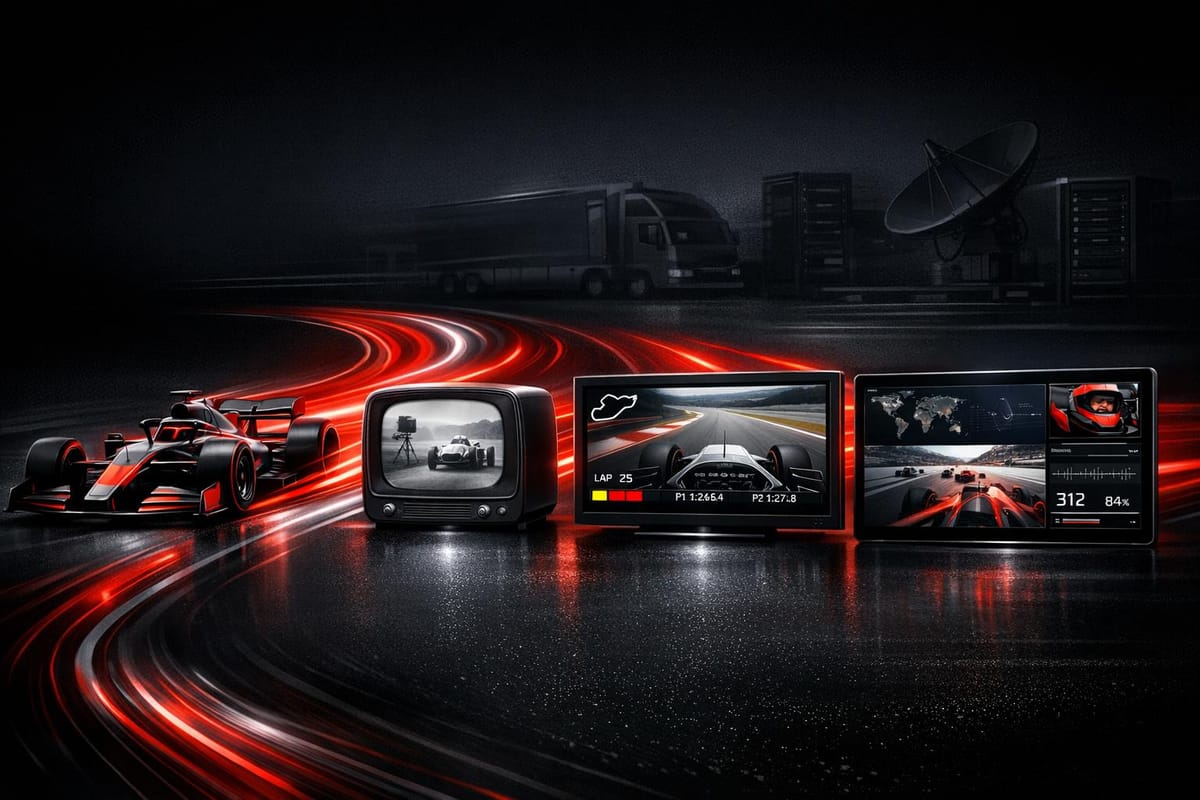
Formula 1's TV journey transformed it from grainy, limited broadcasts in the 1950s to a global media powerhouse by 2024, reaching 1.6 billion viewers worldwide. Key milestones included Bernie Ecclestone's centralization of rights in the 1980s, the shift to pay-TV in the 1990s, and the launch of F1 TV Pro in 2018. Modern broadcasts now feature 96 cameras, 500 terabytes of data per race, and ultra-low latency production. These advancements have redefined how fans interact with F1, offering multi-angle views, live telemetry, and deeper insights into the sport.
Key Highlights:
- 1953: First live F1 race broadcast in the UK (British Grand Prix).
- 1980s: Ecclestone standardizes global TV rights, ensuring consistent race coverage.
- 1997: ITV introduces on-site studios and live grid walks.
- 2012: Sky Sports F1 launches the first 24/7 F1 channel.
- 2018: F1 TV Pro gives fans direct control over their viewing experience.
Today, Formula 1 combines cutting-edge technology, streaming platforms, and AI-driven tools to deliver immersive, interactive coverage that appeals to both casual viewers and die-hard fans.
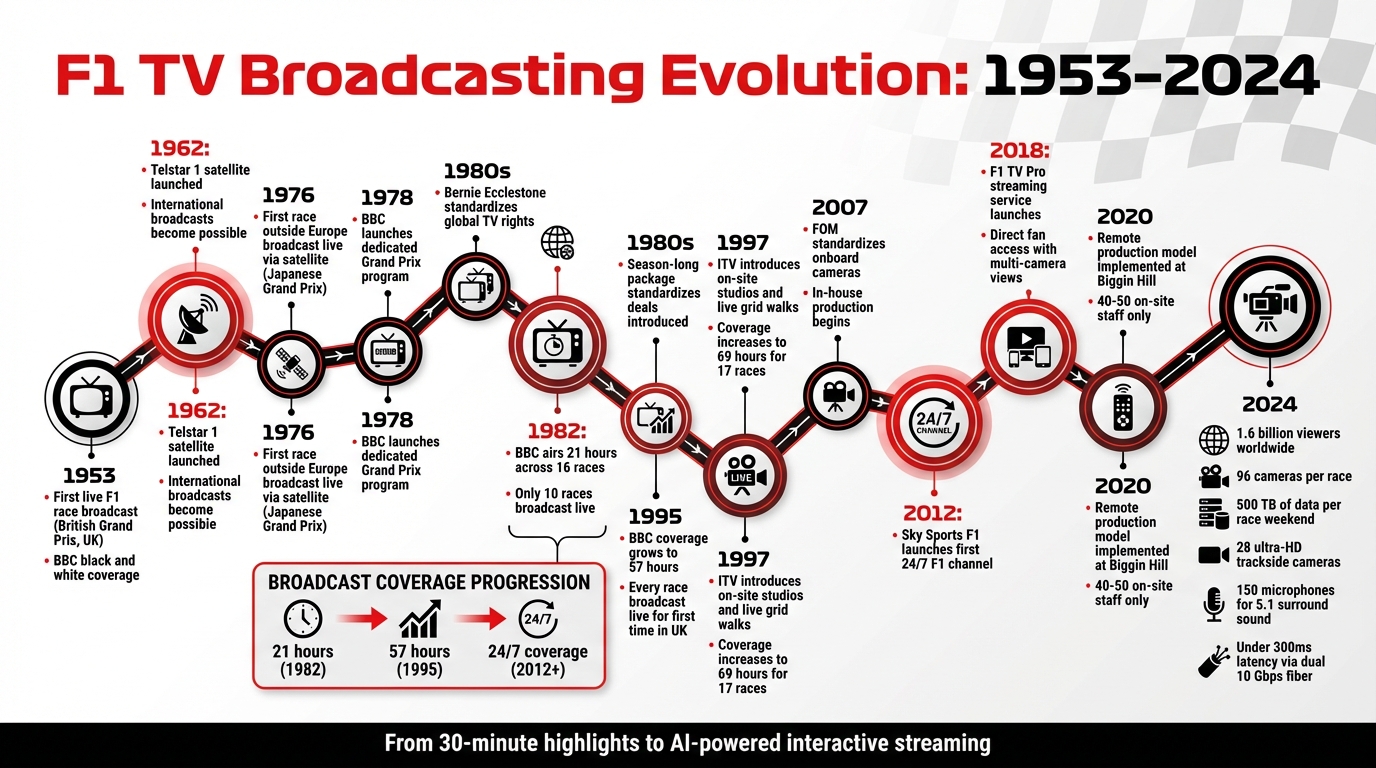
Evolution of F1 TV Broadcasting: 1953-2024 Timeline with Key Milestones
The Early Days: Limited Coverage and First Broadcasts (1950s–1970s)
The First F1 Races on Television
Formula One first appeared on British television in 1950, though coverage was sporadic at best. The 1953 British Grand Prix holds the distinction of being the first live F1 race broadcast in the UK, aired in black and white on the BBC. Over the next three decades, many races went entirely untelevised, with fans often relying on short highlight reels that ran for just 30 to 45 minutes when available. Even these limited broadcasts were subject to competing sports schedules, which often dictated whether a race would make it to air.
Adding to the challenges, race promoters were wary of television coverage, fearing that free broadcasts would discourage fans from attending events in person. One notable incident occurred in 1976 when the BBC withdrew its cameras from the Race of Champions at Brands Hatch after driver John Surtees refused to remove Durex sponsorship logos from his car. These early struggles underscored the hurdles F1 broadcasting faced before it could evolve into the spectacle it is today.
Technical Limitations and Early Commentary
Beyond scheduling issues, early F1 broadcasts were hampered by significant technical limitations. Before videotape became widespread in the late 1950s, highlights were created using telerecording - a labor-intensive process where live footage was filmed off a screen and then manually edited. Even after videotape became available, its high cost led broadcasters to reuse tapes, erasing much of the early F1 footage.
Live international broadcasts were nearly impossible until the launch of the Telstar 1 satellite in 1962. Even then, the expense of live broadcasting meant it was a rarity. For instance, the 1976 Japanese Grand Prix was the first race outside Europe to be broadcast live via satellite. Production quality during this era was basic, with minimal graphics and visuals.
The 1970s also saw the rise of Murray Walker, who became the BBC's exclusive Formula One commentator in 1979. Known for his energetic delivery, Walker had a knack for explaining the sport's technical aspects in ways that resonated with a broad audience. His influence on motorsport commentary was profound, as later commentator Alex Jacques noted:
Murray Walker had a massive impact on me wanting to be a motorsport commentator. His ability to make the sport accessible to such a wide audience was incredible
. Walker's tenure coincided with James Hunt's dramatic 1976 World Championship win, which helped spark greater interest in F1. This momentum led the BBC to launch its dedicated Grand Prix program in 1978. Despite these advancements, coverage remained limited. In 1982, the BBC aired just 21 hours of F1 across 16 races, averaging 1 hour and 20 minutes per race, with only 10 races broadcast live.
Global Expansion and Better Production Quality (1980s–1990s)
Commercial Networks Enter F1 Broadcasting
The 1980s brought a major shift in how Formula One was broadcast. Bernie Ecclestone and FOCA redefined television rights by introducing season-long package deals. These deals required networks to air every race in the championship, creating a consistent viewing experience for fans instead of sporadic coverage of select events. This new approach turned F1 into a global spectacle that viewers could follow from start to finish.
The results were evident. By 1995, BBC's coverage grew to 57 hours, with every race broadcast live for the first time in UK history. Then, in December 1995, ITV signed a four-year deal worth around £60 million (roughly $76 million), a significant leap from previous arrangements.
ITV's first broadcast in 1997 brought a new level of professionalism. They introduced a traveling studio that followed the races, replacing the BBC's London-based format. This on-site setup allowed for real-time interviews and better paddock access. A standout moment came at the 1997 British Grand Prix, where Martin Brundle's live, unscripted grid walk - featuring pre-race interviews - became an iconic feature of F1 broadcasting.
Behind the scenes, Formula One Management took control of the "world feed" in the 1990s, standardizing camera angles and graphics across all markets. Ecclestone also enforced stricter visual standards in the paddock, ensuring the sport looked polished on television. As Stuart Codling, Autosport editor, noted:
The shift in broadcaster was controversial at the time but ITV's coverage – though it included ad breaks – was transformative.
These innovations set the stage for F1's global growth, attracting a broader audience and elevating the viewing experience.
Growing US and International Viewership
With improved production and presentation, F1's reach extended far beyond Europe. Enhanced broadcast quality made it possible for fans worldwide to watch races live, even across different time zones. This was a major leap, as simultaneous global broadcasts were rare before the 1990s, despite the availability of satellite technology since the 1970s.
Before Formula One Management's centralized production, local broadcasters like Italy's RAI or France's TF1 often introduced noticeable national biases in their coverage. The introduction of the standardized "world feed" eliminated these inconsistencies, delivering a unified and professional broadcast experience to fans everywhere.
The UK offered a clear example of F1's growing appeal. By 1997, ITV dedicated 69 hours to cover 17 races - over 4 hours per race - a significant increase compared to prior years. The inclusion of former drivers like Martin Brundle and Jonathan Palmer as commentators added a layer of technical insight that resonated with both die-hard fans and casual viewers alike. Murray Walker perfectly summed up the network rivalry when he said:
ITV were sick of being cut to ribbons by Grand Prix on Sunday afternoons and had decided that if they couldn't beat it, they'd buy it.
This era also saw experimental ventures like F1 Digital Plus, a pay-per-view service launched in 1996 in Switzerland, Germany, and Austria. For about $15 per race, fans could access eight onboard camera feeds and separate commentary channels. Although it was discontinued in 2002 due to low subscriber numbers, F1 Digital Plus hinted at the multi-platform viewing options that would later become a staple of the sport.
These advancements in broadcasting laid the groundwork for F1's future as a global entertainment powerhouse.
Pay-TV and Multi-Platform Viewing (2000s–2010s)
Sky Sports F1: A New Standard in Coverage
The 2010s marked a big turning point for Formula 1 fans, especially when it came to how they accessed the sport. In July 2011, Sky Sports and the BBC announced a deal covering the 2012–2018 seasons. Under this agreement, Sky would broadcast every session live - practice, qualifying, and race - while the BBC would only air 10 live races per season alongside highlights for the rest. This deal, worth around $250 million annually, was a massive financial commitment to F1.
Sky Sports F1 launched in March 2012 as the first-ever 24/7 channel dedicated solely to Formula 1. Sky went all-in, offering live coverage of every session, extended pre- and post-race shows, and specialized programming. The production quality saw a noticeable improvement - pre-race coverage expanded from quick five-minute segments to full hour-long shows filled with detailed technical breakdowns.
While Sky's approach increased the amount of content available to fans, it came with a trade-off: lower peak viewership compared to free-to-air broadcasts. By 2015, this trend was clear. Lewis Hamilton’s title-clinching win at the US Grand Prix drew a peak of 1.7 million viewers on Sky Sports F1, while the BBC’s highlights for the same race averaged over 2 million viewers. That year ended up being the least-watched F1 season in the UK since 2007. For context, the 2011 Canadian Grand Prix on the BBC had previously drawn a peak audience of 8.5 million viewers before the split-broadcast model began.
Even with smaller peak audiences, the pay-TV model changed the way fans engaged with the sport. As F1 commentator Ben Edwards observed:
By the time I rejoined the F1 paddock in 2012... the audience had now grown more accustomed to the concept of paid TV
. This shift not only redefined access for fans but also laid the groundwork for the digital innovations that would soon revolutionize how the sport was consumed.
Streaming and Digital Platforms
The rise of digital platforms in the 2000s and 2010s added a new layer to traditional TV coverage. In 2008, ITV began streaming Friday practice sessions live on its website, and the BBC introduced its "Red Button" service, offering interactive forums and additional content during race weekends.
These early steps set the stage for more advanced digital options. In the US, NBC Sports Network (NBCSN) took over F1 coverage and added streaming capabilities, allowing fans to watch races on mobile devices and computers. This marked a shift from strictly scheduled broadcasts to more flexible, on-demand viewing throughout the week.
A key enabler of these changes was FOM’s 2007 standardization of onboard cameras, which doubled their number and increased bandwidth. This upgrade enriched both traditional and digital broadcasts, giving broadcasters more material to work with and enhancing the experience for fans on all platforms. These advancements helped bridge the gap between TV and digital, offering fans more ways to engage with the sport than ever before.
The Streaming Era: F1 TV Pro and Advanced Production (2020s and Beyond)
F1 TV Pro: Direct Access for Fans
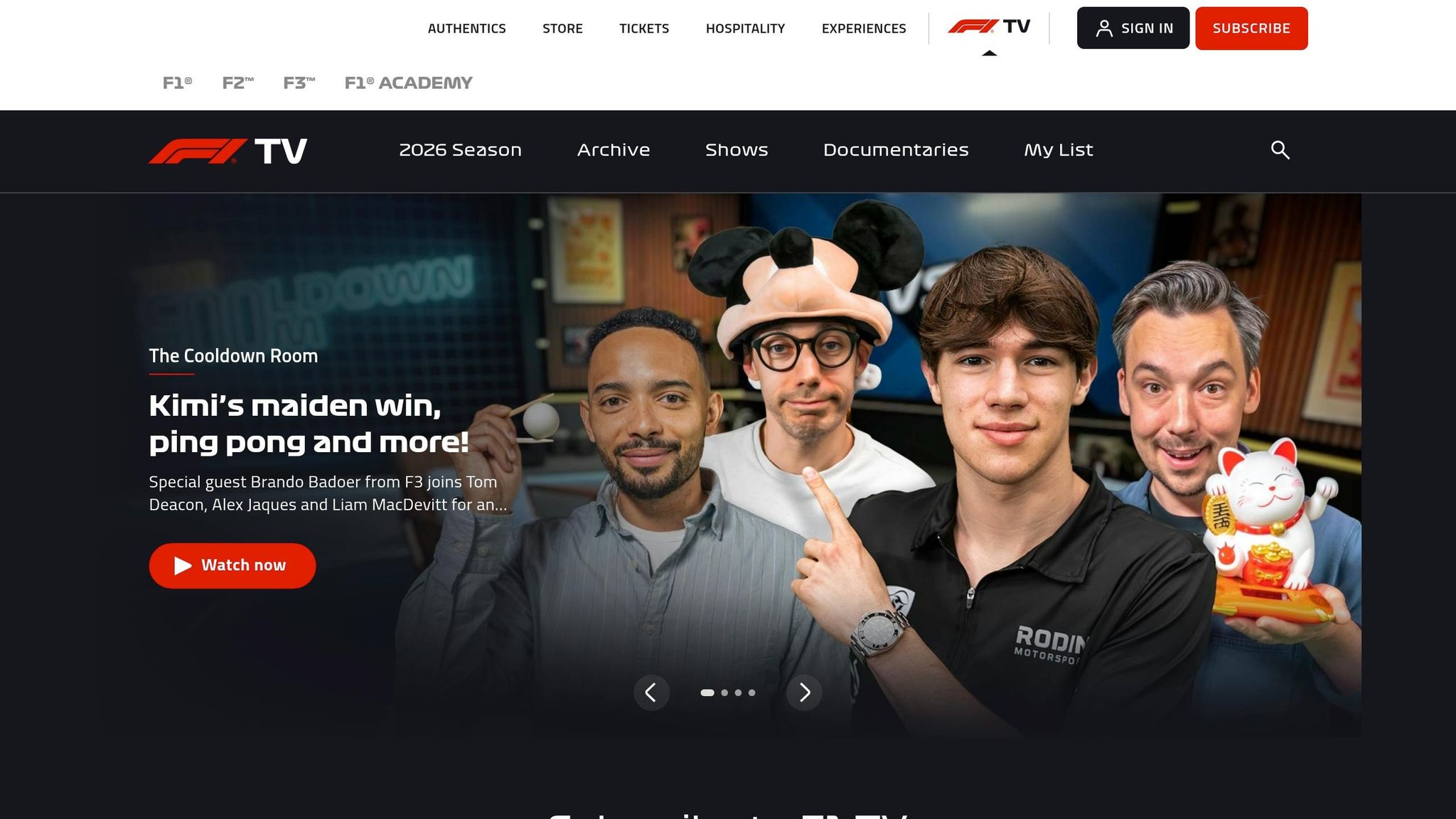
The 2020s brought a new wave of fan engagement and high-tech production to Formula 1. In 2018, Formula 1 introduced F1 TV Pro, a streaming service that changed how fans experience the sport. Instead of relying solely on traditional broadcasters, fans can now access live coverage of every single session - Free Practice, Qualifying, and the Grand Prix - directly through Formula 1.
What sets F1 TV Pro apart is the level of control it offers. Fans can switch between up to nine in-car cameras to follow their favorite drivers or dive into the technical side with live timing data and telemetry. As Anthony Ellis, F1's Broadcast Media Product Executive Producer, explained:
F1 TV goes out to an array of people... and it's got to engage with many, many different kinds of fans – from the hardcore to the casual
.
The platform doesn’t stop at live events. It also features full race replays, exclusive documentaries, and a treasure trove of historical race footage. This lets fans relive iconic moments or catch up on what they missed. Reflecting on this shift in fan engagement, F1 Correspondent Lawrence Barretto noted:
The level of question they're [fans] after has definitely changed – the devil is in the detail. A lot more they want to know why, what is the real truth, and is what we see the reality?
. It's clear that F1 TV Pro is designed to meet the growing appetite for deeper insights and more control over the viewing experience.
New Broadcasting Technologies
To support the interactive features of F1 TV Pro, Formula 1 has embraced cutting-edge production techniques. Since 2020, the sport has utilized a remote production model based at the Media & Technology Centre in Biggin Hill, UK. Instead of sending large teams to every race, only 40 to 50 essential staff are on-site, while the rest of the production happens remotely. This setup processes over 500 TB of data every race weekend.
The system relies on dual 10 Gbps fiber connections, provided by Tata Communications, ensuring a latency of under 300 milliseconds - even from far-off locations like Australia. The use of advanced camera technology has also transformed coverage. Each weekend, 96 cameras capture the action, including 28 ultra-HD trackside cameras and up to nine in-car cameras per car. One standout is the 8-millimeter helmet camera, which offers fans a true first-person view of the race.
Artificial intelligence has become an essential tool in modern broadcasts, handling tasks like real-time radio transcription, driver identification, and even virtual trackside advertisements. Audio quality has also reached new heights, with 150 microphones delivering immersive 5.1 surround sound that captures everything from the roar of the engines to the buzz of the pit lane. Dean Locke, F1's Director of Broadcast and Media, summed it up perfectly:
There's no other sport in the world where you can hear the athlete in the midst of something quite incredible like this... that gives you real insight into their personality
.
These advancements have not only enhanced the viewing experience but also reinforced Formula 1's position as a global leader in sports broadcasting innovation.
How TV Coverage Evolution Changed Fan Engagement
From Passive Viewing to Interactive Experiences
The shift from traditional TV broadcasts to modern streaming platforms has completely transformed how fans engage with Formula 1. In the past, viewers were at the mercy of television directors, limited to pre-selected camera angles and commentary. Now, fans have more control than ever, diving into race strategies, tire choices, and pit stop timings in real time. This shift has turned passive viewers into active participants.
Today's fans expect more transparency about what happens on track. Lawrence Barretto, F1 Correspondent and Presenter, captured this perfectly:
Fans are definitely more knowledgeable than they've ever been, so the challenge for us is to go and find out even more information about why something really happened
.
Broadcasters have risen to the challenge, offering detailed technical insights, real-time stats, and behind-the-scenes content. AI-powered graphics, like predicted overtakes and live gap analyses, now bring the sport's strategic depth to life, helping fans better understand the complexities of each race.
Social media has also played a huge role in reshaping fan interactions. Platforms like YouTube, TikTok, and Instagram cater to younger audiences who often prefer quick highlights and driver-focused content over lengthy broadcasts. Motorsport broadcasting expert David Nelson highlighted this trend:
An 18-year-old watching highlights via YouTube is more attractive to F1 than someone age 60 watching linear free-to-air highlights on Channel 4
.
These advancements haven’t just changed how individual fans experience the sport - they’ve also redefined how Formula 1 connects with audiences in different regions.
Viewership Trends Across Regions
Digital innovation has dramatically shifted how fans in various markets consume Formula 1. In the UK, the sport's transition from free-to-air TV to Sky Sports' subscription-based model in 2012 marked a major change. While overall viewership numbers dropped, those who stayed became a more dedicated audience, willing to pay for full coverage of every session.
In the United States, Formula 1 was once a niche interest. But Liberty Media’s 2017 acquisition and the Netflix series Drive to Survive sparked a surge in popularity. This newfound enthusiasm has been cemented by major streaming deals, such as Apple’s five-year agreement worth roughly $140 million annually - a significant leap from ESPN’s previous $90 million-per-year deal. Today, the U.S. is one of F1’s fastest-growing markets, largely fueled by younger fans discovering the sport through digital platforms.
The blending of traditional broadcasting, streaming services, and social media has pushed Formula 1 far beyond the confines of early TV coverage. These changes have opened up countless ways for fans of all ages and backgrounds to connect with the sport, no matter where they are in the world.
Explanation of the F1 Digital+ service from the end of the 1997 official Review
Conclusion
Formula 1's evolution in broadcasting, from the limited newsreels of the 1950s to today's AI-driven streaming experiences, showcases one of the most remarkable transformations in sports media. The sport's first live broadcast - the 1953 British Grand Prix aired by the BBC - was accessible to only a small audience in the UK. Fast forward to 2024, and F1 now captivates a global fan base of 1.6 billion viewers.
Key milestones have shaped this journey. Bernie Ecclestone's initiative in the 1980s to package entire seasons brought F1 to audiences worldwide. The 2007 move to in-house production ensured consistent coverage quality. Sky Sports F1's 24/7 channel launch in 2012 further raised the bar, while the introduction of F1 TV Pro in 2018 gave fans unparalleled access to multiple camera views and in-depth technical insights. Each of these steps redefined the viewing experience and laid the groundwork for even greater advancements.
Looking ahead, broadcasters face new challenges as the 2026 regulations bring in updated power units and sustainable fuels. Explaining these technical changes to fans will require creativity and clarity. Alex Jacques, Lead Commentator for F1 TV, highlighted the dynamic nature of sports broadcasting:
I think genres will continue to blur. You've only got to look at podcasting's influence on the tone and warmth of sports broadcasting to see how drastically things can change quickly.
Technology continues to reshape the industry. Remote production at Biggin Hill has streamlined operations, reducing on-site staff to 40–50 while enhancing output. AI tools now enable features like real-time transcription, driver tagging, and virtual advertisements. Meanwhile, massive streaming deals, such as Apple's reported $140 million annual agreement, reveal how tech companies view F1 as a premium entertainment asset.
As the sport evolves, so do fan expectations. Viewers increasingly seek greater transparency, interactive elements, and a deeper understanding of the technical aspects - concepts that would have been unthinkable in F1's early days. Laura Winter, Lead Presenter for F1 TV, encapsulated this constant learning curve:
With F1, every day is a school day. The sport develops so quickly, it moves so quickly, and there's always something new to learn.
This relentless pace of innovation ensures that Formula 1 remains at the forefront of sports broadcasting, keeping fans and broadcasters alike deeply connected to the action.
FAQs
Why did F1 move from free-to-air TV to pay TV?
F1 made the shift from free-to-air TV to pay TV as a response to increasing broadcasting costs and the need for more controlled, top-tier coverage. By selling broadcasting rights to pay TV networks, F1 was able to channel more funds into production, introduce cutting-edge graphics, and offer in-depth live coverage. This approach not only boosted revenue but also appealed to a global audience ready to pay for premium content, solidifying its position as a key driver of the sport's commercial growth.
What does F1 TV Pro include that regular broadcasts don’t?
F1 TV Pro goes beyond the standard race broadcast, offering fans a deeper dive into the action. With live streams featuring multiple camera angles, on-board footage, and team radio, it creates a more engaging and immersive experience. Fans can also access real-time data, detailed timing screens, and in-depth technical breakdowns, providing insights into strategies and car performance.
For those who crave even more, F1 TV Pro delivers exclusive content like behind-the-scenes footage, driver interviews, and team communications, making it a must-have for dedicated Formula 1 enthusiasts.
How do AI and remote production change what viewers see live?
AI and remote production have transformed live F1 broadcasts, making them more engaging and informative. AI analyzes real-time data to generate detailed visuals, such as live telemetry and race statistics, which help viewers follow the action more closely. Meanwhile, remote production streamlines broadcast operations by centralizing control. This allows for features like multi-angle coverage, instant replays, and even drone footage. Combined, these technologies create a more dynamic and immersive experience, responding effortlessly to the fast-paced nature of live races.