Qualifying vs Race Trim: What Drivers Experience
How F1 qualifying and race trims differ—fuel, aerodynamics, tires—and how drivers change braking, cornering and energy management across a race weekend.
In Formula One, drivers face two distinct car setups during a race weekend: qualifying trim and race trim. These setups drastically change how the car performs, requiring drivers to adjust their approach. Here's a quick breakdown:
- Qualifying Trim: Built for speed. Cars run with minimal fuel (~22 lbs), aggressive engine settings, and the softest tires for maximum grip. The goal is to set the fastest single lap, prioritizing precision and responsiveness.
- Race Trim: Focused on endurance. Cars start with a full fuel load (~220 lbs), heavier tires, and settings that emphasize reliability and consistency over long distances. Handling is more stable but less sharp.
Key Differences:
- Fuel Load: Qualifying (~22 lbs) vs. Race (~220 lbs)
- Tires: Soft compounds for grip vs. durable tires for longevity
- Handling: Oversteer for agility vs. understeer for stability
- Braking: Shorter distances in qualifying vs. longer due to added weight in the race
Drivers must adjust their braking, cornering, and energy management strategies to handle these changes. The shift from a lightweight, high-performance car on Saturday to a heavier, endurance-ready machine on Sunday highlights the technical and mental challenges of modern F1.
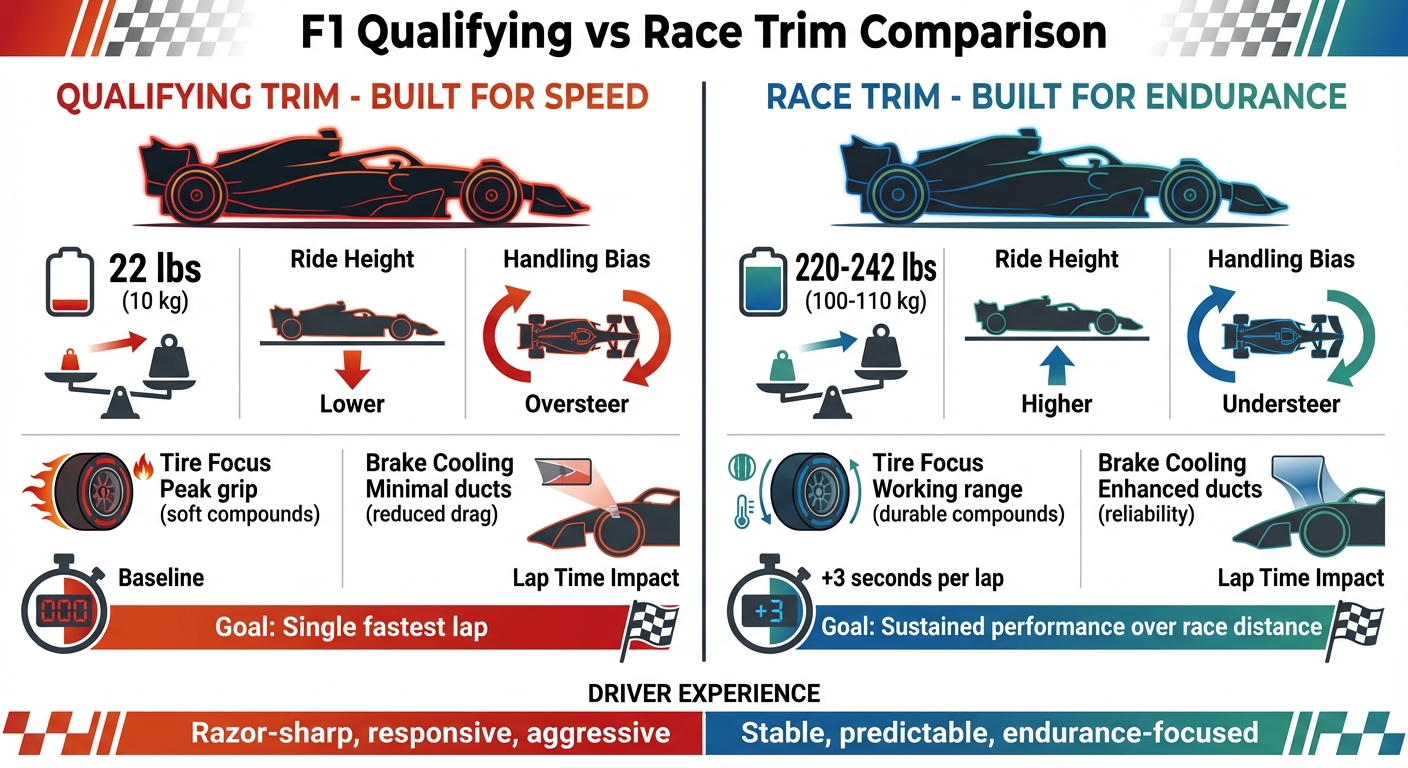
F1 Qualifying vs Race Trim: Key Technical Differences
You Won’t Believe How Much Faster An F1 Car Is In Qualifying Trim
Technical Differences Between Qualifying and Race Trim
Switching a car from qualifying trim to race trim involves fine-tuning its setup to transition from short bursts of speed to sustained performance over a race distance. Let’s break down how aerodynamics, fuel load, and tire management set these two configurations apart.
Aerodynamics and Downforce Settings
Aerodynamics play a pivotal role in differentiating qualifying and race setups. For qualifying, teams prioritize maximum downforce, achieved through a lower ride height and smaller brake cooling ducts. This setup is all about speed and precision. In contrast, race trim involves raising the ride height and using larger ducts to balance downforce with reduced drag. The higher ride height prevents the car from bottoming out under the added weight of a full fuel load - about 220 lbs (100 kg).
Track-specific demands also influence aerodynamic choices. For example, during the Monaco Grand Prix in May 2025, McLaren employed a large rear wing and beam wing to maximize downforce. Andrea Stella, McLaren’s Team Principal, explained:
"One point of downforce is much more valuable than one point of drag... you want to add as much downforce and even if this downforce comes with some drag, that's not a problem".
Meanwhile, Williams opted to retain their 2024-spec high-downforce rear wing, a cost-saving decision driven by budget cap limitations.
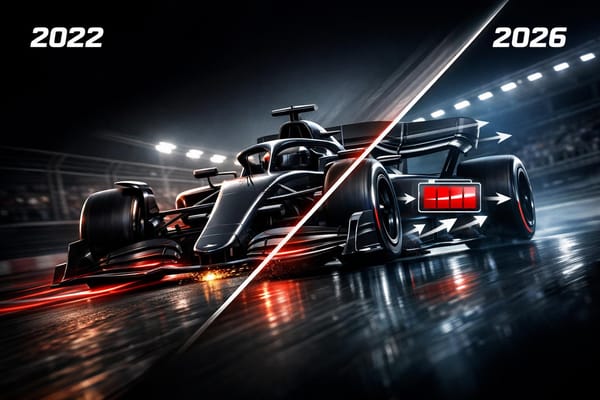
The 2026 regulations have introduced new challenges, particularly with the 350 kW MGU-K. Properly managing its deployment during a qualifying lap can make or break a driver’s performance, with missteps potentially costing over half a second per lap. The contrast between qualifying and race trim isn’t new; back in 1986, BMW’s turbocharged engine produced 850 horsepower for race conditions but surged to 1,300 horsepower in qualifying trim.
Fuel Load and Weight Distribution
Fuel load and its impact on weight distribution form another key difference between the two setups. Qualifying trim is designed to be as light as possible, enabling later braking, sharper turn-ins, and an oversteer bias that aids cornering. Race trim, however, must accommodate a much heavier fuel load - about 242 lbs (110 kg) - which fundamentally changes the car’s handling. This weight adds around 3 seconds per lap and requires a more stable, understeer-biased setup to protect the tires during long stints.
As the fuel burns off during a race, teams must adapt to the shifting weight distribution. Under parc fermé rules, only minor tweaks - like adjustments to front wing angles and tire pressures - are allowed. These small changes help maintain predictable handling, but drivers also need to adapt their braking and cornering techniques as the car’s balance evolves.
Tire Preparation and Grip Levels
Tire management is another area where qualifying and race setups diverge significantly. In qualifying, the focus is on achieving "peak grip" - the sweet spot on the tire’s grip-to-temperature curve. As Mario Isola, Pirelli’s Head of Car Racing and F1, puts it:
"During a flying lap, the driver tries to get as close as possible to peak grip, but avoiding causing the tyre to overheat."
Drivers aim to stay within this narrow window, maximizing grip without overheating the tires.
Race trim, on the other hand, emphasizes the "working range" - a slightly broader zone (around 3% of peak grip) where tire performance remains consistent. Even a small temperature deviation of 18°F (10°C) can push the tire outside this range, leading to a noticeable drop in grip. Teams carefully monitor both surface temperature, which affects immediate grip, and bulk temperature, which influences overall durability.
Different circuits demand unique tire strategies. At Barcelona, for instance, drivers may start a qualifying lap with slightly cooler rear tires to avoid overheating by the end of the lap. Meanwhile, at Baku, the long straights can cause tire surface temperatures to drop by as much as 54°F (30°C), forcing drivers to adjust their braking and cornering techniques. Modern 18-inch tires have also introduced new complexities, with brake ducts designed to manage heat more effectively than the older 13-inch models.
| Feature | Qualifying Trim | Race Trim |
|---|---|---|
| Fuel Load | ~22 lbs (10 kg) | Approximately 242 lbs (110 kg) |
| Ride Height | Lower for aero efficiency | Higher to accommodate fuel load |
| Handling Bias | Oversteer for maximum response | Understeer for tire protection |
| Tire Focus | Peak grip (for one flying lap) | Working range (for consistency) |
| Brake Cooling | Minimal (reduced drag) | Enhanced for reliability |
What Drivers Experience During the Transition
The technical differences between qualifying and race setups create vastly different driving experiences, requiring drivers to adapt their techniques and mindset throughout the weekend.
How the Car Feels in Qualifying Trim
In qualifying trim, the car feels razor-sharp and incredibly responsive. With only 10 kg (22 lbs) of fuel onboard, the car reacts almost instantaneously to steering inputs. The stiffer suspension setup allows for precise turn-ins, aggressive cornering, and maximum grip. Braking distances shrink, and the oversteer-biased configuration ensures the car rotates effortlessly through corners, all tailored for a single, high-performance flying lap.
This setup, however, demands exceptional precision. Under the 2026 regulations, drivers also need to carefully manage the 350 kW MGU-K boost, adding another layer of complexity. The car's responsiveness in qualifying is a stark contrast to the heavier, more composed feel required for race trim.
How the Car Feels in Race Trim
Switching to race trim introduces a completely different dynamic. With around 100 kg (220 lbs) of fuel at the start, the car feels significantly heavier and less nimble, adding over 3 seconds to lap times. The softer suspension settings, designed to protect tires and handle bumps during long stints, reduce the sharpness experienced in qualifying.
The handling setup shifts toward understeer, helping to preserve rear tires by limiting slip angles. While this makes the car more stable and predictable, it also requires drivers to adjust their braking points and overall driving style to accommodate the car's reduced agility.
How Drivers Change Their Driving Style
These differences force drivers to continuously adapt their approach across the weekend. For instance, McLaren driver Lando Norris and his engineer Will Joseph spent extensive time in simulators during early 2020 - up to six or seven hours - testing setups and fine-tuning configurations. Norris explained:
"You want to finish FP3... in a place where you're happy with the car, and any adjustments you're planning to make for qualifying are minor. It could be with the toys, opening the diff a little, or coming up a hole on the front wing."
During the race, drivers must adjust as the car's balance evolves with fuel burn-off. They use steering wheel controls - commonly called "toys" - to tweak settings like the differential, brake balance, and engine maps in real time. Haas Team Principal Ayao Komatsu highlighted the added complexity under the 2026 rules, emphasizing the need for closer collaboration between drivers and engineers for effective energy management. Mercedes driver Andrea Kimi Antonelli described it as:
"It's like a form of 'speed chess', as opportunities and risks are present each time a driver selects or abstains from a dose of power from the 350kW available from the MGU-K."
How Practice Sessions Help Optimize Setups
Practice Sessions and Qualifying Preparation
The first practice session (FP1) is all about establishing a baseline. Teams use tools like aero rakes and flow-vis paint to check if wind tunnel data matches real-world results. They also verify the car’s mechanical reliability with installation laps.
FP2 is where things get serious. This session is split into two key parts: a low-fuel qualifying simulation with soft tires and a heavy-fuel race simulation lasting 30–35 minutes. During this time, the car generates an enormous amount of telemetry - 60–100 MB per lap. This data is sent to the trackside garage in just 10 milliseconds and to the factory in about 30 milliseconds. Teams use this information to analyze tire degradation and fine-tune race strategies, which then feed directly into overnight simulator sessions.
Between Friday and Saturday, teams send data back to their factories for "driver-in-the-loop" simulations. These sessions are crucial for addressing balance issues and testing setup tweaks without wasting precious track time. For example, adjusting anti-roll bars in a simulator takes seconds, whereas doing it in the garage could take up to 20 minutes. As McLaren race engineer Will Joseph explains:
"If the starting point is good, then the rest of the weekend revolves around making gentle improvements. The most disruptive weekends are the one where you haven't found a good starting point".
Final Setup Changes Before Parc Fermé
By the time FP3 rolls around, teams focus on perfecting the setup refined during FP1 and FP2. This last practice session is all about fine-tuning, with the goal of ending FP3 in a position that requires minimal changes before qualifying. As Lando Norris has pointed out, the aim is to wrap up FP3 with only minor adjustments needed for qualifying.
Once the car heads out for qualifying, parc fermé rules kick in. These strict regulations prevent teams from making major changes to the car, such as modifying suspension geometry or gearboxes, without incurring penalties. However, some flexibility remains: teams can adjust front wing angles, bleed brakes, drain fluids, and tweak certain electronic settings. After qualifying, teams have up to 3.5 hours to work on the car, but only within the limits of parc fermé regulations.
This means engineers must find a setup that strikes a balance between qualifying performance and race pace. Even small factors, like a 5 kg (11 lbs) difference in fuel load, can impact lap times by approximately 0.15 seconds. It’s a delicate juggling act, but one that’s vital for success.
Conclusion: Balancing Qualifying and Race Trim
The difference between qualifying and race trim highlights a driver's ability to adapt and strategize under pressure. Once qualifying begins, parc fermé rules lock teams into their setup choices, making early configuration decisions critical. Drivers must commit to a setup that not only secures a strong starting position but also ensures the endurance needed to handle the full race distance.
Looking ahead to the 2026 regulations, drivers will face the added challenge of managing the 350kW MGU-K system. Haas F1 Team Principal Ayao Komatsu likens this to playing "speed chess", where even a single mistake could cost up to 0.7 seconds per lap.
The balance between qualifying and race trim also depends on the circuit. On narrow tracks like Monaco, a strong qualifying trim is critical for securing grid position. Meanwhile, on faster circuits like Las Vegas or Monza, race trim becomes more important for overtaking and tire management. Komatsu elaborates on this complexity:
"The requirements of getting the battery prepared very, very well, versus [how] to prepare the tyres, it's somewhat conflicting. You have this multi-dimensional optimization issue".
This circuit-specific strategy means drivers need to adapt quickly and make precise adjustments throughout the weekend.
The real challenge lies in transitioning from the aggressive, high-risk style required for qualifying to the controlled, strategic approach needed for race day. Modern Formula One demands that drivers master two distinct styles within the same weekend. In qualifying, they push the car to its limits with an oversteer-friendly, all-out attack. During the race, they shift gears mentally and physically, focusing on managing rear tires and maintaining controlled slip angles. This ability to seamlessly switch between these approaches often determines who makes it to the podium on Sunday. It’s this duality that defines the relentless nature of modern F1 and separates the best from the rest.
FAQs
How much slower is race trim than qualifying trim?
Race setups are typically 1 to 1.5 seconds slower per lap compared to qualifying setups. This gap varies based on track design and conditions. The reason? Race configurations focus more on tire durability, handling a full fuel load, and overall stability rather than maximizing speed.
What changes can teams still make under parc fermé?
Under parc fermé rules, teams are allowed to make only a few specific changes to the car. These include switching tires, adding fuel, bleeding the brakes, and making small adjustments to the front wing. These restrictions are in place to ensure the car stays as close as possible to its qualifying setup.
Why does race trim usually favor understeer?
Race setups often lean toward understeer, mainly because modern Pirelli tires tend to wear out faster at the rear. By focusing on understeer, teams can extend the life of the rear tires while maintaining more stable handling over the course of the race.