Ultimate Guide to F1 Prize Money Distribution
Explains how F1 divides its ~$1.6B prize pool—75% performance, 20% historic, 5% heritage—and how the cost cap, anti-dilution fee and Concorde Agreements affect teams.
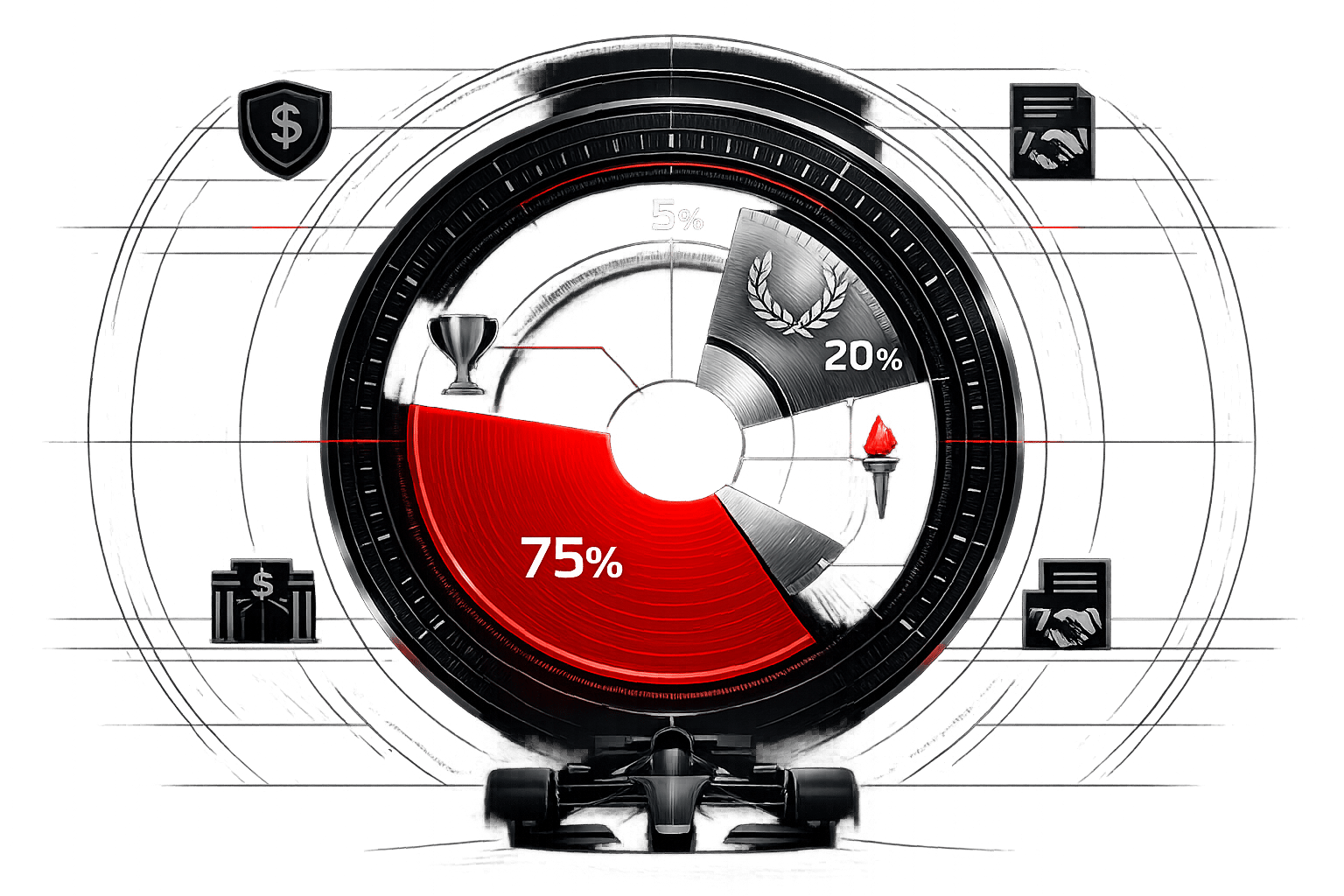
Formula 1 distributes around $1.6 billion in prize money annually, making up about 45% of its operating income. This funding is critical for teams to cover expenses like car development, logistics, and salaries. The prize pool is divided into three parts:
- 75% is based on Constructors' Championship standings.
- 20% rewards historical success.
- 5% is Ferrari's heritage payment.
In 2025, McLaren earned $133.38 million for winning the championship, while Alpine, finishing last, received $56.52 million. The gap between first and last has narrowed significantly under Liberty Media's reforms, ensuring fairer distribution. The cost cap of $135 million further levels the playing field, allowing smaller teams to remain competitive.
New teams, like Cadillac in 2026, must pay a $450 million anti-dilution fee, shared among existing teams to offset the impact of grid expansion. The latest Concorde Agreements ensure financial stability and a balanced competition through 2030. This system supports both legacy teams and new entrants while promoting financial security across the grid.
F1 Prize Money Distribution Breakdown 2025
How F1 Prize Money is Calculated and Distributed
Revenue Sharing and Prize Pool Structure
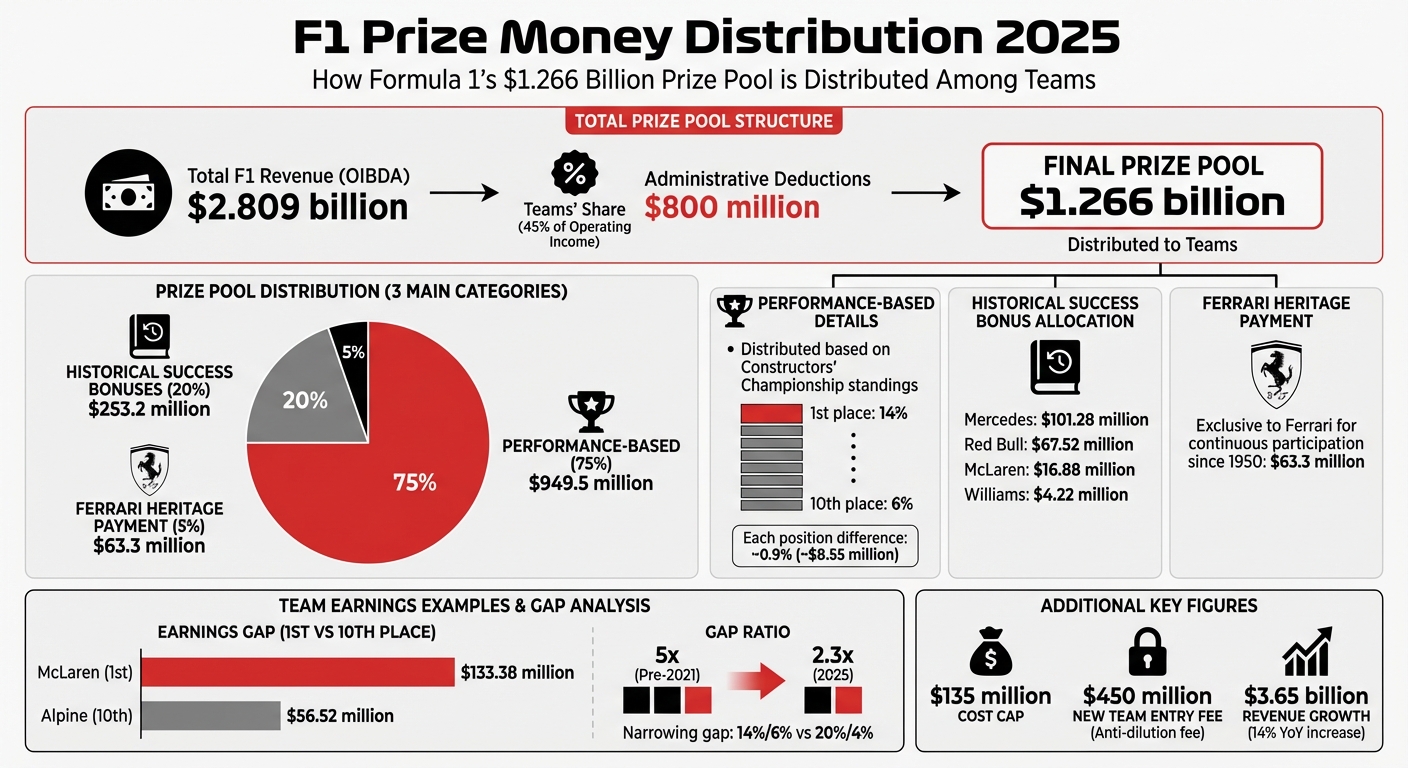
F1 prize money is drawn from the sport's OIBDA (Operating Income Before Depreciation and Amortization). For 2025, this figure is projected to hit $2.809 billion. Teams collectively receive about 50% of this amount, though their share drops to 45% when revenues exceed certain high-growth thresholds. Before any payouts, Liberty Media deducts approximately $800 million to cover administrative and operational expenses. This leaves a total prize pool of roughly $1.266 billion for 2025. Here's how that pool is divided:
- 75% (around $949.5 million) is allocated based on Constructors' Championship standings.
- 20% (approximately $253.2 million) is reserved for historic performance bonuses.
- 5% (about $63.3 million) is set aside for Ferrari's heritage payment.
This structured breakdown directly impacts how funds are distributed to teams based on their performance and legacy.
Performance-Based Payments
The largest slice of the prize pool - around $949.5 million in 2025 - is tied to Constructors' Championship results. The team finishing first in the championship standings gets 14% of this pool, while the team in tenth place receives 6%. The difference between each position equates to about 0.9% of the pool, or roughly $8.55 million. For instance, McLaren, the 2025 champions, earned an estimated $133.38 million, while Alpine, finishing tenth, took home about $56.52 million. These performance-based payouts are especially important for teams managing their operations within the $135 million cost cap.
Special Payments and Bonuses
In addition to the standard prize money, F1 rewards teams for their historical contributions and success. Ferrari, as the only team to have participated continuously since 1950, receives a heritage payment of 5% of the prize pool - about $63.3 million in 2025. This amount can increase to 10% if the total prize pool surpasses $1.6 billion.
The historic success pool, which accounts for 20% of the total prize money (around $253 million), is distributed based on championship wins over the last decade. For 2025, Mercedes is estimated to receive $101.28 million, Red Bull $67.52 million, McLaren $16.88 million, and Williams $4.22 million.
Finally, any new team entering F1 must pay a $450 million anti-dilution fee. This fee is shared among the existing teams to prevent the dilution of their prize money.
Explained: How F1 Prize Money is ACTUALLY Divided
Historical Evolution of F1 Prize Money Distribution
Grasping the historical shifts in Formula 1's prize money distribution helps explain how financial structures shape team strategies and long-term planning today.
The Pre-Liberty Media Era

During Bernie Ecclestone's tenure, the prize money system was built around one principle: reward the top performers while leaving the rest to struggle. The top team would claim around 20% of the total prize pool, while the team at the bottom received just 4%. This massive disparity created a significant wealth gap. Dominant teams could reinvest their winnings into development, further widening the competitive divide.
Adding to the challenge for smaller teams was the "top 10 only" rule, which left teams finishing 11th or lower with no prize money at all. For teams like Marussia and Caterham in the mid-2010s, finishing 11th instead of 10th wasn't just a financial setback - it was a potential death sentence. Meanwhile, established teams benefited from extra payments tied to their historical success. For example, Williams received a $10 million bonus based on their past achievements.
Confidential Concorde Agreements further tilted the balance in favor of the sport's elite teams. Through bilateral deals, the "Big Three" teams - Ferrari, Mercedes, and Red Bull - secured more than half of the total prize pool in 2019. Ferrari alone received an estimated $73 million as part of its "Long Standing Team" bonus, which was more than the total prize money earned by several smaller teams combined. Without a cost cap in place, top teams could spend freely, turning their financial advantage into an overwhelming performance edge. These inequities set the stage for the sweeping changes that came later.
Liberty Media's Reforms
When Liberty Media took control, they aimed to address these imbalances with the 2021 Concorde Agreement. Their goal was straightforward: ensure all ten teams could compete and survive financially. One of the key changes was restructuring how prize money was distributed. The top team's share dropped from 20% to 14%, while the bottom team's share increased from 4% to 6%, reducing the gap from a five-fold difference to just 2.3 times.
Many of the special bonuses for historically successful teams were either eliminated or significantly reduced. Ferrari’s heritage payment, which had been $73 million in 2019, was set to drop to $40 million under the new system. These changes were widely supported by figures like McLaren CEO Zak Brown, who commented:
A more equitable sport is better for everyone: greater balance in the sharing of revenues among all the teams and clearer, simpler governance that cuts through vested interests and puts the sport first.
In addition to reshaping prize money distribution, Liberty Media introduced a mandatory cost cap. Starting at $145 million in 2021 and lowering to $135 million by 2023, the cap prevented top teams from leveraging their larger budgets to outspend competitors indefinitely. Together, these reforms turned F1 teams from money-draining entities reliant on wealthy backers into stable, profitable franchises. To further protect existing teams, Liberty Media also implemented an anti-dilution fee to discourage overcrowding on the grid.
Financial Impact on Teams and the Sport
Balancing Team Budgets
Prize money plays a crucial role in team finances, with its impact varying based on championship standings. For instance, McLaren, following their 2025 championship win, earned an estimated $132.9 million. This amount nearly matched the $135 million cost cap, giving them flexibility to allocate funds to areas outside the cap, such as driver salaries and marketing efforts. On the other hand, Sauber, finishing at the bottom, secured approximately $57.9 million. While still a substantial sum, it required additional sponsorships and owner contributions to cover operational costs.
The revised prize money distribution system ensures every championship position carries financial weight. Each position differs by about 0.9% of the performance pot, creating a more balanced spread compared to the pre-2021 system, where the gap between positions was nearly five times wider. This structured approach directly impacts how teams manage their budgets under the cost cap.
Cost Cap Implications
The $135 million cost cap, combined with the revamped prize money distribution, has reshaped the economic landscape for teams. Top-tier teams like Mercedes and Red Bull can fully fund their operational budgets through prize money alone. Reflecting on this, Mercedes Team Principal Toto Wolff commented, "We are pleased with the more equitable prize fund split, though we still feel the impact of the adjustments".
For teams lower on the grid, the prize money acts as a financial foundation, enabling them to compete at the cost cap level without risking financial instability. A baseline payment of $35 to $40 million per team, supplemented by performance-based earnings, ensures a degree of financial security. By excluding expenses like driver salaries, travel, marketing, and the wages of each team's three highest-paid employees, the cost cap encourages strategic allocation of funds. These measures are critical as the sport adapts to changes in grid composition and revenue dynamics.
Impact of New Teams and Concorde Agreements
Changes in the grid, such as Cadillac's entry as the eleventh team in 2026, pose challenges to revenue distribution. However, the $450 million anti-dilution fee - shared among the original ten teams - offers significant financial protection. This fee, more than double the previous $200 million requirement, compensates teams for the reduced share of the prize pool caused by an additional competitor.
The 2026 Concorde Agreement, divided into separate Commercial and Governance deals signed in March and December 2025, ensures stability through 2030. Teams demonstrating commitment received a $50 million signing incentive. The agreement maintains a fair distribution framework while accommodating grid expansion. All eleven teams, including Cadillac, signed the Governance Agreement, fostering unified decision-making during the 2026 technical reset.
This framework is transforming F1 teams into stable, profitable entities. Claire Williams, former Deputy Team Principal at Williams, highlighted its importance:
The agreement is a major milestone in the development of Formula 1, and also represents a significant opportunity for Williams to continue on our journey back towards the front of the grid.
Conclusion and Key Takeaways
Key Points from F1 Prize Money Distribution
Around 45% of F1's Operating Income Before Depreciation and Amortization is allocated to teams, which translates to an estimated $1.266 billion for the 2025 season. This distribution is broken into three main streams: approximately 75% based on performance standings, 20% linked to historical success, and 5% allocated as Ferrari's heritage payment.
The distribution gaps between teams have narrowed significantly. The top team now earns 14% of the pool, compared to 6% for the last-placed team - an improvement from the previous 20%/4% split. This adjustment complements the $135 million cost cap, helping teams balance competitive spending with financial stability.
Legacy payments still benefit established teams, with Ferrari receiving a baseline of about $63.3 million before other distributions are factored in. However, the system now leans more toward fostering competitive balance rather than rewarding historical dominance. This approach ensures that even lower-ranked teams receive meaningful financial support, creating a more level playing field. These changes mark a shift toward a more sustainable financial model for the sport.
The Future of F1 Prize Money
Looking ahead, F1's financial structure is set for further refinement. The 2026–2030 Concorde Agreements, split into separate Commercial and Governance deals signed in March and December 2025, provide a framework for stability as the sport adapts to grid expansion and new technical regulations. For example, Cadillac's entry as the eleventh team, accompanied by a $450 million anti-dilution fee, demonstrates how the system safeguards existing teams while accommodating growth.
Revenue growth continues to fuel optimism. F1's commercial success reached $3.65 billion in 2024, reflecting a 14% year-over-year increase. This growth is driven by rising competition among streaming platforms and higher fees for hosting premium races. As a result, teams are transitioning from financial struggles to operating as sustainable businesses. These developments highlight F1's dedication to maintaining competitive balance while ensuring its long-term financial health.
FAQs
What counts toward the F1 cost cap, and what doesn’t?
The F1 cost cap focuses on restricting team expenses tied directly to car performance, such as design, development, and manufacturing. The goal is to create a more level playing field and encourage responsible spending.
However, certain expenses fall outside this cap. These include marketing efforts, driver salaries, and specific administrative costs. By excluding these areas, teams can allocate resources beyond car performance while still adhering to the cost cap. This approach helps maintain competition and balance across the grid.
Why does Ferrari get a separate heritage payment?
Ferrari is awarded a special heritage payment in recognition of its long-standing legacy in Formula 1. This ensures the team receives at least 5% of the total prize money pool, occasionally exceeding that amount, as a bonus for its historic contributions to the sport's prestige and development.
How is the $450 million anti-dilution fee distributed?
The $450 million anti-dilution fee is included in the total prize money pool. Part of this pool is allocated to legacy and historical payments, with Ferrari receiving a guaranteed minimum of 5%. The rest is divided among the teams according to their rankings in the Constructors’ Championship, following Formula 1's prize money rules.