Why Cooling Is Key to F1 Aerodynamics
How F1 teams balance engine and hybrid cooling with sidepod design, ducts and CFD to reduce drag while protecting performance.
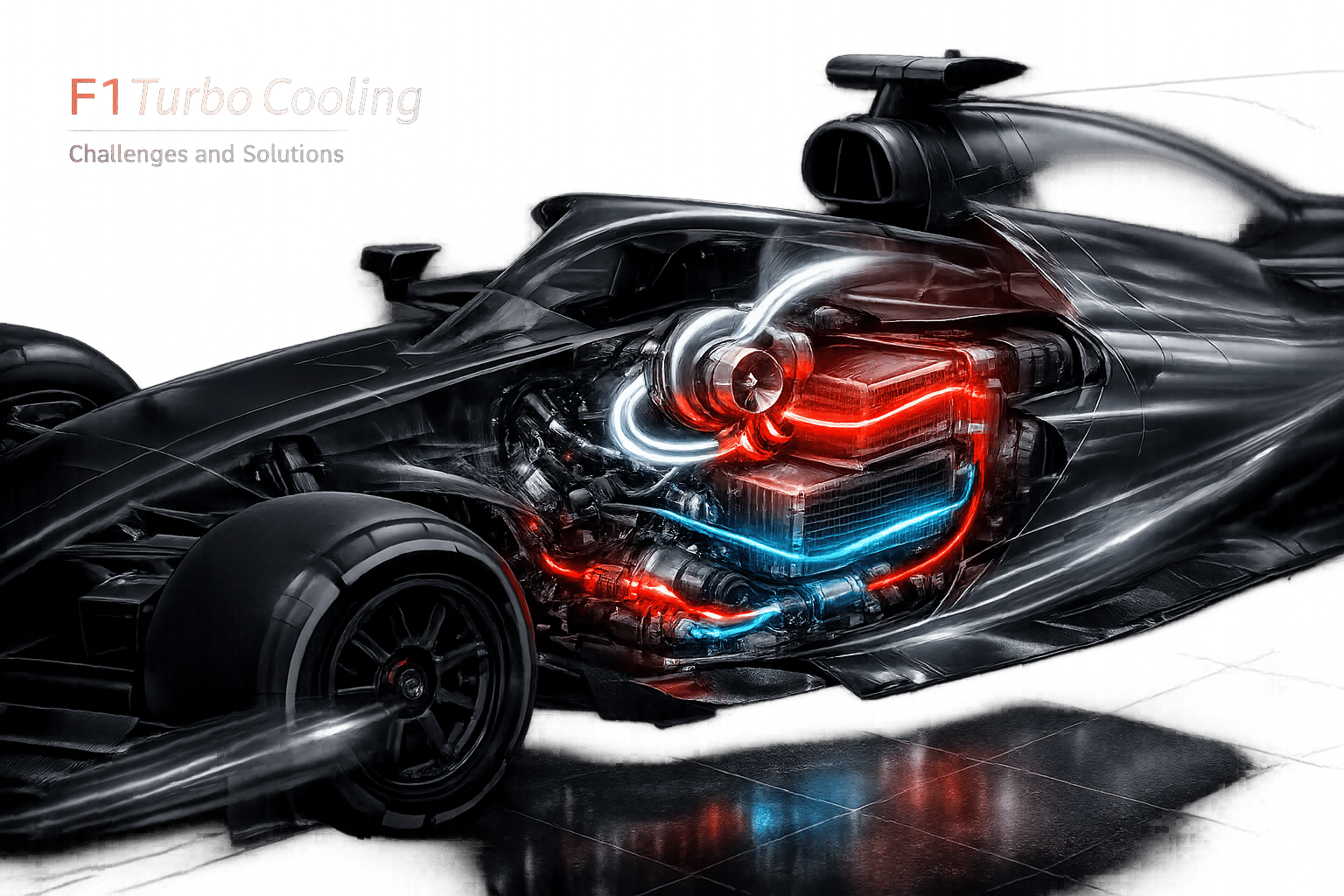
Formula 1 cars push engineering to its limits, generating over 1,000 horsepower and immense heat. Managing this heat is a constant challenge: cooling systems must prevent overheating without adding too much drag or weight, which can slow the car down. Every vent, duct, and radiator impacts both airflow and performance. Here's why cooling is so critical in F1:
- Heat Management: The internal combustion engine alone produces up to 90 kW of heat in the water cooling system and 30 kW through oil cooling. Hybrid components like batteries require even stricter temperature control.
- Aerodynamic Trade-Offs: Cooling ducts and vents disrupt airflow, increasing drag and reducing downforce. Teams must balance reliability with speed.
- Hybrid Complexity: Modern F1 power units use multiple cooling circuits for different components, each with unique temperature needs.
- Sidepod Design: Sidepods are carefully shaped to direct airflow for cooling while minimizing drag.
Cooling isn’t just about reliability - it’s a key factor in aerodynamics. Teams rely on advanced tools like CFD simulations and wind tunnels to design efficient systems. With new 2026 regulations on the horizon, cooling innovations will continue to shape F1 performance.
How To Cool An F1 Car | F1 TV Tech Talk | Crypto.com
Heat Management Demands in Modern F1 Cars
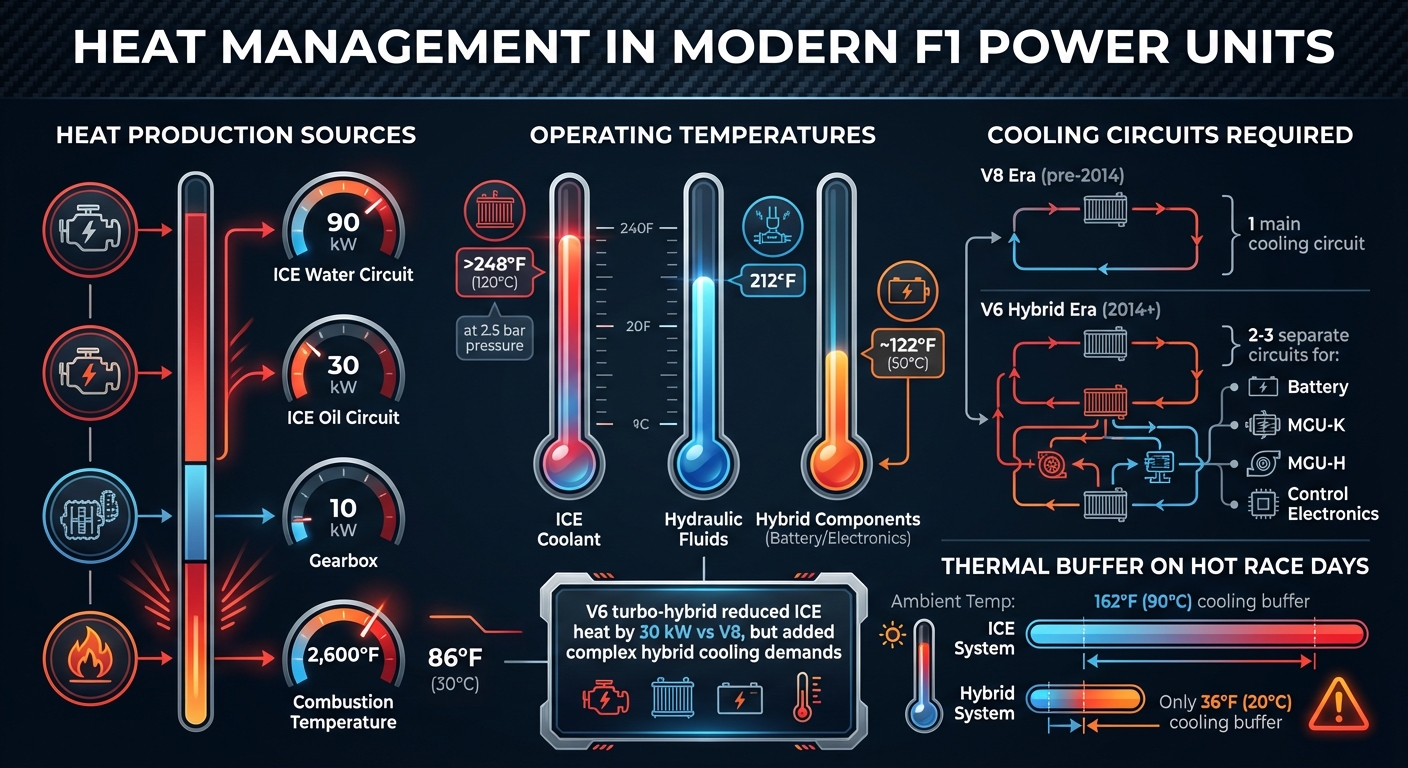
F1 Cooling System Heat Production and Temperature Requirements
Heat Production in Engines and Hybrid Components
Modern Formula 1 power units are engineering marvels, but they come with intense heat management challenges. Inside the internal combustion engine (ICE), combustion temperatures can soar to a blistering 2,600°F, putting immense stress on every component. The engine alone transfers a staggering amount of heat - about 90 kW through the water circuit and 30 kW through the oil circuit. On top of that, the turbocharger adds to the problem by compressing intake air, which dramatically increases its temperature. To keep the engine running efficiently, a charge air cooler is essential.
But the engine isn’t the only heat source. The gearbox generates around 10 kW of heat, while hydraulic fluids, often kept at 212°F, add to the cooling demands. Managing these thermal outputs is a balancing act - every cooling solution impacts airflow and, in turn, aerodynamic performance. If cooling systems fall short, the consequences can be severe. Materials pushed close to their thermal limits face risks like structural weakening and thermal expansion. As Craig Scarborough puts it:
"Materials are pushed closer to their structural limits and aluminium weakens at raised temperatures... Heat also leads to thermal expansion of the metals; this closes the design tolerances, so parts can seize or loosen."
The risks go beyond mechanical components. Overheated oil loses its ability to lubricate, increasing friction and the chance of engine failure. Electronics, such as the ECU and powerboxes, also face a critical threat - semiconductors can overheat, leading to partial or total system failures during a race.
These challenges are only magnified by the introduction of smaller, hybrid power units.
Effects of Smaller Engines and Hybrid Technology
When Formula 1 transitioned to V6 turbo-hybrid power units in 2014, it fundamentally reshaped the sport’s cooling requirements. While the smaller ICE reduced heat rejection by 30 kW compared to the V8 engines, the trade-off came in the form of increased cooling needs for the turbocharger and the Energy Recovery System (ERS). Unlike the simpler oil and water cooling systems of the V8 era, today’s hybrid systems require 2–3 separate cooling circuits for the battery, MGU-K, MGU-H, and control electronics. Each of these components operates at a specific temperature range, adding complexity to the cooling process.
The ICE itself runs at temperatures exceeding 248°F (120°C) and is maintained under 2.5 bar of pressure to raise the coolant’s boiling point, allowing for smaller radiators. Meanwhile, hybrid components, such as the battery and electronic systems, need to stay around 122°F (50°C). This creates a stark contrast in thermal requirements. On a hot race day, with ambient temperatures above 86°F (30°C), the hybrid system has just a 36°F (20°C) buffer for cooling, compared to the ICE’s much larger margin of 162°F (90°C).
This tight thermal window for hybrid components forces teams to make tough aerodynamic compromises. In hotter conditions, they often need to add cooling vents, which increase drag and reduce top speed - critical trade-offs in the pursuit of performance and reliability.
How Sidepods Balance Cooling and Aerodynamics
Directing Airflow Through Sidepods
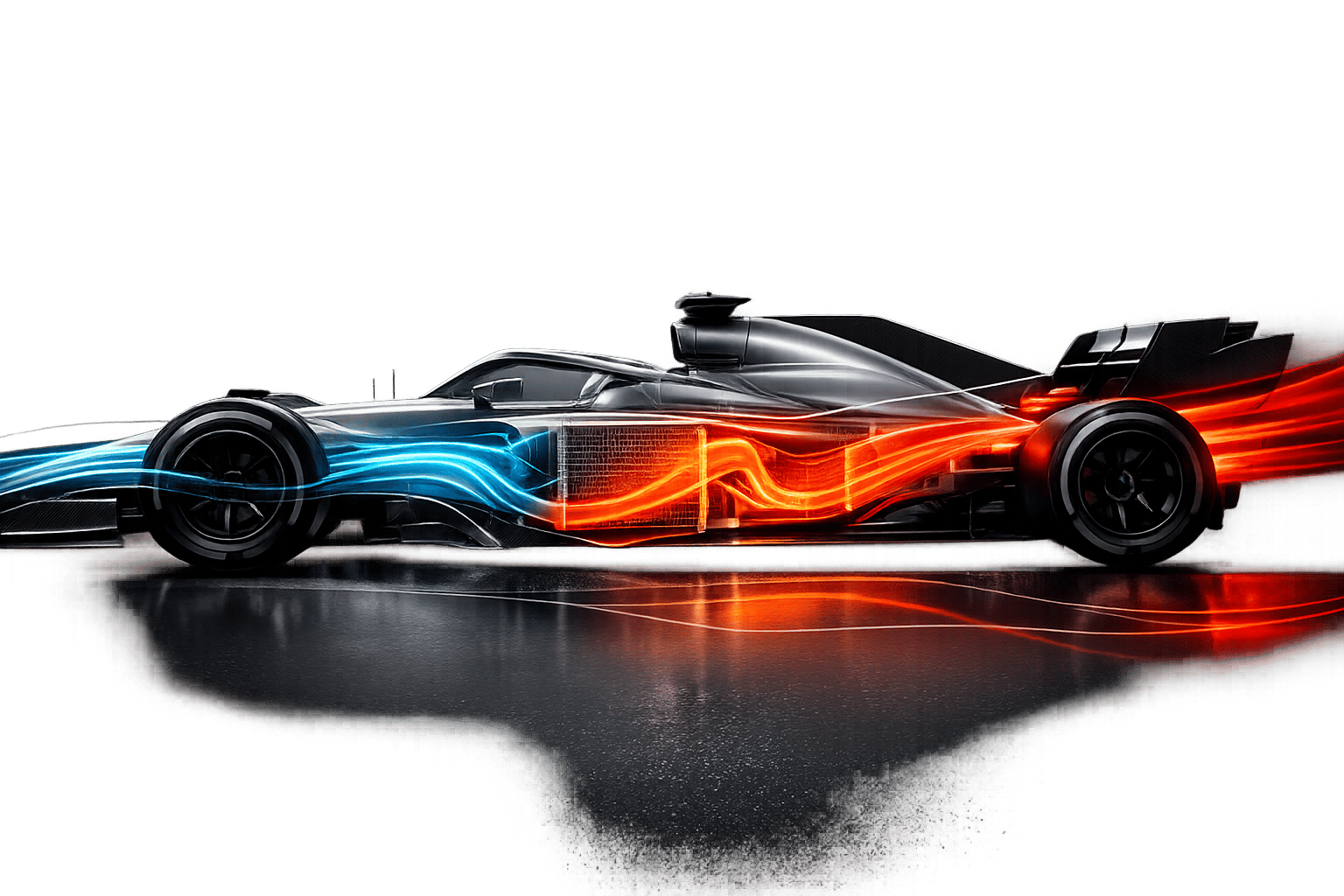
Sidepods play a dual role in Formula 1 design: they are the primary cooling entry points and also one of the most aerodynamically sensitive areas of the car. Air enters through large inlets and smaller "snorkel" openings located behind the cockpit or near the halo. Once inside, this airflow is carefully routed through internal ducts to cool key components like radiators, charge coolers, and intercoolers. As air slows down across the radiator, heat transfer is maximized. Afterward, the air accelerates upon exiting, helping to reduce drag.
Modern teams have perfected how these components are packaged within the car. Take the Red Bull RB20, unveiled in February 2024, as an example. Red Bull redesigned the radiator and charge cooler setup into a V-shaped stack, which deepened the car's midline cut. This adjustment improved airflow to the rear while maintaining sufficient cooling for the Honda power unit. Technical journalist Matt Somerfield explained this shift:
"Over the past few years, Red Bull has moved more of its cooling priority to the car's centreline... in order to take more responsibility off the sidepod's shoulders."
Some teams also rely on centerline cooling, where large saddle-style coolers are mounted above the engine. This approach reduces the cooling burden on the sidepods, allowing for a sleeker and more aerodynamic design. The air is then expelled through various outlets, such as rear-facing vents, cooling louvres (often called "gills"), or adjustable panels that can be tailored to specific track conditions.
This careful management of airflow highlights the intricate trade-offs that come with sidepod design.
Performance Trade-Offs in Sidepod Design
While optimizing airflow improves cooling, it creates a constant balancing act between heat rejection and aerodynamic efficiency. Larger sidepod inlets and outlets enhance cooling but also increase drag, which can negatively impact downforce. On the other hand, placing radiators in the sidepods helps lower the car's center of gravity (CoG), which improves handling. However, wide sidepods can disrupt airflow to the rear wing. Alternatively, moving coolers to the centerline above the engine clears up sidepod space, improving aerodynamics, but this configuration raises the CoG and adds weight due to extra pipework.
Teams calculate "cooling-drag sensitivity" for each track using lap simulations. Depending on the circuit, they might run the engine at higher temperatures - up to 248°F (120°C) - to allow for smaller, more streamlined radiators. However, this strategy pushes materials closer to their limits. Mercedes has even used thin carbon covers over sidepod louvres during qualifying sessions to reduce drag. These covers can be removed during pit stops if extra cooling is needed for the race.
Additionally, designers must address asymmetric cooling demands. Different components, such as ICE radiators and ERS intercoolers, have varying thermal requirements. As a result, sidepods are often designed asymmetrically to balance cooling efficiency and aerodynamic performance on each side of the car.
McLaren's MP4-30 serves as a cautionary tale. The team's "size-zero" design philosophy minimized sidepod volume to prioritize aerodynamics, but this led to severe cooling and reliability problems for the Honda power unit. The ongoing challenge for engineers is to strike the perfect balance between cooling capacity and aerodynamic efficiency in the ever-evolving world of Formula 1.
Aerodynamic Components That Enable Cooling
Vents, Louvres, and Duct Design
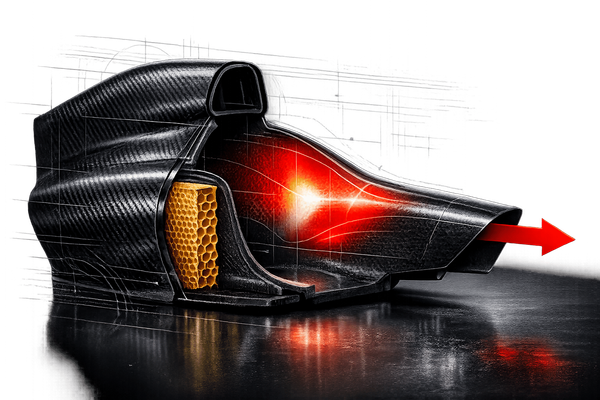
In Formula 1, keeping the car cool isn't just about slapping on a radiator - it's a precise dance of aerodynamics and airflow management. Internal ducts are carefully designed to expand before the radiator, slowing down the air just enough to make heat transfer more effective. Once the air has done its job of cooling, the ducts narrow again, speeding the airflow back up to reduce drag. This is where the "coke bottle" exit comes into play, allowing teams to tweak the outlet's size to strike the right balance between heat expulsion and aerodynamic efficiency.
Since 2009, FIA rules have limited where teams can place cooling vents. These zones are the front top of the sidepod, along the shark fin, or at the coke bottle tail exit. This restriction has led to the consistent vent placement we see on modern F1 cars. To release hot air effectively, teams use louvres - often called "gills" - in these areas, and adjustable panels let them adapt to different track and weather conditions. Another clever trick is thermal stacking, where coolers handling lower temperatures are placed in front of those dealing with higher temperatures. This setup allows the same airflow to pass through multiple heat exchangers, achieving solid cooling performance without adding unnecessary drag. All of this works in harmony with the front wing, which plays a key role in preparing airflow for these systems.
Front Wing's Role in Airflow Preparation
The front wing does more than just generate downforce - it’s also a critical part of the cooling strategy. As the first point of contact with incoming air, it conditions and directs high-pressure airflow toward the sidepod inlets. This airflow, typically concentrated near the vertical sides of the monocoque, is essential for cooling. Engineers face a tricky trade-off here: ensuring enough clean air flows into the cooling inlets while still optimizing the wing for downforce.
The front wing also directly cools some forward-mounted electronics, like laser speed sensors, by channeling airflow over heatsink fins. Beyond that, the vortices created by the front wing and other aerodynamic elements help guide airflow toward cooling inlets and keep it from separating at the rear wing, ensuring smooth aerodynamics throughout the car.
Tools for Thermal Analysis and Performance Tuning
CFD Simulations and Wind Tunnel Testing
Before any car hits the track, F1 teams rely on Computational Fluid Dynamics (CFD) and wind tunnel testing to fine-tune their cooling systems. With CFD, engineers model the entire airflow path - starting at the inlet, moving through the radiator where air slows down, and finally exiting through a converging outlet where it speeds up again. This process helps teams strike a critical balance between heat dissipation and aerodynamic drag.
One key outcome of CFD work is the creation of an "electronic catalogue" - a database that links specific cooling configurations to their aerodynamic trade-offs. This allows engineers to quickly select the best setup for the unique demands of each race track. As Mercedes aerodynamicist Ola Jagied puts it, this process begins with brainstorming solutions to overcome limitations and refine component designs.
Wind tunnel testing complements CFD by validating the airflow predictions and fine-tuning the internal ductwork. It ensures that air interacts with the radiator as expected, helping teams make vital packaging decisions. For instance, they might explore stacking coolers or using water-to-air intercoolers to reduce the sidepod's size. Together, CFD and wind tunnel testing enable engineers to optimize every cubic inch of airflow for cooling while minimizing its impact on lap times. These simulations also guide precise, real-time adjustments during races.
Real-Time Monitoring and Race Adjustments
Once the CFD and wind tunnel insights are validated, the focus shifts to real-time data collected on track. Teams use a network of sensors - tracking brake temperatures, air pressures, and even laser-measured speeds - to monitor the car's thermal performance. This live data is cross-referenced with the electronic catalogue to decide whether to tweak cooling settings for more speed or to prioritize reliability by boosting airflow.
The challenge becomes even more complex under Parc Fermé rules, which restrict bodywork changes after qualifying. To navigate these limitations, teams employ clever strategies that maximize aerodynamic performance during qualifying while still allowing for increased cooling during the race if temperatures rise. As tech illustrator Craig Scarborough explains:
"Teams want performance but also reliability, so cooling must be traded to meet the team's goals. There is nothing for free with this trade off".
How Cooling Design Creates Performance Advantages
New Approaches to Sidepod and Component Packaging
Building on earlier advancements in sidepod airflow management, teams are now finding ways to improve performance through smarter component packaging. By rethinking how cooling components are integrated, engineers can create more aggressive aerodynamic shapes. For example, Mercedes and Ferrari have adopted water-to-air intercoolers. While these systems are heavier than traditional air-to-air setups, they are significantly more compact. This compact design allows the intercooler to be placed in front of the engine, freeing up critical sidepod space for enhanced aerodynamic designs.
Teams are also optimizing airflow by stacking radiators with staggered temperature ranges and designing asymmetric sidepods to meet varying cooling needs. To maximize space, radiator cores are stacked to increase surface area, while keeping inlet and outlet pipes on one side for better layout efficiency. The internal combustion engine’s (ICE) water cooling circuit alone needs to handle around 90kW of heat, with an additional 30kW managed by the oil circuit - all of this must fit within ever-shrinking sidepod dimensions.
Working Within FIA Rules While Customizing Solutions

At the same time, teams must work within the boundaries of FIA regulations while finding ways to innovate. For instance, FIA-mandated vent placements have shaped how teams approach cooling solutions. Additionally, the upcoming 2026 regulations introduce a 5kg weight allowance for cooling systems, which will require further adjustments.
Parc Fermé regulations, which prevent bodywork changes after qualifying, add another layer of complexity. To address this, Mercedes developed thin carbon covers for louvered outlets. These covers, taped in place for qualifying, can be removed during a pit stop if extra cooling is needed during the race.
Looking ahead to 2026, the 5kg weight allowance for driver cooling systems is pushing teams toward modular, battery-powered units. Charles Kline, founder of Chillout Motorsports, highlighted this shift:
"Right now, we're doing bespoke systems to work with the current chassis, but for 2026, the teams will know from testing how much space they need to allocate for a modular system".
These evolving regulations illustrate the constant balance between pushing the boundaries of design and maintaining aerodynamic efficiency in Formula 1.
Conclusion: Why Cooling Systems Matter in F1 Competition
In Formula 1, the balance between cooling and aerodynamics is a constant tug-of-war. Precise cooling designs are essential for maintaining reliability while minimizing aerodynamic penalties. With F1 power units generating around 1,000 horsepower, the intense heat loads they produce demand efficient cooling to prevent component damage and costly race retirements.
However, cooling comes at a price. As Craig Scarborough, Technical Illustrator and F1 Pundit, explains:
"Cooling aids reliability but costs in performance, with added weight and aerodynamic drag".
Every vent and outlet carved into the car's bodywork disrupts the aerodynamic flow, adding drag that can shave off precious fractions of a second per lap. From shaping sidepods to leveraging CFD (Computational Fluid Dynamics) tools, engineers are constantly refining designs to strike the right balance.
To counter these aerodynamic sacrifices, teams have embraced inventive solutions. For instance, water-to-air intercoolers, while heavier, allow for slimmer sidepods that improve airflow to critical areas like the rear wing and diffuser. Similarly, innovative setups like stacked radiators and asymmetrical cooling outlets enhance thermal control while reducing the car’s overall footprint. These developments not only enhance performance but also position teams to adapt to the upcoming 2026 regulations.
Speaking of 2026, the new rules are pushing engineers to rethink cooling systems entirely. The goal? Modular setups weighing under 2 kg - down from the current 5 kg limit. In a sport where every gram and every bit of airflow counts, cooling systems will remain a critical area where engineering brilliance can make or break a team’s podium chances. As highlighted throughout this discussion, mastering cooling strategies is essential for staying competitive on race day.
FAQs
Why does more cooling usually mean more drag?
Increasing cooling in an F1 car often leads to higher drag because it demands more airflow through the vehicle's cooling systems. This added airflow disrupts the car's aerodynamic performance, as larger or more intricate cooling components interfere with the smooth flow of air and generate resistance. Striking the right balance between effective cooling and minimizing drag is a key challenge in F1 aerodynamics.
Why do hybrid parts need tighter temperature control than the engine?
Hybrid components require tighter temperature regulation due to the significant heat they generate and their heightened sensitivity to temperature changes. Inadequate heat management can negatively impact their thermal performance and dependability, particularly during high-performance operations.
How do teams choose cooling setups for hot races without losing speed?
Teams carefully manage airflow and thermal efficiency to strike a balance between cooling and aerodynamics. The goal is to prevent overheating while maintaining speed. This involves fine-tuning elements such as duct sizes, airflow paths, and cooling components like radiators and intercoolers. However, there’s a trade-off: too much cooling can create drag and slow the car, while insufficient cooling risks overheating. To stay competitive, teams adjust these systems based on factors like ambient temperatures, track conditions, and specific car setups, especially during hot races where reliability is crucial.