2022 Aero Rules: Driver Performance Analysis
2022 aerodynamic rules reshaped F1: which teams adapted, how drivers adjusted to ground-effect cars, and why overtaking and setups changed the championship.
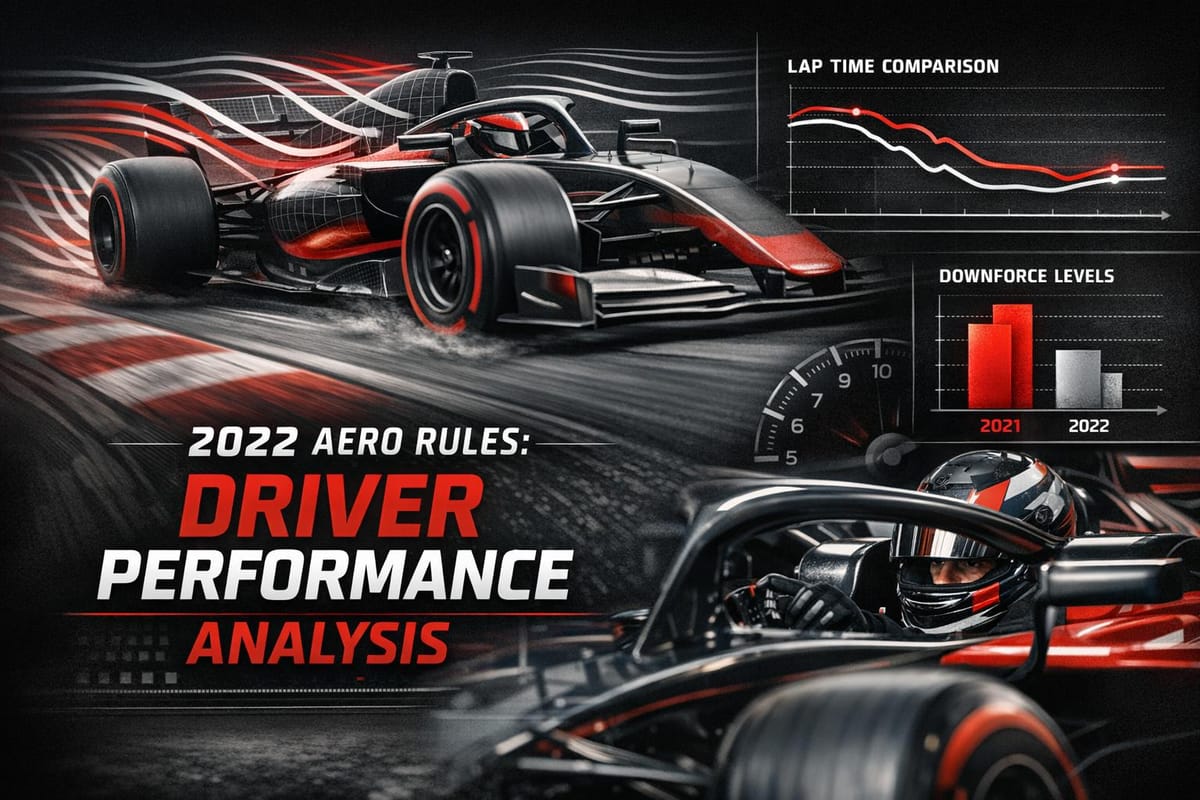
The 2022 Formula One season brought major aerodynamic changes aimed at improving close racing and overtaking. Key updates included the return of ground-effect aerodynamics via Venturi tunnels, simplified wings, and redesigned rear wings to reduce dirty air. These changes helped trailing cars retain more downforce, cutting losses from 46% to 18%. However, adapting to these new rules presented unique challenges for drivers and teams.
Key Takeaways:
- Max Verstappen struggled early but dominated after mid-season updates, securing 15 wins.
- Charles Leclerc started strong with Ferrari’s F1-75 but faced tire degradation issues mid-season.
- Lewis Hamilton and Mercedes suffered from porpoising, ending his win streak since 2007.
- Sergio Perez found the RB18 harder to handle compared to Verstappen, despite Red Bull's straight-line speed.
- Carlos Sainz showed promise but faced balance and tire issues after mid-season updates.
- Lando Norris adjusted to slower lap times and reduced grip, but McLaren’s challenges limited his results.
The new regulations reshaped car behavior and driver techniques, emphasizing the importance of setup precision and weight distribution. Teams that adapted quickly gained a clear edge, while others struggled to keep pace. The season highlighted how small technical adjustments can significantly impact performance.
1. Max Verstappen
Adjusting to Aero Changes
At the start of the season, the RB18's weight imbalance made life tricky for Max Verstappen. The extra weight at the front of the car caused severe understeer and frequent brake lock-ups, hindering his aggressive driving style.
Red Bull's engineers tackled this head-on with a weight-saving program. By shedding more weight from the front than the rear, they shifted the car's weight distribution backward. This also allowed them to move the center of aerodynamic pressure further back, aligning perfectly with Verstappen's preference for a sharp, responsive front end. Unlike most drivers, Verstappen thrives with a car that has a lively rear, handling instability with ease. These changes expanded the car's setup options, giving engineers the flexibility to fine-tune it to his liking.
The revamped multi-link front suspension was another game-changer. It reduced dive during braking, keeping the car's aerodynamic platform stable and enabling Verstappen to attack corners with confidence. Additionally, the car's floor design maintained downforce even at lower speeds, a feature that gave Red Bull an edge over Ferrari's F1-75.
These technical upgrades marked a turning point, laying the groundwork for a remarkable shift in performance.
Dominance on the Track
Once these adjustments were implemented, Verstappen's results began to mirror the car's improved balance. After overcoming early-season struggles, he quickly took control of the championship. During the first 11 races, Ferrari had the upper hand in qualifying, boasting a 0.176-second average advantage in dry sessions and outpacing Red Bull in six races. Red Bull, by comparison, managed three wins in that stretch. But everything changed after the French Grand Prix. By the end of the season, Verstappen had smashed records, claiming an unprecedented 15 victories, including a streak of 14 wins by race 20.
Red Bull Team Principal Christian Horner summed it up perfectly:
"Max is on fire at the moment".
Even Verstappen acknowledged the transformation:
"We've had a lot of different challenges on different kinds of tracks, and now the car really seems to work at every track".
What stood out was the car's ability to perform across various circuit types - from high-speed tracks to tight, twisty street circuits. This adaptability, combined with Verstappen's skill, showcased the perfect synergy between driver and machine once the technical issues were resolved.
2. Charles Leclerc
Adjusting to Aero Changes
Charles Leclerc and Ferrari came out strong in 2022. The F1-75 proved to be quicker than Red Bull in six of the first 11 races, boasting an average qualifying edge of 0.176 seconds in dry conditions. Ferrari’s innovative "bathtub" sidepod design and efficient floor package provided solid downforce, enhancing Leclerc's front-end grip.
One of Ferrari’s key early advantages was their excellent weight management. Starting the season near the minimum weight limit gave them a clear edge, as every additional 22 pounds (10 kg) could slow the car by about 0.3 seconds per lap. This technical precision translated directly into strong race performances.
Race Performance
Ferrari’s early-season technical strengths helped Leclerc secure three wins in the first 16 races of 2022. He excelled on tracks where the F1-75’s performance outpaced the competition. For instance, at Monza, the 2022 Ferrari was 0.4 seconds quicker than its 2021 version. The car also handled high-speed corners, like Silverstone’s Copse, with impressive speed.
However, things took a turn after the French Grand Prix. Ferrari introduced a floor upgrade aimed at improving downforce, but it backfired, creating significant balance issues. Team Principal Mattia Binotto explained:
"We certainly had issues with the car balance and having an open balance... [which] generated overheating into the tyres themselves, which somehow then [leads] to the degradation".
These balance problems led to tire overheating and faster degradation, leaving Leclerc more vulnerable during races. This shift allowed Red Bull to gain the upper hand in the championship.
Overtaking Challenges
The 2022 aerodynamic regulations made it easier to follow closely, which improved overtaking opportunities. Leclerc’s precision in wheel-to-wheel battles, especially against Verstappen early in the season, stood out.
Still, Ferrari’s mid-season difficulties persisted. At high-altitude tracks like Mexico City, the thinner air reduced the slipstream effect and caused cooling problems when cars followed closely. This, combined with Ferrari’s balance issues, limited Leclerc’s ability to overtake. As a result, he often found himself defending rather than attacking during the latter half of the season.
3. Lewis Hamilton
Lap Time Struggles
Mercedes faced a tough adjustment to the new ground-effect regulations in 2022. At key tracks like Monza, Silverstone, and Monaco, the team experienced lap time losses of 2.5 seconds, 0.7 seconds, and 1.5 seconds respectively compared to their 2021 performance. The main issue? Porpoising - intense bouncing at high speeds - which forced Mercedes to raise the car's ride height to avoid damage, sacrificing performance. Meanwhile, Ferrari's 2022 car was 0.4 seconds faster at Monza, underscoring the steep decline Mercedes endured. These technical challenges severely impacted Hamilton's competitiveness throughout the season.
Race-Day Challenges
The time losses on the stopwatch carried over to race day. For the first time since his debut season in 2007, Hamilton ended the year without a single win. The Mercedes W13 was plagued by what the team called a "concept error" and was significantly overweight - about 88 pounds (40 kg) heavier than the 2021 car. This was largely due to new safety regulations and the introduction of larger 18-inch tires. Despite these hurdles, Hamilton still managed to fight for podium finishes. Reflecting on his season, Hamilton noted:
"I was in the fight, which hasn't been often this year".
Adapting to Aero Challenges
The 2022 season demanded a complete overhaul of Hamilton's driving style. The car’s sensitivity to ride height and aerodynamic balance made it especially tricky to handle. At high-altitude tracks like Mexico City, thermal management became a major issue, particularly when driving close to other cars. This led to overheating problems for both brakes and tires. Mercedes also grappled with mismatches between their CFD and wind tunnel predictions versus the car’s actual track performance. These obstacles further complicated Hamilton's ability to execute overtakes and maintain consistent race pace.
Overtaking Difficulties
While the 2022 regulations aimed to reduce "dirty air" and make it easier to follow other cars, Hamilton couldn’t fully capitalize on this change. Mercedes had to use heavily trimmed-back rear wings at high-speed circuits like Monza to cut drag, but even then, they lagged behind the top three teams in straight-line speed. This left Hamilton more focused on defending his position rather than attacking. For instance, at the Italian Grand Prix, overtakes across the grid surged from 18 in 2021 to 48 in 2022, yet Hamilton often found himself on the back foot. Unlike in 2021, when he could use his car's turbulent wake to fend off quicker rivals like Sergio Perez, the 2022 rules left him more exposed to being overtaken.
4. Sergio Perez
Lap Time Gains
Sergio Perez faced challenges in consistently extracting the RB18's full potential under the new ground-effect regulations. At Silverstone, Perez's telemetry data became a key reference point for Red Bull's performance in high-speed corners. It revealed a notable drop in entry and exit speeds through corners like Copse when compared to the 2021 car. The RB18 was approximately 2.3 seconds slower per lap at Silverstone and 0.4 seconds slower at Monza, despite achieving higher straight-line speeds. These slower lap times had a clear impact on Perez's race results.
Race Results
The reduction in cornering performance directly influenced Perez's ability to secure consistent results. For example, while Red Bull managed to increase its straight-line speed by about 7 km/h at Monza, the car's struggles in high-speed corners made it harder for Perez to challenge his teammate, Max Verstappen. Adding to the difficulties, the RB18's extra weight further hindered its cornering ability. At Monaco, the car was 1.4 seconds slower than its 2021 predecessor. These performance inconsistencies highlighted the adjustments Perez needed to make to align with the car's altered aerodynamic profile.
Adapting to Aero Changes
The shift to generating downforce primarily through the car's underfloor required drivers to rethink their approach behind the wheel. McLaren's Technical Director James Key noted that "the cars are definitely easier to follow", but this didn’t automatically translate to better results for all drivers. Perez had to adapt to a car that excelled in straight-line speed but struggled through corners - a significant departure from the high-downforce setup of 2021. This sensitivity to the new aerodynamic balance proved challenging for Perez, especially when compared to Verstappen, who quickly adjusted to the RB18's quirks. The 2022 regulations also redefined overtaking dynamics, further complicating the learning curve.
Overtaking Success
One major change in 2022 was the improvement in following other cars, as downforce loss in dirty air dropped from 46% to just 18%. This allowed Perez to stay closer to rivals through corners without losing as much grip. Additionally, the pace advantage required for a 20% chance of overtaking per lap fell from 1.06 seconds in 2021 to 0.42 seconds in 2022. Red Bull's superior straight-line speed gave Perez opportunities to leverage these changes, but his cornering struggles compared to the previous year's car meant he couldn’t always fully exploit the RB18's strengths in wheel-to-wheel battles.
5. Carlos Sainz
Lap Time Gains
Carlos Sainz, like many top drivers, had to navigate the challenges brought by the new aerodynamic rules. Ferrari's approach to the 2022 ground-effect regulations gave him a solid platform to work with. Unlike Red Bull and Mercedes, Ferrari's car excelled in high-speed corners, such as Copse at Silverstone, showing clear improvement over its 2021 version. At Monza, the F1-75 delivered impressive gains, including a 0.4-second faster lap time and a 7 km/h boost in top speed. However, at Monaco, the car's mandatory weight increase of 40kg proved costly, slowing it down by 1.8 seconds per lap - a larger impact compared to Red Bull's 1.4 seconds and Mercedes' 1.5 seconds.
Race Results
Early in the 2022 season, Ferrari's F1-75 was the car to beat in six of the first 11 races, providing Sainz with a competitive edge. During this period, Ferrari trailed Red Bull in dry qualifying by an average of just 0.176 seconds. However, the dynamics shifted after the French Grand Prix. A mid-season floor update caused balance issues for Sainz, particularly during races. These changes led to tire overheating, making it harder for him to sustain a consistent pace over longer stints. This period highlighted the need for him to refine his approach as he adjusted to the evolving car.
Adaptability to Aero Changes
Sainz demonstrated his ability to adapt to aerodynamic tweaks throughout the season. He adjusted his driving style to match Ferrari's innovative sidepod design, which used a wider geometry to redirect tire wake - an approach that contrasted with Mercedes' narrow "zero-pod" concept. The 2022 regulations shifted much of the downforce generation to the car's underfloor, giving Ferrari an initial edge. However, the introduction of Technical Directive TD039 mid-season, aimed at reducing porpoising, forced teams to raise their ride heights. This adjustment shifted the aerodynamic balance back toward wing-based downforce, reducing Ferrari's early advantage and requiring Sainz to adapt once more.
Overtaking Success
The 2022 regulations, which reduced the effects of turbulent air, allowed Sainz to stay closer to rivals and improve his overtaking opportunities. At the Canadian Grand Prix in June, he kept the pressure on Max Verstappen during the final laps, finishing second. The new rules enabled him to follow Verstappen closely through the technical sections of the track. McLaren Technical Director James Key praised the changes, stating:
"The regs have been effective and hats off to the FIA and F1 for achieving that in such a scientific way, and making it work on track... The cars are definitely easier to follow".
At the Mexican Grand Prix in October, Sainz executed a clean overtake on Fernando Alonso mid-race. However, his progress was limited by power unit temperature issues, a common challenge at high-altitude circuits like Mexico City.
6. Lando Norris
Lap Time Adjustments
In 2022, Lando Norris faced slower lap times compared to the 2021 season. The updated regulations brought several changes, including an increase in the minimum car weight by about 88 pounds (40 kg) due to added safety measures and the introduction of 18-inch tires. Additionally, simplified wings reduced downforce, which impacted cornering speeds. At high-speed tracks like Silverstone, lap times were slower by 0.7 to 2.3 seconds, while on tighter circuits such as Monaco, the deficit ranged from 1.4 to 1.8 seconds. On the straights, however, reduced drag allowed cars to gain an average top speed of about 3 km/h. These changes required Norris to rethink and fine-tune his driving approach.
Adjusting to Aero Shifts
The switch to ground-effect aerodynamics, achieved through venturi tunnels, presented new challenges for Norris. An overweight setup and a shifted aerodynamic balance led to increased understeer and front-wheel locking. Norris also noted that the new cars were more sensitive to slippery surfaces and low-grip conditions. Reflecting on the reduced grip, he remarked:
"The lack of grip is 'just what you have to deal with'".
Navigating Overtaking Challenges
These adjustments also shaped Norris's racecraft. The 2022 aerodynamic changes aimed to reduce the impact of dirty air, allowing cars to follow more closely. Downforce loss for a trailing car dropped significantly - from 46% in 2021 to 18% in 2022 at one car length, and from 35% to 14% at two car lengths. This improvement gave Norris better opportunities to set up overtakes. However, he encountered other hurdles, such as managing brake and tire temperatures in traffic, which became critical during "thermal races." At high-altitude circuits like Mexico City, the thinner air reduced the slipstream effect, making overtaking more challenging despite the aerodynamic improvements.
F1's 2022 Tech in 3D - Everything You Need To Know
Strengths and Weaknesses
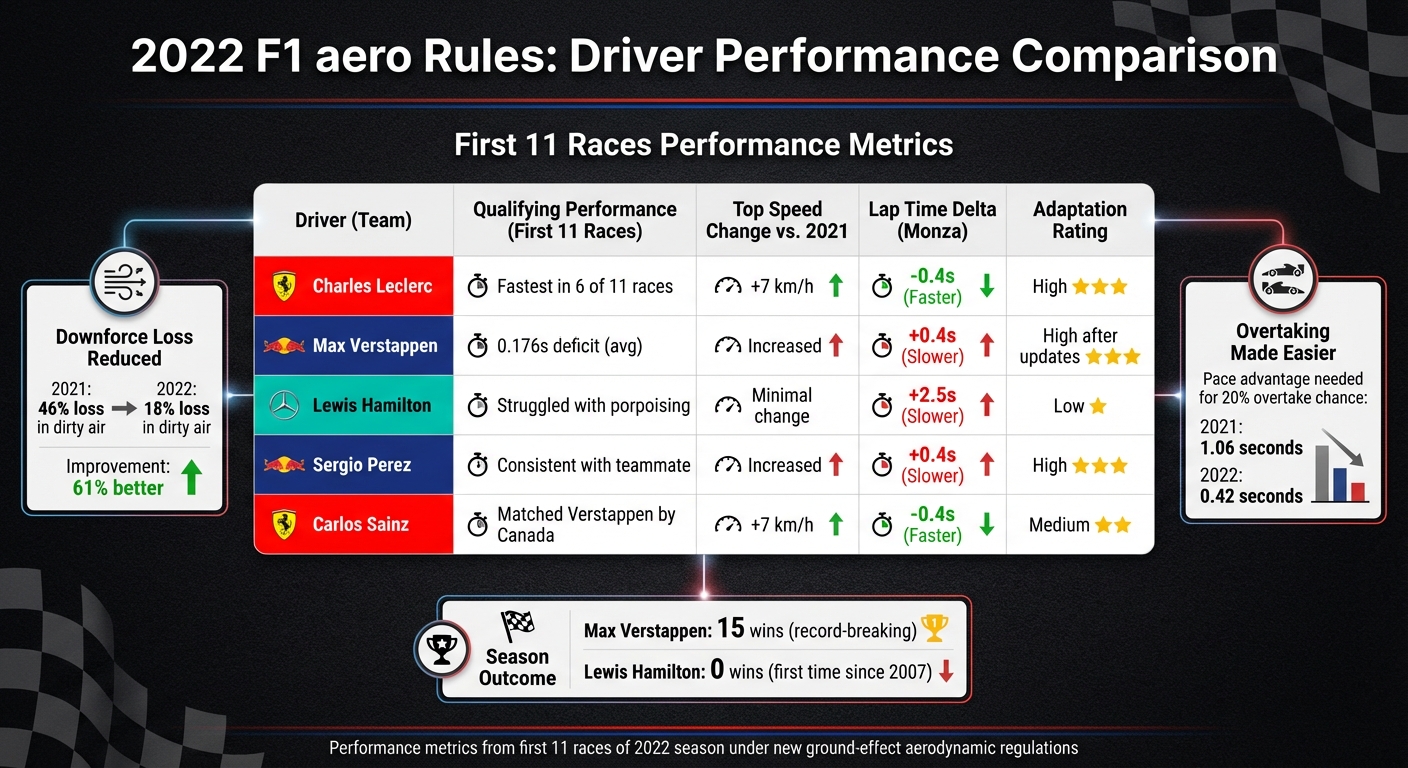
2022 F1 Driver Performance Comparison Under New Aero Regulations
The 2022 regulations brought noticeable disparities in team performance, largely influenced by how well teams leveraged ground-effect aerodynamics. Ferrari and Red Bull adapted most efficiently to these changes, while Mercedes faced challenges with weight distribution and porpoising issues.
Looking at individual adaptations, Charles Leclerc stood out early in the season with impressive performances. Meanwhile, Max Verstappen initially struggled with front-end weight issues, but a focused weight-saving program addressed the imbalance. Once the car's weight was reduced and rebalanced, Verstappen was able to maximize his preferred driving style, which relies on a strong front-end response. In contrast, Lewis Hamilton's car lagged significantly, clocking in 2.5 seconds slower during qualifying at Monza.
The new regulations also made overtaking more feasible. The pace gap required for a 20% chance of overtaking dropped from 1.06 seconds in 2021 to just 0.42 seconds in 2022. Still, not all teams or drivers were able to fully take advantage of this. Ferrari, for example, encountered mid-season balance issues that impacted tire performance. Despite early struggles, Carlos Sainz managed to bring his performance closer to Leclerc's as the season progressed. These developments highlight the varied challenges and rapid adjustments teams faced in 2022.
| Driver | Qualifying Performance (First 11 Races) | Top Speed Change vs. 2021 | Lap Time Delta (Monza) | Adaptation Rating |
|---|---|---|---|---|
| Charles Leclerc | Fastest in 6 of 11 races | +7 km/h | -0.4s (Faster) | High |
| Max Verstappen | 0.176s deficit (avg) | Increased | +0.4s (Slower) | High after updates |
| Lewis Hamilton | Struggled with porpoising | Minimal change | +2.5s (Slower) | Low |
| Sergio Perez | Consistent with teammate | Increased | +0.4s (Slower) | High |
| Carlos Sainz | Matched Verstappen by Canada | +7 km/h | -0.4s (Faster) | Medium |
This table provides a snapshot of how each driver adapted and performed under the revised regulations, showcasing the unique challenges and successes experienced throughout the season.
Conclusion
The 2022 aerodynamic regulations created a clear divide among drivers - those who adapted quickly and those who lagged behind. This gap highlighted how crucial it is to adjust both driving techniques and car setups to meet new aerodynamic demands. Max Verstappen stood out by mastering these changes, securing an impressive 15 wins. Meanwhile, Charles Leclerc showed early promise under the new rules, setting the fastest qualifying times in six of the first 11 sessions. However, Ferrari's mid-season developments led to increased tire degradation, which ultimately undermined his initial advantage.
Lewis Hamilton and Mercedes faced one of the toughest challenges, battling severe porpoising issues. Their struggle emphasized the importance of getting the aerodynamic platform right from the start. Teams like Mercedes, who fell behind early, had to dedicate significant time to catching up. These contrasting experiences underscored how critical adaptability and innovation are in shaping success under new technical frameworks.
The 2022 season also provided a roadmap for future progress. Teams are likely to focus on tailoring car setups to suit individual drivers' strengths, as Red Bull successfully did by aligning their car's characteristics with Verstappen's preference for rear-end instability. Additionally, finding a broader operating window - where cars perform consistently across varying track conditions - will be a key objective in the next phase of ground-effect development. As Mark Hughes aptly noted:
"The aerodynamic battleground became not so much who could generate the most high-speed downforce, but who could generate the best spread of downforce throughout the speed range."
The data supports one clear takeaway: adaptability matters more than outright speed. Kevin Magnussen's surprise pole position in Brazil and Haas's improvement - narrowing their performance gap from 3.2% in 2021 to 2% in 2022 - demonstrate how clever exploitation of the rules can level the playing field. This reinforces the idea that adaptability often trumps raw pace. Looking ahead to 2023 and beyond, success will hinge on drivers who can thrive within narrow setup windows, while teams refine aspects like weight distribution and ride-height sensitivity to maintain a competitive edge.
FAQs
How did the 2022 aerodynamic rules affect Max Verstappen's driving and performance?
The 2022 aerodynamic rules brought ground effect aerodynamics back into play, aiming to promote closer racing and make overtaking easier. These changes had a noticeable influence on Max Verstappen’s driving and overall performance. Red Bull’s RB18 was engineered to thrive under these regulations, combining high downforce with low drag. This gave Verstappen a clear edge, particularly on tracks like Spa and Monza, where aerodynamic efficiency played a decisive role.
To make the most of these changes, Verstappen adjusted his driving style, becoming more aggressive yet precise. He skillfully leveraged the car’s strengths to maintain high speeds through corners while carefully managing tire wear. This seamless alignment between the car’s design and his refined approach on the track enabled him to dominate the season with impressive consistency.
What challenges did Lewis Hamilton face with Mercedes' car in 2022 under the new aerodynamic rules?
Lewis Hamilton encountered tough hurdles with Mercedes' car in 2022, largely due to the challenges brought by new aerodynamic regulations. A major issue was porpoising - a bouncing phenomenon caused by the ground effect design. This made the car unstable and uncomfortable, especially on bumpy tracks like Baku. Hamilton even mentioned experiencing physical pain from the intense bouncing, highlighting the strain it placed on drivers.
Adding to the struggles, Mercedes acknowledged a key misstep in their aerodynamic development during the car's design phase. This error particularly affected the car's performance on low-downforce tracks. As a result, the car became unpredictable and hard to set up, leaving Hamilton unable to consistently fight at the front of the pack.
How did the 2022 aerodynamic rules impact overtaking in Formula One?
The 2022 aerodynamic regulations shook up Formula One by addressing one of its long-standing challenges: overtaking. These updates aimed to reduce the turbulent air - or "dirty air" - that made it difficult for drivers to follow closely behind another car. With changes like simplified front wings and higher-mounted rear wings, the cars were designed to maintain downforce without creating as much disruptive airflow.
The impact? Overtaking saw a boost of about 28% per race compared to previous seasons, proving that the new rules were effective in promoting closer battles on the track. That said, certain circuits still pose challenges, where dirty air continues to hinder tight racing. Even so, the 2022 regulations have undeniably added more excitement and competitiveness to the sport.