AR in F1: Behind the Broadcast
How AR and centralized broadcast tech reshape F1: real-time overlays, 3D virtual studios, onboard cameras and the Apple Vision Pro viewing future.
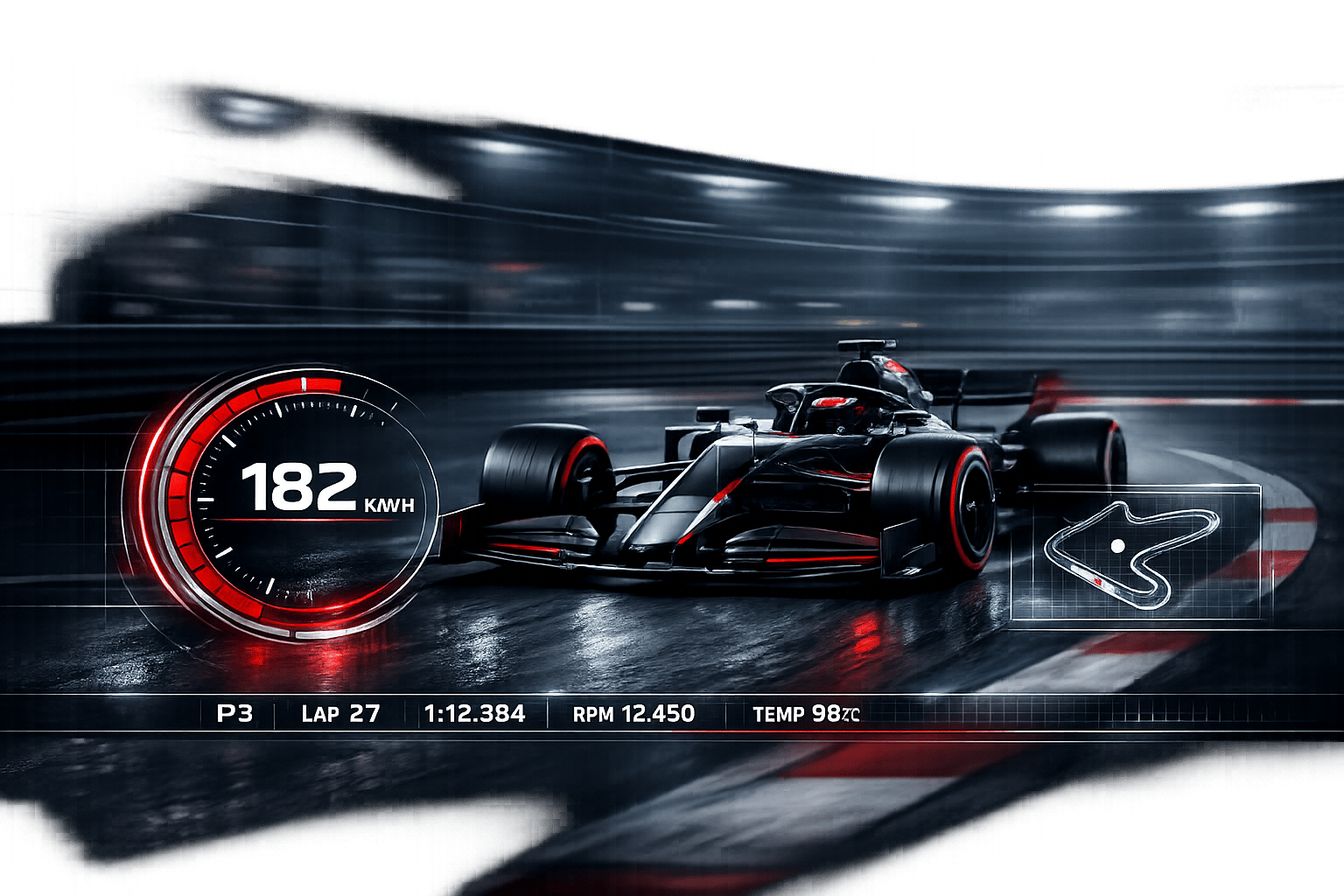
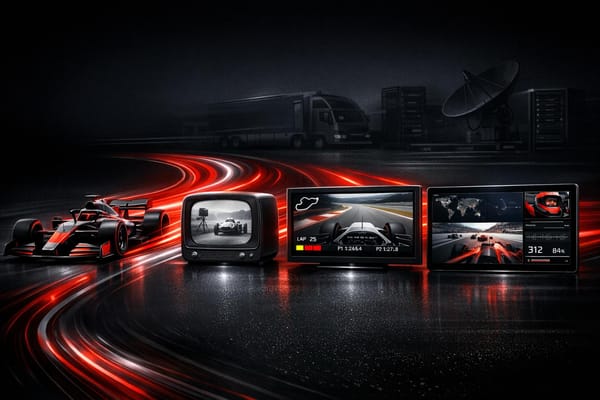
Formula 1 broadcasts have transformed with augmented reality (AR), offering fans an immersive way to experience races. AR overlays real-time data - like driver stats, speeds, and gap times - onto live footage, helping viewers better understand the action. Key innovations include:
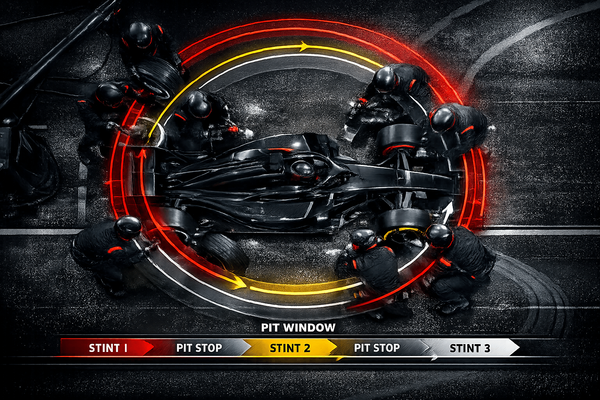
- Real-time graphics: Driver tagging, pit stop countdowns, and gap visualizations simplify complex race dynamics.
- Virtual studios: 3D models of cars, circuits, and drivers appear alongside presenters, powered by Unreal Engine.
- Remote production: Centralized systems at the UK-based Media and Technology Centre process 500TB of data per race, enabling seamless AR integration.
- Onboard cameras: Helmet cams and gyroscope views bring fans closer to the action, with AR overlays adding context.
- Interactive features: Fans engage through strategic "dilemma moment" graphics and touchscreen insights.
With Apple joining F1 broadcasting in 2026, AR is expected to combine with VR for even more personalized, interactive experiences. These advancements ensure fans stay connected to the sport's fast-paced drama and technical depth.
Ziggo Sport AR Storytelling - F1
Technologies Behind AR in F1 Broadcasts
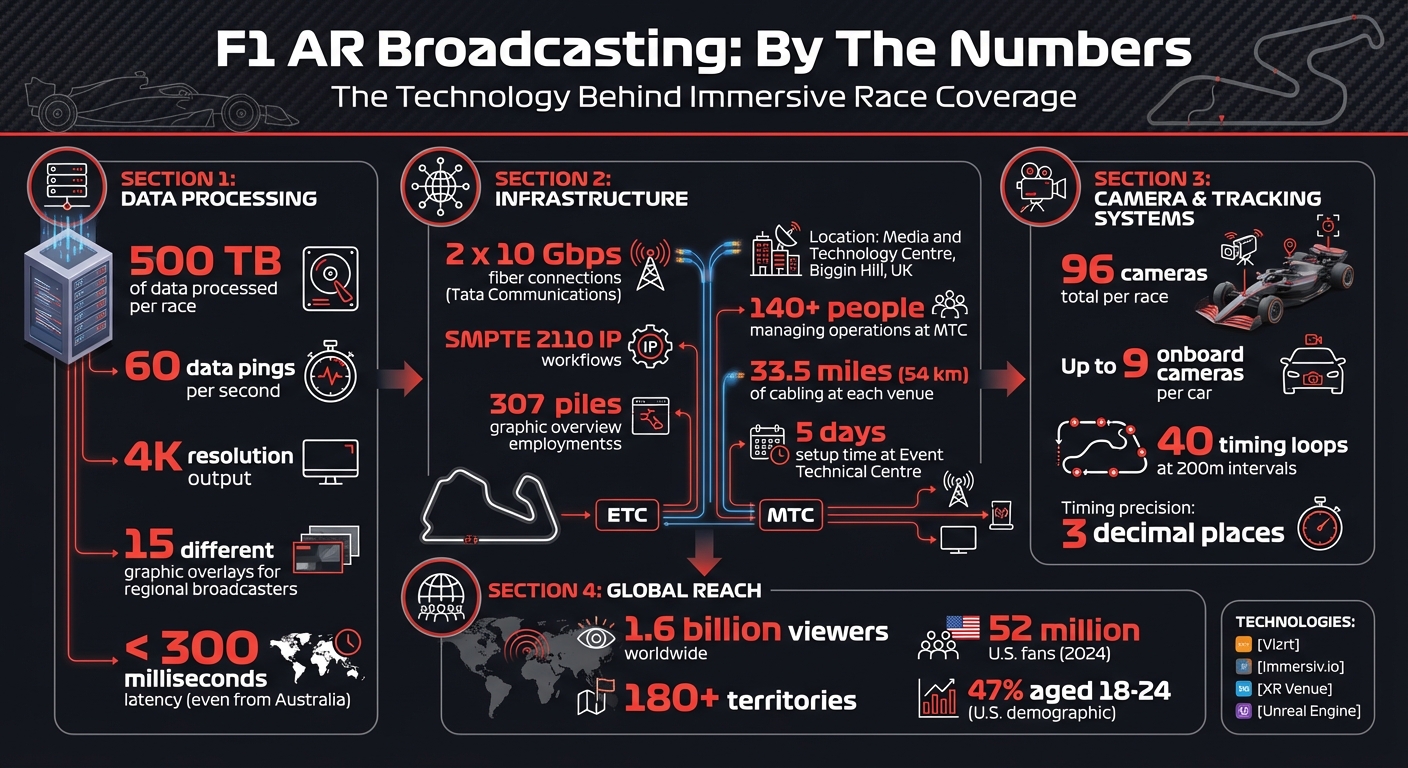
Formula 1 AR Broadcasting Technology: Key Statistics and Infrastructure
Formula One's augmented reality (AR) system operates through a centralized production hub located at the Media and Technology Centre (MTC) in Biggin Hill, UK. Instead of setting up equipment at every race circuit, this facility processes thousands of visual feeds and manages AR tracking remotely. The system handles an impressive 60 data pings per second in 4K resolution, generating up to 15 different graphic overlays customized for regional broadcasters worldwide.
The MTC has transitioned to SMPTE 2110 IP workflows, which streamline the handling of high-definition content. Two 10 Gbps fiber connections provided by Tata Communications transmit more than 500 terabytes of data from the track to the production hub with ultra-low latency - less than 300 milliseconds - even from circuits as far away as Australia. This robust setup allows broadcasters to seamlessly integrate real-time lap times, driver stats, and gap timings into live footage without noticeable delays. Tools like Vizrt, Immersiv.io, and XR Venue leverage this infrastructure to deliver engaging AR visuals.
Vizrt AR and Graphics Tools
Vizrt's AR technology powers the dynamic graphics seen during live races. It processes timing data from 40 timing loops placed at 200-meter intervals around each circuit. These loops ensure timing precision down to three decimal places. The graphics engine also integrates data from 96 cameras, including up to 9 onboard cameras per car, creating a synchronized view of every vehicle on the track.
"It's very complicated because there's 20 balls on a really large pitch all doing their own thing as opposed to football, where it's one ball, and a small pitch." – Dean Locke, Director of Broadcast and Media, Formula 1
Vizrt's platform also features AI-driven driver tagging, which automatically identifies and labels drivers during broadcasts. Additionally, it uses spatial interpolation to generate smooth slow-motion replays by filling in missing frames from standard footage. These tools transform raw telemetry into visuals that make the race action easier to follow and understand.
Immersiv.io for 3D Race Modeling
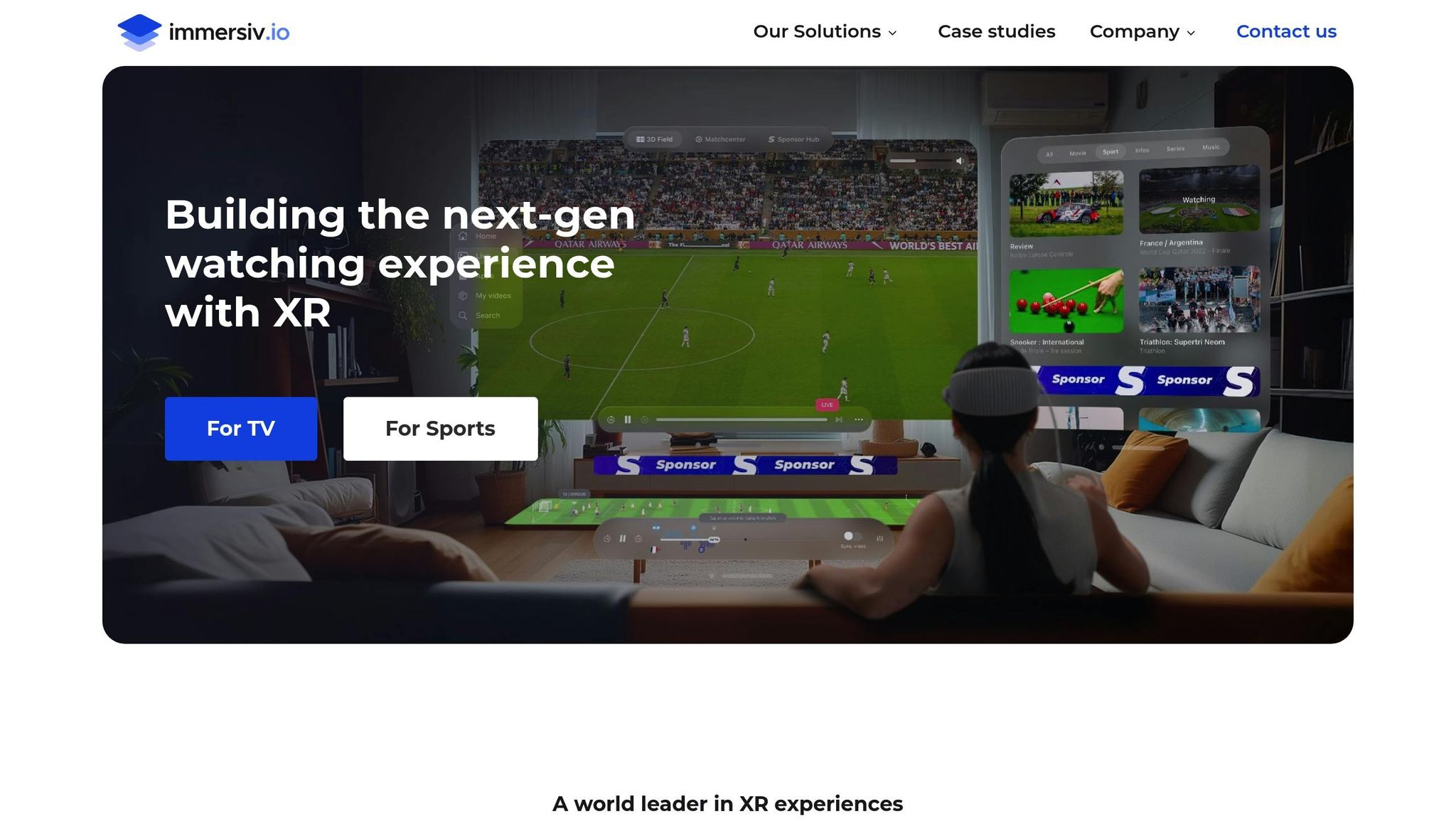
Broadcasters like wTVision use Unreal Engine to create lifelike 3D models of F1 cars, circuits, and drivers, which are displayed in studio settings. During the 2023 season, Sport TV incorporated these AR elements into their broadcasts, showcasing life-sized models of drivers and vehicles alongside presenters. These models respond dynamically to race developments, helping analysts visualize key strategies - such as tire selections or pit stop timing - in real time.
The integration of Unreal Engine also supports interactive features like "dilemma moment" graphics, where fans can vote on strategic decisions. After the race, analysts use AR overlays to break down these scenarios, giving viewers a deeper understanding of the technical aspects of F1. This blend of visuals and interaction enhances fan engagement and brings the intricacies of racing strategy to life.
XR Venue and Remote Production
AR tracking and RF control are centralized at the MTC, ensuring scalable and efficient operations. Dean Locke highlights the benefits of this approach:
"We've got the main RF control here now this season, so it's all managed centrally. That means we can keep track of who's using what frequency and make sure everything's working properly before it even gets to the track".
At the race venues, the Event Technical Centre (ETC) acts as the first collection point for footage and data, requiring five days of setup and 33.5 miles (54 km) of cabling. Meanwhile, a team of over 140 people at the MTC manages AR tracking, graphics rendering, and feed packaging. This centralized workflow eliminates the need to transport bulky equipment to each circuit, ensuring that AR technology is consistently deployed across all races. By simplifying complex race data into accessible visuals, this system helps viewers stay engaged and informed.
How AR Improves the F1 Viewing Experience
Augmented reality (AR) takes the intricate world of Formula 1 and translates it into real-time visuals that are easy to follow. With the broadcast system processing an impressive 60 data pings per second, AR ensures that every overlay aligns perfectly with the live feed. For F1's massive global audience of 1.6 billion viewers, this means a clearer window into race strategies and split-second decisions. By turning complex telemetry into visual aids, AR connects various broadcast features, making the action on track more accessible.
Real-Time Data Overlays and Graphics
AR overlays bring essential race data - like gear shifts, tachometer readings, and speeds - directly onto onboard displays. This makes the fast-paced cockpit activity easier for fans to grasp. One standout feature is the "piece of elastic" graphic, which tracks the time gap between a car in the pits and an approaching rival on the track. It’s a simple yet powerful way to visualize pit stop strategy as it happens.
"Maybe we can do a piece of elastic, so you've got a car comes in the pits and you're chasing the car coming around. It can feature the time ticking down between the two." – Dean Locke, Director of Broadcast and Media, Formula 1
Another fan-favorite is the "dilemma moment" graphic, which highlights strategic choices like whether a driver should pit for fresh tires. These data-driven visuals engage viewers by breaking down critical decisions in real time. Meanwhile, AI-powered driver tagging automatically identifies cars during multi-car battles, a feature that’s especially helpful when helmets and cockpits obscure the drivers.
Virtual Advertising
AR also opens up new possibilities for advertising. Broadcasters can replace physical trackside banners with region-specific digital ads, catering to different markets worldwide. For example, a sponsor displayed on a grassy run-off area might show one brand to viewers in the UK and a completely different one to audiences in the Middle East. This adaptability ensures consistent advertising revenue, even if on-track events block physical banners. In such cases, the broadcast team can digitally reinsert ads within 30 minutes.
Onboard Cameras with AR Integration
To complement these innovations, onboard cameras take fans even closer to the action. Each car is equipped with up to nine cameras, including helmet cams that offer a driver’s-eye view of steering inputs and track positioning. AR overlays on these feeds identify rivals and display their speeds, making overtakes and battles easier to follow. Gyroscope cameras keep the horizon level, emphasizing the circuit’s camber and the car’s lean. Broadcasters are also experimenting with cockpit camera angles, like pedal cams, which capture the precise footwork behind braking and acceleration during critical moments.
AR Implementation Examples from F1 Broadcasters
Broadcasters are using augmented reality (AR) to create more engaging experiences for Formula 1 fans. Let’s take a closer look at how Sky Germany and TSN are incorporating AR into their coverage to elevate storytelling.
Sky Germany's Remote AR Setups
Sky Germany has been leveraging a remote production model since 2017, with its broadcast gallery based at Sky's headquarters in Isleworth. This setup allows the network to produce high-quality AR content with just 45 on-site staff and a 20-person remote gallery team working from headquarters. The AR tracking and RF control are handled through F1's Media and Technology Centre (MTC), enabling advanced graphics and AR features.
"Back in 2017, we went remote, which means that the gallery is back at Sky. The main producer of the show is back at Sky, with the director, the visual mixer – you're probably looking at 20 people in the gallery as well." – Billy McGinty, Director of Formula One, Sky Sports
This collaborative setup spans Sky UK, Sky Germany, and Sky Italy, allowing AR-enhanced content, such as analysis and interviews, to be shared across regions. The results speak for themselves: Sky Sports F1 viewership in the UK and Ireland has grown by 60% since 2019, with 1.7 million of the 4.3 million new viewers being women. Sky Germany’s exclusive media rights through 2027 further solidify its position. This model not only streamlines operations but also brings fans closer to the action with real-time, immersive visuals.
TSN's Interactive AR Features
TSN takes a different approach, focusing on interactive AR to engage viewers. Through partnerships with wTVision and Mediapro Canada, TSN uses Unreal Engine to power photorealistic 3D models of F1 cars and circuits, synchronized with live race data. Presenters enhance this experience with interactive touchscreen systems, offering detailed insights into team and driver performance.
With F1 boasting a global audience of 1.6 billion viewers across 180+ territories, TSN’s AR tools make complex race dynamics easier to understand. These features give fans immediate, data-driven insights, aligning perfectly with F1's reputation for cutting-edge technology and innovation. By blending live data with immersive visuals, TSN ensures fans stay connected to the fast-paced world of Formula 1.
What's Next for AR in F1 Broadcasting
The future of augmented reality (AR) in Formula 1 broadcasting is being shaped by three key developments: Apple’s entry into F1 media rights, the merging of AR and virtual reality (VR) technologies, and the impact of the 2026 technical regulations, which promise to redefine how fans experience the sport on screen.
Apple Vision Pro and F1 Partnerships
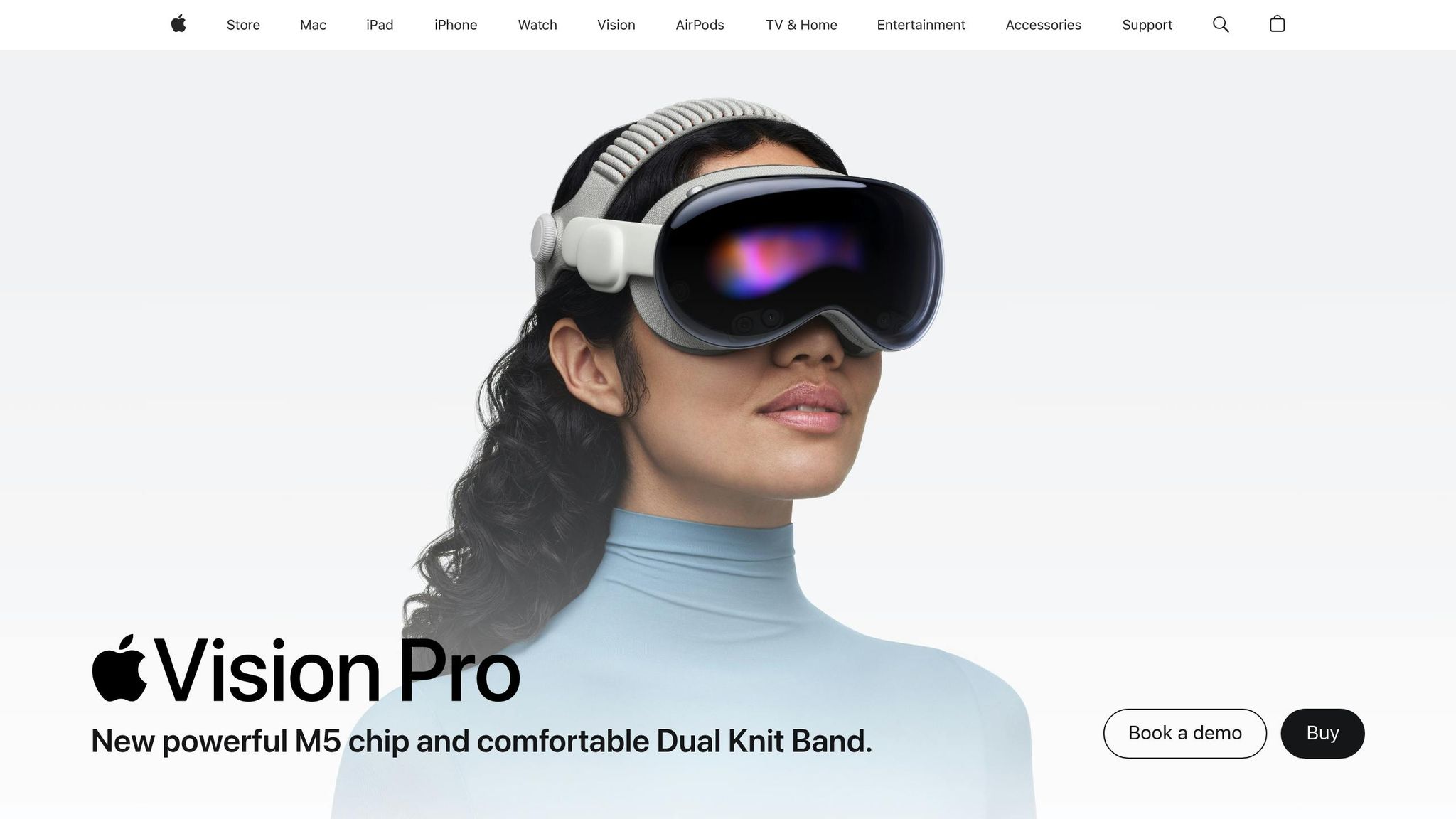
Apple has secured a five-year deal to become the exclusive U.S. broadcast partner for Formula 1 starting in 2026, with the media rights valued at around $140 million annually. This partnership introduces the Apple Vision Pro, launched in October 2025, which features a 23MP micro-OLED display running at 120 Hz - ideal for capturing the high-speed action of F1.
The Vision Pro offers fans a highly personalized viewing experience, often likened to a "personalized pit wall." Viewers can layer interactive camera angles, live telemetry, and driver POV streams into their surroundings. Additionally, Apple’s integration of F1 content across its ecosystem - spanning News, Maps, Music, and Fitness+ - creates a comprehensive fan experience. Eddy Cue, Apple’s Senior Vice President of Services, highlighted this in his statement:
"2026 marks a transformative new era for Formula 1... and we look forward to delivering premium and innovative fan-first coverage to our customers in a way that only Apple can".
Priced at $3,499, the Vision Pro will include free access to F1 TV Premium for Apple TV subscribers starting in 2026. With the U.S. F1 fanbase growing to 52 million in 2024 - 47% of whom are aged 18–24 - Apple’s strategy clearly caters to a younger, tech-savvy demographic. Future features may even include synchronized haptics via the Vision Pro or Apple Watch, letting fans physically "feel" the race as they watch.
As AR evolves, broadcasters are combining it with VR to push the boundaries of immersive F1 experiences.
Combining AR and VR for Live F1 Events
The blending of AR and VR is setting the stage for personalized, multi-screen viewing where fans control their own data streams independently of the main broadcast. According to F1’s broadcast leadership, live 360-degree views and tailored experiences are fast approaching.
With 96 cameras positioned across the grid (including up to nine onboard per car) and 500TB of data processed during each race weekend, F1’s infrastructure supports these innovations. Ultra-low latency transmissions make real-time AR/VR overlays possible. Broadcasters are already using tools like Unreal Engine to create lifelike virtual studios with dynamic 3D graphics. The next step? Extending these features to home AR/VR headsets, allowing fans to interact with live timing, telemetry, and even social media streams directly in their field of vision.
However, there are hurdles to overcome. Massive bandwidth requirements, hardware durability in extreme conditions, and ensuring these advanced features are user-friendly for casual viewers remain significant challenges.
2026 Regulations and AR Technology
The 2026 regulatory changes will further integrate AR into F1 broadcasting, transforming how technical data is presented. The new power units will feature a near 50/50 split between internal combustion and electric energy, with MGU-K power increasing from 120 kW to 350 kW. AR will play a crucial role in visualizing energy deployment, battery recharge, and systems like "Overtake Mode" and "Boost Mode", making these complex elements accessible to viewers.
Additionally, active aerodynamics will replace traditional DRS, with adjustable front and rear wings providing real-time visual cues. Broadcasters can use AR to distinguish between "Corner Mode" (high downforce) and "Straight Mode" (low drag) as they happen. Other updates include lighter cars - dropping from 1,764 lbs to 1,693 lbs - and enhanced safety structures, which AR can highlight during replays to illustrate car construction.
These advancements underscore AR’s growing importance in simplifying F1’s technical aspects while boosting fan engagement with clearer, more interactive visuals.
Conclusion
Augmented reality has reshaped the way Formula 1 is broadcast to its massive audience of around 1.6 billion viewers worldwide. What was once static coverage has now become an interactive experience, where real-time data and AI-powered visuals pull fans closer to the heart of the action. This shift is paving the way for broadcasts that are even more tailored and engaging in the future.
The technology processes vast amounts of race data, transforming it into compelling visual narratives. Dean Locke, Director of Broadcast and Media at Formula 1, summed it up perfectly:
"We are storytellers... editorially, we're looking out for battles, action, that's why people tune into the sport, because of the drama."
Looking ahead, AR could allow fans to take control of their viewing experience by customizing graphics and data streams. Instead of relying solely on the main broadcast feed, viewers might soon have the ability to create their own overlays, making each race feel personal and interactive.
As AR continues to develop, Formula 1 broadcasts will push beyond traditional coverage, offering fans a richer and more immersive experience. The sport's strategy, drama, and cutting-edge technology will feel closer than ever, keeping fans deeply engaged with every twist and turn on the track.
FAQs
How does augmented reality improve Formula 1 broadcasts?
Augmented reality (AR) is changing the way fans experience Formula 1 by adding immersive visuals and real-time data to broadcasts. With AR, viewers get instant access to key details like car performance stats, driver positions, and track layouts, making the sport’s technical side much easier to follow.
Broadcasters use AR to bring the race to life with realistic visuals of cars, drivers, and circuits. These dynamic representations help highlight pivotal moments during the race, offering fans new perspectives that traditional broadcasts can’t match. AR also introduces interactive data displays, giving fans a deeper understanding of team strategies and driver decisions. By blending in-depth analytics with visually captivating elements, AR transforms the storytelling of Formula 1, creating a stronger connection between viewers and the high-speed action on the track.
How does the Media and Technology Center enhance AR broadcasts in Formula 1?
The Media and Technology Center (MTC) serves as the nerve center for Formula 1's augmented reality (AR) broadcasting efforts. From holographic car models to real-time weather updates and track layouts, the MTC integrates these AR elements seamlessly into live race coverage. The result? A viewing experience that’s not only visually striking but also deeply engaging, bringing fans closer to the action.
Nestled in Biggin Hill, the MTC operates with cutting-edge tools like IP workflows and UHD capabilities. These technologies power AR tracking and remote system coordination with precision. With over 300 monitors and a vast array of visual sources, the MTC ensures every broadcast is packed with immersive, high-quality content that elevates the storytelling and visual appeal of Formula 1 races.
How could Apple's involvement in F1 broadcasting shape the use of AR and VR technologies?
Starting in 2026, Apple will become the exclusive U.S. broadcast partner for Formula 1, and this partnership is set to transform how fans experience the sport. With its reputation for pushing tech boundaries, Apple is expected to bring augmented reality (AR) and virtual reality (VR) to a whole new level in race coverage.
Formula 1 already uses AR for features like real-time data overlays and AI-enhanced replays. But with Apple's expertise, fans could gain access to even more advanced tools. Imagine real-time driver stats, interactive race strategy breakdowns, and immersive VR experiences that make you feel like you're right in the middle of the action - whether you're at home or trackside.
This collaboration not only highlights Formula 1's dedication to staying ahead of the curve but also offers a peek at how sports broadcasting could evolve in the years to come.