Benchmarking Driver Mental Performance
F1 teams measure and train drivers' cognition, stress response, processing speed and endurance using neurofeedback and biometric monitoring.
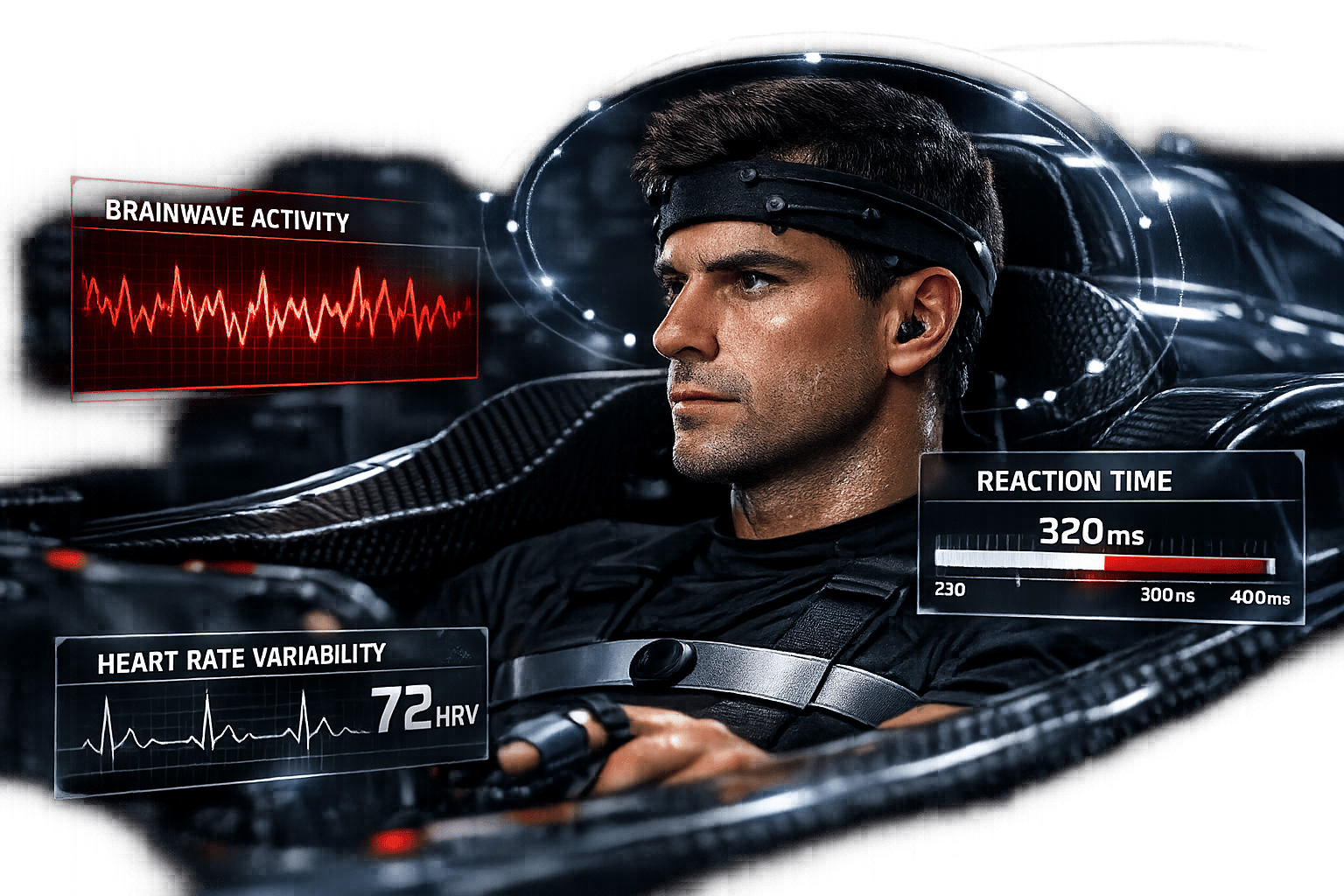
Formula 1 teams are no longer just about fast cars - they’re also about sharp minds. Drivers need to process data at 186 mph, endure 5g forces, and maintain focus for 90 minutes. To measure this, teams use advanced tools like eye-tracking glasses and heart rate monitors. Key metrics include:
- Cognitive Load: How much info a driver can handle.
- Processing Speed: Reaction times measured in milliseconds.
- Stress Response: Decision-making under pressure.
- Mental Endurance: Sustaining focus over a race.
Each team has its own approach:
- Red Bull: Focuses on neurofeedback and recovery techniques, helping drivers like Max Verstappen perform under pressure, as seen in his climb from 17th to 1st in São Paulo 2024.
- Mercedes: Uses routine anchoring to turn nerves into precision, with drivers excelling in high-stakes moments.
- Ferrari: Tracks pupil dilation and uses breathing techniques to manage stress and prevent errors.
- McLaren: Prioritizes mental health and uses meditation to sharpen focus, as demonstrated by Lando Norris.
These strategies highlight how mental performance is becoming as important as engineering in Formula 1.
1. Red Bull Drivers
Cognitive Load Metrics
Red Bull employs advanced techniques to gauge how much information their drivers can handle under pressure. By tracking heart rate variability (HRV) and stress hormone levels, the team gets a clear picture of how a driver's nervous system responds during races. Performance coaches use this biometric feedback to pinpoint "optimal focus patterns" - those physiological markers that show when a driver is in their peak mental state. Drivers are also trained to transition seamlessly between the intense focus required for qualifying laps and the broader situational awareness needed for wheel-to-wheel battles on the track.
These insights lay the groundwork for understanding how processing speed plays a role in performance.
Processing Speed Benchmarks
To boost reaction times, Red Bull incorporates drills like flashing light exercises, designed to fine-tune a driver's ability to respond quickly. A striking example is the 2025 Japanese Grand Prix, where Max Verstappen secured pole position with a razor-thin margin of +0.012 milliseconds. Another tool in their arsenal is "Tunnel Vision training", which helps drivers filter out irrelevant sensory inputs, allowing them to focus exclusively on critical data during high-pressure maneuvers like overtaking.
Physiological Stress Indicators
Beyond cognitive metrics, Red Bull monitors how drivers regulate their nervous system states during different phases of a race. During qualifying, drivers tap into their sympathetic nervous system, which triggers increased heart rate, rapid breathing, and heightened alertness - key for achieving peak performance. However, sustaining that intensity for an entire race isn't feasible. To maintain endurance, drivers activate their parasympathetic system by practicing deep, rhythmic breathing during straights or safety car periods. Dr. Sarah Martinez, a sports psychologist, explains:
"Qualifying is like sprinting with your mind. You need that surge of adrenaline, that razor-sharp focus. But if you try to maintain that intensity for 90 minutes in a race, you'll burn out mentally and physically."
Mental Endurance and Resilience
A standout example of mental endurance came during the November 2024 São Paulo Grand Prix. Max Verstappen, starting 17th on the grid in wet conditions and amidst a championship battle, executed a masterful drive to claim victory over competitors like Esteban Ocon. Red Bull's Junior Team uses tools like neurofeedback and biometric monitoring to prepare drivers for high-pressure scenarios like qualifying while also helping them sustain composure during the race. These strategies give Red Bull a distinct edge in mental performance, a critical factor in the competitive world of Formula 1.
2. Mercedes Drivers
Cognitive Load Metrics
Mercedes, much like Red Bull, taps into biometric data to fine-tune their drivers' cognitive performance. Using advanced systems, they monitor how drivers handle the immense flow of information during a race. Key metrics include heart rate variability (HRV) and stress hormones like cortisol and adrenaline, which reveal how drivers respond to high-pressure scenarios.
Lewis Hamilton has described his mental state during qualifying as "controlled chaos." Instead of trying to suppress nerves, he uses a method called "routine anchoring" to channel adrenaline into sharp, focused performance during pivotal moments. These insights offer a window into how Mercedes drivers manage the intense mental demands of the sport.
Processing Speed Benchmarks
Racing at speeds over 186 mph (300 km/h), Mercedes drivers act as real-time data processors. They constantly interpret sensor data, assess vehicle performance, and adapt to track conditions. Meanwhile, the pit wall operates as a command center, delivering precise, predictive instructions to reduce cognitive strain during critical moments. Even under the stress of wheel-to-wheel battles, drivers maintain strong prefrontal cortex function, enabling them to execute complex strategies like undercuts without hesitation.
Physiological Stress Indicators
The extreme physical demands of Formula 1 racing also create significant mental challenges. These conditions activate the hypothalamus-pituitary-adrenal axis, leading to spikes in stress hormones.
Hamilton has openly discussed the emotional toll of maintaining peak performance, stating:
"I have struggled mentally and emotionally for a long time, to keep going is a constant effort".
This acknowledgment reflects a growing recognition in the sport of the importance of mental health. To support their drivers, Mercedes employs tactical breathing techniques. Quick, sharp breaths are used to boost focus during qualifying, while deep, steady breathing helps sustain endurance during long races. These methods help drivers shift between high alertness and recovery, ensuring they stay composed under pressure.
Mental Endurance and Resilience
Mistakes are inevitable in a sport as fast-paced as Formula 1, but Mercedes drivers are trained to compartmentalize errors. For instance, if a driver locks up the brakes or misses an apex, they conduct a quick mental review and categorize the mistake as "past data", allowing them to stay focused on the present lap. Additionally, they reframe high-pressure situations - like unexpected weather changes or safety car deployments - as opportunities to gain a strategic advantage rather than setbacks. This ability to adapt, supported by personal rituals honed over years, gives Mercedes drivers a mental edge that directly impacts their performance on the track.
Charles Leclerc on F1 Mental Training 🧠 | How He Handles Pressure Before the Race
3. Ferrari Drivers
Ferrari drivers, like those at Red Bull and Mercedes, undergo rigorous evaluations to test their mental sharpness and ability to thrive under pressure. However, Ferrari takes a unique approach by incorporating specific biometric indicators into their assessments.
Cognitive Load Metrics
Ferrari uses pupil dilation as a key measure to evaluate cognitive load. By observing changes in a driver's pupils, engineers can identify moments of mental strain or potential lapses in decision-making. Dr. Zoe Wimshurst, Owner of Performance Vision, elaborates:
"Through analyzing pupil dilation, we can understand the level of cognitive load a driver is facing and therefore get a better understanding of when they might be at risk of poor decision making".
In addition to tracking pupil activity, Ferrari monitors heart rate variability (HRV) and stress hormone levels to understand how drivers handle high-pressure situations. The team also evaluates visual skills, such as peripheral awareness, reaction time, and saccadic eye movements, to set clear performance benchmarks. These insights help Ferrari drivers make precise, split-second decisions during races.
Processing Speed Benchmarks
Ferrari drivers must process an immense amount of information while traveling at speeds over 186 mph (300 km/h). Modern F1 transmissions shift gears in just 2–3 milliseconds, demanding near-instantaneous coordination. Drivers also endure extreme physical forces - 5–6g during braking and up to 6.5g during high-speed cornering.
The mental agility required varies between qualifying sessions, where quick bursts of focus are essential, and race conditions, which demand sustained concentration. Legendary Ferrari drivers like Michael Schumacher and Sebastian Vettel were known for their ability to elevate their mental performance during critical moments.
Physiological Stress Indicators
On top of processing data at lightning speed, Ferrari drivers face grueling physical conditions that test their mental resilience. Cockpit temperatures can soar to 122°F (50°C), while forces of up to 5g can make breathing difficult and impact blood flow to the brain. Research shows that increased core body temperature can impair hand-eye coordination and overall vigilance.
A vivid example occurred during the 2024 Qatar Grand Prix when Charles Leclerc experienced severe heat stress after his car's drink system failed. This incident highlighted the importance of hydration in maintaining mental stamina. Ferrari also monitors the hypothalamic-pituitary-adrenal (HPA) axis to track cortisol levels. While short-term cortisol spikes can enhance alertness, prolonged elevation may dull the brain's stress response. To counteract this, drivers practice tactical breathing techniques to keep their prefrontal cortex functioning effectively, even as their heart rates spike during intense battles on track.
Mental Endurance and Resilience
Ferrari drivers are trained to regulate their autonomic nervous system, toggling between heightened alertness during intense moments and recovery during less demanding periods, such as straights or safety car laps. Dr. Sarah Martinez explains:
"The best race drivers I've worked with describe it as being 'in the flow.' They're highly alert but not tense, focused but flexible enough to adapt to changing circumstances".
Pre-race routines, including meditation and specific self-talk techniques, help Ferrari drivers consistently tap into their peak mental states, ensuring they remain sharp and adaptable throughout the race.
4. McLaren Drivers

McLaren, like other leading teams, prioritizes mental performance to stay competitive. Their strategy involves embracing transparency and leveraging modern psychological tools. For instance, Lando Norris openly uses Headspace to manage nerves and improve sleep - an approach that contrasts with rivals who may see such admissions as vulnerabilities.
Cognitive Load Metrics
McLaren drivers experience intense mental demands both on and off the track. Norris has spoken about the pressure of representing "a thousand people at the factory", a responsibility that doesn't exist in junior racing categories. On the track, drivers must process a constant stream of sensor data while racing at over 186 mph (300 km/h). These challenges provide crucial insights into how McLaren drivers handle high-pressure situations and maintain focus.
Processing Speed Benchmarks
To perform at their best, McLaren drivers train for cognitive flexibility, helping them adapt between laser-focused qualifying laps and the broader awareness required for close racing. During the September 2025 Japanese Grand Prix qualifying, McLaren came within 0.012 milliseconds of pole position. Norris demonstrated this mental adaptability at the April 2021 Emilia Romagna Grand Prix. After a qualifying mistake cost him a better grid position, he used mental reset techniques to recover and finish third - his second F1 podium. He credited his meditation practices and a "much clearer" mindset for his ability to process the error quickly and prevent it from spiraling into further mistakes. This ability to compartmentalize errors as "past data" is key to avoiding cascading setbacks during races.
Physiological Stress Indicators
McLaren carefully monitors physiological data to understand and manage mental strain. Key metrics include heart rate - drivers maintain around 90% of their maximum during a 90-minute race - and core body temperature, which can affect cognitive performance under extreme physical stress. Drivers endure forces of up to 5g during cornering, which adds to the strain. To combat heat-related cognitive fatigue, Oscar Piastri uses ice baths before sessions to lower his core temperature and sharpen focus. Nutritional health is also closely watched; during his 2022 McLaren season, Daniel Ricciardo faced anxiety-induced appetite loss, which left him underweight and underscored how mental stress can manifest physically.
Mental Endurance and Resilience
McLaren drivers use specific techniques to maintain mental endurance. Tactical breathing is a key tool: quick, shallow breaths help boost focus during qualifying, while deep, rhythmic breathing aids sustained attention during races. After the 2025 Bahrain Grand Prix, Norris employed self-talk and debriefing techniques to separate the adrenaline of the race from his post-race analysis. By openly discussing mental health, Norris also breaks down the "robotic" image often associated with F1 drivers, making the sport more relatable and human.
Strengths and Weaknesses
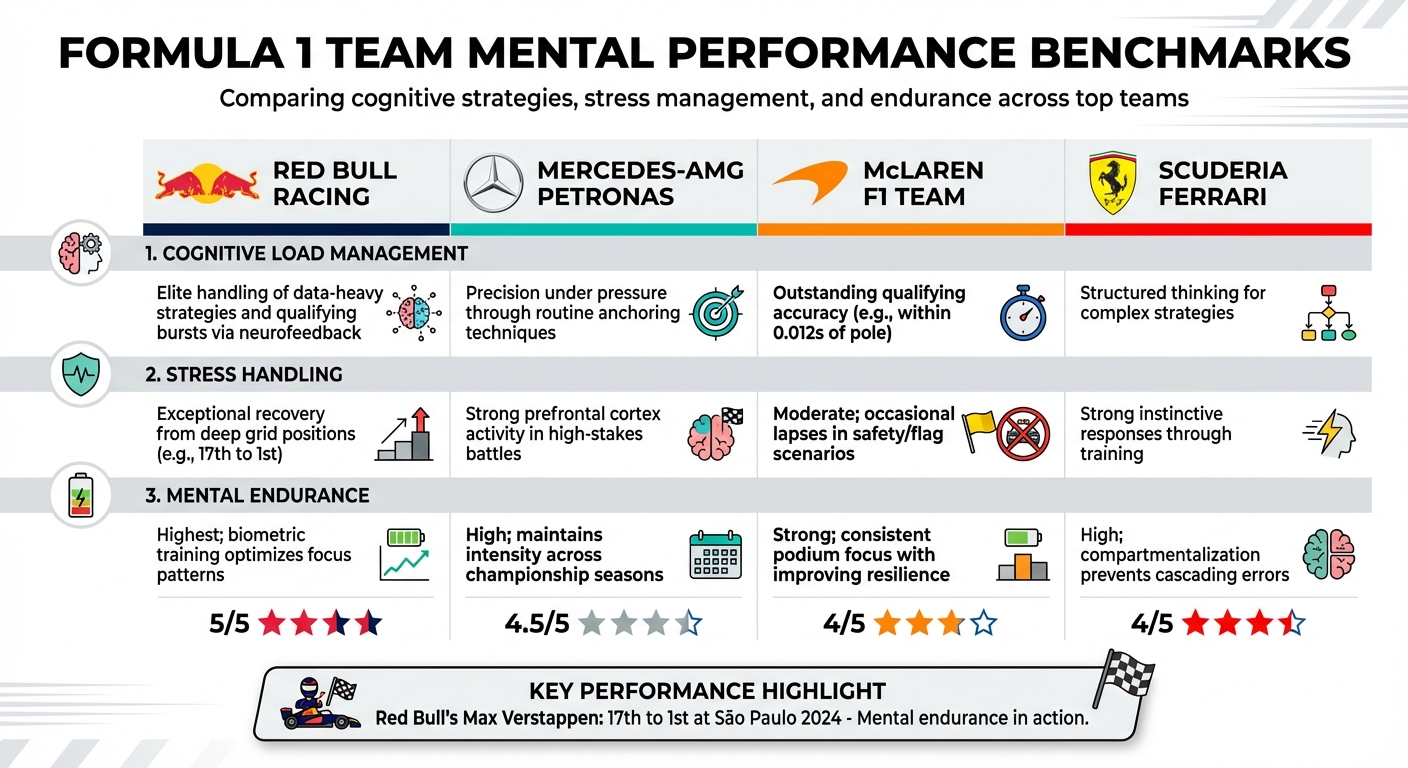
F1 Team Mental Performance Comparison: Red Bull vs Mercedes vs McLaren vs Ferrari
Building on earlier insights into cognitive load, stress response, and mental endurance, each team demonstrates specific mental capabilities and challenges. Here's a breakdown of their performance, supported by key race examples.
Red Bull drivers exhibit exceptional mental endurance, seamlessly transitioning between the intensity of qualifying and the composure needed during races. Max Verstappen’s incredible win at the November 2024 São Paulo Grand Prix - where he surged from 17th to 1st in wet conditions - is a prime example of superior focus management under pressure. Their advanced neurofeedback systems play a critical role in aiding recovery during high-stress moments.
Mercedes drivers thrive under pressure, converting nerves into precise, high-stakes performance. Their use of routine anchoring techniques and strong prefrontal cortex activity ensures consistent results during intense battles.
McLaren drivers shine in qualifying precision, as shown by their near-pole performance at the September 2025 Japanese Grand Prix, missing out by just 0.012 seconds. However, moments like Lando Norris’s ten-second stop-go penalty at the 2024 Qatar Grand Prix - caused by failing to slow under double-waved yellow flags - reveal occasional decision-making lapses when cognitive load peaks.
Ferrari emphasizes mental stamina through compartmentalization techniques, enabling drivers to isolate errors and avoid cascading mistakes. Tactical breathing exercises further support their ability to maintain concentration over long periods.
The table below summarizes these findings with clear benchmarks.
| Team | Cognitive Load Management | Stress Handling | Mental Endurance |
|---|---|---|---|
| Red Bull | Elite handling of data-heavy strategies and qualifying bursts via neurofeedback | Exceptional recovery from deep grid positions (e.g., 17th to 1st) | Highest; biometric training optimizes focus patterns |
| Mercedes | Precision under pressure through routine anchoring techniques | Strong prefrontal cortex activity in high-stakes battles | High; maintains intensity across championship seasons |
| McLaren | Outstanding qualifying accuracy (e.g., within 0.012s of pole) | Moderate; occasional lapses in safety/flag scenarios | Strong; consistent podium focus with improving resilience |
| Ferrari | Structured thinking for complex strategies | Strong instinctive responses through training | High; compartmentalization prevents cascading errors |
Conclusion
Red Bull Racing has set a high standard in mental performance benchmarking, utilizing advanced tools like neurofeedback, biometric monitoring, and specialized coaching. Their commitment isn’t limited to current drivers; the Red Bull Junior Team equips young talents like Isack Hadjar and Arvid Lindblad with psychological training well before their Formula 1 careers begin, ensuring they’re mentally prepared for the challenges ahead.
Max Verstappen’s incredible climb from 17th to 1st in the wet conditions of the November 2024 São Paulo Grand Prix is a prime example of how exceptional focus and mental resilience can turn adversity into triumph. Similarly, Mercedes drivers and McLaren’s sharp qualifying performances underscore how mental state management can directly influence race results.
When comparing teams, it’s clear that their varied strategies for managing mental performance play a pivotal role in determining success on the track. The ability to seamlessly transition between mental states - such as the laser focus required for qualifying and the sustained intensity needed during a race - sets top contenders apart. From Red Bull’s early psychological grooming to Ferrari’s precise handling of errors, these approaches highlight the critical role mental preparation plays alongside technical innovation.
As Formula 1 continues to evolve, it’s evident that future championship battles will hinge not only on engineering brilliance but also on the mental readiness cultivated long before race day. These psychological strategies are becoming an essential component of what defines a champion.
FAQs
How do F1 teams measure a driver’s cognitive load?
F1 teams use advanced eye-tracking technology to measure a driver’s cognitive load during both simulator sessions and real-time evaluations. This technology monitors eye movements to gauge how drivers process visual information and allocate mental resources under intense pressure. By pairing this data with physiological metrics, teams gain deeper insights into a driver’s mental workload, detect signs of fatigue, and fine-tune performance strategies for critical moments like qualifying laps or tight racing battles.
What’s the difference between qualifying focus and race focus?
The key distinction comes down to how drivers mentally prepare and prioritize. Qualifying focus is all about delivering maximum performance in a short, high-stakes session. It demands sharp concentration and pinpoint precision. On the other hand, race focus is a marathon of mental endurance. Drivers need to stay calm, manage their emotions, and make smart, strategic choices over an extended period while handling fatigue and adapting to constantly changing race conditions. Each requires a unique set of mental skills tailored to its challenges.
Can mental training really change race results?
Yes, mental preparation plays a major role in Formula 1 race outcomes. Drivers who develop mental toughness and sharpen psychological skills are better equipped to handle the intense pressure of racing. Techniques such as emotional control, tactical breathing, and reframing stress allow them to stay calm, focused, and make split-second decisions when it matters most. These strategies help drivers maintain peak performance during high-stakes moments, directly influencing their results on the track.