How F1 Chief Strategists Make Race Decisions
F1 races are won by strategists who blend millions of simulations, live telemetry, AI, and driver intuition to make split‑second pit and tire calls.
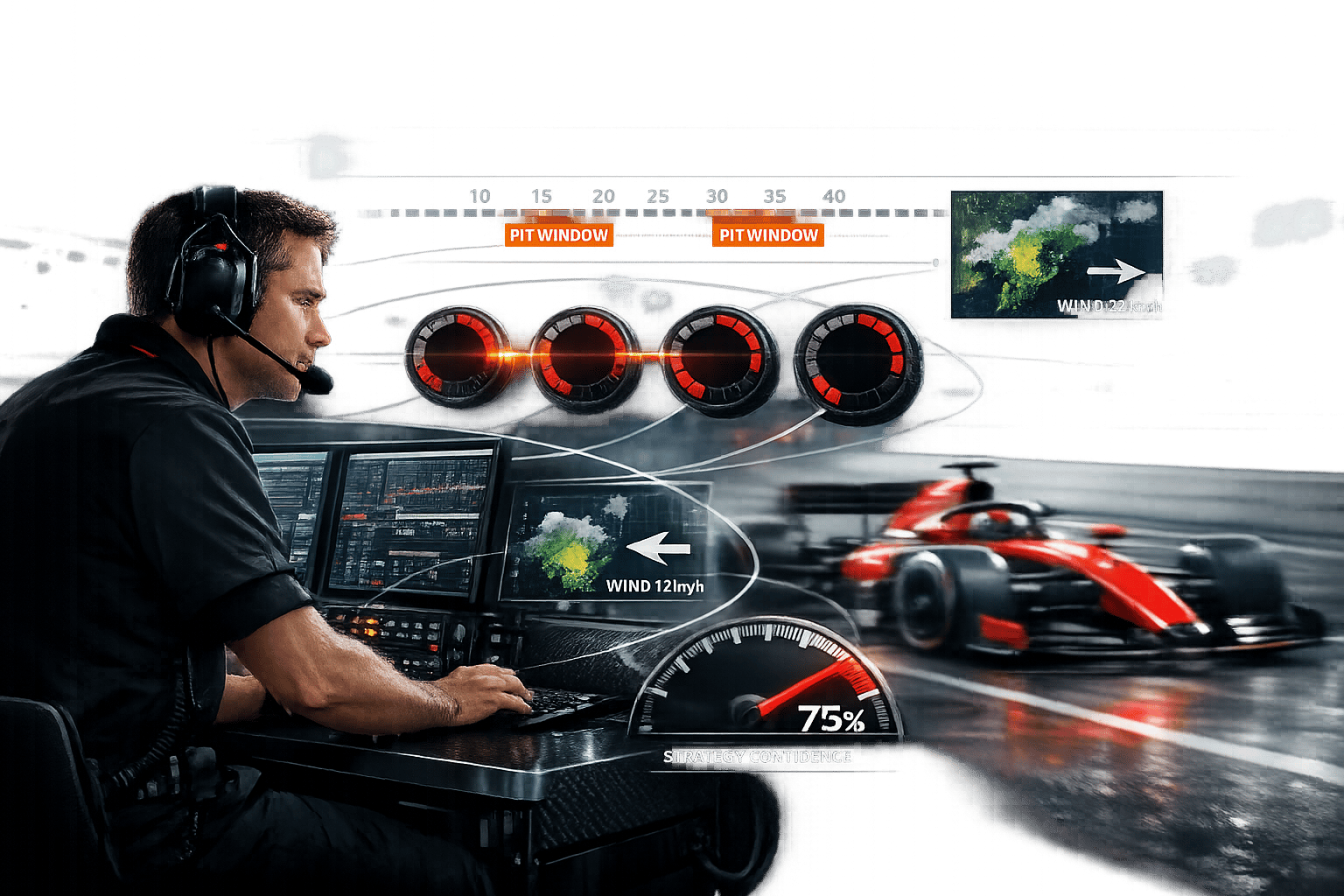
F1 Chief Strategists are the masterminds behind race outcomes. They use advanced simulations, analyze millions of data points, and make split-second decisions to give their teams a winning edge. Here’s how they do it:
- Pre-Race Prep: Tire selections start months ahead. Teams run up to 30 million simulations to prepare for every scenario.
- Race Day Execution: Strategists monitor live data from 300+ sensors per car, manage pit stops, and adjust plans for events like Safety Cars or weather changes.
- Real-Time Tools: AI and remote control centers help process over 1 terabyte of data during a race weekend.
- Post-Race Analysis: Teams review decisions, refine models, and use insights to improve future strategies.
The balance of data, driver feedback, and quick thinking defines their success. Whether it’s a bold undercut or a perfectly timed pit stop, their decisions can make or break a race.
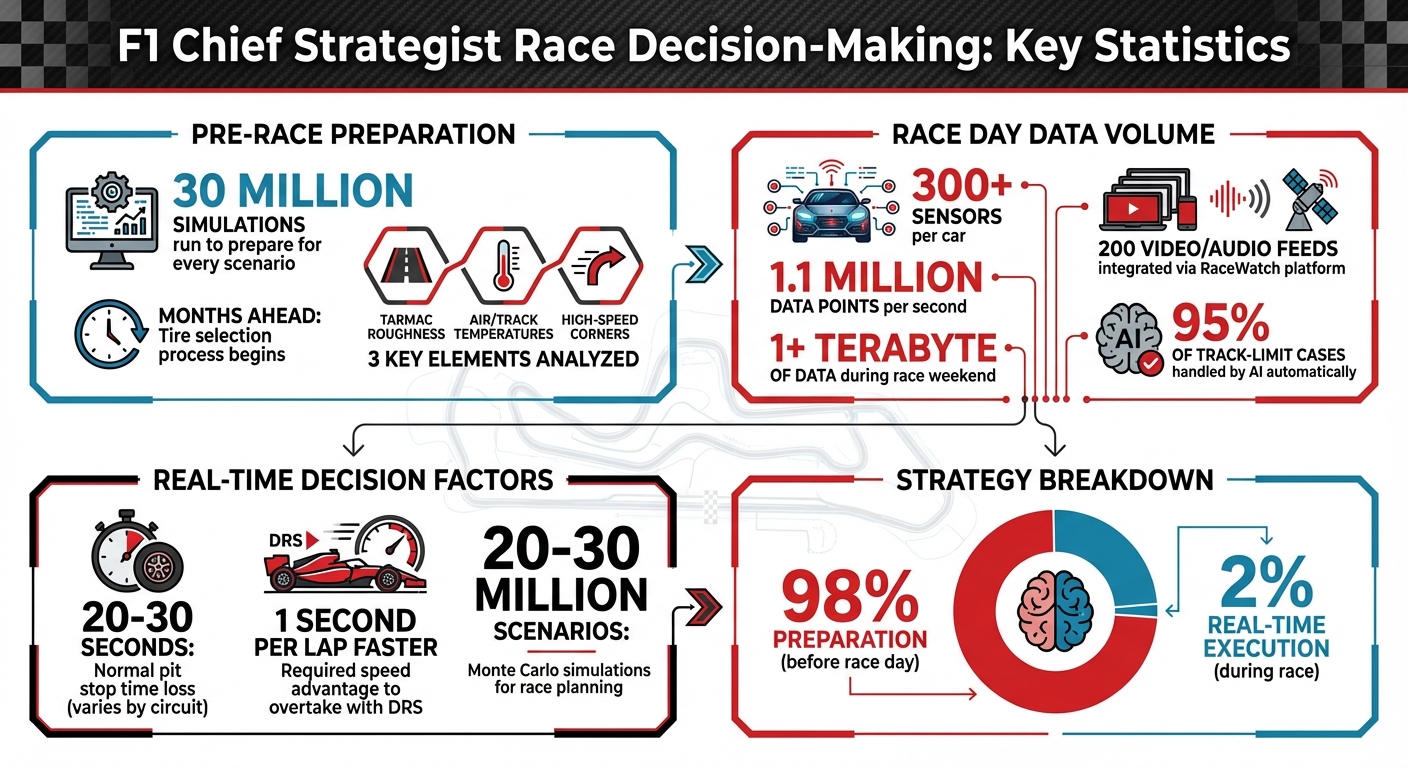
F1 Race Strategy by the Numbers: Data, Sensors, and Simulations
Pre-Race Preparation: Building the Strategy
Analyzing Track and Weather Data
Before the lights go out, strategists dive deep into the factors that influence tire performance. Tom McCullough, Performance Director at Aston Martin, highlights three key elements: tarmac roughness, which affects abrasion; air and track temperatures, which can speed up tire wear; and the number of high-speed corners that put stress on the rubber. A close look at the track surface is especially important - brand-new circuits tend to have different grip levels and wear patterns compared to older, more weathered tracks.
But it’s not just about the track. Weather plays a huge role, and it’s more than just watching for rain. Teams keep a close eye on wind speed and direction. Why? Sudden gusts can throw cars off balance in specific corners. A perfect example of this occurred during the May 2022 Spanish Grand Prix when Max Verstappen went off-track at Turn 4 due to an unexpected gust. Red Bull had to completely rethink their approach, opting for a three-stop strategy. They calculated that the 21-second pit stop loss could be offset by pushing harder on fresh tires in the scorching heat.
Even the layout of the pit lane itself can make or break a strategy. Some circuits, like Spa-Francorchamps, have a pit lane that minimizes time loss because it cuts through the La Source hairpin. Meanwhile, Monza’s pit lane costs more time since cars on the main straight zoom past at top speed. These small but critical details are factored into the broader strategy, helping teams build robust simulation models.
Running Multiple Race Simulations
Once the track, weather, and pit lane data are in, teams feed this information into simulation models to explore every possible race scenario. They start by creating a "baseline" strategy, which is essentially the fastest route to the finish line if no rivals or unexpected events interfere. As Tom McCullough puts it:
"You feed the data into your system and ask, 'Without rivals, what's the fastest route to the finish?'"
The real magic, however, comes from Monte Carlo simulations. These models account for variables like rival strategies, safety car probabilities, and tire behavior. Randeep Singh, Racing Director at McLaren, explains their approach:
"We run simulations that sweep across different tyre behaviours, pit losses, strategies for competitors and ourselves that use a quasi-Monte Carlo method to give us more information about our baseline strategies"
These simulations help teams identify "triggers" - specific conditions that signal when to shift from Plan A to an alternative strategy.
A great example of this was the April 2018 Chinese Grand Prix. Red Bull Racing had pre-planned triggers for a potential safety car scenario. When it was deployed on Lap 31, their strategists had already decided to pit both cars if such an event occurred. Without waiting for new instructions, Daniel Ricciardo and Max Verstappen pitted immediately, and Ricciardo went on to win the race. The groundwork for that decision was laid before the race even began.
Working with Engineers and Drivers
All the data and simulations in the world won’t matter if the team can’t communicate effectively. Strategists, engineers, and drivers work together to turn complex analysis into clear, actionable commands. Race engineers act as the bridge, simplifying information for drivers over the radio.
The goal is to make decisions seamless. Before the race, teams agree on pre-defined triggers so drivers can react instantly without waiting for further instructions. As Ruth Buscombe, Senior Strategy Engineer at Alfa Romeo, explains:
"Before the race, we've taken all the different scenarios and distilled them into clear messages for the drivers... They don't suddenly have to worry about the numbers because we've done all the work in advance"
Drivers also bring something to the table that no amount of data can replicate: real-time feedback. They can sense subtle vibrations, grip changes, or how the car feels under varying conditions. Free Practice 2 (FP2) is especially valuable for gathering this kind of feedback. Held at the same time of day as the race, FP2 gives teams a chance to test tire performance, understand degradation, and see how the car handles as it burns fuel and gets lighter. By Saturday night, teams use this information to fine-tune their baseline strategy, setting the stage for race day.
Real-Time Decision-Making During a Race
Using Real-Time Data and Monitoring Tools
When the race kicks off, strategists dive into a flood of data. Each Formula 1 car, equipped with around 300 sensors, churns out over 1.1 million data points per second, adding up to more than 1 terabyte of raw data during a race weekend. And this data isn’t just about engine RPM or tire temperature - it digs deeper, covering brake pressure, steering angles, GPS positions, and even driver biometrics like pulse and oxygen levels transmitted through their gloves.
Interestingly, most of these decisions aren’t made trackside. Teams rely on remote control centers, typically located at their factory headquarters, far away from the chaos of the pit wall. These centers boast powerful computing systems, high-speed internet, and a calm environment where engineers can analyze data and run simulations without distraction. The introduction of real-time data streaming platforms like Apache Kafka has been a game-changer. These systems act as the team’s "central nervous system", delivering crucial insights in milliseconds instead of minutes.
To make sense of this overwhelming data, AI and machine learning step in. These technologies can predict tire wear, detect mechanical issues before they escalate, and spot undercut opportunities faster than any human could. Tim Goss, Chief Technical Officer at VCARB, sums it up perfectly:
"Every lap teaches us something new, and the faster we can learn, the better we get".
This speed and precision become critical when unexpected events force teams to make split-second decisions.
Responding to Safety Cars, Weather, and Incidents
Races rarely go according to plan. Crashes, safety cars, and sudden weather changes can throw even the best strategies into chaos. That’s where tools like the RaceWatch platform, developed by the FIA and Catapult, come into play. This system integrates about 200 video and audio feeds, including CCTV, onboard cameras, and team radios, giving strategists a comprehensive view of the race. AI-driven features automatically flag incidents and handle around 95% of track-limit cases, leaving only the trickiest scenarios for human review.
Safety cars, in particular, can flip a race on its head. Normally, a pit stop costs between 20 and 30 seconds, depending on the circuit layout. But when the field slows behind a safety car, that time penalty shrinks dramatically. Strategists must quickly decide whether to pit, calculate who their driver will compete against after the restart, and factor in how quickly the tires will heat up. These decisions often reflect the extensive simulations and preparations done before the race.
A perfect example of this came during the British Grand Prix in July 2019. The Mercedes-AMG Petronas team used real-time tire wear data and competitor gap analysis to execute a flawless pit stop for Lewis Hamilton during a safety car period. That quick decision secured his victory. Chris Bentley, the FIA’s head of information systems strategy for single-seater racing, explains the depth of these tools:
"This system goes far deeper into many of the functions we oversee: from race operations, such as incident detection and track‑limits monitoring, to... tyre management and including the operation of the scales".
Making Rapid Decisions: Undercuts, Overcuts, and Pit Stops
Beyond responding to incidents, strategists must also make tactical calls on pit stops, like deciding between undercuts and overcuts. An undercut involves pitting early for fresh tires to gain an advantage, while an overcut focuses on staying out longer to benefit from clean air or reduced traffic.
To successfully overtake on most circuits, a car typically needs to be at least 1 second per lap faster than the car ahead, even with DRS (Drag Reduction System) assistance. This makes it crucial for strategists to monitor "clean air" gaps, ensuring their driver doesn’t rejoin the track into a cluster of slower cars, often referred to as a "DRS train." Tom McCullough, Performance Director at Aston Martin, highlights the delicate balance:
"The undercut is more common but the overcut can be fruitful in certain circumstances... if you have some free air you can sometimes go longer in a stint and pull off an overcut".
A standout example of an overcut came during the 2010 Abu Dhabi Grand Prix. Red Bull strategist Will Courtenay made a bold call to keep Sebastian Vettel on track while rivals Mark Webber and Fernando Alonso pitted early to cover each other. Vettel’s tires regained pace after a brief drop-off, enabling him to stay out longer, maintain his lead, and ultimately secure both the race win and the World Championship. Ruth Buscombe, Senior Strategy Engineer at Alfa Romeo, captures the high-stakes nature of these decisions:
"It's like playing poker, in that you have to back yourself to make good decisions, rather than good outcomes".
Post-Race Analysis: Learning and Refining Strategies
Reviewing Race Data and Outcomes
The conclusion of a race marks the beginning of a critical phase: analyzing what worked, what didn't, and why. Teams dive into the data, comparing pre-race simulations with actual race outcomes. They scrutinize metrics like tire degradation, fuel consumption, and car pace to uncover discrepancies in their predictions. Interestingly, success isn't just about results - it's about whether decisions made sense based on the information available at the time.
Operational efficiency is another key focus. Teams review pit stop performance and evaluate rival strategies to pinpoint their competitors’ strengths and weaknesses. As Matt Youson from Formula1.com explains:
"much of the work strategists do comes in post-race analysis, studying what they got right and wrong, examining how well their models stacked up with reality, and studying their rivals' decisions to build a more complete picture of the competition".
This detailed examination feeds directly into improving their models and decision-making processes.
Updating Models for Future Races
The insights gained from post-race analysis aren't just theoretical - they're immediately applied to refine strategies for the next race. Teams adjust their tire models with real-world degradation data to better predict performance drops per lap. They also tweak their Monte Carlo simulations, which often run through 20 million to 30 million scenarios to map every conceivable race outcome. These simulations provide a clearer understanding of upcoming challenges, incorporating variables like safety car probabilities and overtaking opportunities.
An increasingly important tool in this process is the use of digital twins. These advanced simulations allow teams to recreate races virtually, testing how different decisions might have altered the outcome. However, as former Pirelli Tyre Engineer Gemma Hatton points out:
"A simulation is only as accurate as its models and will always differ from reality".
Driver feedback also plays a vital role. While sensors provide hard data, drivers offer nuanced insights into car balance, grip, and even subtle vibrations that technology can't fully capture. This continuous loop of evaluating and updating ensures teams aren't just learning from the past - they're actively preparing to outperform in the future.
Conclusion: The Art and Science of Race Strategy
Key Takeaways
In Formula One, strategy is built on a foundation of preparation, with 98% of the work done before race day and just 2% unfolding in real time. Chief Strategists rely on simulations of millions of race scenarios, crafting decision trees that act as automatic triggers. These pre-set conditions - like a Safety Car on lap 31 or an unexpected pit stop by a rival - allow teams to pivot quickly without needing to perform complex calculations during the heat of the race.
Yet, the human touch remains essential. While AI can process vast amounts of live telemetry data at lightning speed, it can't interpret the nuanced feedback drivers provide - like subtle tire vibrations or grip levels that sensors can't measure. Strategists must weigh this input and make decisions grounded in logic, fully aware that even an 80% probability of success carries inherent risks. This acceptance of uncertainty is part of what makes racing so dynamic.
Success in Formula One strategy depends on three core elements: thorough pre-race preparation, adaptability in unpredictable moments (like sudden rain or on-track incidents), and a commitment to learning through post-race analysis. Teams that excel in combining these elements - balancing data precision with human intuition - consistently rise above the competition. This approach not only reflects current best practices but also lays the groundwork for future advancements.
How Strategy Shapes the Future of F1
Formula One is transitioning from reactive decision-making to a predictive model. AI has become a vital tool, capable of forecasting tire wear and mechanical failures before they even show up in telemetry. With machine learning and digital twins, teams can now simulate thousands of race scenarios virtually, shifting the strategist's role from crunching numbers to orchestrating high-level tactics.
Still, technology can't fully replace human strategists. The unpredictable nature of Formula One - whether it's sudden weather shifts, mid-race crashes, or split-second decisions involving asymmetric risks - requires the kind of judgment and adaptability that only experienced minds can deliver. The future belongs to teams that blend AI's computational speed with the calm, decisive thinking of strategists who thrive under pressure. This evolving partnership between data and human insight defines Formula One's relentless drive for excellence.
How Formula 1 Race Strategies Work [F1 Explained]
FAQs
What’s a “trigger” in F1 strategy?
A "trigger" in F1 strategy refers to an event or condition - such as a rival's action or shifting track conditions - that prompts a team to adjust its strategy mid-race. These moments are crucial, allowing Chief Strategists to react swiftly and make decisions that can enhance performance and secure a competitive edge.
How do teams decide to pit during a Safety Car?
During a Safety Car period, teams face a tough decision: hold track position or pit for fresh tires. Strategists analyze real-time data, considering factors like tire wear, the current race situation, and how many laps remain. Timing is everything in these moments. The compressed nature of a Safety Car window means pitting too soon or too late can lead to losing crucial positions. To make the best call, teams rely on a mix of predictive models and split-second judgment, aiming to boost performance and gain a tactical advantage.
How much do AI tools actually influence strategy calls?
AI tools have become a key part of F1 strategy, offering real-time data analysis, predictive models, and automation. These tools allow teams to predict tire wear, fuel consumption, and other crucial factors, helping them make precise calls on pit stops and overtaking. Despite this, human expertise remains indispensable - strategists rely on AI insights but use their experience to navigate unpredictable race events, striking a balance between advanced technology and human intuition.