How F1 Teams Forecast Future Skills
F1 teams use telemetry, ML and billions of simulations to forecast driver and engineering skills, reduce testing costs, and prepare for regulatory change.
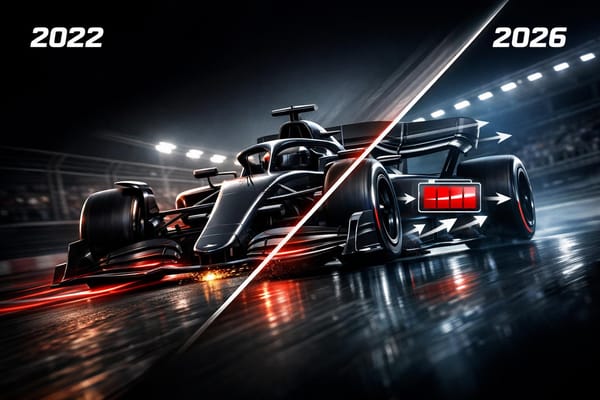
Formula One teams use advanced data analytics and simulations to predict the skills their drivers and engineers will need to remain competitive. By analyzing billions of data points from sensors, telemetry, and simulations, they identify gaps in technical expertise and driver performance. Teams then apply machine learning, scenario testing, and historical trends to refine their strategies, optimize budgets, and prepare for regulatory changes like the 2026 engine rules. Key insights include:
- Data-driven scouting: Academy graduates outperform external hires by 18% and adapt 70% faster.
- AI and simulations: Red Bull runs 4 billion simulations per race weekend, while McLaren uses AI to cut development time.
- Driver analytics: Metrics like tire efficiency, braking consistency, and stress responses guide training.
- Cost efficiency: Simulators cost $19,500 per session vs. $585,000 for track testing.
Teams combine technology with human judgment to shape future talent and stay ahead in a sport where milliseconds matter.
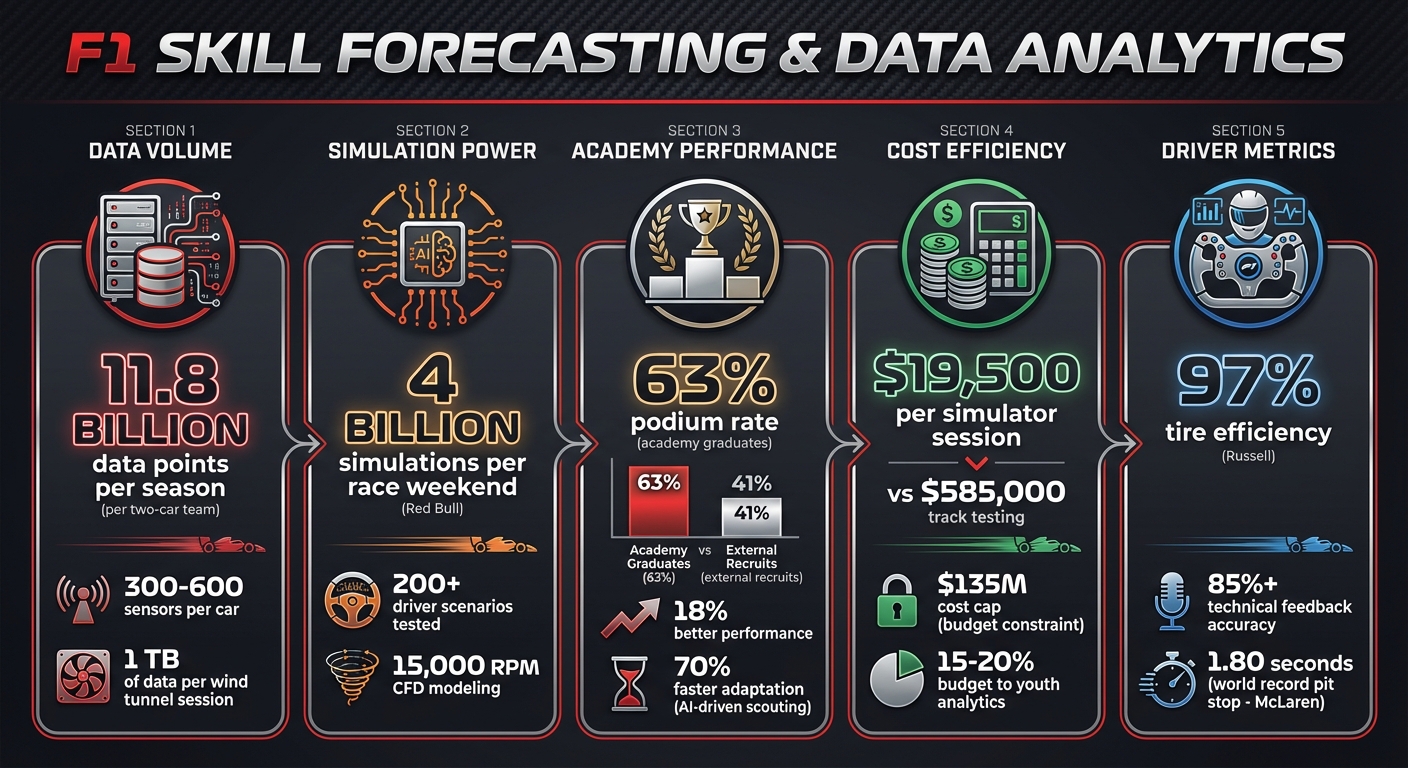
F1 Skills Forecasting: Key Data Analytics Statistics and Performance Metrics
AI & F1: Why Data Scientists Are the New Pit Crew (100M Simulations Per Race)
How F1 Teams Collect Data for Skill Forecasting
Formula One teams gather an enormous amount of data to anticipate the skills they’ll need to stay competitive in the future. A single two-car team can generate a staggering 11.8 billion data points in one race season. This data comes from various sources, each shedding light on different aspects of team performance and the expertise required for future success. Let’s break down how telemetry, technical trends, and behavior analysis help teams shape their forecasts.
Telemetry and Race Performance Data
F1 cars are equipped with 300–600 sensors, tracking everything from tire temperatures to brake pressure. This telemetry data not only measures performance but also highlights areas where technical skills need improvement. For instance, in February 2026, McLaren Racing teamed up with Dell Technologies to use an AI Factory for processing aerodynamic sensor data. According to Andrew McHutchon, McLaren's Head of Data Science, this technology allowed them to identify car strengths and weaknesses much faster, directly influencing their 2026 development strategies.
Teams also dive deep into specific performance metrics. By analyzing lateral G-force data, they can break down cornering into entry, mid-corner, and exit phases, identifying where drivers can improve. In 2023, Mercedes-AMG Petronas studied tire management data and found that George Russell achieved 97% tire efficiency on medium compounds, compared to Lewis Hamilton’s 94%. This insight highlighted areas for targeted training in car preservation skills. Such precise data is critical for sharpening driver performance and preparing for future seasons.
Technical and Regulatory Trends
Wind tunnel testing alone can produce about 1 terabyte of data per session. Teams combine this data with Computational Fluid Dynamics (CFD) simulations to predict technical requirements. Preparing for the 2026 engine regulations, which require a 50/50 split between internal combustion and hybrid power, Oracle Red Bull Racing used Oracle Cloud to run complex CFD simulations. These simulations modeled fuel ignition and airflow at 15,000 rpm, enabling the team to develop a cutting-edge engine-building program entirely digitally within just 12 months.
Regulatory changes also play a big role in shaping skill demands. Some teams are now using Generative AI at the pit wall to track live updates to regulations, reducing the manual workload on engineers. This real-time tracking helps teams anticipate the need for specialized skills, such as expertise in hybrid energy recovery systems, even before new components are introduced.
Driver and Team Behavior Analysis
F1 teams also analyze biometric and behavioral metrics to predict the human skills they’ll need. This includes tracking driver vitals like heart rate, blood oxygen levels, and stress responses using galvanic skin response (GSR) sensors. Mercedes-AMG Petronas took it a step further with high-frequency eye tracking during wet-weather simulations, linking drivers’ visual scanning patterns to lap time consistency - capturing instincts that traditional telemetry can’t measure.
Communication is another vital area. Teams use Natural Language Processing (NLP) to evaluate radio transcripts for technical accuracy and sentiment. Drivers who consistently provide 85% or more accurate technical feedback during races are prioritized for development, regardless of their lap times. In 2023, McLaren Racing partnered with AWS to analyze 87 performance metrics alongside psychometric tests. This approach helped them assess traits like leadership and strategic thinking, refining their driver development programs.
For scouting junior talent, teams track metrics like win ratios, podium finishes, and stress responses during overtaking maneuvers in lower racing categories. Red Bull Racing analyzed five seasons of data ending in 2024 and found that their academy graduates achieved a 63% podium rate, compared to 41% for externally recruited drivers. This data-driven approach to talent development has proven to deliver measurable results. These insights play a key role in shaping recruitment and training strategies for the long term.
Techniques Used to Forecast Future Skills
F1 teams take their data and use it to predict the skills their drivers and engineers will need in upcoming seasons. This involves combining machine learning, scenario simulations, and historical trend analysis to stay ahead of the curve.
Machine Learning and Predictive Analytics
Machine learning has become a powerful tool for evaluating talent and spotting skill gaps. By analyzing over 150 parameters - like braking consistency, communication skills, and stress responses - teams can make precise predictions. For example, McLaren Racing partnered with AWS in 2023 to analyze 87 performance metrics. One insight? Fine-tuning brake control in mixed conditions could shave 0.2 seconds off lap times. Natural Language Processing (NLP) also plays a role, evaluating radio communications to identify drivers who provide highly accurate technical feedback during races, with over 85% accuracy.
The results are hard to ignore. AI-driven scouting has shown that academy recruits outperform external hires by 18%, and predictive modeling has cut rookie adaptation time by 70%. Red Bull Racing takes it further by using computer vision and pose estimation algorithms to analyze pit crew movements, achieving consistent 2.1-second pit stops thanks to analytics-backed strategies.
"The strategist still makes the call, but the machine learning model provides a level of situational awareness that no individual could maintain on their own."
– Rohan Whitehead, Data Training Specialist
Alongside machine learning, scenario simulations add another layer of preparation.
Scenario Simulations
Simulations let teams prepare for challenges before they happen. Oracle Red Bull Racing, for instance, runs nearly 4 billion Monte Carlo simulations before race weekends. They also use Computational Fluid Dynamics (CFD) to model details like fuel ignition and airflow at 15,000 rpm, helping them gear up for the 2026 engine regulations that demand a 50/50 split between internal combustion and hybrid power.
"Ahead of a race weekend, we run close to four billion Monte Carlo simulations... This allows us to prepare for nearly every scenario we might face on track."
– Jack Harington, Partnership Group Lead, Oracle Red Bull Racing
Driver-specific simulations test over 200 different scenarios, focusing on steering precision, tire management, and adapting to changing track conditions. Teams also use high-frequency eye tracking and biometric sensors to measure stress responses in ways traditional telemetry can’t. Red Bull even applies a weighted matrix to their analysis, giving braking consistency a 70% emphasis for real-track performance compared to 30% in simulations.
Historical Trend Analysis
Historical data provides critical benchmarks for forecasting future performance. A study covering F1 data from 1951 to 2021 revealed that 88% of race outcomes now hinge on constructor performance rather than driver skill alone, highlighting the growing importance of engineering and data science expertise.
Teams use past telemetry to train supervised learning models that predict tire wear, mechanical risks, and the best pit stop windows. For drivers, historical data from junior racing series - like win ratios and stress levels during overtakes - helps assess whether they can handle F1’s technical demands.
Under the $135 million cost cap, historical analysis proves cost-effective. A simulator session informed by past data costs around $19,500, while a physical track test can run up to $585,000. By blending historical insights with human expertise, teams can better navigate the unpredictable nature of race conditions.
Applying Forecasting Insights to Team Development
Once they’ve gathered data, F1 teams turn those insights into actionable strategies. This involves designing specialized training programs, recruiting top technical talent, and adjusting for upcoming rule changes.
Driver Training and Development Programs
Teams tailor training programs to each driver’s unique strengths and areas for improvement, using data to guide their approach. For instance, Mercedes-AMG Petronas employs high-frequency eye-tracking during wet-weather simulations to evaluate how instinctively a driver makes decisions. By analyzing how visual scanning patterns correlate with lap time consistency, they can pinpoint where focus falters and create drills to address those gaps.
McLaren Racing, in collaboration with AWS, developed a Driver Performance scoring system that evaluates seven critical metrics: Qualifying Pace, Race Starts, Race Lap 1, Race Pace, Tire Management, Driver Pit Stop Skill, and Overtaking. This system provides a clear picture of where a driver excels and where improvement is needed.
Driver academies adopt these methods early in a driver’s career. Take Audi’s Driver Development Programme, launched in January 2026 under Allan McNish. The program scouts talent from karting and junior series, focusing on engineering skills, human performance, and even media training to prepare drivers for Audi’s F1 debut in 2026. Red Bull’s academy boasts impressive results - 63% of its graduates achieve podium finishes, compared to 41% of externally recruited drivers.
"We are not just looking for raw speed; we are looking for the resilience, intelligence, and team-driven mindset that defines a future Audi champion." – Allan McNish
Building Technical Expertise
Forecasting also plays a crucial role in shaping the technical workforce, helping teams stay competitive in F1’s data-centric landscape. For example, preparing for the 2026 engine regulations - which require an even split between internal combustion and hybrid power - Oracle Red Bull Racing built its engine program in just 12 months. Using Oracle Cloud Infrastructure, the team ran advanced computational fluid dynamics simulations to model fuel combustion at 15,000 rpm before manufacturing even a single component.
In another example, McLaren Racing leveraged Dell Technologies' AI Factory in October 2024 to conduct thousands of simulations, optimizing car setups. Under the leadership of Anjum Sayed (Lead Data Scientist) and Andrew McHutchon (Head of Data Science), this approach significantly cut down the time spent in the garage during practice sessions.
"AI speeds all of that up, and the faster we can answer these questions, the faster we can develop the car and the more likely we are to win championships." – Andrew McHutchon, Head of Data Science, McLaren
Additionally, academy-trained engineers deliver 18% more value compared to external hires. The financial benefits of data-driven methods are clear too - a simulator session costs approximately $19,500, while a physical track test can exceed $585,000.
Preparing for Regulatory Changes
As teams refine their technical and driver development strategies, they also integrate regulatory preparedness into their plans. Changes in regulations often require teams to overhaul their skill sets. For the 2026 rules, Oracle Red Bull Racing runs nearly 4 billion Monte Carlo simulations before race weekends. These simulations help test scenarios and prepare staff for new technical challenges. Cloud-based systems enable 20% more iterations compared to traditional on-premise setups.
To ensure theoretical setups work in practice, teams use "driver-in-the-loop" simulators. These tools allow drivers to test aerodynamic configurations in a controlled environment, bridging the gap between digital predictions and real-world performance.
"AI doesn't decide for us, it informs the human decision. In Formula 1, the most important sensor is the driver. Technology amplifies human judgement, but it doesn't replace it." – Jack Harington, Partnership Group Lead, Oracle Red Bull Racing
These focused strategies equip teams to navigate future challenges in skill and technical forecasting effectively.
Challenges and Best Practices in Skill Forecasting
Even with advanced analytics at their disposal, F1 teams still encounter tough hurdles when it comes to predicting future skill requirements. The biggest challenge? Data can't tell the whole story. Certain qualities - like leadership, motivation, or the ability to communicate clearly under pressure - are hard to quantify. For instance, in November 2022, the Haas F1 Team learned this the hard way. While Mick Schumacher showed promising simulator metrics, his struggles with adaptability in wet conditions only became apparent after analyzing video footage from the Brazilian Grand Prix.
Managing Data Limitations
Bridging the gap between simulated and real-world performance is a constant struggle. Simulations can provide probabilities but often miss the finer details, such as how a driver instinctively reacts in high-pressure situations. Red Bull has tackled this issue by adopting a weighted matrix for skill evaluation. For example, braking consistency is given 70% weight based on real-track performance and just 30% from simulations. This ensures that data-driven insights are grounded in actual on-track behavior.
Another challenge is the limited availability of advanced AI computing resources. The demand for these tools often outpaces supply, complicating efforts to create accurate predictive models.
"We wish to measure and optimize every aspect of how our engineers and drivers operate across multiple time zones, as well as how we manage a large number of off-car devices." – James Allison, Technical Director, Mercedes
These technological limitations are further magnified by financial constraints, forcing teams to make tough strategic choices.
Balancing Short-Term and Long-Term Goals
On top of technical barriers, financial and operational considerations play a huge role. The $135 million cost cap means teams must carefully prioritize their investments. For example, top teams dedicate 15-20% of their budgets to youth development analytics, with 18-22% of junior program budgets specifically allocated to predictive analytics. Such long-term investments are paying off - graduates from Red Bull’s academy achieve podium finishes 63% of the time, compared to 41% for external recruits.
To save costs, teams increasingly rely on driver-in-the-loop simulators for skill development. These simulators allow drivers to prepare for races at a fraction of the cost - $19,500 per session compared to up to $585,000 for physical track testing.
This delicate balance between short-term needs and long-term growth requires teams to work together seamlessly.
Collaboration Across Departments
Skill forecasting in F1 thrives on collaboration across technical, strategy, and HR teams. During a typical race weekend, teams hold around 50 performance review meetings. Post-race debriefs, often lasting longer than the race itself, involve up to 60 on-site staff and another 45 engineers working remotely from the factory.
A standout example of collaboration came during the Qatar Grand Prix in October 2023. McLaren analyzed over 250 million data points per car, enabling them to execute a world-record 1.80-second pit stop for Lando Norris. This effort helped him climb from 10th on the grid to a podium finish.
Creating a no-blame culture is also critical for identifying skill gaps honestly. Rob Smedley, CEO of Smedley Group, explains why this approach matters:
"When you have a blame culture, people spend 60–90% of the effort covering what they have done rather than doing anything positive and understanding the problem, making the car go quicker or making operations slicker."
Teams like McLaren hold twice-daily cross-functional stand-ups and regular all-hands meetings with over 800 staff to stay aligned on emerging skill needs. From navigating data challenges to managing budgets and fostering collaboration, the journey to forecast future skills in Formula One is anything but simple.
Conclusion: The Future of Skill Forecasting in F1
Skill forecasting has become a cornerstone of modern Formula One. By leveraging predictive analytics, teams are slashing rookie adaptation times by 70% and accelerating promotion decisions by 40% compared to traditional approaches. With the $135 million cost cap in place, investing wisely in analytics isn't just an advantage - it’s a necessity. These advancements not only help teams adapt to new regulations but also prepare them for the unexpected challenges that lie ahead.
AI is now detecting potential issues before engineers even identify them. McLaren's collaboration with Dell Technologies highlights this shift, with their AI Factory enabling car designs that were once beyond human capability. Andrew McHutchon, McLaren's Head of Data Science, encapsulates this transformation:
"At McLaren we see there is a great future for AI in F1. It can easily become a Championship-decider."
The innovation doesn't stop at faster simulations. Teams are experimenting with high-frequency eye-tracking and stress response monitoring to evaluate how quickly and instinctively drivers make critical decisions. By combining images, audio, and video data with traditional telemetry, teams are creating a richer, more accurate understanding of performance, further closing the gap between simulation and reality.
However, the human element remains vital. While data-driven methods should guide 70% of junior driver scouting, evaluating experienced candidates still requires 50% human judgment to assess traits like leadership and communication. Teams like Red Bull, whose academy graduates reach the podium 63% of the time compared to 41% for external recruits, demonstrate the power of balancing AI insights with human expertise.
The takeaway is clear: skill forecasting is about staying one step ahead - faster and smarter than the competition. As car development timelines shrink from days to mere seconds, the teams that seamlessly integrate AI into their workflows will shape the future of Formula One. The fusion of cutting-edge analytics with human intuition will define the next generation of success in the sport.
FAQs
How do F1 teams turn telemetry into skill forecasts?
Formula 1 teams rely on cutting-edge tools like data analysis, machine learning, and predictive modeling to turn telemetry data into actionable insights about driver performance and skill development. Each car is equipped with over 300 sensors that gather real-time data, including temperature, pressure, G-forces, and even driver vitals. By studying patterns in this data, teams can forecast skill requirements, fine-tune driver training programs, and adapt strategies to maintain their edge in the fiercely competitive world of Formula 1.
Which driver skills matter most in analytics models?
Teams rely on analytics models to evaluate key driver skills, such as lap times, tire management, driver vitals, and overall racecraft. By analyzing thousands of metrics, they make data-driven decisions to objectively assess and enhance performance in these critical areas.
How do teams validate sim results against real racing?
Teams ensure simulation results align with reality by comparing them to real-time telemetry data collected from cars. These vehicles generate over a million data points every second, offering insights that fine-tune predictions for tire wear, fuel consumption, and race strategies. Engineers also incorporate track conditions and driver feedback into the process, using analytics and machine learning to refine models and boost precision over the course of multiple races.