How F1 Teams Use Composites for Aero Stability
F1 teams use carbon-fiber composites, tailored layups and precision manufacturing to improve aerodynamic stability, cut weight, and control porpoising.
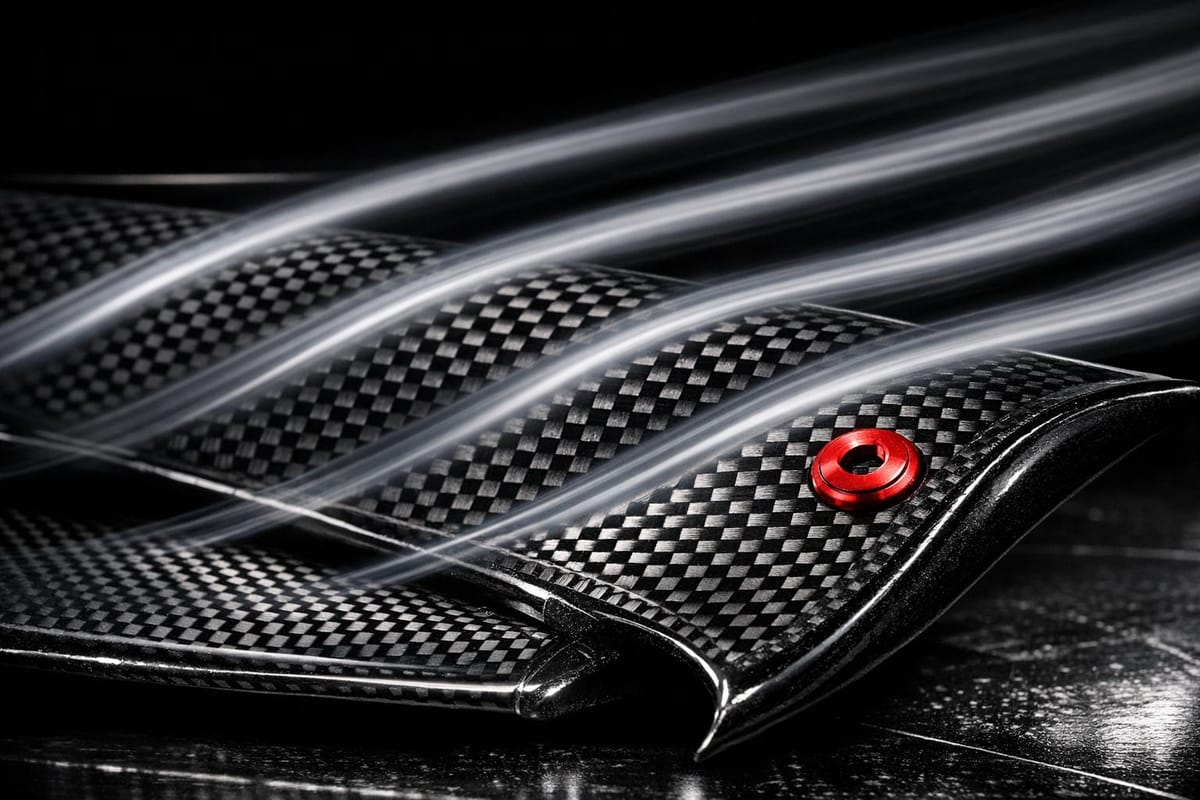
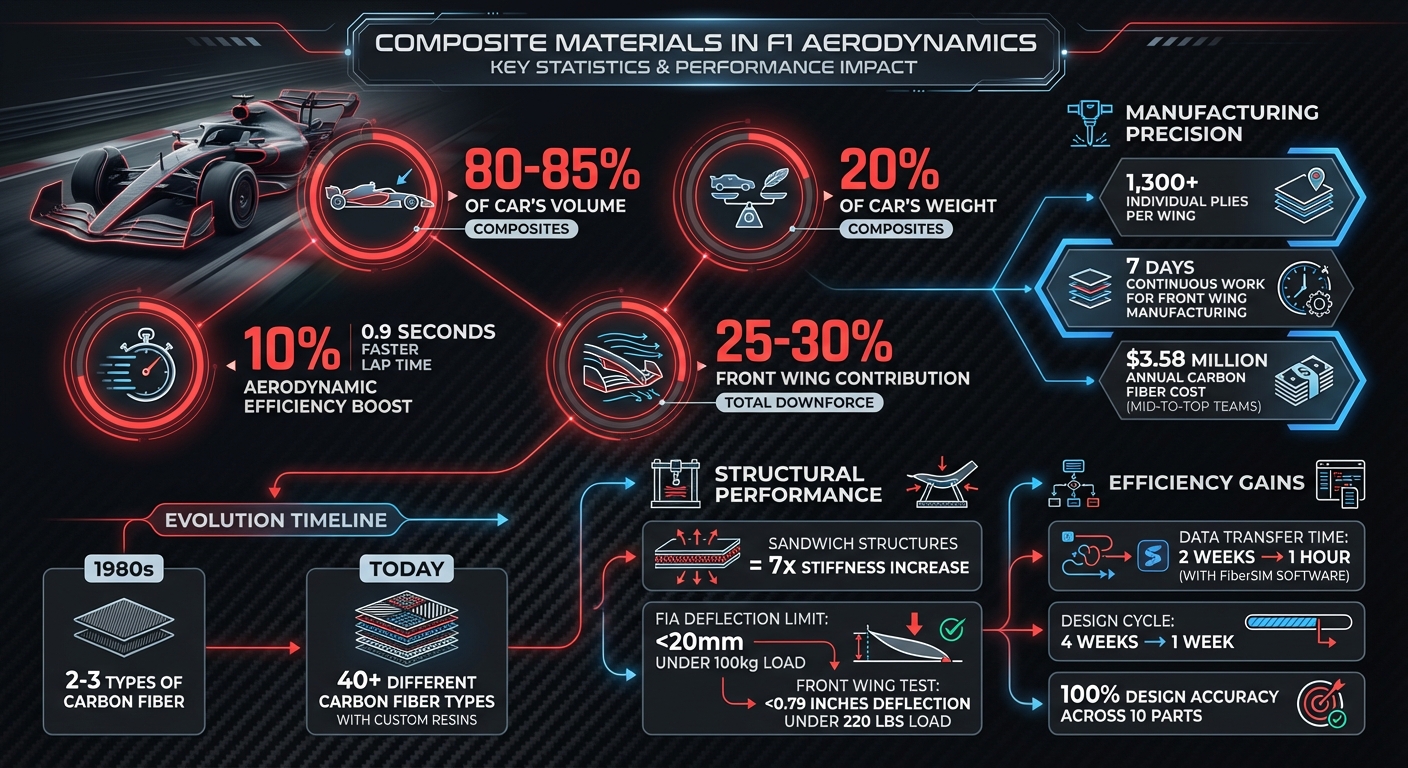
Formula 1 cars rely on composite materials - primarily carbon fiber - to achieve lightweight, durable, and aerodynamically efficient designs. These materials make up 80-85% of a car's volume but only 20% of its weight, offering unmatched strength-to-weight ratios. Here's why composites are critical:
- Precision Aerodynamics: Carbon fiber allows for intricate shapes like wings, floors, and diffusers, optimizing airflow and downforce while minimizing drag.
- Customizable Performance: Engineers adjust fiber orientations and resin systems to balance flexibility and stiffness for specific aerodynamic loads.
- Regulation Adaptation: Modern F1 rules, such as ground-effect designs introduced in 2022, demand advanced composite applications to maintain performance under strict weight and deflection limits.
- Time-Saving Manufacturing: Techniques like laser-guided ply placement and autoclave curing ensure precision, while tools like FiberSIM software accelerate design cycles.
A 10% boost in aerodynamic efficiency can cut nearly 0.9 seconds off lap times, proving that composites are key to staying competitive. Teams continue to innovate in material selection, manufacturing, and testing to refine their designs under evolving regulations.
F1 Composite Materials: Key Statistics and Performance Impact
How Composites Evolved in F1 Design
The Shift from Aluminum to Carbon Fiber
The story of composites in Formula 1 took a major turn in the early 1980s with the introduction of McLaren's MP4/1 - the first car to feature a carbon fiber monocoque. Before this game-changing innovation, teams relied on aluminum monocoques. While aluminum was sturdy, it came with significant drawbacks: it was heavy and lacked the versatility needed for crafting the intricate aerodynamic shapes that modern F1 cars demand.
Carbon fiber completely changed the game. It allowed engineers to create structures that were lighter, stiffer, and far more aerodynamically advanced. Its properties - such as high stiffness, impressive tensile strength, and minimal thermal expansion - made it a perfect fit for Formula 1. And the best part? It weighed significantly less than metal. During the 1980s, carbon fiber's incredible strength-to-weight ratio pushed design boundaries, enabling shapes and configurations that aluminum simply couldn’t handle .
Fast forward to today, and the materials used in F1 have evolved dramatically. Back in the '80s, teams worked with just two or three types of carbon fiber and basic resin systems, valued mainly for being "lighter than metal." Now, F1 cars incorporate around 40 different types of carbon fiber, each paired with custom-made resins designed for specific needs. Gerald Perrin, Global Program Director of Automotive at Solvay, summed up this shift perfectly:
"The type of materials that are used today are completely different to what was designed in the '80s... in the '80s it was probably one fit for all: it was lighter than metal so it was already super nice!"
This evolution in materials laid the groundwork for regulatory changes that took full advantage of composite technology.
How Aerodynamic Regulations Changed Composite Use
Once composites became a mainstay in F1, changes in aerodynamic regulations pushed their application even further. These rules govern the external surfaces of the car - like the chassis, wings, and floor - all of which are now built using composites to maximize both strength and aerodynamic efficiency. Teams have mastered the art of "aero-elasticity", designing parts such as flexible wings that meet the FIA's static deflection tests but bend under aerodynamic pressure to reduce drag or enhance downforce.
The 2022 ground-effect regulations added a new layer of complexity. These rules reintroduced Venturi tunnels and intricate floor designs, forcing engineers to craft advanced composite structures capable of withstanding extreme stresses while maintaining aerodynamic precision. The weight limit challenge also became more intense, leading teams to strip paint and expose bare carbon fiber - saving weight down to the micron level using abrasion-resistant resins. Looking ahead, the 2026 regulations will bring new composite elements like "floor feet" and "tyre spats", designed to improve airflow and reduce turbulence in the car's wake.
How F1 Wings Are Made
Where Composites Are Used in Aerodynamic Components
Composites play a crucial role in Formula 1, extending beyond the car's chassis to enhance aerodynamic components that directly impact stability and performance.
Front and Rear Wings
Front and rear wings are prime examples of where composites shine in Formula 1 design. The front wing alone contributes to 25% to 30% of a car's total downforce. This is possible because composites combine strength with controlled flexibility. Engineers design these wings to pass the FIA's static load test - allowing no more than 0.79 inches of deflection under a 220-pound vertical load - but they’re also built to flex under high-speed aerodynamic forces, optimizing both drag and downforce.
This phenomenon, called aeroelasticity, enables the outer edges of front wings to bend back during high-speed straights, reducing drag while maintaining maximum downforce through slower corners. Such precision is achieved by carefully arranging carbon fiber plies - typically at 0 and +/- 45 degrees - to customize stiffness and manage loads effectively. Mark Steele, Customer Engineering Manager at Solvay, highlighted the sophistication of modern materials:
"Nowadays, the cars don't use one or two resins, they use multiple resins. They are very, very bespoke resins for very specific applications: whether it's a suspension arm, which is driven ultimately by stiffness, through to a side intrusion pod".
Inside each wing lies a network of ribs, spars (commonly I-beams), and skins that maintain the precise aerodynamic shape needed to avoid airflow disruptions. Teams often use laser-guided technology to place over 1,300 individual plies with sub-millimeter accuracy. The payoff? A 10% improvement in aerodynamics can shave 0.9 seconds off lap times.
Car Floors and Venturi Tunnels
The floor and Venturi tunnels are critical for aerodynamic stability, requiring extreme stiffness to resist deformation under intense suction forces. Any warping could compromise the car’s ground-effect performance. To counter this, teams use sandwich structures - carbon fiber skins bonded to aluminum or Nomex honeycomb cores - to achieve a seven-fold increase in stiffness while keeping weight to a minimum.
Carbon fiber prepregs allow for intricate underfloor designs, including scrolled edges and strakes that generate vortices to manage airflow. These strakes guide air effectively to downstream aerodynamic components. Looking ahead to the 2026 regulations, teams plan to use composite "floor boards" and "floor feet" in up to three sections, creating controlled inwashing flows to reduce turbulent wake.
Composites are especially valuable here due to their exceptional volume-to-weight ratio. While composite parts make up about 85% of a modern F1 car's volume, they account for just 20% of its total weight. This allows engineers to strategically place material only where strength is needed, redistributing saved weight lower in the car to improve handling.
Sidepods and Diffusers
Sidepods and diffusers also depend on composites to maintain their aerodynamic shapes under high pressure and suction forces. Using the same sandwich construction as the floors - carbon fiber skins with honeycomb cores - prevents deformation that could upset the car's aerodynamic balance. These components must hold their shape to manage airflow around the midsection and accelerate air through the diffuser at the rear.
Traditional metals simply can’t match the manufacturing flexibility of carbon fiber. Its adaptability allows for the creation of highly curved geometries that streamline airflow. Advanced resins and precision molds ensure ultra-smooth finishes, reducing skin friction drag across large surfaces.
A practical example of how composites improve efficiency comes from Fall 2007, when the ING Renault F1 team utilized VISTAGY's FiberSIM software. Senior CAE Engineer Ian Goddard and his team reduced the data transfer time for chassis halves from two weeks to just one hour. This breakthrough cut the overall simulation-to-design cycle from four weeks to one, achieving 100% design accuracy across 10 parts and allowing for more aerodynamic design iterations before the season began.
How Teams Manufacture and Test Composite Components
Turning carbon fiber into aerodynamic components is a process that demands extreme precision. It all begins with pre-impregnated (prepreg) carbon fiber sheets, which are stored in frozen conditions to maintain the resin's chemistry for up to a year. These sheets are then cut into hundreds of precisely shaped pieces using computer-controlled systems. From there, technicians manually layer these pieces into molds, guided by laser projection systems to ensure each ply is perfectly positioned for structural strength. Ian Goddard, Senior CAE Engineer at ING Renault F1, described the intricate result:
"It looks a little like a patchwork quilt, with stacks of carbon fiber plies here and there to provide strength exactly where we need it".
Carbon Fiber Layup and Autoclave Curing
Once the layers are arranged, the curing process begins to solidify the component. The layered material is sealed inside a vacuum bag to eliminate air pockets and tightly compress the plies against the mold. These vacuum-sealed parts are then placed in an autoclave, where high pressure and temperature - sometimes reaching several atmospheres - cure the resin, fusing the layers into a single, durable structure. For example, manufacturing a front wing can take up to seven full days of continuous work. As the Alpine F1 Team's engineering staff noted, "the first layer determines the entire wing's structural integrity", emphasizing the importance of precision from the outset.
Teams often work with as many as 40 different carbon fiber types and custom resin formulations per car. This customization enables engineers to fine-tune each part's stiffness and flexibility to handle specific aerodynamic loads. The payoff? While composites make up 85% of a modern F1 car's volume, they contribute just 20% of its weight. This efficiency comes with a hefty price tag - mid-to-top-tier teams invest around $3.58 million annually in carbon fiber materials alone. Once cured, these components move forward for rigorous aerodynamic testing.
Wind Tunnel and CFD Testing
Before anything is physically built, teams rely on computational fluid dynamics (CFD) simulations to optimize designs and predict airflow behavior. FIA regulations limit teams to about 2,000 CFD runs every two months, so each simulation must be carefully planned to maximize its value. After refining the digital designs, scale wind tunnel tests provide real-world validation. Teams construct scaled-down models (approximately 60% of full size) for these tests, allowing engineers to confirm whether the components achieve the desired downforce and stability under actual airflow conditions.
This meticulous manufacturing and testing process ensures that components perform as expected in both simulations and wind tunnel trials, which is critical for maintaining aerodynamic stability. In 2017, McLaren Racing introduced trackside 3D printing using Stratasys uPrint SE Plus printers, enabling engineers to create and test last-minute modifications to wing flaps directly at the circuit. Ben Skuse, a writer for CompositesWorld, summed up the advantage:
"The faster a team can iterate its aerodynamic package, the faster its car will go".
Challenges and Solutions in Composite Aerodynamics
Porpoising and Ride Height Sensitivity
Composites are prized in F1 for their stiffness, but this same property can create hurdles. One such issue is porpoising - a violent bouncing effect that became prominent with the reintroduction of ground-effect regulations. Even small variations in ride height can trigger this phenomenon, as rigid floors and underbody components amplify oscillations. Engineers tackle this by carefully managing how composite materials flex under load.
One effective solution is the use of sandwich structures, where carbon fiber skins are bonded to lightweight cores made of materials like Nomex or aluminum honeycomb. These structures enhance rigidity, helping maintain consistent ground clearance and reducing oscillations. Under the 2026 regulations, the FIA has also allowed the use of a floor board brace up to 40 mm in diameter, providing additional structural support to stabilize airflow beneath the car.
Another approach is optimizing ply orientations - the angles at which carbon fiber layers are arranged, such as 0° and ±45°. This allows components to meet FIA static load test requirements, which demand less than 20 mm of deflection under a 100 kg load, while still enabling predictable flex at high speeds. For designers, ensuring that composite materials perform reliably under load is critical, as controlling porpoising is essential for maintaining aerodynamic efficiency. These technical refinements give teams the flexibility to explore unique strategies.
How Different Teams Approach Composite Design
F1 teams use varying strategies to push the boundaries of composite aerodynamics. For instance, in September 2024, McLaren Racing introduced a creative solution on their MCL38 during the Azerbaijan Grand Prix. They engineered the rear wing’s composite properties to produce a "mini-DRS" effect. Under high aerodynamic loads, the leading edge of the DRS flap would lift slightly, reducing drag. This innovation gave driver Oscar Piastri an edge, as Charles Leclerc gained just 0.35 to 0.4 seconds on a 2.2 km straight, despite having both DRS and a tow. McLaren's Team Principal Andrea Stella explained:
"We have upgraded all the rear-wing families... upgraded around some more modern concepts."
On the other hand, the ING Renault F1 team (now Alpine) focused on improving manufacturing speed back in 2008. They adopted VISTAGY's FiberSIM software, which automated the transfer of analysis data from FEA simulations to CAD design. This reduced the time required to create accurate ply schedules from nearly four weeks to just one week. During initial testing, the team achieved 100% design accuracy across 10 production parts. By accelerating their iteration cycles, Renault gained extra time for aerodynamic refinements before the season began, proving that manufacturing efficiency can translate directly into on-track performance.
Conclusion
Composite materials have become the cornerstone of aerodynamic performance in Formula One. The shift from aluminum to carbon fiber revolutionized car design, allowing for lighter, stiffer structures tailored to meet specific aerodynamic demands. This adaptability has enabled modern F1 cars to maintain stable aerodynamic performance even under extreme loads.
The real edge now lies in how quickly teams can iterate and innovate. A mere 10% improvement in aerodynamics can shave nearly a second off lap times. As Ben Skuse aptly puts it:
"aerodynamics has consistently been the difference between winning or losing"
To stay ahead, teams focus on accelerating the production and testing of composite components. Whether it’s 24/7 in-house manufacturing or cutting-edge automated fiber placement systems, faster development cycles offer a key advantage. This efficiency explains why composites make up about 85% of a modern F1 car’s volume but only around 20% of its weight. The ability to rapidly implement aerodynamic upgrades can translate directly into on-track performance gains.
However, achieving this level of precision comes with its own set of challenges. Engineers must navigate strict regulations while fine-tuning aeroelastic properties to manage issues like porpoising and ride height. Each team approaches these challenges differently - some prioritize innovative manufacturing techniques, while others explore the limits of composite materials under high-speed stresses.
As Formula One advances, composites will remain at the heart of aerodynamic progress. Emerging technologies like automation, additive manufacturing, and a focus on sustainability promise to shape the future of the sport. For now, the teams that excel in material selection and manufacturing efficiency will continue to lead the pack, pushing the boundaries of what is possible in the relentless quest for speed and performance.
FAQs
Why can carbon fiber wings flex without failing FIA tests?
Carbon fiber wings pass FIA tests thanks to their construction from composite materials specifically designed to flex under aerodynamic pressure. This controlled flexibility helps minimize drag while keeping the structure intact. Importantly, these wings are engineered to spring back to their original shape, ensuring they meet both safety standards and FIA regulations.
How do teams tune carbon fiber stiffness for aero loads?
Teams fine-tune the stiffness of carbon fiber parts through cutting-edge manufacturing techniques and material design. Aeroelastic tailoring plays a key role by aligning fibers and layering laminates in ways that minimize drag and boost stability at high speeds. By carefully adjusting how the layers are stacked and integrating active aerodynamic components, F1 teams gain precise control over how stiff or flexible these parts are. This allows aerodynamic surfaces to respond dynamically to changing loads, enhancing overall performance.
What makes ground-effect floors so sensitive to porpoising?
Ground-effect floors are particularly prone to porpoising because they depend on a delicate aerodynamic balance between the downforce they generate and the airflow beneath the car. Even slight changes in ride height or airflow can upset this balance, leading to vertical oscillations - essentially, the car starts to bounce. This happens because small disturbances get magnified, making it crucial for teams to meticulously control both airflow and ride height to keep the car stable at high speeds.