How F1 Teams Use Telemetry for Race Simulations
Teams convert millions of sensor readings into digital twins and real-time race simulations, using AI to predict tire wear, prevent failures, and optimize pit strategy.
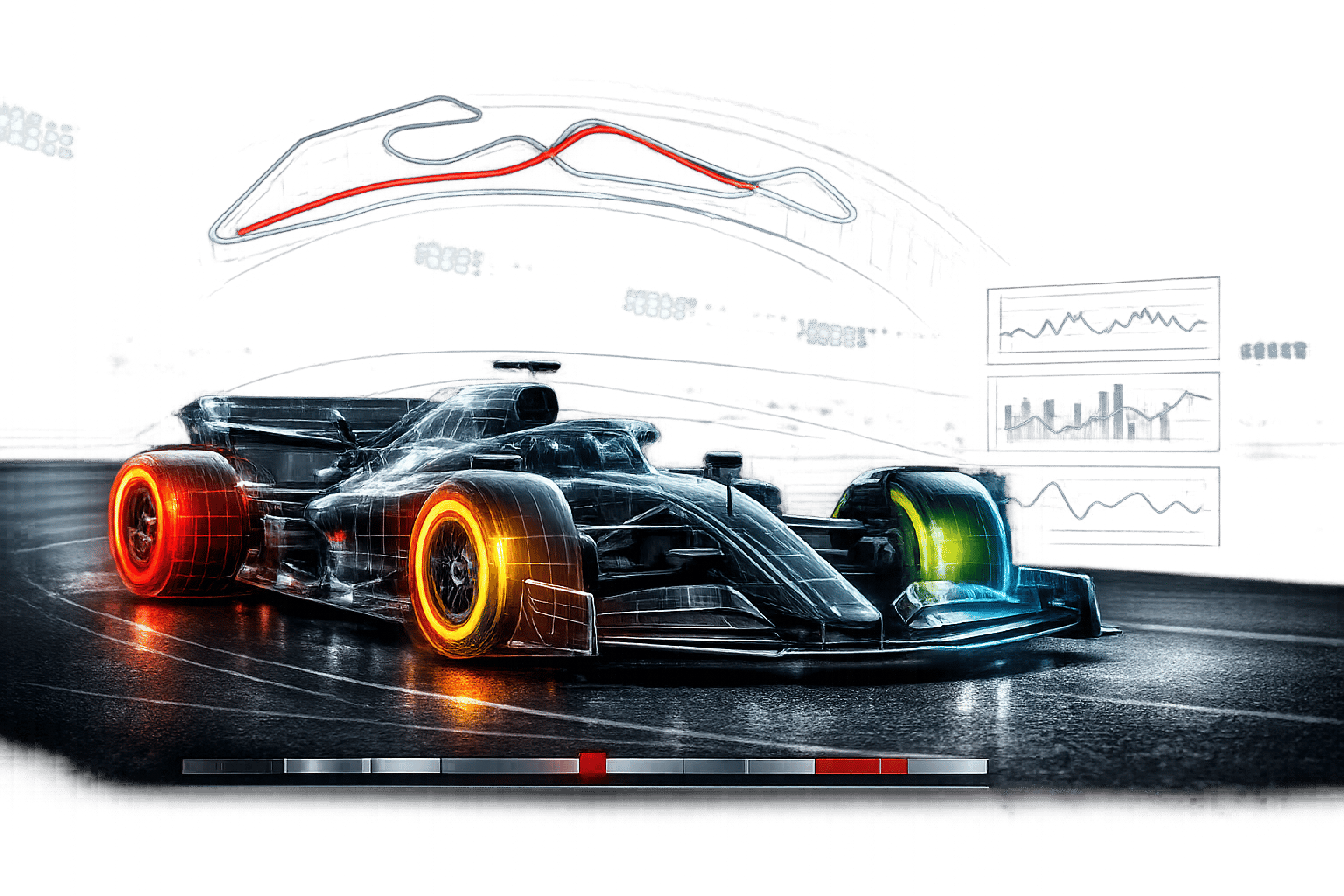
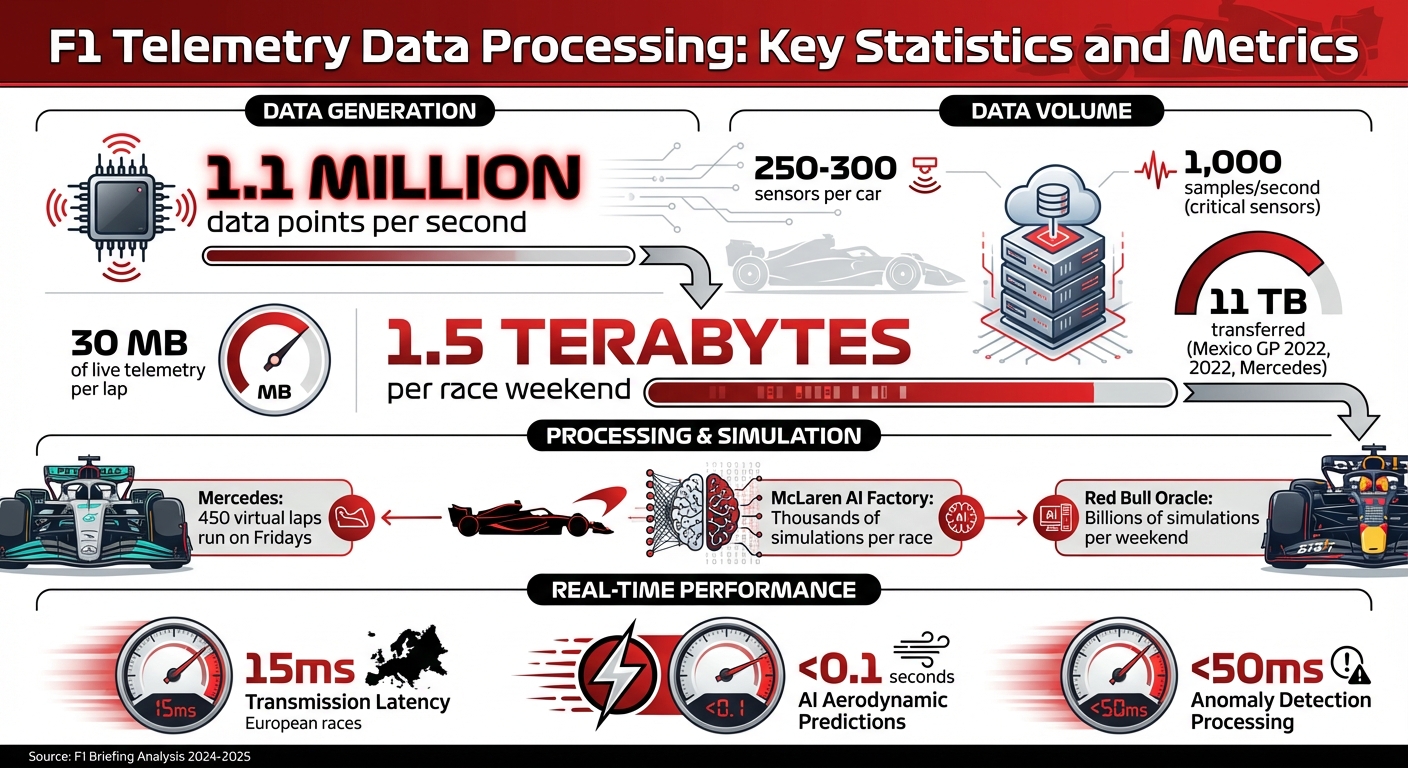
Formula 1 teams rely on telemetry to monitor car performance and make data-driven decisions during races. Each car generates over 1.1 million data points per second, transmitted to engineers both at the track and remotely. This data is used to fine-tune setups, predict mechanical issues, and simulate race scenarios.
Key highlights:
- Telemetry Basics: Wireless data from 300+ sensors tracks metrics like speed, tire temperatures, and fuel consumption.
- Simulations: Teams use telemetry to build virtual models for race strategies, including tire wear, fuel loads, and safety car scenarios.
- Real-Time Adjustments: Live updates allow engineers to refine strategies mid-race.
- AI and Predictive Tools: Machine learning helps forecast outcomes, optimize setups, and detect anomalies.
Telemetry and simulations are essential for competitive success, ensuring teams can adapt strategies and maximize performance.
F1 Telemetry Data Processing: Key Statistics and Metrics
Former F1 Data Engineer Explains Race Telemetry | MoTeC [#TECHTALK]
How F1 Teams Use Telemetry for Race Simulations
Race simulations are a cornerstone of Formula 1 success. Teams don’t just gather telemetry data - they feed it into advanced virtual systems to predict crucial factors like tire wear and fuel consumption before a single lap is completed. This process turns raw sensor data into actionable strategies, giving teams a competitive edge well ahead of race day.
Building Simulation Models with Telemetry Data
Creating accurate simulations starts with aligning on-track telemetry with digital models until the car’s behavior in the simulation matches real-world performance. Sensors collect key physical data, which is then used to fine-tune these models and feed them into simulation engines.
Track modeling has become incredibly precise. Using lidar scanning, teams create high-resolution 3D maps of circuits, capturing details like kerb heights and surface textures. These maps allow drivers to practice braking and cornering strategies in virtual environments that replicate the track down to the smallest detail.
Driver-in-Loop (DiL) simulators add another layer of accuracy. Real drivers use these simulators to generate telemetry in real time, creating "racing line files" that represent ideal trajectories. These files serve as the foundation for countless computer simulations. For instance, in September 2024, McLaren Racing utilized its "AI Factory", developed with Dell Technologies, to optimize Oscar Piastri's car setup for the Baku Grand Prix. Instead of chasing the fastest lap, the simulations prioritized straight-line speed for overtaking and defending on the main straight - a strategy that directly contributed to Piastri’s victory.
"We will run simulations to see how each part of the car behaves – but the various systems don't operate in isolation... Tying all of these together requires thousands and thousands of simulations."
- Anjum Sayed, Lead Data Scientist, McLaren
The use of digital twins, virtual models of the car updated in real time, allows teams to conduct immediate "what-if" analyses. For example, during the October 2022 Mexico Grand Prix, the Mercedes-AMG PETRONAS F1 Team transferred 11 terabytes of data between the track and their factories. This helped refine setups and guide engineering decisions during the race weekend.
Once these models reflect real-world conditions, teams use them to evaluate race strategies and make data-driven decisions.
Simulating Race Scenarios
With a solid baseline model in place, teams can simulate thousands of race scenarios to explore every possible outcome. Two-day simulation programs often cover hundreds of laps, while computer models run hundreds of thousands of virtual laps to test variables like tire degradation, fuel consumption, and even the timing of safety car deployments.
Key factors in these simulations include:
- Tire dynamics: Wear rates, thermal degradation, and compound performance.
- Fuel loads: Consumption under various engine modes.
- Environmental conditions: Track temperature, weather forecasts, and wind direction.
By analyzing how these elements interact, teams pinpoint optimal pit stop windows and strategic moves like the "undercut" or "overcut".
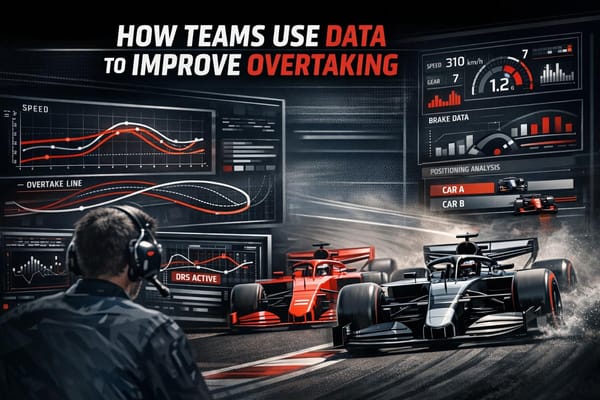
Real-time telemetry further enhances these models during the race. Live data updates simulations instantly, allowing teams to adjust strategies on the fly. Shared GPS telemetry from all 20 cars helps teams identify where competitors are faster, enabling swift changes to setups or defensive tactics. This constant feedback loop ensures teams can react to sudden developments, such as safety car deployments or weather changes.
Synthetic Data and Driver Behavior
Beyond real-world data, teams now rely on synthetic data to predict scenarios they haven’t physically tested. Using advanced modeling and artificial intelligence, they simulate driver responses and car behavior under extreme or untested conditions - especially useful for new tracks or bold setup experiments.
McLaren Racing has been at the forefront of using AI to predict tire performance. As one team representative explained:
"Just as you can use an AI model to forecast weather, we can use it to forecast tyre behaviour. It helps our race engineers and strategists understand if we can push for another five or 10 laps."
- McLaren Racing
Driver behavior modeling has also reached new levels of sophistication. Telemetry data profiles individual driving styles, enabling simulations to predict lap times and tire wear under different strategies.
"The full car model can never be perfectly accurate, and you also can't model the grip of the tarmac and how the tyre responds to it."
- Mercedes-AMG PETRONAS F1 Team
While no simulation can perfectly replicate every variable - like precise tire grip or track evolution - teams have come remarkably close. By combining telemetry, advanced modeling, and machine learning, they’ve developed tools that are accurate enough to guide decisions that can make or break a race.
Key Processes for Telemetry Integration
Transforming raw telemetry data into actionable insights for race simulations involves a complex process. This pipeline must handle vast amounts of noisy, high-frequency data and convert it into clean, synchronized inputs. During a single Grand Prix weekend, Formula 1 teams process over 1.5 terabytes of data, with critical sensors sampling up to 1,000 times per second.
Data Processing and Normalization
The journey begins with data from 250 to 300 sensors installed on the car. This information flows through the standardized McLaren Applied SECU (Electronic Control Unit) via a CAN bus, which compresses and encodes the data before transmitting it through a WiMaX mesh network to the pit wall. Once received in the garage, an ATLAS telemetry server ensures synchronized data streams are accessible to engineers both at the track and back at the factory.
Handling this large volume of data is only part of the challenge. Consistency is crucial, and teams rely on AI-driven normalization to prioritize specific data points. This process balances historical data, recent race information, and insights from similar track conditions. Simulators are essential here, as they generate "clean" data sets that remove noise from external factors like weather or traffic. These refined datasets establish a baseline for car performance.
"The output of algorithms depends on the quality of data going in, the benefits of simulators include very clean, precise data sets which provide an excellent picture of the car without the effects of randomized external factors." - Carey Wodehouse, Everpure Blog
Digital twins further enhance this process by replicating mechanical issues encountered on the track in real time. Once normalized, the data is ready for deeper analysis to understand complex system interactions.
Cross-Analysis of Variables
With clean data in hand, teams integrate telemetry parameters to uncover how different systems interact. For example, AI models are used to analyze relationships like how front ride height influences rear ride height and aerodynamics.
In October 2024, McLaren's Lead Data Scientist, Anjum Sayed, explained how the team leverages Dell Technologies' AI Factory to assess trade-offs between drag and downforce. By analyzing competitor GPS data and photos, they identified whether a rival's speed advantage came from engine power or aerodynamic setup. This insight shaped Oscar Piastri's car setup for the 2024 Azerbaijan Grand Prix, prioritizing straight-line defense over lap time.
"We will run simulations to see how each part of the car behaves – but the various systems don't operate in isolation." - Anjum Sayed, Lead Data Scientist, McLaren
Teams also use Monte Carlo simulations to account for random variables. By running millions of race scenarios, these simulations predict the likelihood of outcomes based on factors like tire wear, fuel consumption, and safety car interventions. This helps strategists refine models and adjust race strategies in real time, comparing live data to pre-race predictions to spot issues or opportunities.
Anomaly Detection and Model Refinement
After cross-analysis, the focus shifts to identifying unusual patterns that may signal potential problems. Teams use unsupervised machine learning methods, such as the Isolation Forest algorithm, to detect anomalies by setting specific thresholds. These tools can flag risks like engine, gearbox, or hydraulic failures before they lead to a DNF (Did Not Finish).
In January 2026, researchers Rubén Juárez Cádiz and Fernando Rodríguez-Sela tested an "Agentic Visual Telemetry" framework using the Aspar-Synth-10K dataset. By combining Retrieval-Augmented Generation (RAG) and Cache-Augmented Generation (CAG) architectures, they boosted the Macro-F1 score for detecting suspension chatter from 0.62 to 0.88. This system operated in real time on NVIDIA Jetson AGX Orin hardware, with most frames processed in under 50 milliseconds.
Modern frameworks now integrate high-speed video with standard telemetry data - like IMU readings and wheel speeds - to detect subtle issues such as suspension chatter or evolving tire textures. Sensors alone might miss these finer details. After each race, teams review AI predictions against actual outcomes to refine their models. Engineers also step in to adjust AI outputs, particularly during critical moments like pit stops, ensuring the system continues to improve.
"In a sport where milliseconds matter, thinking faster than the competition may be more important than driving faster." - RaceK Design
How Teams Apply Telemetry-Driven Simulations
Telemetry data is more than just raw numbers; it’s the foundation for crafting strategies, predicting mechanical issues, and fine-tuning performance. By turning sensor readings into actionable insights, teams gain a competitive edge that can define race outcomes.
Strategy Development and Adjustment
Before the first practice session even starts, teams have already simulated countless laps to explore possible race scenarios. These simulations factor in tire choices, weather conditions, safety car probabilities, and rival strategies to create a detailed decision tree of "what-if" scenarios.
During the race, live telemetry feeds - tracking tire wear, fuel consumption, and GPS data - update simulations in real time. This allows engineers to make split-second decisions, such as timing an undercut strategy, where a driver pits early to exploit fresh tires for an advantage.
"The car sends data to the factory, the factory calculates scenarios, and within seconds the race engineer gets advice back." - Patrick Kalkman, MySimRig
One standout example is the Mercedes-AMG PETRONAS F1 Team's "Friday programme." While the race team gathers data at the circuit, their factory simulator department runs approximately 450 virtual laps - about eight full race distances - to extract insights from Free Practice sessions. This constant data exchange highlights how crucial real-time updates are in Formula 1.
But strategy isn’t the only area where telemetry proves invaluable - it also helps prevent mechanical failures.
Mechanical Issue Prediction
An F1 car is essentially a rolling data hub, with 250 to 300 sensors monitoring everything from engine RPM to brake pressure and energy recovery systems. Engineers compare live data against pre-race models to identify any irregularities that could signal mechanical trouble.
Digital twins - virtual replicas of the car - run "what-if" scenarios to predict how components will perform under various conditions. Additionally, automated alerts flag any deviations in critical metrics like temperature or pressure, ensuring potential issues are addressed before they escalate. With some data channels sampling up to 1,000 times per second, even fleeting anomalies are caught and analyzed promptly.
These predictive tools not only safeguard the car but also contribute to performance improvements.
Performance Optimization Across Teams
Telemetry-driven simulations are key to extracting every ounce of performance. A great example comes from McLaren Racing during the October 2024 Azerbaijan Grand Prix in Baku. Using Dell Technologies' AI Factory, Lead Data Scientist Anjum Sayed and his team analyzed competitor GPS data and discovered a rival's speed advantage was due to aerodynamics, not engine power. Armed with this insight, they adjusted Oscar Piastri's MCL38 for better straight-line speed, helping him defend his position on the long main straight and secure victory.
"Using Dell Technologies' AI Factory to join the dots helps us narrow down the possibilities and puts us in the best position to give Lando and Oscar a car that's in the right area when practice begins." - Anjum Sayed, Lead Data Scientist, McLaren
Teams also rely on Driver-in-Loop (DiL) simulations, which use lidar-scanned 3D track maps. These simulations allow drivers to perfect braking points and turn-in angles while engineers fine-tune the car's balance. This approach ensures that both drivers and cars are fully optimized before hitting the track.
Future Trends in Telemetry and Simulations
The future of telemetry-driven simulations is taking shape, fueled by artificial intelligence (AI) and an ever-growing network of sensors. These advancements are setting the stage for teams to predict, test, and refine their strategies with unprecedented accuracy - long before cars hit the track.
AI and Machine Learning in Telemetry Analysis
Modern Formula 1 cars generate a staggering 1.5 terabytes of data over a single race weekend, with around 30 megabytes of live telemetry streaming back to pit crews every lap. This sheer volume of information is far beyond what humans can process, but AI steps in to make sense of it all in real time.
Recurrent neural networks (RNNs) are a game-changer here, as they excel at analyzing time-dependent data. For example, models trained on telemetry from 2020 to 2024 demonstrated a precision of 0.77 and a recall of 0.86 for optimizing pit stop strategies. These systems evaluate dynamic variables such as tire wear, lap times, and weather changes to forecast race outcomes with impressive accuracy.
"No human would be able to trawl through all of it - it'd take a person years to just get through a single race weekend. These AI models, on the other hand, can trawl through it in seconds."
- Jude Hunt, Data Scientist, McLaren Racing
Aerodynamic simulations have also been revolutionized by AI. Using Geodesic Convolutional Neural Networks (CNNs), surrogate models can now predict airflow performance in less than 0.1 seconds. This approach eliminates the need for hours-long Computational Fluid Dynamics (CFD) simulations. Racing Bulls, for instance, partnered with Neural Concept in mid-2025 to evaluate thousands of design options ahead of the 2026 technical regulation changes.
Additionally, AWS and Formula 1 have developed a machine learning-powered Design of Experiments workflow. This has tripled CFD simulation throughput, cutting turnaround times in half. The same system supports "F1 Insights", delivering real-time analytics like "Overtaking Probability" and "Tire Performance Predictor."
Generative AI is pushing the boundaries even further. It enables teams to simulate hundreds of "what-if" race scenarios simultaneously, including unexpected events like safety cars or rivals' strategy changes. In August 2025, McLaren Racing used generative AI through the Dell Technologies AI Factory to predict optimal pit stop timing and tire performance with remarkable precision.
| Aspect | Traditional | AI-Driven |
|---|---|---|
| Processing Speed | Hours to days (manual) | Real-time / Milliseconds |
| Aero Simulation | Hours (CFD/Wind Tunnel) | <0.1 seconds (Surrogate Models) |
| Data Volume | Sampled/Key metrics | 1.5 TB+ per weekend |
| Strategy Basis | Rule-based/Linear models | Non-linear Deep Learning models |
Source:
IoT and Enhanced Data Collection
The rise of IoT devices in Formula 1 has unlocked a new level of data granularity. Today’s F1 cars are equipped with 300–600 sensors, each sampling performance metrics as frequently as 1,000 times per second. These sensors monitor everything from engine performance and tire degradation to aerodynamics and brake temperatures.
With edge technology, telemetry is streamed directly from the car to trackside receivers. This creates a "hot path" for live monitoring and a "cold path" for in-depth analysis. Engineers can now keep a real-time pulse on how the car interacts with the track, cross-referencing variables like throttle input and tire temperature to detect potential issues.
"Every lap, data whispers: tire life, fuel burn, brake temps, wind shifts, traffic risk. The fastest cars aren't just quick - they're the best listeners."
- Syntal
IoT data is increasingly integrated with AI to adjust car setups and predict race results dynamically. Algorithms like Isolation Forest are used for unsupervised anomaly detection, helping engineers spot early signs of mechanical stress or aerodynamic inefficiencies. These advancements in data collection and analysis are paving the way for simulations that better prepare teams for race day.
Expanded Use of Virtual Simulations
Virtual simulations have evolved to become an essential tool for managing race strategies in unpredictable conditions. Instead of sticking to rigid plans, teams now use probabilistic simulations to juggle multiple objectives and prepare for high-stakes scenarios.
In October 2024, McLaren leveraged the Dell Technologies AI Factory to run thousands of simulations before practice sessions even began. This allowed drivers like Lando Norris and Oscar Piastri to focus more on track time and less on in-garage adjustments. These simulations explored how interconnected factors, such as ride height and aerodynamic balance, could impact performance.
"Just as you can use an AI model to forecast weather, we can use it to forecast tire behavior. It helps our race engineers and strategists understand if we can push for another five or 10 laps."
- Andrew McHutchon, Head of Data Science, McLaren
Generative AI enhances these simulations by creating synthetic data that mirrors actual race conditions. This enables "digital twins" to operate in hyper-realistic environments, improving decision-making accuracy. Transmission latency is now as low as 15 milliseconds for European races and 300–400 milliseconds for long-haul events.
Conclusion
Telemetry has reshaped Formula 1 from a pure test of speed into a sophisticated battle of strategy, where data is king. Today’s F1 cars are equipped with 250 to 300 sensors, generating over 1 terabyte of data during a single race weekend. The ability to interpret, simulate, and act on this data often determines whether a team fights for the championship or settles for mid-field finishes.
Telemetry-powered simulations allow teams to run thousands of scenarios before and during a Grand Prix. These simulations help predict everything from the best pit stop windows to the effects of sudden weather changes. For instance, Red Bull Racing uses Oracle Cloud Infrastructure to run billions of simulations per race weekend, staying within the F1 cost cap while evaluating real-time strategies. Similarly, McLaren’s AI-driven tools played a pivotal role in Oscar Piastri’s Baku Grand Prix win in October 2024, helping the team strike the perfect balance between lap time and straight-line speed.
"In 2025, it's not the car with the most horsepower that wins, but the team that uses the data stream most effectively."
- Patrick Kalkman
This quote perfectly captures the essence of modern Formula 1 - where real-time data and strategy define success. With AI and machine learning advancing rapidly, the precision of telemetry-driven simulations is reaching new heights. Teams now process 1.1 million data points per second, using AI models and digital twins to predict tire performance and conduct real-time "what-if" analyses during races.
These developments underline the central role of data in F1’s ongoing evolution. For a deeper dive into the technology and strategies shaping the future of Formula 1, visit F1 Briefing, where we explore the innovations driving the sport forward.
FAQs
How do teams turn raw telemetry into a usable simulation model?
F1 teams take raw telemetry data and turn it into simulation models through a mix of data processing, modeling, and validation techniques. Engineers dive into sensor data - things like tire pressure, engine performance, and other key metrics - using sophisticated software to pinpoint performance trends. From there, they build mathematical models that represent how the car behaves on the track. These models are fine-tuned with real telemetry data and tested through simulations to ensure accuracy. This approach allows teams to predict performance with precision and make smart, strategic choices for both race day and pre-race preparations.
How accurate are digital twins and race simulations in real races?
Digital twins and race simulations play a crucial role in Formula 1, offering highly precise tools for real-time analysis and predictive modeling. By leveraging telemetry data, teams can develop strategies that adapt to the dynamic nature of racing. However, the accuracy of these simulations hinges on the quality of the sensors and data processing systems in use. Better sensors and advanced processing mean more dependable simulations, directly impacting race strategy decisions.
What makes AI better than engineers at spotting issues in telemetry?
AI has proven to be better than engineers at detecting telemetry issues, thanks to its capacity to handle enormous amounts of data with speed and precision. Formula 1 cars produce millions of data points every second, and AI shines in analyzing these streams to spot patterns and anomalies almost instantly. Using machine learning, AI can forecast tire degradation, fuel consumption, and potential mechanical problems far more efficiently than traditional methods. This allows racing teams to make faster, data-backed decisions during the heat of competition.