How FIA Certifies Sustainable Fuels
Explains FIA’s four-step process to certify 100% sustainable, drop-in racing fuels through lifecycle audits, supply‑chain tracing, lab tests and race monitoring.
The FIA has developed a strict process to certify fuels that align with Formula 1's Net Zero by 2030 goal. These fuels are created without fossil carbon and must meet high performance standards while being compatible with current engines. Here's how the certification works:
- Clear Guidelines: Fuels must be made from approved sources like CO₂ capture, waste, or non-food biomass. The FIA bans food-based biomass and mass-balanced materials, requiring a strict Chain of Custody to trace fuel origins.
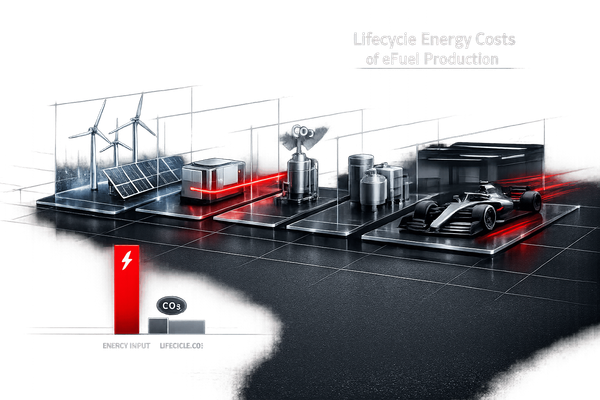
- Lifecycle Emissions Audits: Independent bodies, like Zemo Partnership, audit the entire production process, ensuring renewable energy powers fuel creation and emissions are minimized.
- Energy Density Standards: Starting in 2026, fuel is measured by energy density (capped at 3,000 MJ/h), not mass flow, pushing manufacturers to optimize fuel chemistry.
- Supply Chain Verification: A third-party assurance scheme tracks and audits every step of the supply chain, from raw materials to delivery.
- Laboratory Testing: Certified labs test fuel blends to ensure they meet technical and performance criteria, including being 99% derived from renewable sources.
- Race-Day Monitoring: Random fuel samples are checked against pre-certified "fingerprints", and cars' ECUs monitor energy flow in real time.
This approach ensures fuels meet strict sustainability standards while maintaining performance for racing and everyday use.
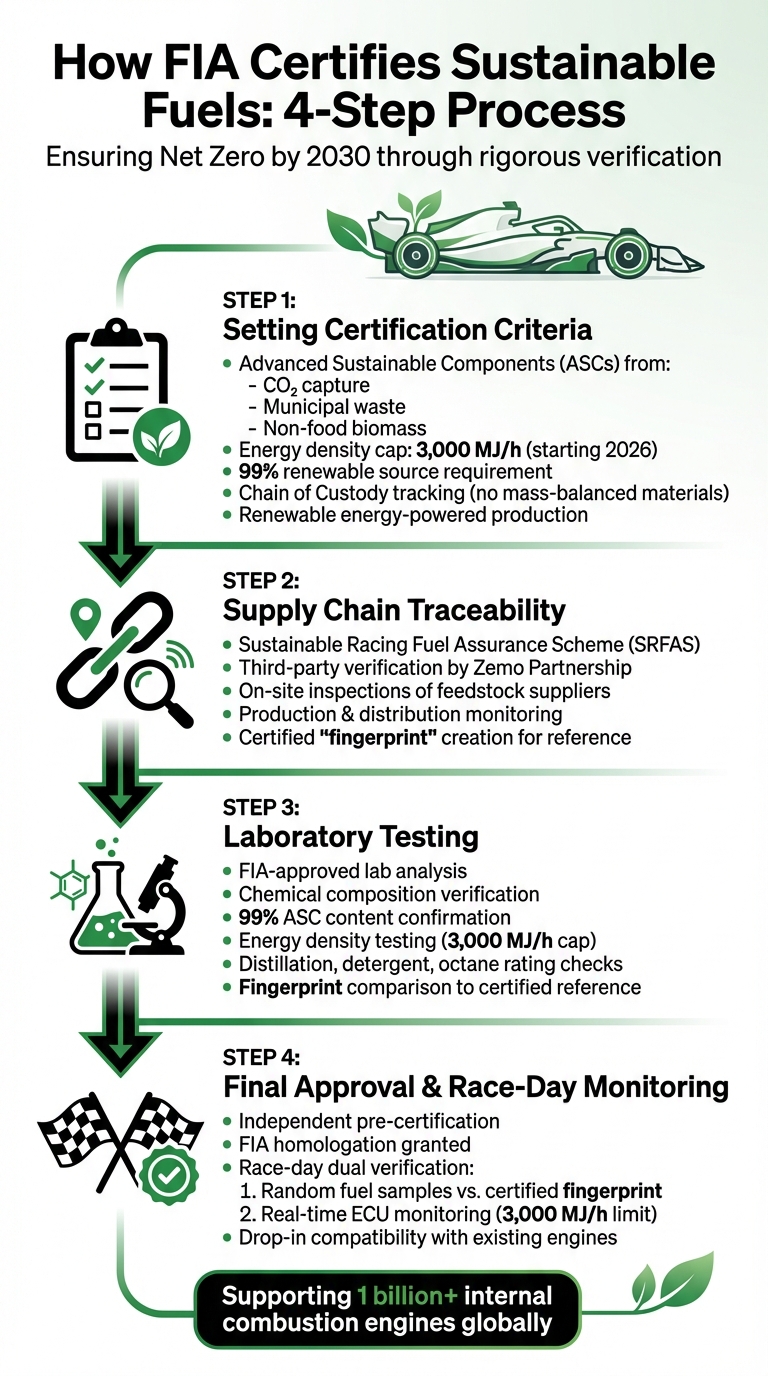
FIA Sustainable Fuel Certification Process: 4-Step Framework
F1's Messy 'Sustainable Fuel' Situation Explained
Step 1: Setting the Certification Criteria
The FIA's certification framework introduces rigorous guidelines to define what qualifies as a sustainable fuel. Unlike earlier standards that primarily focused on performance and safety, these new rules demand that fuels are entirely free of fossil carbon. Additionally, the entire production process must rely on renewable energy sources instead of fossil-fueled electricity, aligning with the FIA's Net Zero goals.
This marks a major shift in how motorsport governs fuel chemistry. Starting in 2026, fuel will be evaluated based on energy density - capped at 3,000 MJ/h - rather than mass flow measured in kilograms per hour. This change encourages manufacturers to optimize the energy output of their sustainable components. Below are the key criteria for Advanced Sustainable Components and lifecycle emissions requirements.
What Qualifies as Advanced Sustainable Components
Advanced Sustainable Components (ASCs) must come from specific, approved sources such as direct carbon capture (CO₂ extraction), municipal waste, or non-food biomass. To avoid competing with global food supplies, the FIA explicitly excludes food-based biomass. Matt Youson, a contributor to Formula1.com, elaborates:
"For a fuel created from biomass, for example, it has to be produced using waste biomass rather than crops grown on arable land that would otherwise be used to grow food".
The FIA also prohibits the use of mass-balanced materials. This method involves mixing sustainable and fossil feedstocks during production and tracking them through accounting credits. Instead, the certification requires a strict Chain of Custody system that traces the physical origin and movement of every ASC throughout the supply chain. This ensures fuels are composed entirely of certified components, avoiding reliance on bookkeeping methods to claim sustainability.
Greenhouse Gas Reduction Requirements
The certification process also assesses emissions across the entire lifecycle of the fuel. Pierre-Alain Michot, Technical Director of F2 and F3, underscores this comprehensive approach:
"When we speak about sustainable fuels, we need to make sure that the full life cycle of the production remains sustainable. Aramco is working that out as well, to make sure that the energy needed to produce this sustainable and synthetic fuel comes from sustainable energy as well".
To ensure these standards are met, the Sustainable Racing Fuel Assurance Scheme (SRFAS), developed alongside Zemo Partnership, verifies greenhouse gas performance through independent audits. These audits include on-site inspections of production facilities and thorough reviews of supplier certifications. This meticulous process goes beyond laboratory testing, ensuring every stage of production supports Formula 1's ambitious Net Zero by 2030 commitment.
Step 2: Confirming Supply Chain Traceability
After setting clear criteria, the FIA moves forward to ensure the integrity of the supply chain. With the criteria in place, the FIA verifies that every fuel component originates from approved sources, relying on the Sustainable Racing Fuel Assurance Scheme (SRFAS). Developed by the Zemo Partnership, SRFAS provides independent oversight for the entire supply chain - from the extraction of raw feedstocks to the delivery of fuel to race teams.
At the heart of this process is a Chain of Custody system, which meticulously tracks the movement of materials. Gloria Esposito, Director of Sustainable Business at Zemo Partnership, played a key role in launching the SRFAS in December 2024. This third-party verification framework is designed specifically for the 2026 Formula 1 season. Such detailed tracking paves the way for stringent third-party audits of feedstock suppliers.
Third-Party Audits of Feedstock Suppliers
To ensure sustainability claims hold up, accredited auditing companies conduct on-site inspections of feedstock suppliers before any materials enter the production chain. These audits confirm that biomass comes from waste sources rather than food crops and that renewable energy is used during production.
Claire Haigh, Managing Director of Zemo Partnership, underscores the importance of these audits:
"It's vital that the renewable fuels used in ICE vehicles undergo robust sustainability verification to ensure they deliver clear benefits".
The SRFAS builds on the Renewable Fuels Assurance Scheme (RFAS), which already includes 46 approved suppliers. This existing framework provides a reliable foundation for certifying racing fuels.
Monitoring Fuel Production and Distribution
Auditors also oversee the entire production and distribution process. They track everything from blending to delivery, ensuring that all certified components meet emissions performance standards. These checks confirm compliance with FIA's strict thresholds set during Step 1. This level of verification aligns with the broader goals of achieving Net Zero emissions and maintaining sustainable fuel performance.
To finalize the process, auditors create a "fingerprint" of the fuel - a certified reference sample stored for comparison. Matt Youson, Special Contributor at Formula1.com, explains how this works on race day:
"The random fuel samples taken at the track by the scrutineers will be examined to ensure the 'fingerprint' of live samples matches the reference on file".
This final step ensures that no substitutions or tampering occur, completing the traceability loop from the initial source of the fuel to its use in race conditions.
Step 3: Laboratory Testing and Analysis
After the supply chain is verified, FIA-approved laboratories carry out detailed testing to ensure fuel blends meet all certification standards. These tests examine the fuel's chemical makeup, confirm its physical characteristics, and verify it contains at least 99% Advanced Sustainable Components (ASCs). These ASCs are derived from renewable sources such as non-biological origins, municipal waste, or non-food biomass.
For the 2026 season, the testing process has shifted focus. Instead of measuring fuel flow by mass (kilograms per hour), labs now assess energy density, capping it at 3,000 megajoules per hour (MJ/h). This change accounts for the differences in energy content between sustainable fuel blends and traditional fossil fuels. Additionally, labs examine distillation profiles, detergent levels, and octane ratings to ensure the fuel delivers both high-performance combustion and aligns with road-use standards.
The complexity of the updated certification process was highlighted in March 2026 when Petronas achieved FIA homologation for the sustainable fuel used by Mercedes, McLaren, Williams, and Alpine engines. This approval, finalized just before the season opener in Melbourne, faced delays due to the requirement of verifying every component and supplier in the supply chain. Unlike the pre-2026 process - where lab results were typically available within 20 days - the new system requires an external certifying body to audit not just the final product but the entire production chain.
Comparing Samples to Certified References
Certified reference samples now play a crucial role in maintaining fuel integrity throughout race events. Once the laboratory analysis is complete, technicians create a unique chemical "fingerprint" of the certified fuel sample. This fingerprint serves as the standard for all subsequent testing, as outlined in Step 2.
During race weekends, scrutineers take random fuel samples directly at the track and compare them to the pre-certified fingerprint. Simultaneously, the car's electronic control unit (ECU) performs real-time calculations to monitor energy density, ensuring compliance with the regulated 3,000 MJ/h limit using the certified data. This two-step verification process - combining lab-based fingerprinting with on-board electronic monitoring - prevents any tampering or substitutions and guarantees that teams stick to the approved sustainable fuel during races.
Step 4: Final Approval and Race-Day Monitoring
Once laboratory testing confirms that the fuel meets all technical requirements, it undergoes independent pre-certification as the final step before being used in a race. An external certifying body evaluates the fuel samples and grants formal approval, enabling the FIA to issue homologation. This process ensures that no components come from crude oil and that the fuel's energy density matches the certified reference exactly. FIA President Mohamed Ben Sulayem highlighted the importance of this step:
"Alternative fuels are the next step, and today we are bringing a significant part of our sustainability vision to life with the availability of FIA-certified sustainable fuel, underpinned by an extremely robust procedure we can all be confident in".
Once homologation is granted, the FIA enforces compliance during race weekends through a dual-layer verification process. FIA scrutineers randomly collect fuel samples directly from cars and compare their chemical makeup to the certified reference stored in the FIA database. At the same time, the car's electronic control unit (ECU) monitors energy flow in real time to ensure it stays within the strict 3,000 MJ/h limit set for 2026.
The SRFAS framework adds another layer of assurance by requiring third-party verification for each fuel batch. This prevents tampering and guarantees consistency. Claire Haigh, Managing Director of Zemo Partnership, stressed the importance of such measures:
"It's vital that the renewable fuels used in ICE vehicles undergo robust sustainability verification to ensure they deliver clear benefits".
This meticulous oversight reflects the FIA's dedication to maintaining high sustainability standards throughout the racing season.
Despite these stringent controls, the certified fuels remain "drop-in" solutions, meaning they are fully compatible with existing power units. This feature aligns with Formula 1's broader goal of achieving Net Zero by 2030 and demonstrates how sustainable fuel technology can serve the global fleet of over 1 billion internal combustion engines.
How Sustainable Certification Differs from Standard Fuel Approval
The transition from standard to sustainable fuel certification represents a major change in how the FIA evaluates racing fuels, aligning with its broader Net Zero 2030 vision. Traditionally, fuel approval centered on chemical composition - ensuring the fuel met specific octane ratings and delivered consistent performance. Sustainable certification, however, goes beyond this, incorporating environmental considerations like the fuel's lifecycle - from feedstock origin to emissions. This shift introduces a more detailed and transparent certification process.
One major difference is in supply chain accountability. While standard fuels derived from crude oil only required laboratory analysis of the final product, sustainable fuels demand full lifecycle documentation. This includes Chain of Custody records and compliance with stricter feedstock and energy sourcing criteria.
Sustainable certification also introduces an energy density cap of 3,000 MJ/h, a metric not used in standard approvals. Moreover, the verification process has evolved significantly. Previously, FIA technical delegates conducted periodic "fingerprint" checks on fuel samples. Now, sustainable certification mandates batch-specific third-party approval through frameworks like the Sustainable Racing Fuel Assurance Scheme (SRFAS). Independent auditors, such as the Zemo Partnership, verify each fuel batch, ensuring compliance with the new standards.
As Roberto Chinchero noted, this new process is far more complex than the procedures used in previous seasons. However, this added complexity ensures that F1's sustainability goals are backed by measurable environmental benefits rather than just marketing claims.
Comparison Table: Standard vs. Sustainable Fuel Certification
| Feature | Standard Fuel Certification | Sustainable Fuel Certification (SRFAS) |
|---|---|---|
| Primary Focus | Chemical composition, octane rating, and performance consistency | Feedstock origin, greenhouse gas reduction, and lifecycle sustainability |
| Measurement Metric | Mass flow rate (kg/h) | Energy density (MJ/h, 3,000 MJ/h limit) |
| Feedstock Requirements | Crude oil/fossil sources | Advanced Sustainable Components from non-food biomass or municipal waste |
| Verification Process | On-track fingerprint matching of samples | Three-pillar verification: Chain of Custody, Fuel Composition, and Emissions Performance |
| Oversight Body | FIA technical delegates and scrutineers | Independent third-party assurance (e.g., Zemo Partnership) |
| Documentation Required | Technical data sheets and chemical safety profiles | Feedstock sustainability certificates, GHG emissions disclosure, and renewable energy logs |
| Testing Frequency | Periodic sample analysis | Batch-by-batch independent approval and verification |
Conclusion
The FIA’s certification process for sustainable fuels is reshaping the future of motorsport. Through the Sustainable Racing Fuel Assurance Scheme (SRFAS), backed by third-party verification from the Zemo Partnership, the FIA has introduced a system that goes far beyond traditional fuel approval. This three-pillar approach ensures every batch of fuel adheres to stringent sustainability standards while still delivering the high performance required for elite racing.
This certification framework also plays a key role in supporting Formula 1's broader goal of achieving Net Zero by 2030. FIA President Mohamed Ben Sulayem highlighted this connection, stating, “Innovation and progress go hand in hand and the FIA is at the forefront as we drive towards a sustainable future”. The successful use of these certified fuels in junior racing categories proves they can maintain performance and reliability without compromise.
One of the most promising aspects of these fuels is their drop-in compatibility. Since they are chemically identical to traditional fossil fuels, they can be used in existing internal combustion engines without requiring any modifications. This means they can immediately benefit the global fleet of over 1 billion vehicles. By addressing both immediate performance needs and long-term sustainability goals, the FIA is steering motorsport - and potentially the broader automotive industry - toward a more sustainable future.
FAQs
Why does the FIA ban mass-balanced materials?
The FIA has banned the use of mass-balanced materials in competitions to guarantee that fuels are made entirely from sustainable components. These components must originate from certified sources such as non-food biomass, municipal waste, or sustainable carbon capture processes. This approach aims to eliminate fossil carbon emissions and support broader environmental goals.
How are a fuel’s lifecycle emissions audited?
The lifecycle emissions of a fuel undergo a thorough third-party verification process to meet FIA's strict sustainability standards. This detailed assessment examines every stage of the fuel production process - starting from sourcing raw materials to manufacturing and distribution. The goal is to ensure the fuel comes from sustainable sources, such as non-food bio-based materials or waste, and is completely free of fossil carbon. This process not only guarantees transparency but also aligns with FIA's mission to reach net-zero emissions by 2030.
What does the 3,000 MJ/h energy limit change for teams?
The FIA's certification introduces a 3,000 MJ/h energy limit for sustainable fuels, shifting fuel flow regulation from mass or volume to energy output. This change motivates teams to embrace fully sustainable fuel components, supporting the FIA's vision for greener mobility in competitive racing.