
How Netflix Transformed F1's Global Reach
Story-driven coverage transformed a niche motorsport into a global, youthful entertainment phenomenon.
Formula 1 was once a niche sport with declining viewership, an aging audience, and limited appeal in the U.S. But Netflix’s Drive to Survive, launched in 2019, changed everything. By focusing on personal stories, rivalries, and behind-the-scenes drama, the series attracted younger fans, doubled the percentage of female viewers, and significantly boosted F1’s popularity worldwide.
Key takeaways:
- U.S. Viewership: Grew from 550,000 in 2018 to 1.2 million by 2022.
- Average Viewer Age: Dropped from 44 to 32 years old.
- Female Fans: Increased from 8% to 40% in the U.S.
- Global Revenue: Jumped from $1.83 billion in 2018 to $2.57 billion in 2022.
- Social Media Growth: 99% increase in interactions in 2020.
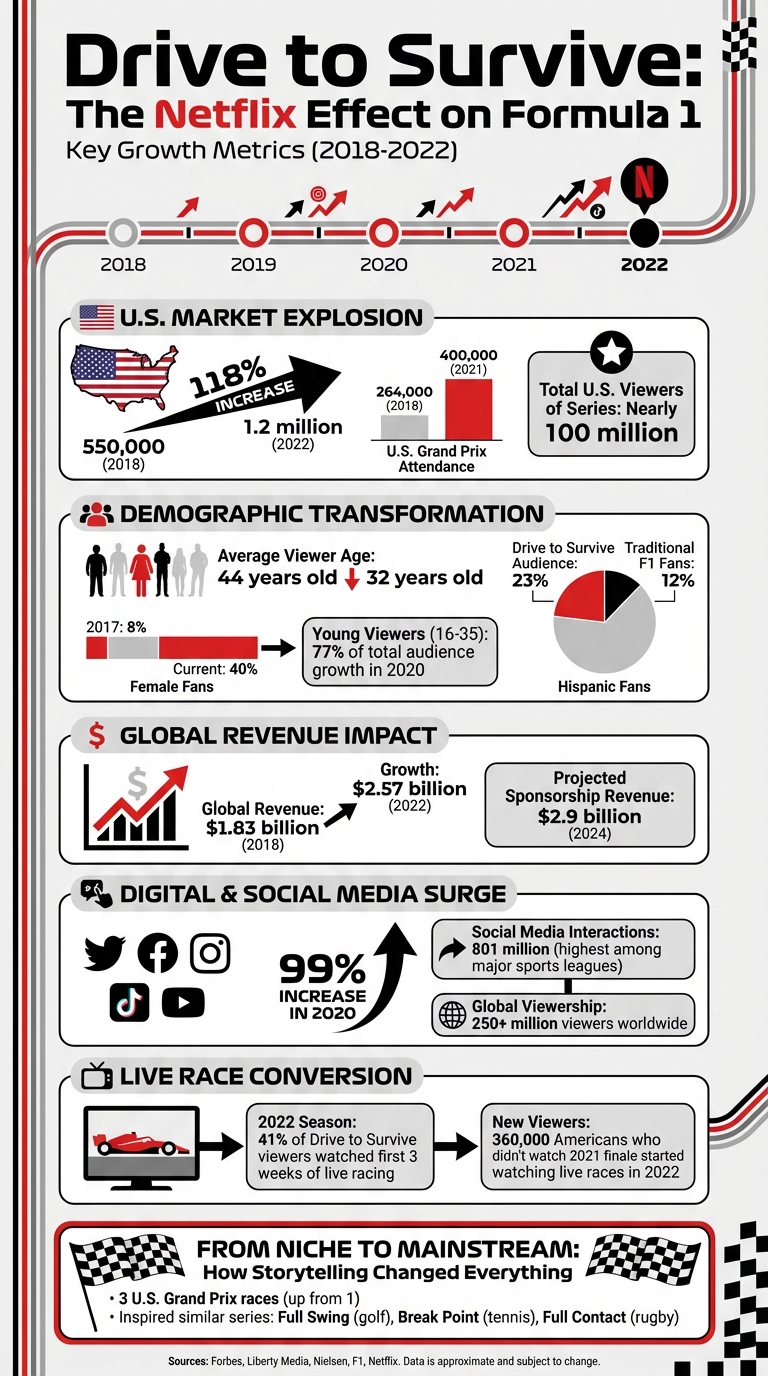
Netflix Drive to Survive Impact on Formula 1 Growth Statistics 2018-2022
How 'Drive to Survive' Began
Formula 1's Limited Audience Before Netflix
For years, Formula 1 catered to a niche audience - primarily older, wealthy fans. Bernie Ecclestone, the sport's former chief executive, openly dismissed the value of social media, once stating:
I'm not interested in tweeting, Facebook and whatever this nonsense is... I'd rather get to the 70-year-old guy who's got plenty of cash.
This mindset put the focus on high-end sponsors like Rolex, while younger fans were largely ignored. F1's absence on digital platforms made it feel out of touch, especially in an era dominated by online engagement.
The sport's technical jargon and complex commentary only added to its inaccessibility. For casual viewers, especially in the U.S., F1 seemed like a closed-off world. Making matters worse, the strict rules before 2017 barred drivers from sharing behind-the-scenes content on social media, limiting their ability to connect with fans and build personal brands. This left the sport feeling corporate and predictable, with powerhouse teams like Mercedes and Ferrari often dominating the conversation.
These challenges created the perfect opportunity for a fresh approach.
The Goals Behind 'Drive to Survive'
Recognizing these barriers, Formula 1's new leadership team took bold steps to modernize the sport. In January 2017, Liberty Media completed its $4.4 billion purchase of F1. This marked a turning point, as the new owners embraced a digital-first strategy to reinvigorate the sport's global appeal. Sean Bratches, a key figure in this transformation, pushed for F1 to partner with a streaming platform to reach untapped audiences.
The collaboration with Netflix aimed to achieve three things: make Formula 1 more relatable, break into the U.S. market, and attract younger viewers accustomed to streaming. Ian Holmes, F1's Director of Media Rights, highlighted the impact of this shift:
Netflix has enabled us to showcase the sport in a whole different light, making the drivers and team principals overnight celebrities to a new audience.
However, the debut season of Drive to Survive faced immediate hurdles. Ferrari and Mercedes - the sport's dominant teams - opted out of filming in 2018, citing concerns about potential distractions and the risk of exposing sensitive technical data. This forced the producers to turn their cameras toward smaller teams like Haas and Renault, giving underdog stories a chance to shine. Figures like Haas team principal Guenther Steiner quickly became fan favorites. Reflecting on the show's approach, Steiner explained:
Each race should have a story, and the story should not be all the time Mercedes or Ferrari wins, because that story gets old pretty quickly.
How the Series Grew F1's Audience: The Numbers
Changes in Viewer Demographics
Drive to Survive has dramatically reshaped F1's audience. Since the show's debut in 2019, the average age of F1 TV viewers has dropped significantly, from 44 to just 32 years old. By 2020, younger viewers in the 16-to-35 age group made up a staggering 77% of F1's total audience growth. This shift highlighted the series' ability to attract a younger, tech-savvy audience - one that Bernie Ecclestone, F1's former chief, had previously overlooked.
The gender dynamics also saw a striking transformation. Female fans now account for roughly 40% of the F1 fanbase, a substantial increase from just 8% in 2017. Ethnic diversity within the audience also grew, with Hispanic fans making up 23% of the Drive to Survive-inspired audience compared to 12% of the traditional F1 fanbase. On top of that, these new fans tended to be wealthier, with 69% earning $100,000 or more annually, compared to 49% of non-Drive to Survive viewers.
These demographic shifts paved the way for F1's rapid growth in both viewership and market value.
Growth in the United States Market
The U.S. market, once considered a tough nut to crack for F1, saw explosive growth thanks to the series. Nearly 100 million U.S. viewers have watched Drive to Survive. Nielsen data from May 2022 revealed that 360,000 American viewers who hadn’t watched the 2021 F1 season finale began tuning into live races in 2022 after watching the show.
This impact wasn't limited to TV screens. Attendance at the United States Grand Prix in Austin, Texas, jumped from 264,000 in 2018 to an impressive 400,000 by October 2021. This surge in popularity led F1 to expand its presence in the U.S., adding races in Miami and Las Vegas, bringing the total to three American events. Zak Brown, CEO of McLaren Racing, summed it up perfectly:
"It's got to be the single most important impact in North America. Almost every comment you get out of someone out of the U.S., they reference 'Drive to Survive.'"
Worldwide Fan Growth and Engagement
Globally, Drive to Survive has propelled F1 to new heights. With over 250 million viewers worldwide, the sport's revenue climbed from $1.83 billion in 2018 to $2.57 billion in 2022, with sponsorship revenue projected to reach $2.9 billion by 2024. English-speaking countries, in particular, saw significant fan growth: 37% of new fans were in the U.S., 12% in the U.K., and 9% in Australia.
Social media engagement also skyrocketed. In 2020 alone, F1 experienced a 99% spike in social media interactions, hitting 801 million - the highest growth among major sports leagues that year. This digital momentum carried forward, with 41% of Drive to Survive viewers tuning into the first three weeks of the 2022 live racing season. The series didn’t just attract casual viewers; it turned them into passionate fans, boosting digital activity and strengthening their connection to the sport.
How Storytelling Made F1 More Relatable
Showing the Human Side of Drivers and Teams
Drive to Survive broke through the barrier of anonymity created by racing helmets, offering fans a glimpse into the emotions, personal lives, and personalities of F1 drivers. As MAT Foundry put it, "It is, after all, hard to relate to someone behind a helmet". By pulling back the curtain, the show transformed drivers from mere technical experts into relatable individuals.
Instead of focusing solely on race results, the series leaned into the personalities within the sport. Guenther Steiner, Haas F1 Team Principal, became a fan favorite thanks to his unfiltered reactions to challenges, proving that emotional honesty can resonate even when a team isn’t winning. Similarly, Daniel Ricciardo's charm and humor captured hearts, showing that charisma can shine regardless of on-track performance.
The show also highlighted rivalries, particularly the tension between Red Bull’s Christian Horner and Mercedes’ Toto Wolff, adding an extra layer of drama. One of the most gripping moments came after Romain Grosjean’s fiery crash at the Bahrain Grand Prix in November 2020. The narrative shifted to the collective fear and relief felt by his colleagues and competitors, creating a deeply emotional and human moment.
By spotlighting these personal and dramatic stories, Drive to Survive turned F1 into more than just a sport - it became a stage for human triumphs and struggles.
Making Technical Complexity Accessible
Beyond humanizing the drivers, the series also made F1’s intricate technical world easier to understand. Featuring insights from journalists like Will Buxton, it transformed complex topics - such as pit stop strategies, tire wear, and aerodynamic tweaks - into compelling stories tied to personal stakes and team survival. What might have seemed like dry engineering details became gripping narratives that appealed to both seasoned fans and newcomers alike.
Through this approach, Drive to Survive didn’t just explain F1’s complexities - it made them part of the drama, ensuring that even the technical side of the sport felt accessible and engaging.
What 'Drive to Survive' Means for Sports Broadcasting
The Rise of Documentary-Based Sports Marketing
The explosive growth of Formula 1's fanbase owes much to Drive to Survive, a series that redefined sports marketing by turning casual viewers into dedicated fans. By pulling back the curtain on the sport's behind-the-scenes drama, it showed how documentaries could serve as a gateway to live events.
In May 2022, Nielsen published a study that quantified this phenomenon. It revealed that viewers who hadn’t followed the end of the 2021 F1 season began watching live races in 2022 after engaging with the series. This finding highlights how well-crafted, behind-the-scenes content can act as a powerful marketing tool for increasing live viewership.
Other sports leagues have taken note. Dan Singer, a Partner at McKinsey & Company, pointed out:
I can say that other leagues are building groups to pursue nonfiction program development because they see that effect that it's had in Formula One.
This trend has already inspired productions like Netflix's Full Swing for golf, Break Point for tennis, and Full Contact for rugby union. The formula is clear: technical coverage alone no longer suffices. Instead, personal rivalries and off-track drama are being used to deepen fan engagement. As ESPN's Director of Programming and Acquisitions, John Suchenski, aptly remarked:
A rising tide lifts all boats.
The overwhelming success of Drive to Survive has even sparked discussions about Netflix's broader role in Formula 1.
Netflix's Future Role in Formula 1
The success of the series has led to speculation about Netflix's ambitions in Formula 1, particularly regarding live race broadcasts. With over 250 million viewers tuning in to the series, the platform has demonstrated its ability to attract a massive global audience. This raises the question: Could Netflix eventually secure live broadcasting rights for F1?
Ian Holmes, Formula 1's Director of Media Rights, acknowledged the series' transformative impact:
Netflix has enabled us to showcase the sport in a whole different light, making the drivers and team principals overnight celebrities to a new audience.
The series hasn’t just changed how fans engage with the sport; it has also pushed F1 to innovate its broadcast strategies. By blending streaming documentaries with live race coverage, Formula 1 has tapped into a broader market. Between 2018 and 2022, F1's global revenue climbed from $1.83 billion to $2.57 billion, and sponsorship revenue is projected to reach $2.9 billion by 2024. These numbers suggest that documentary-style content doesn’t steal attention from live events - it amplifies it.
For now, Netflix seems content focusing on its documentary niche, while Formula 1 continues to enhance its own streaming platform, F1 TV. This service offers fans an in-depth experience, with features like multi-camera views and detailed race data. The success of Drive to Survive underscores how streaming platforms, armed with advanced audience insights, are reshaping sports broadcasting and fan interaction in ways traditional formats could never achieve.
Will Buxton Reveals How Drive To Survive Is Really Made
Conclusion
Drive to Survive did more than just introduce Formula 1 to new fans - it reshaped how the sport connects with people in today’s digital world. By moving the spotlight from technical details and lap times to the human stories behind the drivers and teams, Netflix turned Formula 1 from a niche motorsport into a global entertainment powerhouse. The numbers back it up, but the real takeaway is how storytelling has the power to redefine a sport's identity.
The series showed that emotions trump statistics when it comes to building a loyal fanbase. By making drivers and team principals household names and simplifying complex strategies into engaging narratives, Netflix turned casual viewers into die-hard enthusiasts. As Doug Matthews aptly put it, "Formula 1 did not change what it is. It changed how it is seen".
What’s more, Drive to Survive set off a ripple effect in the sports world. Other sports like golf, tennis, and rugby have jumped on the bandwagon, creating their own behind-the-scenes documentaries to replicate F1’s success. The message is clear: in the age of streaming and social media, fans want more than just the action - they want to see the personalities, rivalries, and drama that traditional broadcasts often miss. By embracing this entertainment-first approach, sports don’t just gain viewers - they build thriving communities.
For those eager to dive deeper into Formula 1’s meteoric rise and its evolving landscape, F1 Briefing (https://f1briefing.com) offers detailed analysis of the sport’s strategic and cultural transformations. It goes beyond the on-screen drama to explore the technical advancements, tactical decisions, and team dynamics that drive the sport forward, both on the track and behind the scenes.
FAQs
How has Netflix's 'Drive to Survive' changed the Formula 1 fanbase?
'Drive to Survive' has reshaped Formula 1 by making the sport feel personal and emotionally engaging. Instead of focusing solely on the technical aspects of racing, the series highlights the human side - drivers’ personal struggles, team rivalries, and behind-the-scenes drama. This shift has drawn in a younger, more diverse audience.
Take the U.S. as an example: the percentage of female viewers has nearly doubled, jumping from about 20% before 2019 to 40% in recent years.
By emphasizing storytelling, the show has expanded F1’s reach well beyond its core fanbase. This has directly impacted viewership, especially in the U.S., where audience numbers have doubled between 2018 and 2022. 'Drive to Survive' has helped transform Formula 1 into a sport that resonates with people across the globe.
What obstacles did Netflix's 'Drive to Survive' face when it first launched?
When Netflix's Drive to Survive debuted in 2019, it was met with some hesitation from the Formula One community. Many within the sport were uneasy about the show's focus on personal stories and rivalries rather than the intricate technical aspects that long-time fans cherished. There was a fear that this approach might lean too heavily on entertainment, potentially compromising the sport's authenticity.
Another concern was the risk of over-dramatization, which some thought could misrepresent Formula One. Yet, by showcasing the drivers' personalities and highlighting emotional, behind-the-scenes moments, the series succeeded in drawing in a much broader audience. This was especially true in the U.S., where it played a major role in growing Formula One's fanbase worldwide.
Could Netflix start broadcasting live Formula 1 races?
Netflix might step into the world of live Formula 1 broadcasting in the future. With ESPN’s exclusivity deal nearing its end, Netflix has shown interest in expanding its live sports portfolio, potentially bidding for the U.S. F1 broadcasting rights.
Considering the massive success of Drive to Survive - which played a huge role in boosting F1's global popularity - offering live race coverage seems like a logical move for Netflix. That said, nothing has been officially announced yet.