How Teams Manage Tire Degradation
Explains F1 tire degradation types, testing, driver techniques, and race strategies using telemetry and predictive models.
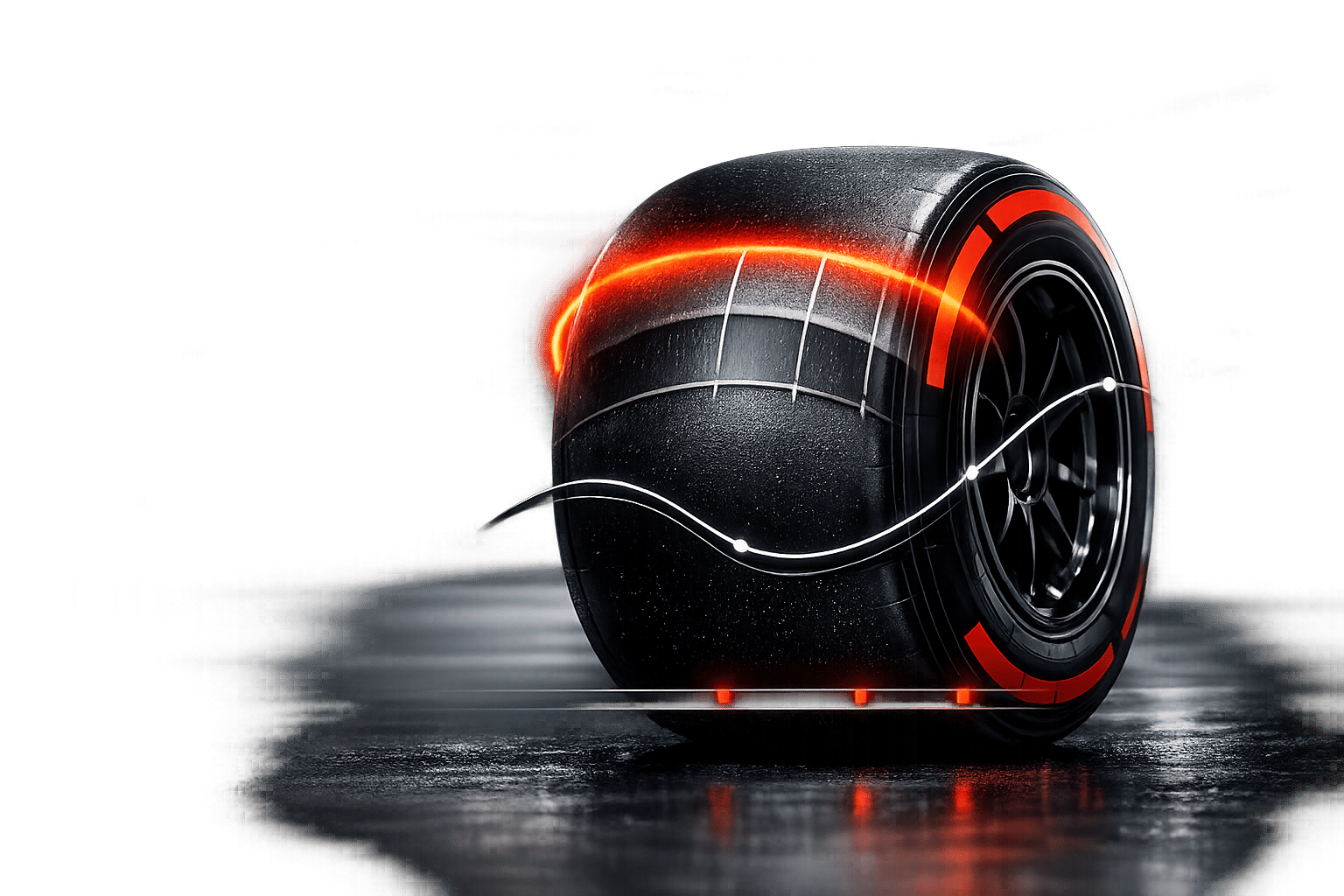
In Formula 1, managing tire degradation is a balancing act between maintaining speed and ensuring durability. Tire degradation refers to the gradual loss of grip and performance, influenced by factors like temperature, track surface, and tire pressure. Teams and drivers must decide when performance loss due to worn tires outweighs the time lost during a pit stop. Here's a quick breakdown:
-
Types of Tire Degradation:
- Graining: Happens at low temperatures, causing rubber chunks to tear off and reduce grip.
- Blistering: Caused by overheating, leading to surface bubbles and severe grip loss.
- Physical Wear: Visible rubber loss from abrasive tracks or aggressive driving.
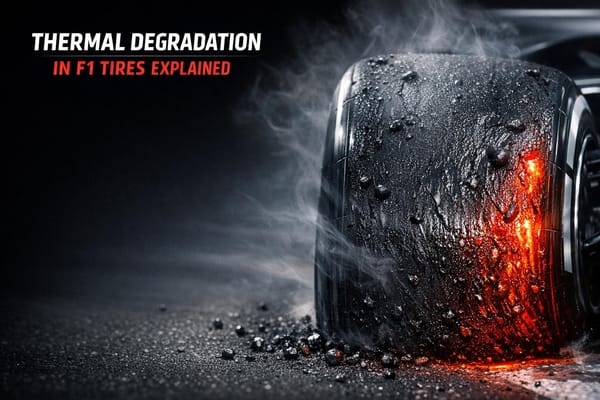
- Thermal Degradation: Overheating alters rubber structure, reducing performance without visible wear.
-
Key Factors:
- Track characteristics, temperature changes, and car setups (e.g., aerodynamics, brake bias) all impact tire wear.
- Smooth driving and controlled braking help prolong tire life.
-
Strategies:
- Teams use testing data, telemetry, and predictive models to plan pit stops and manage tire performance.
- Real-time adjustments and driver feedback are crucial during races.
For example, at the 2024 Italian Grand Prix, Charles Leclerc won by managing his tires effectively with a one-stop strategy, despite not setting the fastest lap times. Tire management isn’t just about speed - it’s about precision and timing.
McLaren’s GENIUS Tyre Trick Explained

What Causes Tire Degradation in F1
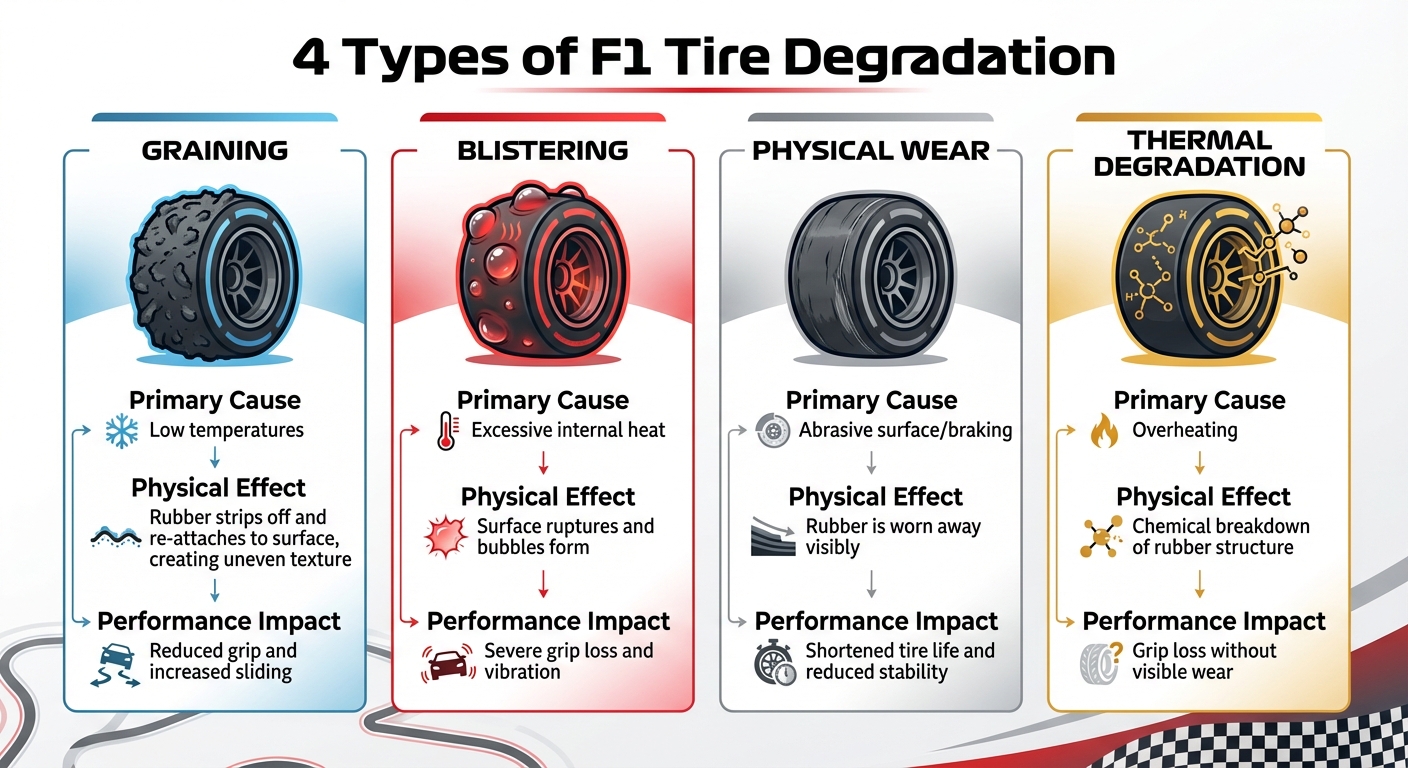
Four Types of F1 Tire Degradation: Causes and Effects
Tire degradation in Formula One refers to the gradual loss of performance and grip, which can happen even before visible signs of wear appear. This decline isn't just about the rubber wearing down; it’s also tied to changes in the tire’s molecular structure. Let’s break down the main types of degradation and what causes them.
The key to preventing degradation lies in managing tire temperatures with precision. F1 tires are designed to perform within a specific temperature range. When that range is exceeded - either too hot or too cold - the tire's performance drops. For instance, when a driver pushes too hard, the tires can overheat from excessive sliding, creating a cycle of heat buildup that quickly reduces grip and slows lap times. This can completely derail a race strategy.
Common Forms of Tire Degradation
Graining happens when tires aren’t warm enough. At lower temperatures, the tire rubber stiffens, losing flexibility. This can cause small chunks of rubber to tear off and then stick back onto the surface, creating an uneven texture that reduces grip.
"At low temperatures... the chains become ordered and stiff. When this happens on tyre rubber, it can cause sections of the rubber to fall off during the race, also called tyre graining", explains data analyst Zara Wang.
Blistering, on the other hand, is caused by excessive heat. When the tire’s internal temperature gets too high, the rubber’s structure breaks down, forming bubbles or blisters on the surface. A striking example occurred at the 2023 Belgian Grand Prix, where Williams Racing faced severe blistering after their "cake tins" (carbon components that regulate heat from the brakes) were damaged during a pit stop. Team Principal James Vowles noted:
"Our cake tins were broken, probably during a pit stop... I'm fairly convinced that's part of the reason why we suddenly had very significant degradation".
Physical wear refers to the visible loss of rubber from the tire surface due to abrasive track conditions, aggressive cornering, or heavy braking. Unlike thermal degradation, physical wear is easier to predict and manage. However, it still reduces tire life and can compromise stability.
Each of these forms of degradation is influenced by external factors and car setup, which we’ll explore next.
Environmental and Mechanical Factors
The characteristics of the track surface significantly affect how quickly tires degrade. For example, smooth circuits like Monza are gentle on tires, while abrasive tracks like Silverstone or Suzuka accelerate both wear and thermal stress. Additionally, shifts in temperature during a race weekend can turn a graining issue into blistering in a matter of hours.
Higher temperatures also increase tire pressure, which shrinks the contact patch and reduces grip. Car setup plays a role too - imbalanced setups that cause understeer or oversteer force the tires to slide, generating extra heat and speeding up wear. Even aerodynamics come into play; driving in "dirty air" behind another car reduces downforce, leading to more sliding and faster thermal degradation.
| Degradation Type | Primary Cause | Physical Effect | Performance Impact |
|---|---|---|---|
| Graining | Low temperatures | Rubber strips off and re-attaches | Reduced grip and increased sliding |
| Blistering | Excessive internal heat | Surface ruptures/bubbles | Severe grip loss and vibration |
| Physical Wear | Abrasive surface/braking | Rubber is worn away | Shortened tire life and stability |
| Thermal | Overheating | Chemical breakdown of rubber | Grip loss without visible wear |
How Teams Manage Tires During Testing
Testing sessions, especially during pre-season and Friday practice, are critical for teams to gather data that shapes their race strategies. The focus during these sessions isn't just on setting quick lap times. Instead, teams aim to understand how tires perform over an entire race distance under different conditions.
Replicating Race Conditions
To better predict tire behavior, teams simulate full race conditions during testing. A significant part of Free Practice 2 (FP2) is often dedicated to long runs instead of short bursts of speed. For instance, during the 2025 Austrian Grand Prix, Charles Leclerc's team used an FP2 long run on Medium tires to estimate a race pace of 69–69.5 seconds per lap. This established the "reset point" - the pace a fresh tire can deliver before degradation begins to affect performance.
Teams also account for variables like fuel load reduction and compound-specific degradation. For example, Hard tires degrade at a rate of 0.054 seconds per lap, while Medium tires degrade slightly faster at 0.060 seconds per lap. Since F1 cars start with up to 110 kg of fuel, which burns off steadily during the race, engineers model this weight reduction alongside tire wear. This approach helps isolate the true decline in tire performance from the lap time improvements caused by a lighter car.
Using Telemetry and Data Analysis
Real-time telemetry plays a key role in refining strategies during testing. By continuously monitoring tire temperature, pressure, and wear, teams can adjust car settings in real time to maximize performance. In June 2025, analyst Raul Garcia used the FastF1 library to evaluate Charles Leclerc's telemetry during the Spanish Grand Prix. The data showed how tire degradation forced Leclerc to modify his driving - braking earlier and applying throttle more cautiously to avoid wheelspin. These adjustments were measurable down to milliseconds per lap.
"In the era of new technologies, machine learning and GenAI, the ability to analyze data in real time has increased exponentially, effectively shrinking the margins teams are actively fighting for on the track", explains data analyst Zara Wang.
Advanced predictive tools have also transformed tire management. Bayesian state-space models, for example, allow teams to forecast tire degradation with impressive precision. In a November 2025 study, researchers Cole Cappello and Andrew Hoegh applied this method to Lewis Hamilton's data from the Austrian Grand Prix. Their model achieved a predictive accuracy (Total RMSPE of 1.082) that surpassed traditional forecasting methods like ARIMA, which had a baseline of 1.520. These models treat tire degradation as a hidden factor inferred from lap times, accounting for variables like fuel weight and driver consistency. This real-time insight is invaluable for making critical decisions, such as when to pit.
Driver Techniques for Tire Management
Drivers play a pivotal role in determining how long their tires last by focusing on steady, controlled driving. The gap between good and exceptional tire management often lies in consistency rather than outright speed. Drivers like Max Verstappen and Lewis Hamilton have shown their expertise by maintaining minimal lap-time variations over a stint, setting them apart from the rest.
Smooth Driving and Lift-and-Coast
Smooth driving forms the backbone of effective tire management. Abrupt actions - like sharp steering, sudden braking, or wheelspin during acceleration - can overheat tires and strip away rubber unnecessarily. The key is to keep tires within an optimal temperature range: overly aggressive driving can lead to blistering, while being too cautious might cause graining.
A great example of this was Lewis Hamilton's performance during the 2024 Italian Grand Prix. His ability to maintain consistent lap times stood out against the more erratic performances of other drivers, showcasing how smooth inputs can significantly impact tire longevity.
Another element that complements smooth driving is refining braking techniques to avoid excessive tire wear.
Adjusting Brake Bias and Avoiding Lock-Ups
Precise brake management is another critical factor in preserving tire performance. It ensures the tire maintains the ideal contact patch with the track. Overheated tires tend to expand, which reduces grip and makes handling more challenging. Drivers can mitigate this by tweaking their brake bias throughout the race and steering clear of lock-ups, which can cause flat spots and accelerate wear.
Charles Leclerc’s win at the 2024 Italian Grand Prix is a prime example of this strategy in action. By carefully adjusting his brake bias, Leclerc managed to extend the life of his hard tires during a demanding final stint. Even though his competitors had fresher tires, they struggled to match his pace.
"The combination of Leclerc's ability to manage tyre wear, maintain consistent lap times, and his commitment to a risky one-stop strategy ultimately secured him the win", explains data analyst Zara Wang.
When drivers combine smooth driving, calculated braking, and strategic adjustments, they create a comprehensive approach to managing tire degradation - an essential skill in the high-stakes world of Formula 1.
Race Day Tire Management Strategies
On race day, teams must combine testing insights with sharp decision-making to master tire management.
Tire Compound Selection and Pit Stop Timing
Teams rely heavily on pre-season testing data to fine-tune race-day strategies. During testing and practice sessions, engineers establish a "reset pace" - the baseline lap time for each tire compound (Hard, Medium, Soft) - and analyze tire degradation using linear regression. This approach helps quantify how quickly lap times deteriorate, typically measured in milliseconds per lap. For instance, at the Austrian Grand Prix, Lewis Hamilton's Hard tires degraded at a rate of 5.4 hundredths of a second per lap, while his Medium tires showed a slightly faster degradation rate of 6 hundredths per lap.
One of the biggest challenges is separating tire wear from other factors affecting performance, such as fuel burn. By isolating the impact of fuel consumption, engineers pinpoint the moment when the time lost due to tire wear outweighs the pit stop time. This calculation is crucial for deciding between a one-stop strategy, which emphasizes tire conservation, and a multi-stop approach, which allows for higher pace but requires more pit stops.
"Deciding to make a pitstop is a delicate balance, and can easily affect a competitor's results", says Cole Cappello from Montana State University's Department of Mathematical Sciences.
When the race begins, all plans remain flexible, with real-time data and driver feedback shaping adjustments.
Real-Time Adjustments and Team Communication
Once the lights go out, tire strategy becomes a dynamic game. Engineers continuously monitor tire degradation, both overall and lap-by-lap, to determine whether the tires are performing as expected or starting to "fall off". This real-time data allows teams to adapt strategies mid-race. For example, a planned two-stop strategy might shift to a one-stop if tire wear proves to be less severe than predicted.
Driver feedback plays a critical role in spotting early signs of performance decline, such as understeer or rear instability, often before telemetry data fully reflects the issue. Engineers then provide drivers with target lap times to keep the tires within their optimal operating range, avoiding the overheating and accelerated wear caused by overly aggressive driving.
Advanced analytics have become a game-changer, enabling teams to make rapid strategic shifts during the race. At the 2024 Italian Grand Prix, Ferrari demonstrated this advantage. By adjusting their strategy in real time, they helped Charles Leclerc maintain consistent lap times around 83 seconds during his stint. This precision allowed him to secure victory, despite not recording one of the fastest laps of the race.
Conclusion: Balancing Speed and Tire Life
In Formula One, tire management isn’t about choosing between speed and durability - it’s about finding the perfect balance. Teams that excel in this area often dominate races, even without setting the fastest lap times. A great example of this was the September 2024 Italian Grand Prix. Charles Leclerc clinched victory despite having only the 10th fastest lap, while Lance Stroll, with the 6th fastest lap, ended up finishing 19th.
A key takeaway here is understanding the difference between physical tire wear and performance degradation. Drivers like Max Verstappen and Lewis Hamilton showcase their expertise by maintaining consistent lap times, with variations as tight as -0.28 to +0.22 seconds. In contrast, less seasoned drivers can see fluctuations exceeding 1.3 seconds.
"The management of degradation between cars, tracks, and conditions is arguably the difference between fighting for the championship and simply competing", GPBlog explains.
Modern strategies lean heavily on real-time telemetry to fine-tune tire performance. Teams rely on testing to establish baseline degradation rates, use practice sessions to refine compound choices, and make real-time adjustments on race day. These strategies allow for split-second decisions, such as when to make crucial pit stops, ensuring every move is backed by data.
FAQs
How do teams know when a tire will “fall off”?
Teams use telemetry data - such as tire temperature, pressure, and wear indicators - alongside advanced modeling techniques to predict when a tire’s performance will decline sharply. This analysis helps forecast when grip will significantly decrease. By closely monitoring factors like heat buildup and abrasion, teams can time pit stops with precision, ensuring tires are replaced before they lose effectiveness or become a safety concern.
What’s the difference between graining and blistering?
Graining happens when tiny rubber particles, often called marbles, accumulate on the tire's surface. This usually results from excessive heat or aggressive driving, leading to uneven grip and a drop in performance. Blistering, however, is when bubbles or blisters appear on the tire's surface due to overheating or chemical reactions. This can cause a sudden loss of grip or even tire failure.
Why can a slower pace win with a one-stop strategy?
A slower pace can work well with a one-stop strategy because it allows drivers to better manage tire wear. By maintaining tire performance over a longer period, they can avoid making extra pit stops. This helps balance out the time lost from driving at a slightly lower speed.