Mental Health Risks of Intense F1 Rivalries
How intense F1 rivalries amplify physical stress, anxiety and burnout in drivers - and why standardized team and regulatory mental health support is essential.

Formula 1 rivalries push drivers to their physical and mental limits. Beyond the thrill of competition, these intense battles can lead to serious mental health struggles. Drivers face extreme physical demands, relentless schedules, and constant pressure from fans, media, and sponsors. Rivalries often amplify these stresses, creating a perfect storm for anxiety, depression, and burnout.
Key takeaways:
- Physical toll: Drivers endure high heart rates, extreme g-forces, and strict weight requirements, which can cause hormonal imbalances and mental health challenges.
- Psychological strain: Social media harassment, contract uncertainty, and perfectionism add to the pressure.
- Historical examples: Nico Rosberg retired after his rivalry with Lewis Hamilton, citing mental health struggles. Lando Norris and Lewis Hamilton have also opened up about their battles with anxiety and depression.
- Team initiatives: Teams like Mercedes and McLaren now integrate mental health support, including psychologists and wellness programs.
The takeaway? F1 drivers need more consistent mental health support to manage the pressures of the sport. Teams and governing bodies must prioritize well-being alongside performance to ensure drivers thrive both on and off the track.
Mental Health Statistics and Pressures in Formula 1 Racing
Physical and Mental Stressors in F1 Rivalries
Physical Demands and Mental Health Effects
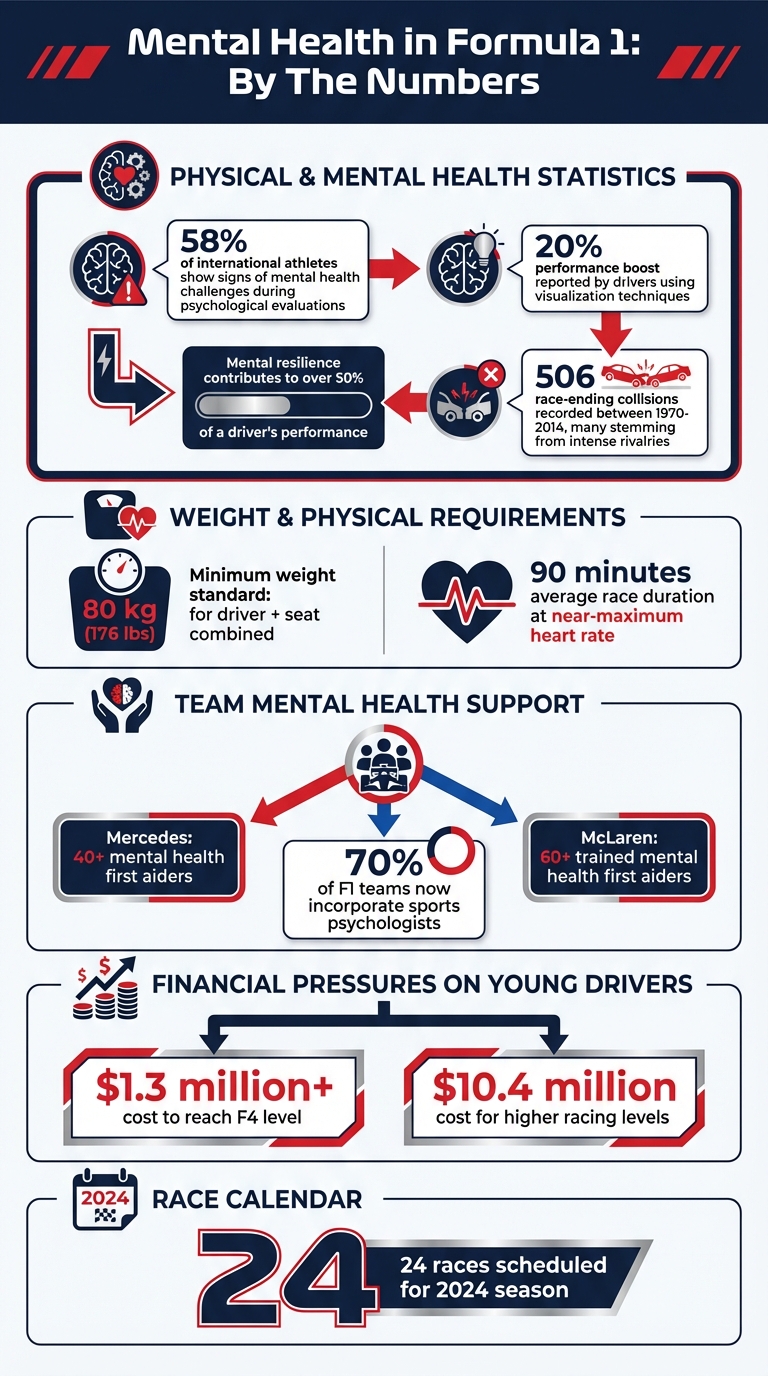
Formula 1 drivers endure grueling physical challenges during a race. Over the course of 90 minutes, their heart rates push near maximum levels, they experience intense g-forces, and they battle extreme heat inside the cockpit. Fireproof suits only add to the thermal stress, especially during races in hot climates like Qatar. On top of that, drivers must manage the weight of a heavy helmet, make split-second decisions, and apply significant pressure to the brake pedal - repeatedly and with precision.
This relentless physical strain activates the hypothalamic-pituitary-adrenal (HPA) axis, flooding the body with stress hormones. Over time, this can disrupt brain chemistry, contributing to issues like anxiety, depression, and even sleep disorders. Research shows that 58% of international athletes display signs of mental health challenges during psychological evaluations. For F1 drivers, the situation can be even tougher due to strict weight regulations. Drivers, including their seat, cannot exceed 80 kg (about 176 pounds). To meet these limits, some resort to extreme calorie restrictions, which can lead to low energy levels, hormonal imbalances, and an increased risk of depression. These physical demands often amplify the psychological toll, especially in the heat of intense rivalries.
Psychological Pressures of Driver Rivalries
The mental strain of F1 isn’t just about the physical toll - it’s magnified by the fierce rivalries that define the sport. Drivers face constant psychological pressure, balancing their own perfectionist tendencies with the expectations of fans, media, and team sponsors. The stakes are always high, with the looming possibility of losing their seat during competitive contract negotiations.
Social media adds another layer of stress. Drivers often encounter harassment and, in some cases, even death threats, all of which can take a heavy toll on their mental wellbeing. On top of that, mandatory media appearances and sponsor commitments leave little time for recovery, as their public image directly impacts team revenue.
To combat these challenges, many F1 teams - roughly 70% - now incorporate sports psychologists into their training programs. Drivers who use techniques like visualization have reported performance boosts of up to 20%. These efforts highlight the growing recognition of mental health as a critical component of success in such a high-pressure environment.
Case Studies: How Rivalries Affect Driver Mental Health
Mental Health Impact in Historical Rivalries
Throughout F1 history, intense rivalries have taken a significant toll on drivers' mental well-being. A study analyzing F1 races from 1970 to 2014 revealed 506 race-ending collisions, many of which stemmed from heightened rivalries between drivers of similar skill levels. When competitors are evenly matched, the lack of a clear "superior" driver often fuels relentless competition and constant scrutiny. This dynamic has frequently led to dangerous on-track incidents, particularly among drivers close in age and performance.
Damon Hill, the 1996 World Champion, is a striking example of how these pressures can affect drivers. Despite his success, Hill later shared how the mental strain of racing left him feeling overwhelmed:
I was worthless and not going to make it. It got so bad I went to the manager and said I needed a break and I couldn't cope.
These past examples provide valuable context for understanding how mental health challenges continue to manifest in the high-pressure world of modern F1.
Recent Examples of Driver Mental Health Struggles
The mental health challenges tied to F1 rivalries are far from a thing of the past. Nico Rosberg's fierce rivalry with Lewis Hamilton between 2014 and 2016 is a case in point. The stress of competing at such a high level ultimately led Rosberg to retire immediately after securing the 2016 championship. Reflecting on his decision, he explained:
In the end [after winning the 2016 title], however, my life and mental health were on the line.
For Valtteri Bottas, the pressures of meeting F1's strict weight requirements - drivers and their seats must weigh at least 176 pounds (80 kg) - triggered an eating disorder that required professional intervention.
Lewis Hamilton has also opened up about his struggles, describing a lifelong battle with depression made worse by the unique pressures of racing, as well as experiences with bullying and racism:
I have struggled mentally and emotionally for a long time, to keep going is a constant effort.
Lando Norris has been another voice shedding light on mental health in F1. During his rookie season in 2019, Norris faced crippling anxiety. Partnering with the mental health charity Mind and working closely with team psychologists helped him develop vital coping strategies.
These modern examples highlight how the intense environment of F1 continues to challenge drivers' mental health, underscoring the need for support systems both on and off the track.
How Teams and F1 Organizations Address Mental Health
Team-Based Mental Health Programs
F1 teams are stepping up their efforts to tackle the psychological demands of the sport, especially those intensified by fierce rivalries. Many have established structured programs to support drivers' mental well-being. McLaren, for instance, has a dedicated Human Performance team that includes psychiatrists, psychologists, physiotherapists, and nutritionists. This team works closely with drivers to help them handle the immense pressures they face. As Tom Stallard, McLaren's Senior Principal Race Engineer, put it:
The aim was to establish an environment where the team was supported as elite athletes, independent of their role.
McLaren also has over 60 trained mental health first aiders who are available to provide immediate support during moments of stress caused by competition.
Mercedes has adopted a similar approach, with more than 40 mental health first aiders and a Wellbeing Manager, Chris Armstrong, who oversees programs focused on physical and mental recovery. They also use Instahelp, a digital platform offering drivers confidential access to professional psychological support. Armstrong underscores the value of open communication:
Silence can often be negative, in terms of performance. Speaking up and having regular conversations can be a really positive thing.
The Haas F1 Team introduced the Mental Health at Work Allies Scheme in 2023. Staff members wearing green ribbon badges provide confidential support and guidance to those in need. Teams are also using advanced mental training techniques such as mindfulness exercises, biofeedback monitoring to measure stress in real-time, and visualization practices to prepare drivers for high-pressure race scenarios.
While these team-led initiatives are making strides, F1's governing bodies are also working to address mental health challenges throughout the sport.
F1 Regulations and Mental Health Support
F1 has implemented some regulatory changes aimed at easing specific mental health pressures. One notable step was the 2018 introduction of a minimum weight standard for drivers and seats, set at 176 pounds (80 kg). This rule helped eliminate unhealthy weight-loss practices that had been a major source of stress for drivers.
Despite these efforts, challenges remain. Mental health support across teams is inconsistent, with the quality of care often depending on individual team resources. The ever-expanding race calendar, which will include 24 races in 2024, adds further strain on drivers and team personnel. Unlike other sports, F1 has no mandatory staff rotation policies, despite calls for change from figures like Mercedes' Toto Wolff. Experts suggest that F1 should adopt standardized mental health protocols, similar to those used by the International Olympic Committee, and require mental health education for all teams and drivers.
Future Research and Recommendations for F1 Mental Health
Research Gaps in F1 Mental Health Studies
While the physical and psychological demands of Formula 1 (F1) are well-documented, research on drivers' mental health remains scarce. Despite anecdotal reports of depression, anxiety, and eating disorders, there is limited data on psychiatric symptoms among drivers. This is partly due to the small sample size of the F1 community, with only around 20 active drivers and 30–50 reserve drivers per season, making large-scale studies challenging.
Another major gap lies in gender-specific research. As the F1 Academy works to nurture female talent, the lack of studies addressing gender-specific mental health needs in motorsport becomes increasingly pressing. Additionally, there is no longitudinal data tracking drivers' mental health from their early karting days through retirement, leaving the long-term effects of sustained high-pressure competition largely unknown.
Team-specific mental health protocols often remain proprietary, limiting opportunities for independent validation. Moreover, much of the existing research focuses on mental health solely as it relates to performance - such as improving lap times - rather than addressing clinical issues like anxiety or depression, regardless of on-track outcomes. Jill Colangelo from the University of Bern's Department of Forensic Psychiatry underscores this need:
It is imperative to integrate mental health into driver science and larger discussions of psychopathology in elite sports.
To truly support F1 drivers, addressing these research gaps is crucial.
Steps to Support Driver Mental Health
Given these gaps, several actionable steps could help protect the mental health of F1 drivers. First, introducing standardized mental health protocols across all teams and junior academies would ensure consistent, evidence-based care. Following the International Olympic Committee's (IOC) model, such protocols could include mandatory mental health education for drivers, team managers, and support staff to combat stigma and promote early intervention.
Regulatory changes are also worth considering. For example, Toto Wolff has proposed allowing drivers and team members to skip up to five races in a 23-race season to avoid burnout. He explained:
From 23 races, being able to take five out, makes a huge difference for every individual that is in the sport.
Adjustments to travel logistics and race schedules could also help reduce stress, particularly by minimizing time zone changes and addressing sleep deprivation.
Young drivers in feeder programs face unique pressures, with financial costs to reach F4 exceeding $1.3 million and climbing to $10.4 million for higher levels. This financial burden heightens stress, making it essential to introduce limits on training hours and awareness programs tailored to their needs. Additionally, providing mandatory counseling for retiring drivers could help them navigate challenges like identity loss, depression, and chronic pain as they transition out of the sport.
F1 Drivers Open Up On The Pressures They Face: World Mental Health Day
Conclusion: Managing Rivalries and Mental Health in F1
Formula One thrives on intense rivalries, but the sport's allure doesn't have to come at the expense of driver well-being. Studies show that mental resilience contributes to over 50% of a driver's performance, making psychological support not just a moral responsibility but also a strategic advantage. Teams like Mercedes, with more than 40 trained mental health first aiders, and McLaren, through its collaboration with the charity Mind, are proving that investing in mental health can deliver those crucial gains in a sport where milliseconds matter.
The way forward for F1 lies in blending fierce competition with practices that support long-term well-being. This could mean introducing standardized mental health protocols across teams, separating mental health initiatives from performance metrics, and treating psychological care with the same seriousness as physical training. As Toto Wolff, Team Principal and CEO of Mercedes-AMG PETRONAS F1 Team, aptly put it:
I think it gives you an edge in understanding yourself. If you understand yourself, it's much easier to understand others.
A balanced approach like this is crucial as the sport continues to evolve. Practical changes could include allowing drivers and team members to skip non-essential obligations, reworking travel schedules to combat fatigue, providing private spaces during marathon race weekends, and using data to foresee and resolve potential tensions.
This shift - from seeing drivers as "gladiators" to acknowledging them as elite athletes who need comprehensive support - marks a cultural transformation within F1. With prominent figures like Lewis Hamilton and Lando Norris candidly discussing their mental health challenges, the stigma around these issues is fading. The future of Formula One depends on keeping its competitive spirit alive while ensuring that its stars can perform at their peak - both on and off the track.
FAQs
How do intense rivalries in Formula One impact drivers' mental health?
Intense rivalries in Formula One create a high-pressure environment that can deeply impact drivers' mental health. The constant push to outperform competitors often leads to stress, anxiety, and even feelings of isolation. Drivers are under the microscope of media and fans, where even the smallest mistakes or subpar performances can magnify emotional challenges.
Adding to this, the grueling F1 schedule - with its frequent travel and relentless demands - can lead to burnout and, in some cases, depression. Over the years, several drivers, including well-known figures in the sport, have spoken openly about their mental health struggles, highlighting the toll that pressure and rivalry can take.
To combat these challenges, Formula One has started placing greater importance on mental health support. Efforts like counseling services and resilience training are becoming more common, aiming to equip drivers with tools to better handle the unique stresses of their profession.
How do F1 teams support drivers' mental health?
F1 teams are putting more emphasis on drivers' mental health to tackle the intense psychological challenges of the sport. Many now have sports psychologists on staff to help drivers develop resilience, manage stress, and stay focused when the pressure is at its peak. These experts provide strategies for handling setbacks, dealing with media scrutiny, and navigating the emotional ups and downs of competition.
In addition to this, teams are rolling out tailored mental health programs. These often include resilience training and creating structured routines aimed at supporting drivers' overall well-being. By encouraging open discussions about mental health and weaving psychological care into their broader support systems, F1 teams are creating an environment where drivers can perform at their best - both on and off the track.
Why should Formula One adopt standardized mental health protocols?
Formula One drivers and team members deal with overwhelming psychological pressure. The relentless competition, sky-high expectations, constant media attention, and grueling schedules can take a serious toll. This intense environment often leads to challenges like anxiety, burnout, and emotional strain, highlighting the importance of mental health support.
Introducing standardized mental health protocols could make a real difference. These protocols would ensure consistent care across the board, promote early intervention, and equip individuals with effective coping strategies - much like the practices already in place for physical health. By making mental well-being a priority, F1 can create an environment where its people can excel both on the track and in their personal lives.