Qualifying vs Race Day: Tire Strategy Differences
Qualifying demands razor-thin tire precision for a single fast lap; race day rewards durability, pit timing, and adaptable compound strategies.
Tire strategy in Formula One is a game-changer. Qualifying and race day require completely different approaches to tire management, and understanding these differences can make or break a team's performance. Here's the key takeaway:
- Qualifying focuses on squeezing maximum grip out of soft tires for a single flying lap. The goal? Peak performance within a razor-thin temperature range to secure the best grid position.
- Race day prioritizes durability and efficiency. Teams balance speed, tire wear, and pit stop timing to optimize performance over multiple laps.
Quick Overview:
- Qualifying: Soft tires, short stints, low fuel loads, and precise setups for peak grip.
- Race Day: A mix of tire compounds, long stints, and strategies shaped by pit stops, track conditions, and regulations.
The article dives into how tire compounds, setups, and strategies differ between these two critical phases of a race weekend. It also highlights real-world examples, regulatory impacts, and the evolving role of technology in shaping tire performance.
Every F1 Tire Strategy Explained in 13 Minutes
Qualifying Tire Strategy: Maximizing Single-Lap Pace
Qualifying in Formula 1 is all about squeezing every fraction of a second out of a single flying lap. Unlike race day, where durability plays a key role, qualifying is laser-focused on achieving peak grip - that fleeting moment when the tire delivers its maximum performance. Durability takes a backseat as teams zero in on the tire's narrow thermal window to extract the best lap times. With the entire 20-car grid often separated by just over a second, these tiny margins can mean the difference between pole position and starting mid-pack. This is where the role of soft compounds becomes absolutely crucial.
Soft Tire Requirements in Qualifying
Soft tires are the go-to choice for qualifying because they offer the fastest base pace compared to other compounds - about 0.7 seconds per lap faster than the medium tire. This speed advantage comes from the softer rubber's ability to generate grip almost instantly. However, this performance comes at a cost: the tire operates within a much narrower temperature range. Mario Isola, Pirelli's Head of F1 and Car Racing, highlights this challenge:
"During a flying lap, the driver strives for peak grip while preventing tire overheating. We are talking about a very narrow field, because we are trying to eliminate this 3% deviation that exists between the working range line and peak grip".
The preparation lap, known as the out-lap, is critical for getting the tires into this optimal range. Drivers carefully balance the temperatures of the front and rear tires. The front tires heat up primarily through braking, while the rear tires gain temperature through traction and acceleration. On tracks like Barcelona, drivers deliberately start their flying lap with rear tires slightly cooler than ideal, ensuring they don’t overheat in the traction-heavy final sector.
Setup Adjustments for Qualifying
To complement the demands of soft tires, car setups for qualifying differ significantly from race configurations. With the added grip from fresh soft tires, teams can push aerodynamic and mechanical setups to the limit. Eric Blandin, Deputy Technical Director at Aston Martin Aramco F1 Team, explains:
"In qualifying you will typically adjust the front wing flap to put more aero balance on the front axle. When they are new, the tires offer a lot more mechanical grip... so you can put more load on the front axle".
Teams also run low fuel loads to reduce weight and maximize speed. Aggressive negative camber settings ensure the tires maintain an optimal contact patch during high-speed cornering. Additionally, drivers tweak brake balance on the out-lap to quickly warm up the slower-heating front tires. F1 regulations allow teams to preheat slick tires in blankets up to 158°F (70°C) for two hours before a session, giving them a head start in reaching the ideal temperature.
Risks of Over-Pushing Tires
Pushing too hard during qualifying can backfire. Over-pushing can lead to graining, where the tire surface tears before reaching its working temperature, permanently reducing grip. If the thermal ceiling is exceeded, performance can drop off sharply. Isola warns:
"All you need to do is go out of the window by about 10-degrees and you will lose the peak grip".
Excessive heat can also cause internal pressure to spike, leading to a "ballooning" effect that reduces the contact patch and accelerates overheating. On tracks with long straights, such as Baku, surface temperatures can drop by as much as 54°F (30°C) between acceleration zones, forcing drivers to anticipate reduced grip at the next braking point. The slim margin for error in tire management during qualifying means that even the smallest mistake can cost multiple grid positions, highlighting just how different qualifying strategies are from race day approaches.
Race Day Tire Strategy: Balancing Performance and Durability
On race day, the focus shifts from sheer speed to finding the perfect balance between performance and durability. Unlike qualifying, where the goal is to extract maximum grip for a single lap, races require managing tire wear over multiple stints. Teams must carefully weigh the benefits of fresh tires against the roughly 22-second time penalty for a pit stop.
Flexible Tire Allocations
Race day offers teams more freedom in choosing tire compounds compared to qualifying, where soft tires dominate for their short-term speed. As McLaren Racing Director Randeep Singh puts it:
"There are two fundamental factors that give you a baseline for the right strategy: tire behavior and pit loss. The worse the tire behavior, the more stops you want to make, and the higher the pit loss, the fewer the stops you want to make".
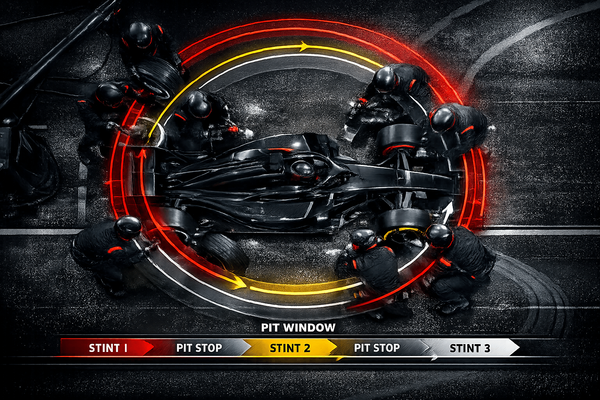
Teams analyze tire performance using three key metrics: base pace (speed when new), degradation (how quickly performance drops), and tire life (how long the tire stays competitive). Soft tires, for example, offer better speed early on but typically last about 15 laps, while medium compounds stretch closer to 25 laps. Hard tires trade initial speed for long-lasting durability, making them ideal for reducing pit stops during longer stints. These choices directly shape multi-stint strategies throughout the race.
Multi-Stint Planning
To find the fastest path to the finish line, teams rely on billions of simulations. These models compare different compound combinations - like two soft stints versus two medium stints - or evaluate the risks and rewards of a one-stop versus a two-stop strategy. A standout example occurred at the Italian Grand Prix in Monza in September 2024. Ferrari’s Charles Leclerc opted for a one-stop strategy using hard tires, maintaining steady lap times around 83 seconds to claim victory, while most competitors chose a two-stop approach.
During the race, teams use Monte Carlo simulations to account for live variables such as traffic, overtaking challenges, and rival speeds. Strategies like the "undercut" (pitting early to use fresh tires for overtaking) or the "overcut" (staying out longer to avoid traffic) are critical decisions made in real time. Even the most detailed pre-race plans must adapt to the unpredictable nature of a race.
Adapting to Changing Conditions
Race conditions often throw unexpected challenges. Safety Cars, for instance, can drastically alter strategies by reducing the time lost during a pit stop. Slower race conditions make pit stops "cheaper", prompting many teams to pit simultaneously .
Weather changes add another layer of complexity. Shifts in track temperature can push tires out of their optimal range, leading to issues like graining or blistering. At the Qatar Grand Prix in November 2025, extreme lateral loads forced Pirelli and the FIA to enforce a 25-lap maximum per tire set, effectively ruling out one-stop strategies. Pirelli’s Director of Motorsport, Mario Isola, explained:
"These instances, noted mainly on the front-left, are exactly why the limit of 25 laps on each set has been imposed [for Qatar 2025]".
Unlike qualifying, which is all about achieving peak grip, race day is a constant exercise in adaptation. Drivers must keep their tires within the optimal range determined during qualifying, while also adjusting to changing conditions and benefiting from a lighter fuel load as the race progresses. It’s a high-speed chess match where smart tire management often determines who stands on the podium and who doesn’t.
Qualifying vs Race Day: Key Strategy Differences
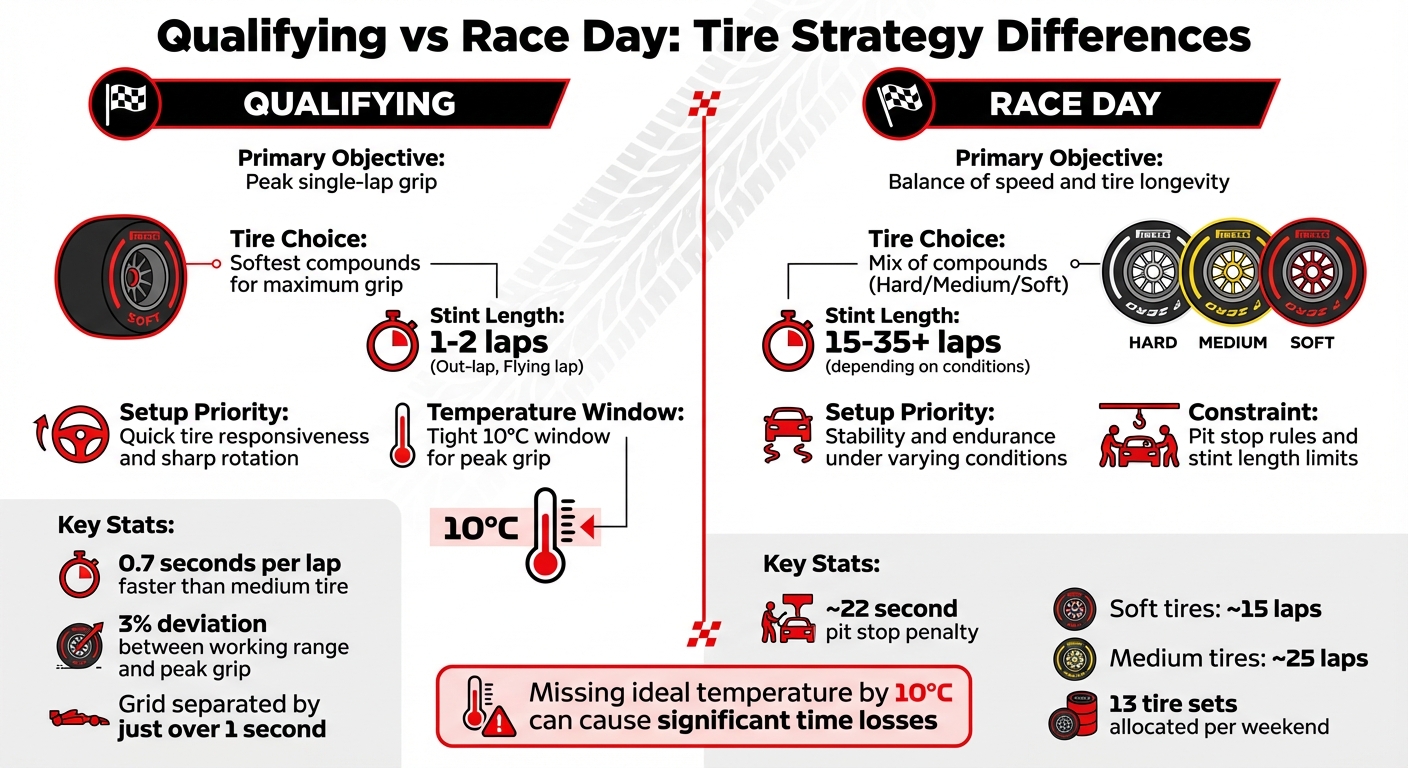
F1 Qualifying vs Race Day Tire Strategy Comparison
When it comes to tire performance, qualifying and race day strategies couldn't be more different. Qualifying is all about extracting maximum grip for a single flying lap, while race day demands a broader approach to ensure consistent performance over longer stints. The focus shifts from short bursts of speed to managing tires for durability and efficiency across multiple laps.
In qualifying, teams aim for the absolute peak of the tire's grip-to-temperature curve. As Mario Isola, Pirelli's Head of Car Racing and F1, explains:
"During a flying lap, the driver tries to get as close as possible to peak grip, but avoiding causing the tire to overheat. We are talking about a very narrow field, because we are trying to eliminate this 3% deviation that exists between the working range line and peak grip."
On race day, this narrow target expands into a broader working range. Teams focus on managing tire degradation over stints that can range from 15 to 35 laps or more. Missing the ideal temperature range by even 10°C during qualifying can result in significant time losses. Therefore, the car's setup changes dramatically between these two scenarios: qualifying setups prioritize instant responsiveness and rotation, while race setups aim for thermal stability and consistent performance, even in turbulent air.
Tire Strategy Comparison Table
Here's a quick breakdown of how strategies differ between qualifying and race day:
| Factor | Qualifying Strategy | Race Day Strategy |
|---|---|---|
| Primary Objective | Peak single-lap grip | Balance of speed and tire longevity |
| Tire Choice | Softest compounds for maximum grip | A mix of compounds (Hard/Medium/Soft) to meet regulations |
| Stint Length | 1–2 laps (Out-lap, Flying lap) | 15–35+ laps, depending on conditions |
| Setup Priority | Quick tire responsiveness and sharp rotation | Stability and endurance under varying conditions |
| Constraint | Tight 10°C temperature window for peak grip | Pit stop rules and stint length limits |
How Regulations Shape Tire Strategies
FIA regulations play a significant role in shaping these strategies. Drivers are allocated 13 sets of dry-weather tires for a standard race weekend (12 for Sprint weekends), with an additional soft set for Q3 participants. This setup ensures that qualifying revolves around soft compounds, while race strategy must include at least two different compounds and one mandatory pit stop during a dry race.
Regulations can also change mid-season, forcing teams to adapt. For instance, during the 2025 Qatar Grand Prix, Pirelli and the FIA introduced a 25-lap maximum limit per tire set due to excessive graining on the front-left tires. This rule forced all teams into a two-stop strategy, regardless of their car's tire management capabilities. Mario Isola highlighted that the optimal approach was likely a Medium–Medium–Soft sequence, with teams pushing each tire set to the 25-lap limit. These kinds of regulatory adjustments directly influence how teams plan and execute their race strategies.
Case Studies: Tire Strategy Decisions
These examples highlight how carefully planned tire strategies can influence race outcomes by balancing top performance with endurance.
Mercedes: 2021 Abu Dhabi GP

During the 2021 Abu Dhabi Grand Prix, Mercedes showcased a smart approach to managing both qualifying performance and race-day durability. Under the rules, top-10 qualifiers had to start the race on the tires they used for their fastest Q2 lap. To prioritize a durable start, Mercedes opted for the Medium compound for Lewis Hamilton's Q2 session. This decision became crucial when Max Verstappen, a key rival, damaged his Medium tires with flat spots, forcing him to switch to Soft tires. For the race, Hamilton moved to Hard tires for his second stint, committing to a one-stop strategy that preserved his track position and extended tire life. With pit stops typically adding around 25 seconds to total race time, Mercedes calculated that avoiding an extra stop would be critical for maintaining control of the race. This strategy showed how prioritizing durability and track position could pay off, even as other teams approached the challenge differently.
Red Bull: 2024 Monza GP
The 2024 Italian Grand Prix at Monza highlighted a completely different strategy. Red Bull focused on maximizing single-lap performance by using Soft tires in qualifying, securing strong grid positions. However, on race day, Ferrari's car setup, which was more compatible with Hard tires, allowed them to execute a successful one-stop strategy and secure the win. In contrast, Red Bull's car struggled with higher tire degradation, forcing them into a multi-stop race. Known for their strategic tendency to run longer first stints and rely on late-race "Soft-enabled pass bursts" to leverage their superior top-end speed, Red Bull's approach reflected the limitations of their car's tire management. This contrast between Ferrari's tire-friendly setup and Red Bull's aggressive degradation profile demonstrated how car-specific behavior can determine whether qualifying speed translates into race success.
These cases highlight the trade-offs teams face when trying to convert strong qualifying performances into effective race-day strategies.
Technology and Regulations Shaping Tire Strategy
Tire Construction Developments
Recent advancements in tire technology and upcoming regulations are transforming how teams manage tire performance for both qualifying and race day. Pirelli's tire design focuses on two distinct performance zones: peak grip for single-lap qualifying speed and a broader working range for consistent race performance. Modern tire construction enhances this broader range, ensuring more stable performance over extended stints during races.
The switch to 18-inch tires in 2022 brought significant changes to thermal management. Teams now rely on intricate brake ducting systems to control heat generation and dissipation. Previously, tire warming depended on heat radiating from brake rims. However, with the introduction of ground-effect cars and larger-diameter tires, teams must manage temperature fluctuations with greater precision. For example, at circuits like Baku, tire surface temperatures can drop by as much as 54°F (30°C) along the main straight. These advancements are paving the way for the upcoming 2026 regulation changes, which promise to further redefine tire management strategies.
2026 Regulation Changes
The 2026 regulations will introduce significant shifts in tire strategy through two primary changes. First, the elimination of tire warmers will require drivers to generate operating temperatures mechanically during out-laps and formation laps. Second, the increase in electrical power output from 120 kW to 350 kW will change torque delivery, introducing new thermal stresses that will necessitate updated tire constructions.
Additionally, Pirelli plans to roll out 100% sustainable tire compounds by 2026. These compounds could alter optimal thermal windows and, when combined with expected active aerodynamics and reduced downforce, might allow for longer stints. However, this will place greater importance on how quickly drivers can bring tires into their working range without relying on external heating aids.
Conclusion
The gap between qualifying and race day tire strategies is one of Formula One's most critical performance factors. During qualifying, achieving peak grip requires operating within a tight 3% margin above the standard working range. Even a small deviation - like a 10°C temperature shift - can lead to significant time losses. As James Allison pointed out:
"Around the part of the battle we're fighting, a few hundredths can make a difference sometimes and a couple of tenths would make all the difference in the world".
Race day, on the other hand, is a completely different challenge. Teams must manage tire degradation over multiple stints while navigating unpredictable elements like Safety Cars, changing weather, and rival strategies.
Flexibility becomes the name of the game. Teams rely on Monte Carlo simulations ahead of race weekends to fine-tune their plans. McLaren's Randeep Singh explained this balancing act:
"The worse the tyre behaviour, the more stops you want to make, and the higher the pit loss, the fewer the stops you want to make".
This means teams must juggle aggressive two-stop strategies with more conservative one-stop approaches, making real-time adjustments based on tire wear, track conditions, and competitor moves. These split-second decisions highlight the combination of preparation and adaptability that defines Formula One today.
With qualifying grids often separated by just over a second, the margin for error is razor-thin. Mario Isola stressed how crucial precision is:
"In the past there were times where the top positions had margins of two or three tenths per lap... Now, with everyone so close... it becomes essential to reach peak grip: this is the secret to look for in qualifying".
On race day, that same level of precision must stretch across an entire race. A poorly timed pit stop or miscalculation can mean the difference between gaining points or losing them.
As technology evolves and regulations shift, this ability to adapt remains at the heart of Formula One success. The contrasting approaches to qualifying and race strategies demand not just technical expertise but also a broader vision, proving why tire strategy continues to be one of the most decisive factors in who claims the podium.
FAQs
Why do soft tires work best for qualifying but not always for the race?
Soft tires excel during qualifying sessions because they deliver top-tier grip and optimal performance for a single lap, allowing drivers to clock their fastest times. On the flip side, their quick wear makes them less suitable for races, where endurance and consistency over multiple laps are key.
How do teams decide between a one-stop and a two-stop race strategy?
Teams decide between a one-stop or a two-stop strategy by considering factors like tire wear, track layout, and race conditions. A one-stop strategy works best on tracks where tires wear out slowly, minimizing the need for extra pit stops. On the other hand, a two-stop approach can provide fresher tires and improved grip, which is crucial on tracks with high tire degradation.
Race strategists dive into data - such as lap times and the likelihood of safety car interruptions - to weigh the time lost in pit stops against the performance boost from newer tires. These plans aren't set in stone; they often adapt during the race based on real-time developments.
How will the 2026 no-tire-warmers rule change qualifying out-laps?
The 2026 rule eliminating tire warmers will add a new layer of challenge to qualifying out-laps. Drivers will need to work harder to bring their tires up to the right temperature and grip levels entirely on their own. Since preheating tires won't be an option, hitting peak performance right away won't happen. Instead, drivers will have to carefully manage their out-laps to ensure their tires are ready to deliver the best performance during their qualifying attempts.