Recycling in F1: Lessons from McLaren
McLaren trials recycled carbon fiber, publishes the Circularity Handbook, and overhauls logistics to cut emissions and push F1 toward a fully circular car by 2030.
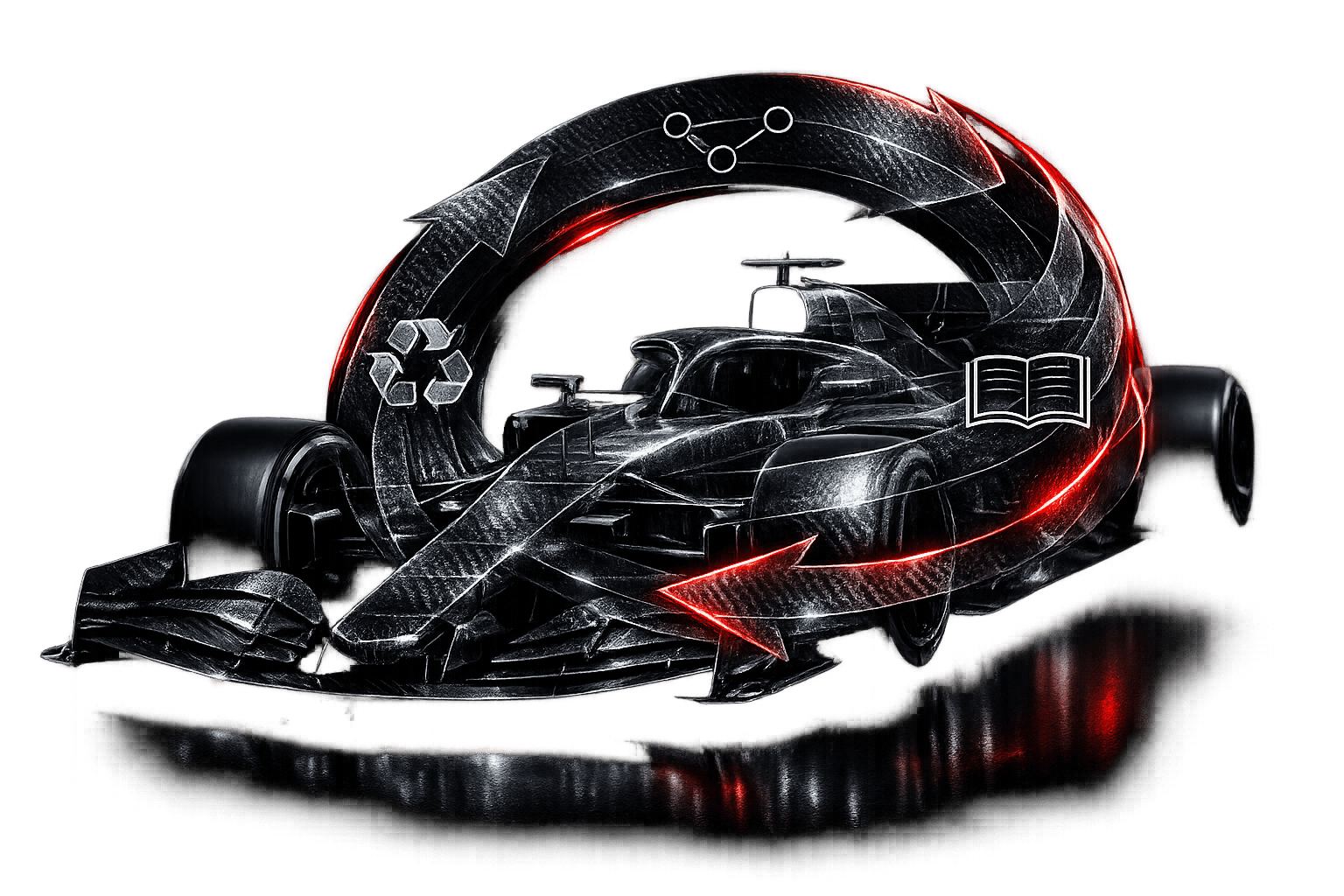
McLaren Racing is leading Formula 1's efforts to reduce waste and emissions by focusing on recycling and material circularity. Key highlights:
- First in F1 Sustainability: McLaren was the first team with net-zero targets approved by the Science-Based Targets initiative and achieved FIA's top 3-star Environmental Accreditation.
- Circularity Handbook: In 2025, McLaren partnered with Deloitte UK and FIA to launch the "F1 Constructors' Circularity Handbook", helping teams assess and improve material reuse.
- Recycled Materials in F1: McLaren used recycled carbon fiber (rCF) in competition for the first time in October 2023, cutting material emissions by 90%.
- Supply Chain Overhaul: Switching to sea freight reduced emissions by 97% per kilogram, while biofuels cut transport emissions by up to 90%.
- Future Goals: McLaren aims to create a fully circular F1 car by 2030.
While other teams like Mercedes focus on sustainable chemistry, McLaren is setting measurable benchmarks for recycling and circularity in motorsport. This approach is reshaping how F1 tackles waste and emissions without compromising performance.
Inside F1's first-ever recycled carbon fibre trial #USGP
McLaren's Recycling and Circularity Programs
McLaren is pushing boundaries with its vision for a fully circular F1 car, leveraging precision tracking and advanced material testing to improve recycling efforts. The team has partnered with Deloitte UK to create a platform that traces the lifecycle of materials - equivalent to the weight of about 550 F1 cars per season - from extraction all the way to disposal. This platform became the backbone of the F1 Constructors' Circularity Handbook.
This handbook helps teams pinpoint areas for improvement within existing regulations and cost caps, driving better material efficiency. Kim Wilson, McLaren Racing's Director of Sustainability, emphasized the collective benefit of this approach:
"If we can encourage all teams to measure their circularity, we can collectively influence the technical regulations to improve sustainability without compromising performance".
McLaren has already applied these principles in groundbreaking ways. In October 2023, they became the first F1 team to use recycled carbon fiber (rCF) in competition, incorporating it into the cockpit branding panels of their MCL60 during the US Grand Prix in Austin. This material, supplied by V Carbon, reduces lifecycle emissions by 90% while retaining 85% of the strength of original carbon fiber. Piers Thynne, McLaren's Chief Operating Officer, highlighted its potential:
"V Carbon offers up to 85% of carbon fibre original strength, making it strong enough for a variety of applications in F1, and beyond".
McLaren has also been using bio-based flax fiber in driver seats since 2020. This material not only reduces weight by 9% but also provides vibration damping that is five times better than traditional carbon fiber. Additionally, the team has experimented with bio-based vacuum bags to replace single-use plastic in manufacturing.
Their efforts extend to decarbonizing the supply chain. By shifting from air freight to sea freight, McLaren achieved a 97% reduction in emissions per kilogram in 2023. Meanwhile, using HVO biofuel for transport trucks cuts emissions from outbound journeys by up to 90% compared to standard diesel. These initiatives, combined with other efficiency measures, have led to a 25% reduction in emissions from facilities and fuel usage compared to 2019 levels.
McLaren's circularity and supply chain innovations set a high standard, paving the way for other F1 teams to rethink their sustainability strategies.
1. McLaren's Recycling Methods
McLaren is pushing the boundaries of sustainability in Formula 1 with a recycling approach that weaves together innovations in materials, metrics, regulations, and supply chain practices. These efforts aim to reduce their environmental footprint without compromising performance on the track.
Material Innovation
McLaren is leading the charge in sustainable materials. For example, in October 2023, they made history by using recycled carbon fiber (rCF) in their MCL60 car during the United States Grand Prix in Austin. This material, developed with partner V Carbon, slashes lifecycle emissions by 90% while maintaining about 85% of the strength of new carbon fiber.
But that’s not all. Back in 2020, McLaren introduced bio-based flax fiber for Lando Norris’s race seat, cutting down on the use of new composite materials. They’ve also taken steps to replace single-use plastics in production, opting for bio-based vacuum bags instead. Even their machine maintenance got an overhaul - switching to soluble oil and water reduced hazardous waste by a whopping 80% in 2023.
Circularity Metrics
McLaren doesn’t just innovate - they measure their progress. Using the F1 Constructors' Circularity Handbook, they reached a 37% material circularity rate for the 2024 season. This metric sets a benchmark for the entire industry. On top of that, they achieved a 23% drop in greenhouse gas emissions per race in 2024 and cut total emissions by 8.6% compared to the previous year.
Regulatory Influence
McLaren is also shaping the rules of the game. They’ve shared the Circularity Handbook with all F1 teams and engine manufacturers, encouraging the adoption of sustainability standards across the sport. Nikolas Tombazis, FIA Single Seat Director, emphasized its importance:
"the handbook will allow teams to gather data around their circularity and identify interventions within the current set of regulations and cost cap"
Beyond that, McLaren successfully advocated for sustainability investments to be exempt from F1's cost cap. This change removes financial hurdles, making it easier for teams to prioritize environmentally friendly innovations.
Supply Chain Sustainability
Logistics is another area where McLaren is making strides. They’ve shifted focus from air freight to sea freight, a more eco-friendly option. In 2024, they partnered with Ecolab to fund 1 million U.S. gallons of Sustainable Aviation Fuel, which avoided 8,464 tons of CO2e - equivalent to 14.7% of their annual carbon footprint. Additionally, using biofuels for road freight cut emissions by half.
McLaren’s "People, Planet, and Performance" framework highlights how sustainability and competitiveness can go hand in hand, proving that innovation isn’t just about winning races - it’s about leaving a lasting, positive impact.
2. Other F1 Teams' Sustainability Methods
While McLaren has taken the lead with its recycling initiatives, other Formula 1 teams are finding their own ways to tackle sustainability. Mercedes-AMG PETRONAS, for instance, is focusing on sustainable chemical precursors instead of relying solely on recycled materials.
Material Innovation
In March 2025, Mercedes revealed a partnership with INEOS Nitriles and Toray to certify sustainable carbon fiber composites for the W16, utilizing "Invireo" - a more sustainable alternative to traditional acrylonitrile. This is a big deal because carbon fiber composites make up about 75% of an F1 car's materials, so this shift significantly reduces their production footprint.
Toto Wolff, Team Principal and CEO of Mercedes-AMG PETRONAS, highlighted the importance of this effort:
"When you combine performance and innovation, you create progress... Collectively we are moving the dial on sustainable products and demonstrating that Formula 1 continues to be the fastest laboratory in the world."
While McLaren focuses on recycled and natural materials like recycled carbon fiber (rCF) and bio-based flax fiber, Mercedes is prioritizing advancements in sustainable chemistry for both fibers and resin systems. This contrast in approaches underscores the variety of strategies teams are using to address sustainability.
Circularity Metrics
Mercedes is also incorporating rigorous circularity metrics to measure its environmental impact. By adopting the F1 Constructors' Circularity Handbook methodology, the team can analyze material inflow and outflow, ensuring a consistent evaluation of the sustainability of their chassis manufacturing processes.
Nikolas Tombazis, FIA Single Seat Director, explained the broader vision:
"The Handbook... will allow teams to gather data around their circularity and identify interventions within the current set of regulations and cost cap. In the longer term, our ambition is... to influence future regulations and innovation in this space."
Regulatory Influence and Supply Chain Sustainability
Mercedes combines its material innovations with strategic decisions in regulations and logistics. Notably, the team became the first global sports organization to invest in Sustainable Aviation Fuel (SAF). Meanwhile, McLaren is making strides by shifting from air to sea freight whenever possible, achieving a 97% reduction in emissions per kilogram in 2023.
The bigger picture is clear: F1 is moving beyond isolated team efforts toward industry-wide collaboration. With the 2025 Circularity Handbook and a goal of using 100% advanced sustainable fuels by 2026, the sport is aligning itself with shared sustainability objectives.
Pros and Cons
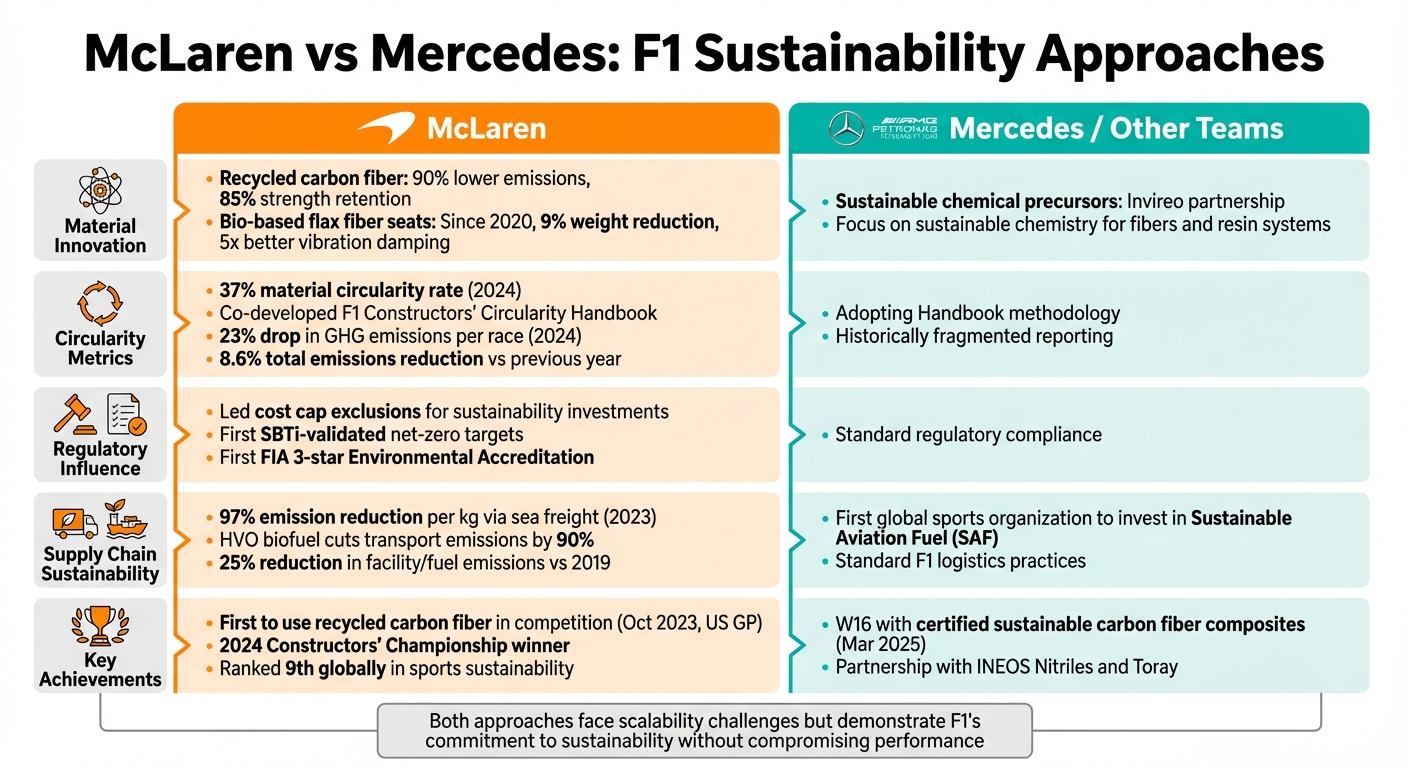
McLaren vs Mercedes F1 Sustainability Strategies Comparison
McLaren's emphasis on recycling and Mercedes' focus on sustainable chemistry highlight two distinct approaches to advancing sustainability in Formula 1, each with its own strengths and challenges.
McLaren's key strength lies in its leadership in setting measurable standards. Through initiatives like the Circularity Handbook and achieving a 37% circularity benchmark, McLaren has positioned itself as a pioneer in establishing industry-wide metrics. The team also successfully advocated for excluding sustainability investments from the cost cap, allowing teams to invest in green technologies without affecting on-track competitiveness.
However, material limitations remain a hurdle. While recycled carbon fiber (rCF) offers a 90% reduction in lifecycle emissions and retains 85% of the strength of virgin carbon fiber, its application is currently restricted to non-structural components like cockpit branding panels. Critical parts, such as the monocoque, still rely on virgin carbon fiber, making McLaren's goal of a fully circular F1 car by 2030 an ambitious target.
Mercedes, on the other hand, focuses on sustainable chemistry to innovate materials at a molecular level. Through partnerships like Invireo, Mercedes aims to enhance carbon fiber composites, offering a more fundamental approach to material innovation. However, this strategy demands extensive collaboration across the supply chain and longer development timelines, which can be a disadvantage compared to McLaren's more immediate use of recycled materials.
| Category | McLaren | Mercedes / Other Teams |
|---|---|---|
| Material Innovation | Recycled carbon fiber (90% lower emissions, 85% strength); bio-based flax seats introduced in 2020 | Sustainable chemical precursors (Invireo); limited bio-composite adoption |
| Circularity Metrics | 37% material circularity; co-developed FIA Circularity Handbook | Adopting Handbook methodology; historically fragmented reporting |
| Regulatory Influence | Led cost cap exclusions for sustainability; first SBTi-validated targets | – |
| Supply Chain | 97% emission reduction via sea freight; HVO biofuel for road transport | Standard F1 logistics practices |
| Accreditations | First FIA 3-star; ranked 9th globally in sports sustainability | Most teams now hold FIA 3-star accreditation |
Both strategies face a shared challenge: scalability. As Kim Wilson, McLaren's Director of Sustainability, explained:
"If we can encourage all teams to measure their circularity, we can collectively influence the technical regulations to improve sustainability without compromising performance".
For now, the performance gap between recycled materials and virgin carbon fiber in structural applications - or the high costs of sustainable chemistry at scale - means that progress in F1's sustainability efforts is likely to be incremental rather than transformative.
Conclusion
McLaren's recycling efforts and the F1 Constructors' Circularity Handbook provide a practical roadmap for reshaping the industry. By standardizing material tracking across all 10 teams, the Handbook demonstrates that environmental responsibility and top-tier performance can coexist. The proof? A 37% material circularity rate and a Constructors' Championship win in 2024. While other teams are making strides, McLaren's measurable progress sets a high benchmark.
One key takeaway for other teams is the value of collaboration over competition. McLaren's push to exclude sustainability investments from the cost cap is a prime example of how collective action can lead to regulatory changes without undermining financial constraints. This cooperative approach lays the groundwork for further advancements in F1's green initiatives.
The sport's future hinges on applying the same precision to environmental issues as teams do to race engineering. A standout example is McLaren's use of recycled carbon fiber at the October 2023 US Grand Prix. This trial reduced emissions by 90% while retaining 85% of the original material's strength, proving that small-scale tests on non-structural parts can pave the way for broader implementation.
For more insights into how innovation and strategy are shaping F1, check out F1 Briefing (https://f1briefing.com). Reaching the goal of a fully circular F1 car by 2030 will demand shared data, collective regulatory influence, and a commitment to proving that sustainability can drive competitive success across the grid.
FAQs
What parts of an F1 car can recycled carbon fiber be used for today?
Recycled carbon fiber has found its way into both structural and non-structural parts of Formula 1 cars. Teams like McLaren have already tested its use in non-critical components. The goal? To maintain top-notch performance while taking steps toward a more sustainable future, showcasing how the sport can embrace eco-friendly advancements without compromising on quality.
How does the Circularity Handbook measure a team’s circularity rate?
The Circularity Handbook offers a structured framework to analyze how F1 teams incorporate circular practices into car development and manufacturing. By collecting data on these practices, teams can measure their circularity rate and pinpoint opportunities to enhance their sustainability initiatives.
What’s the biggest barrier to a fully circular F1 car by 2030?
The biggest hurdle in designing a fully circular F1 car by 2030 is the continued use of traditional carbon fiber. This material comes with hefty environmental costs, both in its production and disposal. McLaren has started experimenting with recycled carbon fiber, which could potentially reduce emissions by as much as 90%. However, there are still obstacles to overcome, particularly in maintaining the material's durability, performance, and scalability. On top of that, implementing circular practices throughout supply chains will demand major innovations and close cooperation among teams, suppliers, and regulators.