Thermal Degradation in F1 Tires Explained
How overheating degrades F1 tires, impacting grip, lap times and strategy — causes, effects, and temperature management tips.
Thermal degradation is a critical factor in Formula 1 that affects tire performance, race strategies, and driver consistency. It occurs when tire temperatures exceed their optimal range, causing the rubber's chemical structure to break down and grip to diminish. Unlike physical wear, thermal degradation doesn't leave visible marks but significantly impacts lap times and handling. Here's what you need to know:
- What It Is: Overheating causes the rubber to lose grip, creating a feedback loop where sliding generates more heat and accelerates the problem.
- Why It Matters: It shapes pit stop strategies and race outcomes. For example, Charles Leclerc's 2024 Italian GP win showcased superior tire management with a one-stop strategy.
- Key Effects: Overheated tires lose grip, leading to understeer or oversteer, slower lap times, and potential tire failure.
- Management: Teams and drivers use pre-race setups, tire blankets, and precise driving techniques to maintain optimal temperatures.
Thermal degradation is a hidden but powerful force in F1, influencing every aspect of race performance. Understanding it reveals why some drivers excel while others struggle during a race.
How Does F1 Tire Degradation Affect Race Performance? - Pole Position Experts
The Science Behind Thermal Degradation
Temperature plays a key role in tire performance, and understanding the science behind it reveals why managing heat is so critical.
How Heat Changes Rubber Compounds
F1 tires are crafted from a blend of synthetic and natural rubber polymers - long molecular chains that react differently to temperature changes. When tires operate within their ideal temperature range, these chains absorb thermal energy, becoming flexible enough to deform and grip the track effectively.
However, when temperatures climb too high, the polymer chains lose their structural stability. They become overly flexible, stretching and compressing so much that the tire's surface begins to fail. This can lead to blistering, where the rubber tears at the surface level. Additionally, excessive heat increases the internal pressure of the tire, causing it to expand and reduce its contact with the track - a critical factor for grip.
"At high temperatures, the long polymer chains gain thermal energy which leads to an increase in the mobility and flexibility of the chains. They can stretch and compress more easily. When this happens on tyre rubber, it can create a rupture at the surface, also known as tyre blistering." - Zara Wang, Mathematics of Formula 1
On the flip side, tires running too cold experience a different issue. The polymer chains lose energy, becoming stiff and brittle. Instead of conforming to the track, the rubber starts to break apart, causing graining - a condition where small rubber fragments detach from the tire surface. Cold tires simply can't generate the grip necessary for competitive performance.
These molecular reactions highlight why maintaining the right temperature is crucial for tire performance.
The Tire Working Range
Each F1 tire compound is designed to function within a specific temperature range - a narrow "working window" where performance peaks. Outside this range, the rubber either overheats and deteriorates or becomes too cold to provide adequate grip. Within the optimal range, the tire grips the track with maximum efficiency.
Interestingly, driving harder doesn’t always equal faster lap times. Over-aggressive driving generates excess heat, pushing the tire beyond its working range. This not only degrades the rubber but also causes the car to slide, creating more friction and heat - a self-perpetuating cycle that speeds up tire wear. Drivers who excel at maintaining stable tire temperatures often achieve more consistent lap times, underscoring the importance of precise temperature control.
Navigating these challenges requires careful management to keep tires in their ideal operating range for peak performance.
How Thermal Degradation Affects Tire Performance
When tires heat up beyond their ideal temperature range, the impact on performance is both immediate and measurable. This explains why some drivers maintain a steady pace during a race stint while others struggle to keep up.
Chemical and Physical Changes in Overheated Tires
Excessive heat alters tires in both physical and chemical ways, leading to a noticeable drop in grip. One key factor is the increase in internal pressure caused by rising temperatures (as explained by the formula P = nRT). This expansion reduces the tire's contact patch - the small area where the rubber meets the asphalt. Zara Wang, a data analyst with expertise in F1, breaks it down:
"As temperature increases, pressure also increases... the contact patch or the area of the tire that touches the ground will decrease, leading to lower grip".
With less rubber gripping the road, performance suffers. Overheating can also cause blistering, further reducing a tire's ability to maintain traction.
It’s important to distinguish between thermal degradation and physical wear. As GPblog.com notes:
"Degradation, in F1 terms, refers to the process of losing tire performance, rather than how much rubber has worn away".
This means a tire might look fine visually but still perform poorly due to chemical breakdown. These changes directly affect how the car handles on track.
Performance Effects: Understeer, Oversteer, and Slower Lap Times
Thermal degradation creates a feedback loop that worsens handling. As grip diminishes, the car slides more, generating additional heat that further damages the tire structure. Drivers often feel this as understeer when the front tires overheat, making the car less responsive in corners. On the other hand, if the rear tires degrade, oversteer can occur, leaving the car feeling unstable or “snappy” during acceleration.
This unpredictable handling slows lap times significantly. A great example comes from the 2024 Italian Grand Prix at Monza, where Charles Leclerc managed his tires’ thermal stress with a bold one-stop strategy. Despite higher overall degradation, he kept his lap times tightly clustered around 83 seconds, showcasing the importance of precise thermal management.
These scenarios highlight how even small temperature deviations can cost drivers precious tenths - or full seconds - per lap, underscoring the critical role of tire management in maintaining consistent performance.
Managing Tire Temperatures in F1
Keeping tire temperatures in check is a key factor in crafting winning strategies in Formula 1. Teams tackle this challenge from two main angles: pre-race preparation and real-time adjustments during the race. Both are crucial for maintaining tire performance and ensuring drivers stay competitive on track.
Pre-Race Preparation: Compound Choices and Setup Adjustments
Before the lights go out, teams make critical decisions about tire management. Pirelli offers six dry tire compounds (C1 to C6), with C6 being the softest, introduced for the 2025 season. For each race weekend, three compounds are chosen as Hard, Medium, and Soft, tailored to the track's demands. Teams then select from 13 dry-weather tire sets, balancing grip and durability for the race.
Tire blankets play a big role here, warming the tires to near-optimal temperatures before they're fitted onto the car. Teams also carefully adjust initial tire pressures, applying the P=nRT formula to account for the natural pressure increase as temperatures rise during the race. This meticulous preparation ensures the car is set up to handle the thermal stress that tires will face on track.
A well-planned pre-race setup ensures drivers can make the most of their tires during the race, giving them the tools to fine-tune performance as needed.
On-Track Techniques for Temperature Management
Once the race begins, drivers rely on specific techniques to keep their tires in the ideal temperature range. During formation laps or safety car periods, weaving side to side generates friction, helping maintain surface heat. As they approach their grid positions, drivers perform controlled burnouts to heat the rear tires and remove debris from the surface. These small but critical actions help prevent thermal degradation and ensure grip remains consistent.
During the race itself, maintaining tire temperatures requires precision. Top drivers like Max Verstappen have shown incredible skill, keeping degradation rates within a narrow range, such as –0.280 to 0.193 seconds per lap. Lewis Hamilton demonstrated this mastery during the 2024 Italian Grand Prix, improving his lap times by an average of 0.065 seconds while keeping his tires in their optimal range. These examples highlight how effective temperature management translates directly into better performance and race results.
Thermal Degradation vs. Other Tire Wear Types
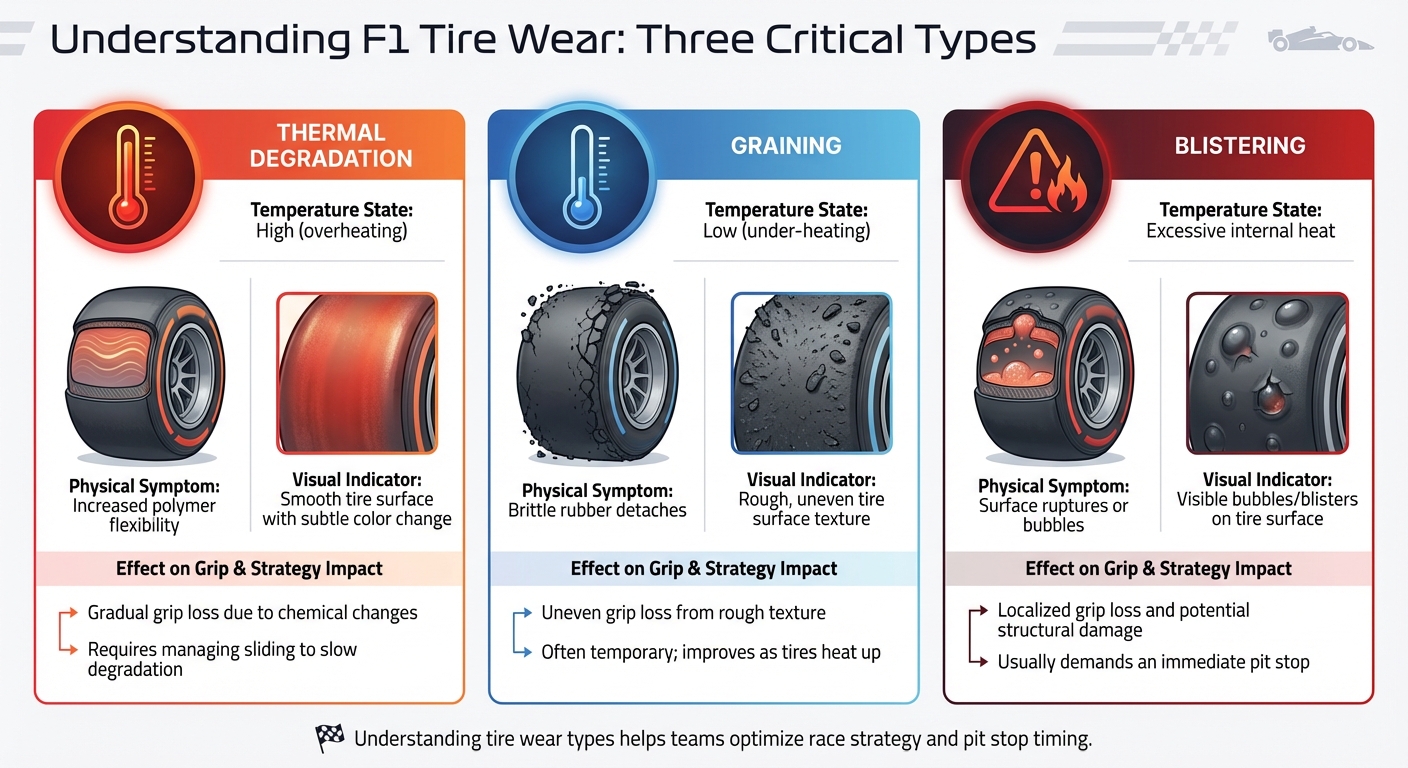
F1 Tire Wear Types: Thermal Degradation vs Graining vs Blistering
Distinguishing thermal degradation from other types of tire wear, like graining and blistering, is crucial for Formula 1 teams to address tire issues effectively during a race. Each wear type stems from different temperature conditions and impacts tire performance in unique ways. Here's a closer look at how they differ.
Graining happens when tires run at temperatures below their optimal range. At lower temperatures, the rubber becomes brittle due to reduced chain mobility. This brittleness causes small chunks of rubber to tear away from the surface, creating an uneven texture. The good news? Graining can sometimes resolve itself as the tires heat up and smooth out through self-cleaning.
Blistering, on the other hand, is a severe consequence of excessive heat. When the tire's polymer chains become overly mobile, the surface can form ruptures or bubbles. Unlike graining, blistering often results in irreversible damage, forcing teams to call for an immediate pit stop to avoid further performance loss or safety risks.
For instance, during the September 2024 Italian Grand Prix, Zhou Guanyu faced significant performance inconsistency in the final 15 laps on hard tires. His lap times fluctuated wildly between -1.401 seconds and +1.334 seconds. In contrast, Lewis Hamilton managed a much more stable degradation pattern, with lap time changes ranging from -0.281 to +0.223 seconds.
To make these distinctions clearer, here’s a comparison of the three wear types:
| Feature | Thermal Degradation | Graining | Blistering |
|---|---|---|---|
| Temperature State | High (overheating) | Low (under-heating) | Excessive internal heat |
| Physical Symptom | Increased polymer flexibility | Brittle rubber detaches | Surface ruptures or bubbles |
| Effect on Grip | Gradual grip loss due to chemical changes | Uneven grip loss from rough texture | Localized grip loss and potential structural damage |
| Strategy Impact | Requires managing sliding to slow degradation | Often temporary; improves as tires heat up | Usually demands an immediate pit stop |
Understanding these wear types helps teams refine their race strategies, ensuring optimal tire performance under varying conditions.
How Thermal Degradation Shapes Race Strategy
Thermal degradation plays a pivotal role in shaping race strategies, influencing how teams and drivers approach everything from stint lengths to in-race adjustments.
Planning Stint Lengths and Pit Stops
Thermal degradation isn't just about tires wearing out - it’s about how overheating impacts lap times over a stint. Teams use degradation curves, mathematical models that predict how performance will decline, to decide on the ideal number of pit stops for the fastest race time. These curves are constantly refined during the race, filtering out anomalies caused by traffic or safety cars.
Temperature changes, sometimes as extreme as 68°F, add another layer of complexity. On cooler tracks, teams focus on managing graining, while hotter conditions demand strategies to avoid blistering. AI tools analyze telemetry data, such as steering angle and speed, to forecast tire energy. Research from Imperial College London highlights steering angle as the most critical factor in predicting tire energy and subsequent wear.
A standout example of this was Charles Leclerc's performance at the September 2024 Italian Grand Prix. Ferrari adopted a bold one-stop strategy, requiring Leclerc to preserve his tires meticulously. Despite not setting the fastest laps - his best was only the 10th quickest - he maintained consistent 83-second lap times. This consistency allowed him to edge out competitors who lost time making additional pit stops for fresher tires.
"The combination of Leclerc's ability to manage tyre wear, maintain consistent lap times, and his commitment to a risky one-stop strategy ultimately secured him the win." - Zara Wang, Mathematics of Formula 1
This level of strategic planning sets the foundation for the precise driving techniques needed to manage thermal stress effectively.
Driver Techniques to Reduce Thermal Stress
Drivers are just as crucial as strategists when it comes to managing thermal degradation. Their driving style directly impacts how much energy is transferred to the tires. Smooth, controlled steering inputs help minimize sliding, which generates heat, while careful throttle application prevents wheelspin that can rapidly break down the tire's structure.
The best drivers focus on maintaining consistent tire performance throughout a stint. This often means starting cautiously, resisting the urge to push too hard on fresh tires. By doing so, they keep their tires within the optimal performance range for longer, avoiding the dreaded performance drop-off caused by overheating.
Virtual Safety Car (VSC) periods can also offer a tactical advantage in managing tire temperatures. Data shows that during VSC incidents, there’s a 57.5% chance of reducing tire energy levels compared to normal green-flag racing. This gives drivers an opportunity to cool overworked tires without losing track position. Teams incorporate these probabilities into their strategies, knowing that a well-timed VSC can turn a borderline stint into a race-winning move.
Conclusion
Thermal degradation plays a key role in reducing tire performance, affecting grip and balance even when the tire looks undamaged. A tire might appear fine on the surface, but its chemical structure could be compromised, leading to slower lap times. This hidden issue often explains why a car that dominates in qualifying may falter during the race; achieving peak one-lap speed often comes at the expense of consistent thermal management.
This concept highlights the unpredictable nature of Formula 1 races. Teams must carefully weigh aggressive strategies, like undercuts, against the need to maintain track position. As GPblog.com aptly states:
"Tyres rarely grab centre stage but they define pretty much everything that happens on a Formula 1 Sunday".
Even small changes, such as slight variations in track temperature, can push tires out of their narrow optimal range. This can transform a pole position into a disappointing mid-pack finish, emphasizing just how critical tire management is.
For fans, understanding thermal degradation offers fresh insight into the sport. When drivers report understeer or rear instability over the radio, it’s often a sign that their tires have overheated - long before visible wear becomes apparent. What might seem like baffling strategy decisions suddenly make sense when viewed through the lens of managing tire temperatures.
Top drivers excel in this area, with smooth steering and controlled throttle inputs helping to keep their tires in the ideal performance window. This skill not only maximizes performance but also underscores the strategic weight of tire management. As GPblog.com explains:
"The tyre degradation factor is the invisible force behind unexpected podiums, race crashes and seemingly crazy strategy calls that only make sense after the chequered flag flies".
Throughout this guide, we’ve explored how managing tire temperatures is just as important as car setup or driver skill. Races like the September 2024 Italian Grand Prix demonstrate how thermal degradation shapes strategy and influences outcomes. It’s a reminder that Formula 1 isn’t just about speed - it’s about strategy, precision, and the ability to adapt. Tire management often becomes the deciding factor, separating champions from the rest of the grid.
FAQs
How can teams tell thermal degradation is happening if the tire looks fine?
Teams rely on performance data and sensors to spot signs of thermal degradation, even when a tire looks perfectly fine. Some key red flags include slower lap times, reduced grip, and unusual tire temperatures or pressures. With the help of real-time telemetry and advanced modeling, teams can detect heat buildup and performance drops early. This allows them to tweak strategies on the fly and extend the lifespan of their tires.
Why do some cars overheat tires more on certain tracks or in traffic?
When cars are pushed hard on certain tracks or stuck in heavy traffic, tires can overheat due to thermal degradation. This happens when the tires get hotter than their ideal temperature range. At that point, the rubber compounds start to break down, leading to less grip on the road and making the car trickier to handle. The heat, often caused by friction or inadequate cooling, softens the tire’s polymer chains, speeding up wear and causing performance to drop quickly.
What can a driver change mid-stint to cool the tires without losing pace?
Drivers looking to cool their tires during a stint without losing speed can opt for a harder tire compound - like switching from soft to medium or medium to hard. These harder compounds produce less heat and wear down more slowly. Beyond that, certain driving adjustments can also help manage tire temperatures. For instance, easing off the throttle, steering more gently through corners, and lifting off the throttle earlier before braking zones can effectively reduce heat buildup and control thermal wear.