Top 5 Penalties for Aerodynamic Rule Breaches in F1
A concise guide to the five most consequential aerodynamic penalties in F1—disqualification, grid drops, fines, in-race sanctions, and points deductions, plus 2026 rule context.
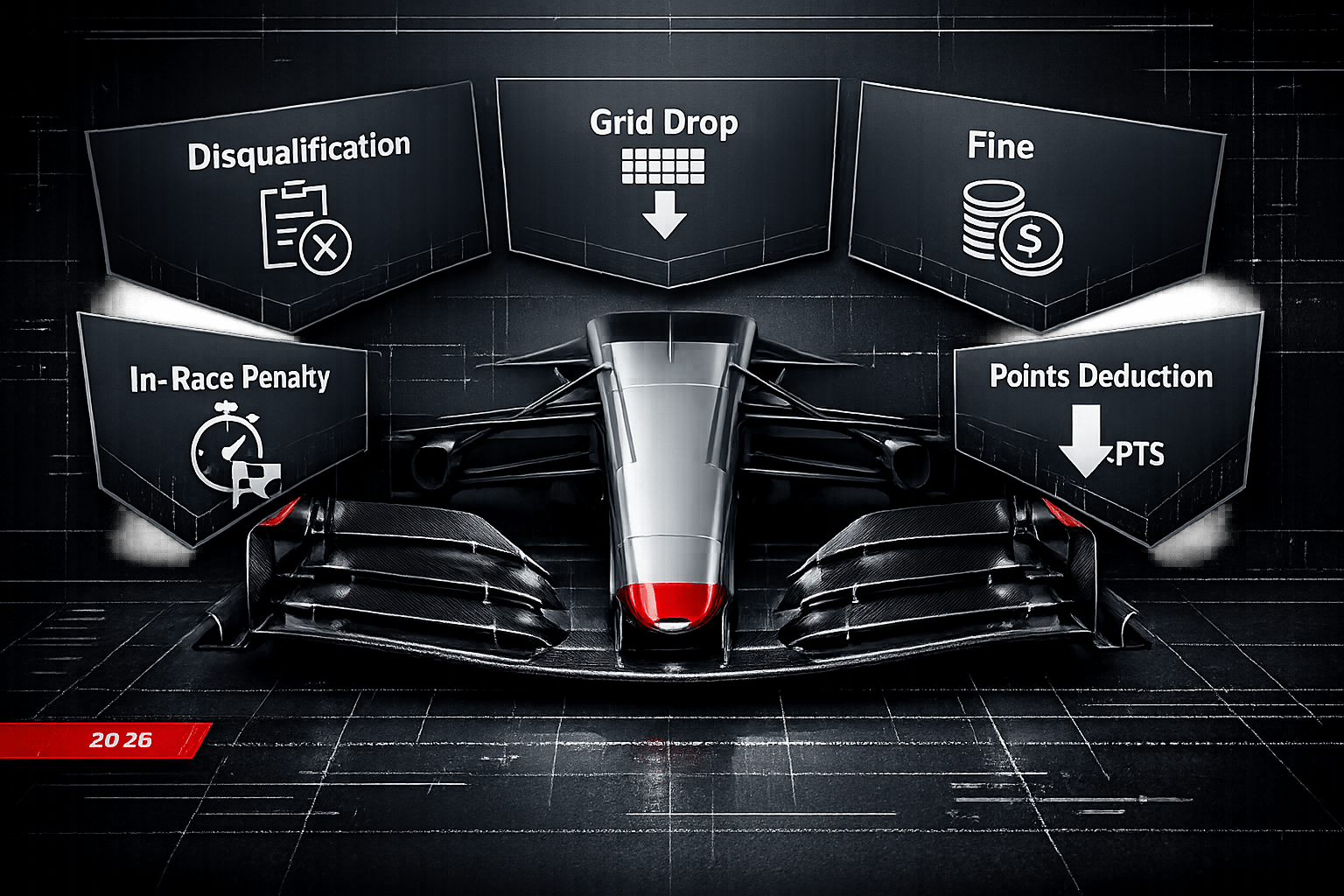
Formula 1 enforces strict aerodynamic rules to maintain fair competition. When teams break these regulations, penalties can range from disqualifications to fines. Here's a quick look at the five most impactful penalties for aerodynamic violations:
- Disqualification: Drivers lose all race points, reshuffling standings. Example: Hamilton and Leclerc's disqualifications at the 2023 US GP for illegal skid block wear.
- Grid Penalties: Drivers drop positions at race start, impacting strategy. Example: Verstappen's one-place penalty at the 2024 Qatar GP.
- Monetary Fines: Teams face financial hits under cost cap rules. Example: Red Bull's $7M fine for exceeding the 2021 cost cap.
- In-Race Penalties: Drive-throughs or stop-and-go penalties disrupt race plans, costing valuable time.
- Points Deductions: Teams lose championship points, affecting standings and prize money. Example: Racing Point's 15-point deduction in 2020 for using Mercedes-inspired parts.
These penalties emphasize compliance, especially with new 2026 rules introducing active aerodynamics and stricter dimensional standards.
Every F1 PENALTY EXPLAINED in 10 minutes
1. Disqualification from Race Results
Disqualification is the most severe penalty a team can face for aerodynamic rule violations. If a technical breach is uncovered during post-race inspections, the FIA strips the driver of all points and removes them from the official classification. This leaves both the driver and their team with zero points for that race.
But the impact doesn’t stop there. When a driver is disqualified, all competitors who finished behind them are bumped up one position in the final standings. This reshuffling can redistribute points in ways that influence championship battles, giving other teams and drivers an unexpected advantage.
Disqualifications often result from components failing to meet precise dimensional regulations. For example, at the October 2023 United States Grand Prix, Lewis Hamilton (2nd place) and Charles Leclerc (6th place) were disqualified after their rear skid blocks were found to have worn below the minimum thickness. This excessive wear suggested a lower ride height designed to gain an aerodynamic edge on Austin's bumpy circuit.
A similar case occurred in August 1994 when Michael Schumacher was disqualified from his Belgian Grand Prix victory. Post-race inspections revealed excessive wear on the wooden plank beneath his Benetton, indicating the car had been run too low to enhance aerodynamic performance.
These examples highlight the challenges teams face as regulations evolve. Under the upcoming 2026 rules, the risks of disqualification could increase with the introduction of active aerodynamic systems. These systems, featuring moveable front and rear wing elements, must function within strict "Corner" and "Straight" modes, controlled automatically by engine maps. If any deviation is detected during technical inspections, teams could face immediate disqualification. Despite these advancements, the same rigid dimensional and operational standards will continue to govern these new technologies, just as they do for traditional aerodynamic components.
2. Grid Position Penalties
Grid penalties drop a driver by 3, 5, or 10 places from their qualifying position. Unlike a full disqualification, these penalties allow drivers to stay in the race but with a clear disadvantage. The FIA uses grid penalties to address less severe aerodynamic or sporting rule violations. These penalties not only shake up the starting grid but also force teams to rethink their strategies.
For example, an aerodynamic rule breach during Free Practice might lead to a fine or a grid penalty for the next race. If the violation happens during Qualifying, the driver could be sent to the back of the grid or even required to start from the pit lane.
Take the December 2024 Qatar Grand Prix: Max Verstappen received a one-place grid penalty for a slow cooldown lap in Qualifying.
These penalties carry important strategic consequences. Starting further back means dealing with heavier traffic and "dirty air", which can hurt aerodynamic performance and raise the risk of early-race collisions. To counter this, teams often shift focus to a race-oriented car setup rather than chasing the best qualifying lap. On tracks where overtaking is easier, teams sometimes even accept grid penalties deliberately. For instance, they may replace power unit components beyond the allowed limit to refresh their component pool for the rest of the season.
Looking ahead, the 2026 regulations could make aerodynamic infractions more frequent. With the introduction of active front and rear wings, these systems will need to stay within precise "Corner Mode" and "Straight Mode" parameters, governed by engine maps. Any deviation found during inspections could lead to grid penalties or harsher consequences. As these advanced systems come into play, understanding grid penalties will become even more crucial for shaping race strategies.
3. Monetary Fines
Monetary fines are another tool used to enforce aerodynamic regulations, alongside disqualifications and grid penalties. These fines hit teams where it hurts most - their budgets. While they don't directly influence race outcomes, they act as a strong financial deterrent, especially in an era where cost caps are in place. The FIA determines the size of these fines based on the type and severity of the violation. Technical infractions are handled by stewards, while breaches of financial regulations fall under the Cost Cap Administration. This dual approach highlights the FIA's dedication to enforcing both technical and financial rules.
The numbers involved can be staggering. For instance, in October 2022, Red Bull Racing was fined $7 million for exceeding the 2021 cost cap by 1.6% (approximately £1,864,000). Team principal Christian Horner called this penalty:
"draconian"
In the same month, Aston Martin faced a $450,000 fine for procedural errors, which included incorrectly excluding costs like signing bonuses and office furniture.
Technical violations also come with hefty penalties. During the 2021 Brazilian Grand Prix, Max Verstappen was fined €50,000 (around $53,000) for violating Article 2.5.1 of the International Sporting Code after unintentionally touching Lewis Hamilton's rear wing in parc fermé. Teams can also be fined up to €100,000 (approximately $106,000) for submitting false information on scrutineering forms.
In 2023, the FIA raised the maximum fine to €1 million (around $1.06 million) to align with the sport's growing financial scale, as teams are now valued at roughly $1 billion. By 2024, the FIA had already collected €270,000 (about $286,000) in fines over the course of the season.
Looking ahead, the upcoming introduction of active aerodynamics in 2026 - where automated systems will control moveable front and rear wings - could make technical compliance even trickier. Fines for breaches involving these systems are likely to be even more severe. Even smaller fines can force teams to rethink their development budgets, adding another layer of pressure to their strategies. These financial penalties, combined with other regulatory measures, play a key role in shaping how teams operate within the rules.
4. In-Race Penalties like Drive-Throughs
When aerodynamic violations happen during a race, stewards can issue immediate penalties that force drivers into the pit lane, throwing off their race strategy and costing valuable seconds. Among the toughest mid-race penalties are the drive-through penalty and the 10-second stop-and-go penalty.
A drive-through penalty requires the driver to pass through the pit lane at the regulated speed limit - usually around 50 mph (80 km/h) - without stopping at their pit box. The 10-second stop-and-go penalty is even harsher, requiring the driver to stop in the pit box for 10 seconds, during which no work can be done on the car.
In terms of time impact, a drive-through typically adds 20–30 seconds to a driver’s race, while a 10-second stop-and-go penalty increases this to about 30–35 seconds. These delays can severely affect a driver’s final position and reduce their chances of scoring championship points. Once a penalty is issued, teams are given only two laps to bring the car into the pits to serve it.
These penalties are often handed out when aerodynamic issues pose safety risks, such as loose front wing endplates or unstable bodywork that teams fail to address. Using real-time telemetry and aerodynamic data from pressure taps, stewards can detect such breaches. If a car is found to gain a "lasting advantage" through illegal aerodynamic behavior, FIA rules recommend a baseline 10-second penalty, which can escalate to a drive-through if necessary.
The consequences of these penalties go beyond the time lost in the pits. They completely disrupt team strategies. For example, when a loose front wing endplate forces an unplanned pit stop, teams have to abandon carefully planned tire and fuel strategies. This often leaves drivers stuck in traffic or trapped in "DRS trains", where overtaking becomes extremely difficult. These disruptions highlight how critical mid-race enforcement can be. As noted in Silverstone's F1 guide:
"The harshest mid-race punishments at the stewards' disposal are: Drive-through... and 10-second stop-go."
Unlike time penalties that can be served during routine pit stops, drive-through and stop-and-go penalties require an additional pit lane entry, making them far more disruptive. This makes them an effective way to enforce aerodynamic rules, ensuring safety and fairness in the competition.
5. Championship Points Deductions
When teams commit severe aerodynamic violations, the FIA can impose penalties like deducting championship points or disqualifying race results. These measures can shake up championship standings and significantly impact the distribution of prize money. A team's position in the Constructors' Championship directly determines how much revenue they receive - often amounting to millions of dollars. Unlike disqualifications, which affect the outcome of a single race, points deductions can derail an entire season's standings, making them a far-reaching penalty.
Points deductions primarily target the Constructors' Championship. A notable example occurred in August 2020 when Racing Point was penalized 15 constructors' points and fined €400,000 (around $424,000). The FIA found the team guilty of using rear brake duct designs from Mercedes' 2019 car, which had become "listed parts" for the 2020 season. This meant teams were required to design these components independently. Despite Technical Director Andrew Green admitting to following a "Mercedes philosophy", the penalty severely impacted Racing Point's championship position and reduced their prize money prospects.
While race disqualifications erase points from a single event, championship points deductions can have a broader impact, altering season-long rankings and revenue. In some cases, penalties also include reduced wind tunnel testing time, which can hamper future aerodynamic advancements. This combination of penalties can create a ripple effect, weakening a team's competitive edge for the remainder of the season.
Below is a breakdown of how these penalties affect teams:
| Penalty Type | Impact on Standings | Financial Consequence |
|---|---|---|
| Direct Points Deduction | Permanent reduction in season total | Loss of prize money tied to final championship position |
| Race Disqualification | Loss of all points from that event | Possible drop in standings, affecting year-end payouts |
| Reduced Testing Time | Limits future aerodynamic development | Competitive disadvantage in future seasons |
Penalty Comparison Table
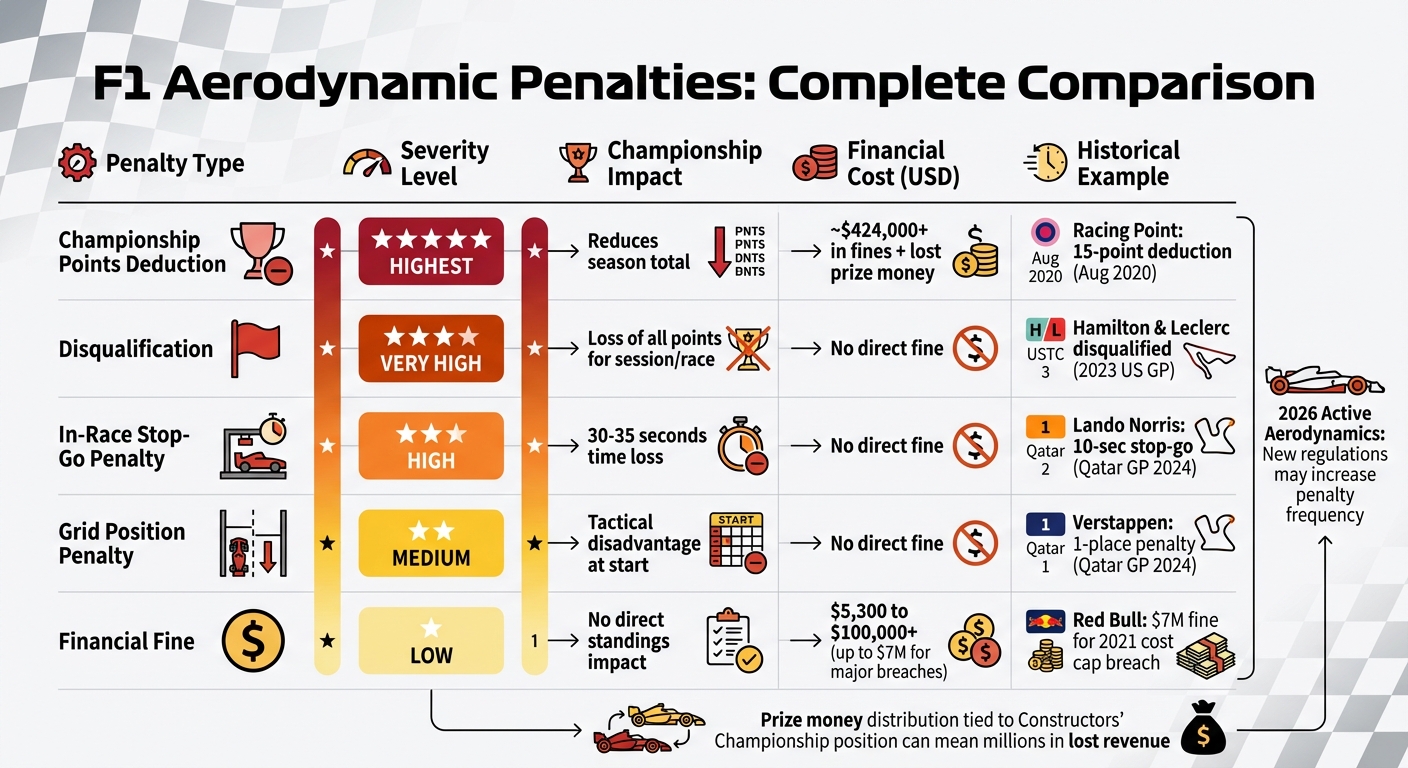
F1 Aerodynamic Penalty Types: Severity, Impact and Costs Comparison
Championship points deductions are the toughest penalty in motorsport. They directly cut into a team's season total, potentially costing millions in prize money due to lower standings. Disqualifications come next, wiping out all points earned in a session or race. In-race penalties, like 10-second stop-go orders, can lead to significant time loss and jeopardize scoring opportunities. Grid penalties, while challenging, leave room for drivers to recover during the race. Financial fines, though often hefty, don't directly affect championship rankings. The table below breaks down these penalties, helping teams weigh tactical risks against financial consequences.
| Penalty Type | Severity Level | Championship Impact | Financial Cost (USD) | Historical Example |
|---|---|---|---|---|
| Championship Points Deduction | Highest | Reduces season total | Around $424,000+ in fines and lost prize money | Racing Point: 15-point deduction and ~$424,000 fine (August 2020) |
| Disqualification | Very High | Loss of all points for session/race | No direct fine | Williams: Both drivers disqualified from Singapore GP qualifying (September 2025) |
| In-Race Stop-Go Penalty | High | Causes significant time loss | No direct fine | Lando Norris: 10-second stop-go penalty at Qatar GP (November 2024) |
| Grid Position Penalty | Medium | Tactical disadvantage at race start | No direct fine | 10-place grid penalty due to a fifth reprimand |
| Financial Fine | Low | No direct impact on standings | Typically $5,300 to $100,000+, higher for major breaches | Aston Martin: $450,000 fine for cost cap breach (October 2021) |
Teams need to carefully consider both immediate race impacts and the potential long-term financial fallout when facing penalties, especially for breaches involving aerodynamic regulations.
Conclusion
F1's aerodynamic regulations are designed to maintain fair competition and ensure grid safety. The FIA enforces these rules with a tiered penalty system, ranging from fines to points deductions, effectively neutralizing any advantage gained from technical breaches. As FIA President Mohammed Ben Sulayem emphasized in 2025:
"To demonstrate the rigour with which [stewards] pursue their role, we are today publishing the Penalty and Driving Standards Guidelines... This will give fans and members of the media a much deeper and more accurate insight into how decisions are made in Formula 1."
This approach showcases F1's dedication to strict regulatory oversight. Notable examples include George Russell's disqualification in July 2024 and Racing Point's $424,000 fine alongside a 15-point deduction in August 2020. These cases highlight the sport's firm stance on ensuring teams innovate within the rules.
Looking ahead, the introduction of active front and rear wings in 2026 will require even tighter regulatory scrutiny. This evolving framework pushes teams to find a delicate balance between performance and compliance. Even minor infractions can result in severe consequences, such as disqualifications or lost championship points.
For more in-depth coverage of F1's technical regulations, penalty systems, and strategic developments, check out F1 Briefing at https://f1briefing.com for expert insights and behind-the-scenes analysis.
FAQs
What impact will active aerodynamics have under the 2026 F1 regulations?
The 2026 F1 regulations bring active aerodynamics into the spotlight, aiming to improve racing dynamics. By making cars lighter and more agile, these changes are expected to enhance overtaking opportunities and overall race quality. This marks a push toward not only more competitive racing but also innovation within tighter boundaries.
Alongside this, the rules place stricter limits on wind tunnel testing and CFD simulations. These measures are designed to cut development costs and reduce the performance gaps between teams. With a focus on efficiency and streamlined designs, the regulations aim to deliver more unpredictable and thrilling races, all while prioritizing safety and sustainability. Active aerodynamics signal a move toward balancing cutting-edge technology with fairer competition.
How do fines for aerodynamic rule violations affect a team's budget under F1's cost cap?
Fines for breaking aerodynamic rules in Formula 1 can hit a team's budget hard, especially with the sport's strict cost cap in place. These penalties directly cut into the money teams can spend on critical areas like car upgrades, day-to-day operations, or even staff salaries. This makes managing resources a much tougher challenge.
The cost cap is meant to level the playing field, so any unexpected expense - like a fine - can throw a wrench into a team's plans to stay competitive. If fines pile up or are particularly hefty, teams might have to make tough decisions about where to trim their budgets, which could hurt their performance on the track and disrupt long-term planning.
Why do grid penalties matter so much in Formula 1?
Grid penalties play a key role in Formula 1 because they directly impact where a team starts the race - and that can make or break their strategy and championship hopes. Starting further back on the grid means navigating through traffic, which not only increases the chances of on-track incidents but also makes climbing into the top positions much tougher.
These penalties are usually handed out for technical rule violations, such as aerodynamic infractions, and serve as a clear deterrent to keep teams within the rules. Major penalties, like a 10-place grid drop or even disqualification, can force teams to completely rethink their approach. Adjustments to tire strategies or pit stop timing often become necessary to make up for the lost positions. Successfully managing these challenges is crucial for staying in the fight across the season.