Ultimate Guide to Pit Stop Efficiency in F1
How F1 teams shave tenths of a second: phases, crew roles, tools, metrics, and strategy to achieve consistent 2.0–2.5s pit stops.
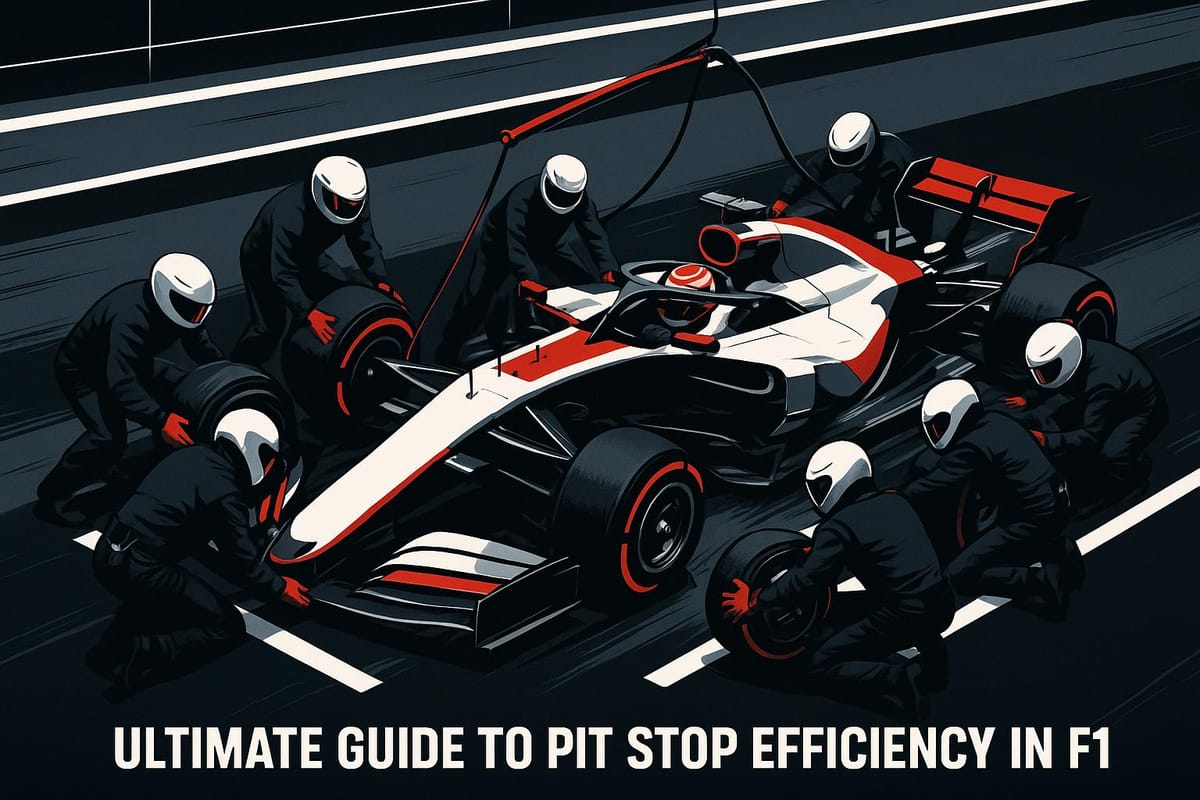
Pit stops can win or lose races. In Formula 1, a fraction of a second can determine whether a driver gains or loses track position. Modern pit stops, often completed in under 2.5 seconds, are a blend of precision teamwork, advanced tools, and strategic planning. Here’s what you need to know:
- Why It Matters: Pit stops are critical for maintaining track position, executing undercut or overcut strategies, and minimizing time lost during tire changes.
- Evolution: From 30-second stops in the 1950s to Red Bull's record-breaking 1.82-second stop in 2019, pit stops have become faster and more efficient due to better tools, larger crews, and relentless practice.
- Core Phases: A pit stop has three key parts - entry (driver precision), stationary time (crew speed), and exit (safe reentry to the track).
- Metrics for Success: Teams track stationary time, consistency, error rates, and positions gained or lost in the pit lane to measure performance.
- Human and Tech Factors: Specialized roles, rigorous training, and cutting-edge equipment like pneumatic guns, hydraulic jacks, and traffic light systems ensure efficiency.
Pit stops aren’t just about speed - they’re a tool for race strategy. Teams balance reliability with fast execution to maximize results. Keep reading for a detailed breakdown of how pit crews operate, train, and use data to perfect their craft.
Core Components of Pit Stop Efficiency
Time Breakdown: Entry, Stationary, and Exit
A pit stop is divided into three critical phases, each playing a key role in how teams shave off precious fractions of a second that can make or break a race.
The entry phase starts as soon as the driver crosses the pit lane entry line and ends when the car halts in the pit box. During this time, the driver must slow down from blistering race speeds - often over 200 mph - to the pit lane limit, which is around 50 mph (80 km/h). Precision is everything here. If the car stops even 4 to 8 inches off the mark, it may need repositioning, costing valuable tenths of a second. This phase relies heavily on the driver’s skill, as even the most polished pit crew can't fix a poorly executed entry.
The stationary phase is when the car is at a complete stop, and the pit crew swings into action - typically for a four-tire change. Top teams aim to finish this in just 2.0 to 2.5 seconds. The choreography is mind-blowing: within 0.3 seconds, the front jack lifts the car; by 0.8 seconds, the jack operator engages the swivel and steps aside; by 1.6 seconds, the area is cleared, and by 2.1 seconds, the car is ready to go. Each crew member’s actions are measured in tenths of a second, and even a slight misstep can ripple into a slower stop.
The exit phase begins when the car leaves the pit box and ends as it crosses the pit lane exit line, rejoining the track. Automated traffic lights ensure the car is released safely, avoiding penalties for unsafe releases. The driver then accelerates back to racing speed, merges into pit lane traffic, and regains momentum - all while trying to hold or gain position. The efficiency of this phase is just as crucial as the others in determining overall pit stop performance.
When all three phases - entry precision, flawless stationary work, and a quick, safe exit - are executed seamlessly, the result is a high-stakes, race-winning operation.
Key Metrics to Measure Success
Teams rely on several key metrics to assess the effectiveness of their pit stops.
Average stationary time is the most basic measurement, reflecting how long the car typically remains in the pit box. For elite teams, this is usually between 2.0 and 2.5 seconds, offering insight into their ability to perform consistently under pressure.
The fastest stop is the single quickest pit stop achieved. Red Bull Racing holds the Guinness World Record for a 1.82-second stop during the 2019 Brazilian Grand Prix. Before that, they clocked a 1.92-second stop for Mark Webber at the 2013 United States Grand Prix in Austin, Texas. While these record-breaking moments make headlines, they’re less critical than consistent performance across an entire race.
Pit lane delta measures the total time lost from entering the pit lane to returning to the track. This includes the entry, stationary, and exit phases, as well as the time difference between pit lane and full racing speed. Teams use this metric to make strategic calls, such as deciding when to undercut or overcut competitors.
Consistency, often evaluated through the standard deviation of stop times, highlights how reliably a team can hit their target times. A team that consistently delivers 2.3-second stops with minimal variation is better positioned than one with erratic performance.
The error rate tracks mistakes like improperly fitted wheels, cross-threaded nuts, or unsafe releases. Even a single error can have monumental consequences for a team’s championship hopes. To minimize mistakes, teams rely on video analysis and high-speed telemetry to identify and address problem areas.
Lastly, positions gained or lost in the pit lane is a direct measure of whether a driver exits the pits ahead of or behind rivals. This metric reflects the combined impact of pit stop timing, stationary efficiency, and traffic management in the pit lane.
To refine their performance, teams use advanced tools like infrared sensors, high-speed cameras, and AI-based analysis. These technologies track reaction times and the duration of each task, enabling continuous improvement.
Consistency vs. One-Off Speed
The data makes one thing clear: reliability beats occasional bursts of speed. While Red Bull Racing’s 1.82-second stop is an incredible feat, championships are won with consistent, low-risk stops in the 2.0 to 2.5-second range.
Chasing sub-2-second stops can invite errors that cost critical time. On the other hand, consistent stop times provide strategic flexibility. For example, shaving just a few tenths of a second off each stop can open new opportunities for undercut or overcut strategies, helping a team gain track position.
For teams further down the rankings, the focus shifts even more toward reliability. The difference between a 2.0-second stop and a 2.3-second stop is just 0.3 seconds - the time it takes to cover 30 to 40 feet at 100 mph. This small margin can be decisive during a pit lane merge. Data from 2016–2017 pit stops showed that the fastest 10 stops were all within the 2.02 to 2.33-second range, emphasizing how even minor differences matter.
Pit crews practice hundreds of stops each season, using video analysis and reaction drills to hone their skills. This relentless commitment to consistency, rather than chasing one-off glory, is what often separates championship-caliber teams from the rest.
F1 Pit Stop In 2-Seconds: An In-Depth Analysis
How Pit Stop Efficiency Affects Race Strategy
In Formula 1, pit stop efficiency plays a crucial role in shaping race strategies. Shaving even 0.3–0.5 seconds off each stop can create race-defining gaps, giving teams the flexibility to adopt more aggressive tactics. Essentially, faster and more reliable pit stops reduce the "cost" of pitting, allowing teams to take calculated risks. Let’s dive into how this unfolds in practice.
Undercut, Overcut, and Offset Strategies
The undercut is one of the most potent tools in a Formula 1 strategist's arsenal. It works by pitting a driver earlier than their rival, equipping them with fresh tires, and using the immediate pace advantage to gain track position. For this to succeed, the time gained on fresh tires must outweigh the rival's track position buffer. A small delay - just 0.3–0.4 seconds - during the pit stop can completely undermine an undercut. Teams rely on simulations of tire degradation and historical data to time these moves perfectly. A standout example is Mark Webber’s Red Bull team at the 2013 United States Grand Prix, where a lightning-fast 1.92-second stop turned an undercut into a game-changing strategy.
An overcut flips the script. Here, the driver stays out longer, capitalizing on their current tires while their rival struggles with the initial "warm-up" phase of fresh tires. However, the success of an overcut hinges on a smooth pit stop - any delays can erase the advantage gained by staying out.
Offset strategies, on the other hand, focus on taking a different approach altogether. Teams might choose alternative tire compounds or vary stint lengths compared to their competitors, aiming for long-term gains over the race distance. In these cases, consistent and efficient pit stops are critical, as even a small penalty in the pit lane can derail the entire plan.
According to Formula 1’s official analysis, shaving just a couple of tenths off pit stop times can open up strategic windows earlier, giving teams the edge to avoid traffic or execute bold moves. Think of it like a football team adjusting plays mid-game - confidence in flawless execution is everything.
Risk vs. Reward in High-Stakes Stops
Not all pit stops are created equal. For routine mid-race stops, teams focus on consistency and safety. But in high-pressure scenarios - like late-race battles, championship-deciding moments, or Safety Car periods - the stakes skyrocket. In these moments, teams push the limits, trimming safety margins to save precious tenths of a second. However, the risks are substantial: mistakes like cross-threaded wheel nuts, improperly secured tires, or unsafe releases can lead to penalties or even retirements.
Top teams mitigate these risks by relying on extensive practice data and assigning their most experienced crew members to critical stops. Under Safety Car conditions, where every tenth of a second counts, teams with consistently fast stops are more likely to gamble on pitting, while slower crews might play it safe and stay out. Telemetry data often highlights how differences as small as 0.3–0.5 seconds in pit lane time can decide track positions, underscoring the gap between elite teams and the rest of the field.
Pit Stop Efficiency at Different Circuits
The impact of pit stop times isn’t just about the garage - it’s also influenced by the track itself. Circuit characteristics, like pit lane length and layout, significantly affect strategy. At tracks with short pit lanes, such as Monaco, pit stops take on added importance because overtaking on the track is nearly impossible. Here, saving even two-tenths of a second can mean gaining - or losing - a position.
On the flip side, circuits with longer pit lanes, where the speed limit of around 50 mph applies over a greater distance, amplify the time lost during a stop. This often forces teams to adopt a more conservative approach, prioritizing track position over frequent stops.
Overtaking opportunities also vary widely by circuit. Tracks like Monaco, Singapore, and Budapest, where passing is notoriously difficult, put a premium on fast, clean pit stops. Meanwhile, at venues with long straights and multiple DRS zones, such as Monza or Spa, teams have more flexibility to recover from a less-than-perfect stop.
Tire degradation is another key factor. High-wear tracks favor undercuts, as fresh tires provide a significant performance boost. Conversely, low-degradation circuits might make overcuts more viable. The variability in pit stop execution also matters - a crew that’s slightly slower but consistently reliable can be more valuable than one that occasionally sets record times but is prone to errors.
Modern Formula 1 teams use live pit stop performance data to adjust strategies in real time. By analyzing each phase of a stop, they can adapt their plans on the fly. For fans trying to understand the finer points of race strategy, it’s important to view pit stop times as variables with both averages and ranges, rather than fixed numbers. This nuanced approach is a hallmark of the expert analysis featured on F1 Briefing.
Human Factors: Training and Team Coordination
While cutting-edge technology plays a significant role in Formula 1 pit stops, it's the human element that transforms potential into performance. Behind every sub-2.5-second pit stop is a finely tuned team of specialists working in perfect harmony. These pit crews train like elite athletes, operate with military-level precision, and communicate seamlessly. The difference between a flawless stop and a costly mistake often hinges on how well these 20 individuals function as a cohesive unit under intense pressure.
Pit Crew Roles and Responsibilities
An F1 pit stop involves around 20 people, a number that has grown over the years to accommodate the sport's push toward specialized roles. Each crew member focuses on a specific task, minimizing errors and maximizing speed.
The core roles are broken down into distinct responsibilities. Four wheel-gun operators - one for each corner - handle the critical job of removing and refitting the center-lock wheel nuts. These operators must align their pneumatic guns perfectly, complete the task in under 0.5 seconds per action, and visually confirm the lock before signaling completion. Even the slightest misalignment can cost valuable time.
Working alongside them are four tire-off mechanics and four tire-on mechanics, who ensure a smooth transition between old and new tires. The tire-off crew removes the used tires without interfering with others, while the tire-on crew positions the new tires with millimeter precision. Teams track individual performance metrics, such as error rates for dropped tires or delayed placements, to ensure accountability and improvement.
Two jack operators - one at the front and one at the rear - handle one of the most physically demanding tasks. The rear jack operator must absorb the car's momentum and align perfectly with the lift point, while the front jack operator deals with similar challenges, including managing the car's forward pitch under braking.
Two stabilizers keep the car steady at the sidepods or front wing, ensuring no unwanted movement during the tire change. Meanwhile, front wing adjusters are on standby to make aerodynamic tweaks if required, though these adjustments are rare due to the extra time they add.
Behind the car, additional team members focus on safety and traffic management. The lollipop or traffic light operator oversees the release process, ensuring all wheel changes are complete and monitoring for potential hazards in the pit lane. Spare jack operators and safety spotters remain on standby to address unexpected issues, such as equipment failures or sudden traffic changes.
This level of specialization allows teams to consistently achieve pit stops in the 2.0–2.5 second range. By assigning narrowly defined tasks to each crew member, teams enhance muscle memory and reduce variability, minimizing the risk of costly errors like cross-threaded wheel nuts or misaligned jacks. The focus isn't just on achieving the fastest stop but on maintaining consistency around a target time - often 2.2 seconds. Avoiding catastrophic delays, such as 5–10 second stops, is critical, as these can result in losing multiple track positions or even the race.
This structured approach to roles lays the groundwork for the intensive training programs that ensure peak performance.
Training for Precision and Speed
With clearly defined roles in place, teams invest heavily in training programs to ensure flawless execution under race conditions. Top F1 teams approach pit crew development with the same rigor as athletic training, running structured programs year-round. Pre-season, crews engage in daily pit stop drills, combining strength and conditioning, reaction training, and full-car simulations to refine their skills. The aim isn't just speed but also building the muscle memory and mental toughness needed to perform under pressure.
During race weekends, teams blend live pit stops during practice sessions with dedicated drills. A typical session includes 8–10 full practice stops. Overtraining is avoided to prevent fatigue and complacency, as quality matters more than sheer volume. Crews focus on staying sharp and maintaining precision.
Training sessions often take place in state-of-the-art gyms, emphasizing explosive strength, core stability, and joint health - particularly for the back, shoulders, and wrists. Exercises include Olympic lifts, sled pushes, plyometrics, and mobility routines, along with job-specific drills like repeated jack lifts or wheel-gun holds. These sessions are closely monitored by performance staff, much like strength and conditioning programs in U.S. professional sports.
Ergonomics play a vital role in both performance and injury prevention. Teams fine-tune stance, grip, and movement angles to minimize strain and repetitive stress. Fatigue indicators are tracked to avoid overuse injuries, particularly toward the end of a race weekend. In challenging conditions, such as high heat and humidity, teams may scale back practice to preserve energy and maintain peak performance.
Advanced feedback tools, including sensors and telemetry, provide detailed timing data for each role - tracking splits like gun-off, wheel-off, wheel-on, and car-drop times. This data-driven approach helps crews identify inefficiencies, such as a wheel-gun operator's approach angle or a tire carrier's foot placement, that might otherwise go unnoticed.
Common drills include segment-specific repetitions, where crews focus on perfecting individual tasks like wheel changes, and full-sequence rehearsals to refine overall choreography. Reaction drills introduce unpredictability, simulating scenarios like delayed car arrivals or sudden release signals to prepare crews for race-day surprises. Scenario drills, such as stuck wheels or double-stacked cars, build decision-making skills under stress. Post-drill debriefs often prioritize communication and error recovery over raw speed.
To maintain performance over a grueling calendar, many teams now rotate pit crew members and cross-train them for multiple roles. This flexibility ensures that the team can adapt seamlessly if someone is unavailable.
Seamless communication and synchronized movement are just as critical as physical skill, as detailed in the next section.
Communication and Choreography
With up to 20 people moving around a car in less than three seconds, effective communication and precise choreography are non-negotiable. A single misstep can turn a 2.2-second pit stop into a costly five-second delay.
Communication within the team is highly standardized to eliminate ambiguity. The pit wall decides when to call the stop, relaying instructions to the driver via radio (e.g., "Box this lap, confirm") and signaling the garage to prepare. Once the car arrives, the release decision is centralized through a traffic light or lollipop system, managed by a single person who monitors wheel-change completion and pit lane traffic.
Non-verbal cues are equally essential. Wheel-gun operators, for instance, may raise a hand or tilt their gun to signal completion. These cues are synchronized with the traffic light system, ensuring that every action triggers a predefined response. There’s no room for hesitation or misinterpretation.
Choreography is mapped out with precision. Garage floors often feature markings that indicate exact positions for feet, wheels, and jacks during each stage of the stop. Movement paths are carefully planned to avoid collisions, with tire carriers approaching from the sides while jack operators move in straight lines before retreating to safe zones once their tasks are complete.
Teams use video analysis and motion-tracking software to identify and correct minor issues like delays or missteps. This continuous refinement ensures that movements are smooth and repeatable, even at full speed. Each race weekend provides new data to fine-tune the choreography for future stops.
The operations staff act as the "quarterbacks" of the pit crew, coordinating timing, practice schedules, and adjustments throughout the weekend. This meticulous choreography, combined with advanced equipment and data insights, ensures that every pit stop aligns perfectly with race strategy.
Technology and Equipment in Pit Stops
While the skill and coordination of human pit crews are at the heart of Formula 1 pit stops, the role of specialized tools and cutting-edge technology cannot be overstated. Modern crews depend on custom-built equipment, meticulously organized garage setups, and real-time data systems to shave off precious seconds. The difference between a 2.2-second stop and a 2.8-second stop often boils down to how efficiently teams manage their tools, space, and data feedback.
Key Equipment: Wheel Guns, Jacks, and Traffic Systems
The tools used in F1 pit stops are designed to deliver speed, accuracy, and reliability under immense pressure.
- Pneumatic wheel guns are the backbone of tire changes, capable of removing and securing wheel nuts in mere fractions of a second. These tools run on compressed air systems, ensuring consistent power and precision for rapid tire swaps.
- Hydraulic jacks are another critical component, especially given the low ride height of modern F1 cars. The ground-effect aerodynamics that keep these cars glued to the track also make lifting them a challenge, requiring significant force. In a perfectly executed 2.2-second stop, the front jack engages at 0.3 seconds, the rear at 0.4 seconds, and both are cleared by 0.8 seconds, with the car released at 2.1 seconds. Timing here is everything - any delay can ripple through the entire stop.
- Automated traffic light systems have revolutionized pit stop safety and efficiency. These systems use sensors to confirm that all wheel changes are complete and the pit lane is clear before signaling the car's release. By reducing reliance on human judgment, these systems minimize errors and ensure cars adhere to the 50 mph pit lane speed limit, allowing for a smooth reentry onto the track.
The record-breaking 1.82-second stop by Red Bull Racing at the 2019 Brazilian Grand Prix is a testament to how precision tools and flawless execution can achieve near-perfection.
Garage Layout and Setup Optimization
The physical setup of the pit area is just as critical as the equipment itself. With a large team working in unison, every inch of space must be optimized to ensure smooth and efficient operations.
Teams carefully design their garage layouts to eliminate unnecessary movement. Floor markings precisely indicate where crew members, tires, and jacks should be positioned. These layouts are the result of detailed motion studies aimed at choreographing every movement.
To perfect these setups, teams use full-scale mock-ups of pit boxes at their factories. These replicas, complete with electric mule cars to simulate race conditions, allow crews to practice under controlled conditions. These sessions help identify inefficiencies and refine processes, ensuring every action is executed with pinpoint accuracy on race day.
Data and Telemetry for Real-Time Adaptation
Data analytics play a crucial role in fine-tuning pit stop performance. Every stop generates a wealth of information that teams analyze in real time to identify areas for improvement.
Infrared sensors and AI systems provide instant feedback on key metrics, allowing crews to address bottlenecks as they arise. Timing data is meticulously recorded for every aspect of the stop, from the car's entry speed and positioning to jack engagement, wheel changes, and exit acceleration. This data is then integrated with race telemetry to help strategists optimize pit stop timing and tire choices based on factors like tire wear and temperature.
Post-stop reviews are equally important. Teams analyze video footage and sensor data to spot inefficiencies, while daily practice sessions during race weekends help crews refine their technique and consistency. These drills focus on everything from equipment calibration to crew positioning, ensuring peak performance when it matters most.
The relentless focus on technology and process refinement has driven pit stop times down dramatically. Compared to the 30-second stops of the 1950s, today's sub-2-second stops represent a nearly 96% reduction in time. This evolution highlights the ongoing pursuit of precision and speed that defines modern Formula 1 operations.
Conclusion: The Pursuit of Perfection in F1 Pit Stops
Formula 1 pit stops are a masterclass in combining human skill, strategic decision-making, and technological precision. What started as a slow and inefficient process has evolved into a high-stakes operation where a fraction of a second can change the course of a race. The shift to today’s sub-2-second tire changes highlights the relentless drive for better performance through strategy, execution, and innovation.
Key Lessons from F1 Pit Stop Efficiency
The biggest takeaway? Pit stop efficiency isn’t just about speed - it’s a strategic advantage. Teams that consistently execute stops in the 2.0- to 2.5-second range gain the flexibility to make bold moves, like undercuts or overcuts, and keep their options open during critical moments on the track.
Three core elements define top-tier pit stop performance. Strategy plays a key role, with teams using realistic race simulations based on their own data, not just ideal scenarios. This ensures their plans align with actual capabilities. The human factor is equally important, with clear role assignments and rigorous training. As McLaren’s Operations Director Charlie Hooper wisely noted:
It's no good breaking a world record if the next pit stop is five seconds!
Consistency often trumps isolated moments of brilliance.
Technology ties everything together, turning pit stops into finely tuned processes. Using tools like high-speed video, infrared sensors, and telemetry, teams analyze every detail - jack lifts, wheel changes, torque checks, and car drops - down to the smallest fraction of a second. This meticulous attention to detail mirrors the precision seen in car development itself.
Becoming consistently elite requires prioritizing process over flash. Teams focus on standardizing roles, practicing realistic scenarios (like front wing changes), and running structured practice sessions - usually 8 to 10 stops per session to avoid fatigue while maintaining quality. Video reviews and timing splits after every session create a feedback loop that drives ongoing improvement. This commitment to refinement is what separates the best from the rest in Formula 1.
Future Trends in Pit Stop Efficiency
Looking ahead, new trends are set to push pit stop performance even further. In a sport where every fraction of a second counts, innovation remains key.
Regulatory shifts could shake things up. For example, the FIA and Pirelli have explored requiring two mandatory pit stops per race. Such a change would add layers of complexity to strategy, forcing teams to rethink how they balance stop duration with race pace. Adjustments to wheel sizes, tire rules, or the number of crew members allowed in the pit box could also prompt teams to redesign equipment, retrain crews, and rework choreography to stay competitive. Current rules, which focus stops solely on tire changes, already demand that teams operate at the very edge of what’s possible within safety guidelines.
AI and machine learning are poised to revolutionize pit crew training and performance analysis. Advanced algorithms can now track crew performance across hundreds of stops, identifying even the smallest inconsistencies. Simulation tools could suggest optimized choreographies or reassign roles based on reaction times and precision, creating highly personalized training programs. Real-time AI systems might even integrate live race data - like tire wear, traffic, and weather forecasts - to recommend the best pit windows dynamically, turning pit decisions into a constantly evolving puzzle.
Technical advancements in car design will also drive changes in pit stop equipment. As cars grow heavier and more complex with evolving hybrid systems and aerodynamic tweaks, teams will need to adapt their tools. Expect innovations in jack designs, wheel guns, and other pit gear to keep up with these demands. Teams are already investing heavily in factory mock-ups, electric mule cars, motion analysis, and cutting-edge training facilities to stay ahead in this technological arms race.
For fans in the U.S. who follow Formula 1 through broadcasts or platforms like F1 Briefing, understanding these trends adds a whole new layer of appreciation. Spotting the strategic impact of a slightly faster stop or marveling at the precision of a perfectly executed double-stack during a safety car period highlights the intricate choreography that makes F1 so much more than just speed.
Pit stops are the heartbeat of Formula 1 - a place where strategy, human skill, and technology meet under immense pressure. The pursuit of perfection in this arena never stops, with each season bringing new challenges and opportunities to push the limits. In the end, those fleeting moments in the pit lane often define who stands on the podium, proving that preparation, precision, and adaptability are the true keys to success in this relentless sport.
FAQs
How do F1 teams maintain consistent pit stop performance despite varying track conditions?
F1 teams deliver reliable pit stop performance by blending thorough preparation, advanced tools, and flawless teamwork. Before every race, teams evaluate track-specific elements such as weather conditions, surface grip, and pit lane design to fine-tune their strategies.
Pit crews undergo intense training to master both speed and accuracy, ensuring they can perform seamlessly in any situation. On top of that, teams leverage state-of-the-art equipment and monitoring systems to refine every detail of the process, from swift tire changes to efficient refueling (when required). This perfect balance of human expertise and technology guarantees consistent execution, even on the toughest circuits.
What challenges do teams face during record-breaking pit stops, and how do they address them?
Breaking records in Formula 1 pit stops isn’t without its challenges. Teams face risks like errors, safety issues, and mechanical failures. A single mistake - like a wheel not being secured properly or a breakdown in communication - can result in penalties or, worse, endanger the driver.
To tackle these risks, teams invest heavily in intensive training to ensure every crew member operates like a well-oiled machine. Advanced technology, including automated tools and sensors, plays a key role in improving accuracy and minimizing human error. On top of that, teams run thorough pre-race checks and simulations, preparing for the intense, high-stakes moments when every second counts. This approach balances speed with safety, keeping operations sharp and secure.
How do AI and machine learning improve pit stop efficiency and strategy in Formula 1?
AI and machine learning have become game-changers when it comes to boosting pit stop efficiency in Formula 1. By processing enormous amounts of data in real time, these tools help teams make smarter decisions - like pinpointing the best moments for pit stops, evaluating tire wear, and adjusting strategies based on the ever-changing conditions of a race.
With machine learning algorithms, teams can run simulations of countless scenarios, which sharpens their ability to make split-second decisions under intense pressure. AI also streamlines communication and coordination among crew members, ensuring every action during a pit stop is executed with precision and speed. This seamless blend of cutting-edge technology and human expertise is what helps teams stay ahead in the fiercely competitive world of Formula 1.