Undercut vs. Overcut: Pit Timing Explained
When to use an undercut or overcut in F1: benefits, risks, and how tire wear, track type and traffic shape pit timing decisions.
In Formula 1, pit stop timing can decide race outcomes. Two key strategies, the undercut and overcut, are all about using tire changes to gain track position. The undercut involves pitting earlier to exploit the speed of new tires, while the overcut delays the stop to capitalize on warm, used tires' consistent performance.
Key Points:
- Undercut: Pitting early for faster laps on new tires. Works best on high tire-wear tracks.
- Overcut: Staying out longer to gain time while rivals struggle with tire warm-up or traffic. Ideal for low-degradation tracks.
Quick Comparison:
| Strategy | When to Use | Key Advantage | Risk |
|---|---|---|---|
| Undercut | High tire wear, clear track ahead | Faster laps on new tires | Traffic can negate time gained |
| Overcut | Low tire wear, rivals stuck in traffic | Strong laps on warm tires, clear track | Tire performance drop-off |
Each strategy depends on tire behavior, track conditions, and timing precision. F1 teams use real-time data to decide which approach will secure the upper hand.
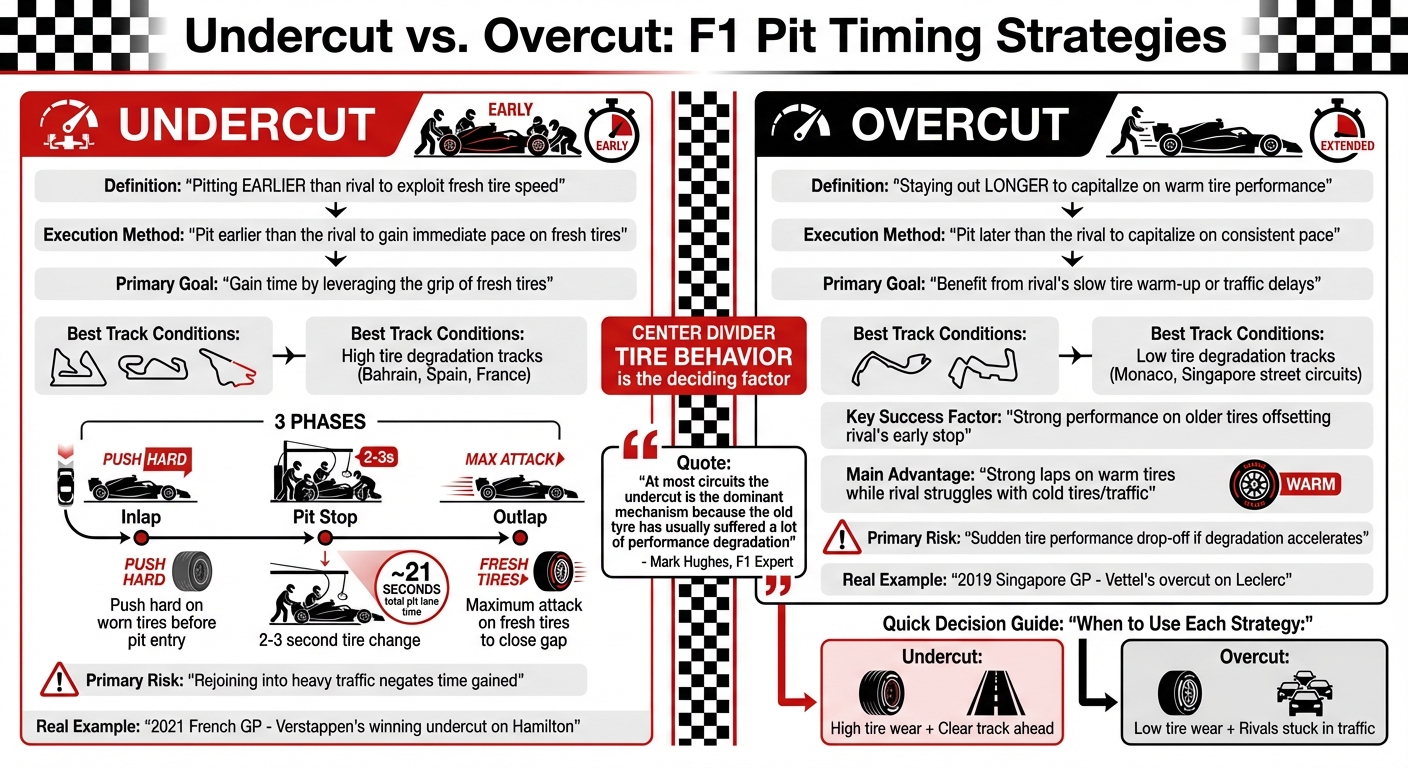
F1 Pit Strategy: Undercut vs Overcut Comparison
F1 Undercut vs Overcut Explained
The Undercut: Gaining Time with Early Pit Stops
The undercut is a pit strategy where a driver pits earlier than their rival to replace worn tires with fresh ones, aiming for an immediate boost in speed. The idea is simple: fresh tires offer better grip, allowing the driver to set faster lap times while their competitor continues on degraded rubber.
This strategy hinges on maximizing the performance of fresh tires, especially during the critical outlap when every second counts.
The 3 Phases of an Undercut
Pulling off an undercut successfully involves three key stages:
- The inlap: This is the driver’s last lap on worn tires before heading to the pits. Here, the goal is to push hard and minimize any time lost before the stop.
- The pit stop: This is where the team takes over, aiming to complete a tire change in just 2–3 seconds. On tracks like Monaco, the entire pit lane process - entry, stop, and exit - can cost around 21 seconds.
- The outlap: The driver’s first lap on fresh tires. This is where they must push to the limit, making the most of the improved grip to close the gap or even leapfrog their rival.
These phases are all about timing and precision, with each playing a crucial role in the success of the strategy.
When to Use the Undercut
The undercut works best on tracks where tire wear is high, as worn tires lose performance rapidly. On circuits like these, the time advantage from fresh tires can be significant, often shaving off multiple seconds per lap. This makes it incredibly hard for competitors to respond effectively.
However, timing is everything. A clean track is essential - rejoining the race into heavy traffic can nullify the fresh-tire advantage. Teams rely on live telemetry and predictive tools to identify the best window for a pit stop, ensuring the driver comes back out in clear air. The strategy is especially useful on tracks where overtaking is tough, allowing teams to gain positions through clever pit timing instead of risky on-track battles.
Still, the undercut isn’t always a guaranteed success. Take the May 2021 Monaco Grand Prix, for example. Mercedes and Lewis Hamilton attempted an undercut on Pierre Gasly. But Hamilton’s hard tires took too long to warm up, leaving him unable to match Gasly’s pace on pre-warmed soft tires. As a result, Hamilton remained stuck behind the AlphaTauri. This highlights the importance of choosing the right tire compound - one that can quickly reach its optimal temperature.
The Overcut: Using Extended Track Time to Gain Position
The overcut flips the script by delaying a pit stop to take advantage of tires that are already at their ideal temperature. Instead of pitting early, the driver stays out longer on worn tires, aiming to create enough of a time buffer to pit later and still reenter the track ahead of their competitor. This approach relies on the idea that, in certain conditions, warm, used tires can outperform fresh, cold ones. Like its counterpart, the undercut, the overcut demands precise timing and up-to-the-second data to turn this gamble into a winning move.
Here’s why it works: when a competitor pits for fresh tires, those tires need time to warm up to their peak performance. During this critical warm-up phase, the driver who stayed out can push hard on their already heated tires, gaining valuable seconds. If the timing is right, this gap can be enough to pit and rejoin the race ahead of the rival.
How the Overcut Works
For an overcut to succeed, the driver must maintain a strong pace while their competitor is either warming up new tires or stuck behind slower cars. Clear track conditions are crucial here, as they allow the driver to clock fast laps without interference. Meanwhile, the rival who pitted early might lose time navigating traffic or waiting for their tires to reach optimal temperature.
Tire performance is a major factor in this strategy. While fresh tires have better grip potential, they need time to heat up. During this period, the driver on older, warm tires can exploit the gap by delivering faster laps. This tactic is especially effective on circuits where getting fresh tires up to temperature is a challenge.
A great example of this strategy in action was seen at the 2019 Singapore Grand Prix.
The overcut thrives on exploiting these operational advantages, but its success depends heavily on timing and track conditions.
When to Use the Overcut
The overcut works best on tracks where tire degradation is minimal. On these circuits, drivers can maintain competitive lap times even with older tires, making an early pit stop unnecessary. Tracks with smooth surfaces are particularly favorable, as they allow worn tires to perform well for longer stints without a dramatic drop in pace.
Traffic is another critical element. If a rival pits and rejoins behind slower cars, the overcut driver can take advantage of the open track to build a time cushion. Teams use real-time data and simulations to predict whether the time gained on warm tires will outweigh the time lost in the pit stop and tire warm-up phase.
That said, the overcut comes with risks. If the rival’s fresh tires heat up quickly or if the driver staying out loses too much time on worn rubber, the strategy can backfire. Success depends on aligning track conditions, timing, and tire performance to perfection.
Undercut vs. Overcut: Direct Comparison
After breaking down the mechanics of each strategy, let's put the undercut and overcut head-to-head. Both tactics revolve around pit stop timing to gain track position, but they differ in execution. The undercut involves pitting earlier than a competitor, temporarily giving up track position to take advantage of fresh tires and faster lap times. On the other hand, the overcut keeps the driver on the track longer, leveraging the performance of warmed-up tires while the rival struggles with fresh tires that need time to reach peak performance - or gets stuck in traffic.
The key factor separating these strategies? Tire behavior and track conditions. Mark Hughes, a Formula 1 expert, sums it up well:
"At most circuits the undercut is the dominant mechanism of passing at the pit stops because the old tyre has usually suffered a lot of performance degradation".
When tire degradation is high, fresh tires can deliver a significant speed boost, making the undercut particularly effective. However, on tracks with low wear - like many street circuits - the overcut can shine, especially if new tires take longer to warm up. Traffic also plays a pivotal role: an undercut can backfire if the driver reenters the track into congestion, while an overcut can thrive if the rival loses time behind slower cars after their stop.
Here's a quick breakdown of how the two strategies compare:
Comparison Table: Strengths, Weaknesses, and Conditions
| Feature | Undercut | Overcut |
|---|---|---|
| Execution Method | Pit earlier than the rival to gain immediate pace on fresh tires | Pit later than the rival to capitalize on a consistent pace |
| Primary Goal | Gain time by leveraging the grip of fresh tires | Benefit from a rival's slow tire warm-up or traffic delays |
| Track Suitability | Most effective on high-degradation tracks | Best for circuits with low tire degradation and minimal interference |
| Tire Behavior | Relies on the marked performance advantage of new tires | Depends on maintaining a competitive pace on older tires |
| Success Factor | Fast outlap on fresh tires | Strong performance on older tires offsetting the rival's early stop |
| Risk | Rejoining the track into heavy traffic | A sudden drop in tire performance if degradation accelerates |
For some real-world examples, consider the June 2021 French Grand Prix. Max Verstappen executed a textbook undercut against Lewis Hamilton, using fresh tires to gain a critical pace advantage and secure victory. Conversely, at the September 2019 Singapore Grand Prix, Sebastian Vettel successfully deployed an overcut. By staying out longer, he took advantage of his teammate Charles Leclerc's struggles with tire warm-up and traffic, ultimately claiming the lead.
How Teams Make Pit Timing Decisions During Races
During a race, strategists rely on real-time metrics to decide when to call their drivers into the pits. One of the key considerations is gap management - teams constantly track the time difference between their car and competitors. This gap is compared to the time lost during a pit stop. For instance, a 25-second gap allows a car to pit and retain its lead, but with only an 18-second gap, a driver risks losing position.
Another critical factor is tire degradation. Teams use telemetry to monitor how quickly tires are wearing down and whether switching to fresh tires will provide a noticeable speed boost. If tire wear is severe, fresh tires can deliver a significant performance advantage, making the undercut - pitting earlier than a rival - a strong strategy. On the other hand, if tire wear is minimal, the current set can maintain competitive lap times longer, which might make the overcut - staying out longer - a better option.
A great example of this was during the May 2021 Monaco Grand Prix. Red Bull's strategists carefully controlled Max Verstappen's lap times, keeping him at 1:16 to match Sebastian Vettel's pace in 8th place. This strategy ensured the gap to traffic remained smaller than the time lost during a pit stop, effectively preventing Valtteri Bottas from executing an undercut without rejoining in heavy traffic.
Another consideration is how quickly new tires reach their optimal performance. If fresh tires require more than a lap to warm up, the overcut becomes more appealing. Using all this data, teams decide whether an undercut or overcut will provide the best advantage based on the unfolding race conditions.
Teams also run predictive simulations to prepare for variables like traffic, weather changes, or a safety car deployment. A safety car can dramatically reduce the time lost during a pit stop, cutting it in half. These simulations compare the speed of a fresh-tire out-lap against an old-tire in-lap to determine which strategy will yield better results.
Defending Against Undercuts and Overcuts
Teams don’t just plan their own pit strategies - they also work to counter their rivals' moves. To defend against an undercut, a leading driver might deliberately slow down to force the chasing car into traffic, negating the advantage of fresh tires. On the flip side, to counter an overcut, a driver who has just pitted must push hard on their out-lap - this aggressive approach, often referred to as "hammer time", helps them build a gap before their rival pits. By maximizing the pace on fresh tires, they aim to stay ahead once the rival completes their stop.
How Track Characteristics Affect Strategy Choice
The layout and surface of a track play a huge role in deciding whether an undercut or overcut strategy will work better. Tracks with high tire degradation and fast corners push tires to their limits, causing them to wear out faster. On these circuits, fresh tires offer an instant speed boost, making the undercut the go-to strategy. Circuits like Bahrain, Spain, and France fall into this category, where the lap time advantage of fresh rubber is especially noticeable.
On the other hand, low-degradation tracks demand a different game plan. Street circuits like Monaco and Singapore, with their slow corners and low-grip surfaces, don’t put as much stress on the tires. Mark Hughes, a Special Contributor for Formula 1, explains it well:
"Monaco is slightly different in that the corners are of such low speed and the street surface of such low grip that not much energy is fed into the tyres. So even with the softest compounds in Pirelli's range, the degradation rate is low".
On these circuits, tires hold up well over longer stints, while fresh tires can take time to heat up and perform at their best. This makes the overcut strategy more appealing. By analyzing these track traits, teams can fine-tune their pit stop timing to suit the specific demands of each circuit.
Examples of the Undercut's Efficacy
High-degradation circuits, like the Circuit Paul Ricard during the 2021 French Grand Prix, highlight why the undercut is so effective. The fast corners at this track magnified the performance gap between fresh and worn tires, making early pit stops a winning strategy.
Examples of the Overcut's Efficacy
Low-degradation street circuits like Monaco and Singapore showcase how the overcut can shine. These races demonstrate how track design and tire performance shape strategy decisions. On such circuits, worn tires can still deliver solid lap times, while fresh tires may struggle to warm up quickly on the low-grip surfaces . This understanding of track-specific dynamics explains why teams adapt their strategies based on the unique challenges of each race.
Conclusion: Selecting the Right Pit Strategy
Choosing the best pit strategy hinges on several factors: track conditions, tire wear, and timing. On circuits where tire degradation is high, an undercut often proves effective since fresh tires deliver an instant boost in speed. However, on low-grip tracks like Monaco, the overcut can be the better choice, especially when new tires take longer to reach their ideal temperature.
Managing traffic and tire warm-up is just as critical. With an F1 pit stop typically costing around 21 seconds, drivers must rejoin the track with enough space to avoid getting stuck behind slower cars. If fresh tires require several laps to perform at their peak, staying out longer might be the smarter move. Mark Hughes explains it well: the overcut works "where you pass by staying out after they pit and being faster on your old-tyred in-lap than they can go on their new-tyred out-lap". These details often dictate the success of a pit stop strategy and can shift the outcome of a race.
The car's performance also plays a role. Cars that wear out their tires quickly may have no choice but to go for an undercut. On the other hand, vehicles that handle tires more efficiently can benefit from an overcut. Monaco is a great example of this, where overcuts have worked well because fresh tires sometimes take longer to heat up and deliver optimal performance.
FAQs
How do teams calculate the undercut window?
Teams determine the undercut window by analyzing real-time data such as tire wear, lap times, track position, and overall race conditions. They estimate the advantage gained from pitting early for fresh tires, which typically offer better performance, and weigh it against the rival's pace on older tires. With the help of telemetry and simulations, they identify the best moment to pit, aiming to gain an edge while minimizing the loss of track position.
Why are new tires slower right after a pit stop?
New tires often perform slower right after a pit stop because they need to heat up to their ideal operating temperature. Before reaching this point, they don't grip the track as effectively, which can make them temporarily less efficient than the worn tires that are already warmed up from previous laps.
How does a safety car change undercut vs. overcut calls?
A safety car shakes up race strategies like undercuts and overcuts by compressing the field and slowing down the overall pace. Undercuts, which rely on fresh tires to gain time, become less effective during the slower laps under the safety car. On the flip side, overcuts can become more attractive, as drivers may opt to stay out longer, pit later, and take advantage of fresher tires when the race picks up speed again. Ultimately, the success of either approach depends on timing and the specific race conditions.