2022 vs. 2026: Comparing Driver Adaptation to Rule Changes
How F1 rule changes from 2022 to 2026 shift driving demands from underbody aero handling to active aero, battery management, and strategic energy use.
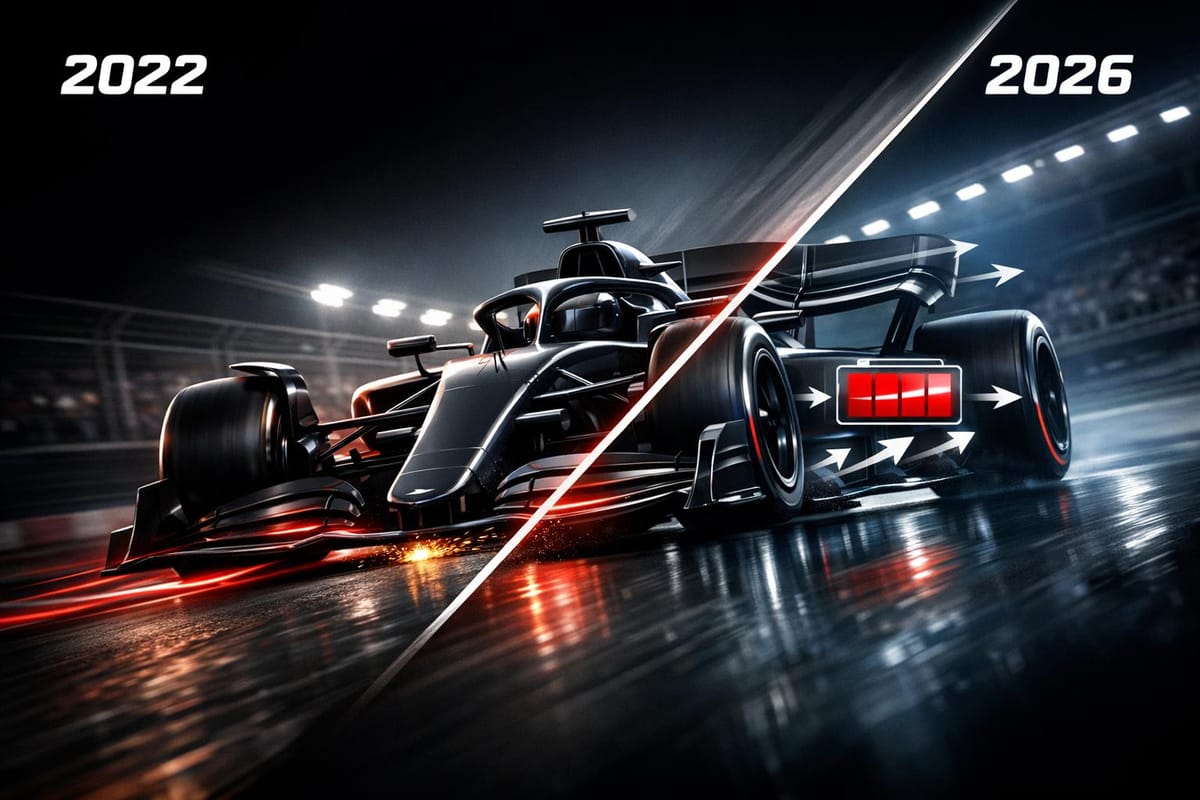
Formula 1 has undergone major transformations from 2022 to 2026. In 2022, the return of ground-effect aerodynamics reshaped car design, prioritizing underbody downforce but introducing challenges like porpoising and increased car weight. By 2026, the sport has shifted focus again, with lighter, shorter cars, active aerodynamics, and a 50/50 power split between combustion engines and electric systems. These changes demand drivers to manage energy, toggle between aero modes, and handle more complex strategies during races.
Key differences:
- 2022: Ground-effect aerodynamics, heavier cars, reliance on mechanical grip, and sensitive ride heights.
- 2026: Active aero systems, lighter cars, higher electric output, and strategic energy deployment.
The shift highlights how Formula 1 has moved from mechanical challenges to requiring drivers to think like strategists, balancing speed, grip, and energy efficiency.
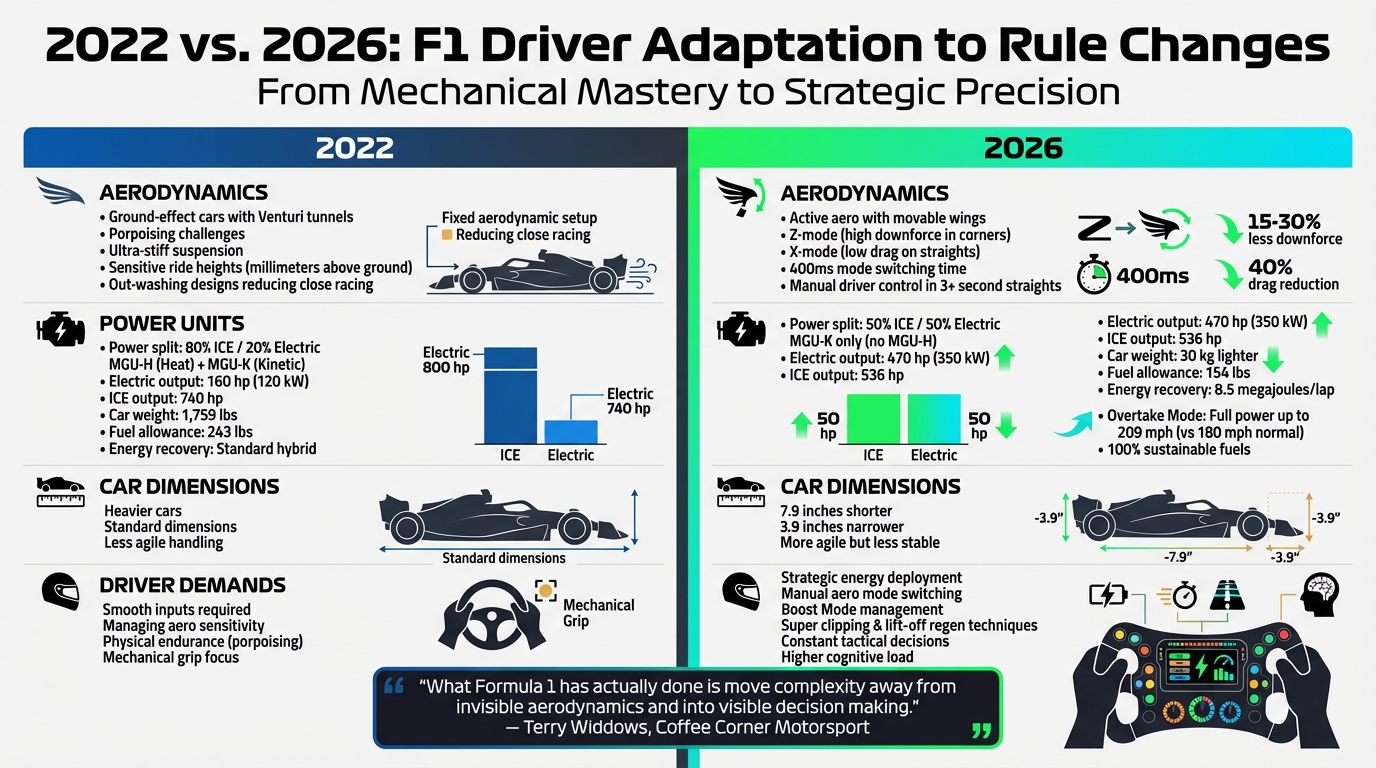
Formula 1 2022 vs 2026 Technical Regulations Comparison
Aerodynamics: Ground Effect vs. Active Modes
2022: Managing Ground-Effect Cars
The 2022 ground-effect cars introduced a brutal challenge for drivers: porpoising. This phenomenon occurred when the Venturi tunnels underneath the car stalled and recovered in quick succession, creating a violent bouncing motion that made driving physically exhausting. To maximize performance, teams set ride heights incredibly low - just millimeters above the ground - and used ultra-stiff suspension. This left the cars with almost no ability to absorb bumps, making them unforgiving on uneven tracks.
But the real difficulty wasn’t just the physical strain. Even the smallest adjustments to ride height or airflow could throw the car's balance completely off. One moment, the car felt glued to the track; the next, it slid unpredictably. This sensitivity made the cars incredibly tough to manage. Although the 2022 regulations initially improved how closely cars could follow each other, teams quickly countered this with "out-washing" designs. These tweaks redirected turbulent air toward trailing cars, making close racing progressively harder as the season wore on. As Matt Youson put it:
The ground-effect era succeeded in many of its aims but as the teams developed their cars... it got harder and harder to get close to the car in front.
This unpredictable and physically demanding setup stands in stark contrast to the precision required by the active aerodynamic systems introduced in 2026.
2026: Handling Active Aero Systems
The 2026 regulations bring a complete overhaul to aerodynamics, replacing the reliance on underbody tunnels with movable front and rear wings. These wings operate in two distinct configurations: Z-mode for high downforce in corners and X-mode for low drag on straights. Drivers manually switch between these modes in specific zones on the track (typically straights lasting over three seconds), adding a layer of strategy to every lap.
Switching between modes happens in just 400 milliseconds, but the transition must be perfectly synchronized. If the front and rear wings don’t adjust in harmony, the car risks losing stability or snapping mid-corner. Byron Score summed up this new challenge well:
The 2026 car asks the driver a new question every lap: grip or glide.
Unlike the fixed setups of 2022, drivers in 2026 must constantly decide whether to prioritize speed or grip, factoring in energy deployment strategies as well. The cars themselves are smaller - 7.9 inches shorter and 3.9 inches narrower - making them inherently less stable than their 2022 counterparts. To ensure safety, the active aero system includes a fail-safe that automatically switches to high-downforce Corner Mode in case of a malfunction.
These rapid adjustments require drivers to rethink their approach every lap, balancing speed, grip, and energy efficiency. This shift highlights how the role of the driver has evolved, demanding not just skill but also tactical precision to master the dynamic nature of modern aerodynamic systems.
Power Units: Hybrid Systems vs. Sustainable Technology
2022: Optimizing Hybrid Power
In 2022, power units required a careful balance to maximize performance while managing fuel efficiency. Drivers worked with both the MGU-H (Heat) and MGU-K (Kinetic) systems, which were integral to the hybrid setup. The MGU-H captured energy from exhaust gases, helping spin the turbocharger and reducing turbo lag, while the MGU-K harnessed energy during braking, delivering an extra 160 horsepower when deployed.
At 1,759 pounds, the cars were heavier, which made precise use of hybrid energy crucial. Teams had to carefully balance the need for speed with fuel efficiency, all while focusing on the future 2026 systems. By 2022, the electrical systems contributed about 20% of the total power output, with the internal combustion engine (ICE) still handling the majority of the workload. These complexities laid the groundwork for the major energy system changes introduced in 2026.
2026: Learning New Energy Systems
The 2026 season brings a whole new challenge for drivers with a reimagined power unit. The removal of the MGU-H shifts more responsibility to the MGU-K, which now has to recover and deploy three times as much energy as before. The power split between the ICE and the electrical system moves to a near-equal ratio, a stark contrast to the ICE-heavy 2022 configuration. Electric output jumps to 470 horsepower (350 kW), significantly up from 160, while ICE output drops to around 536 horsepower from 740.
Drivers are also adapting to a new "Overtake Mode", which unleashes full electrical power when within one second of a competitor. This mode extends full power up to 209 mph (337 km/h), compared to the 180 mph (290 km/h) limit in normal mode. While this offers a clear advantage for overtaking, it demands careful battery management. Mismanaging the battery could leave drivers defenseless on long straights, making strategic energy use critical. As Valtteri Bottas explained during testing:
"The cars handle different... you have so much more torque out of the corners, but then you have the battery to manage."
To meet the new energy recovery target of 8.5 megajoules per lap, drivers employ advanced techniques like "super clipping" (harvesting energy even at full throttle) and "lift-off regen", where the power unit acts as a generator during cornering. Engines may even rev at high speeds mid-corner to maximize energy recovery, a phenomenon Adrian Newey described as:
"The engines will be working flat-chat as generators just about the whole time."
Running the battery dry while defending can leave the car vulnerable, underscoring the importance of energy strategy. Beyond the changes to energy systems, the shift to 100% advanced sustainable fuels also reshapes race dynamics. These fuels behave differently compared to the 2022 blend, and the fuel allowance drops significantly - from 243 pounds to just 154 pounds. Combined with the lighter fuel loads, this further alters driving strategies. Together, these changes mark a dramatic shift in how drivers approach both performance and efficiency.
Driving Styles: Aggression vs. Precision
2022: Smooth Inputs and Aero Sensitivity
The 2022 Formula 1 season introduced ground-effect cars that demanded a shift in driving techniques. These cars relied heavily on underbody Venturi tunnels to generate downforce, but this came with a catch - when the car got too close to the ground, the aerodynamic balance could be thrown off entirely. This phenomenon, known as porpoising, became a major challenge during early-season testing, as drivers struggled to manage ride height and floor entry effectively.
Adding to the challenge, the reduced sidewall cushioning of the tires left little room for error with aggressive steering or throttle inputs. On the upside, the removal of the Y250 vortex and bargeboards reduced dirty air, allowing for tighter, more competitive wheel-to-wheel racing. Teams like Red Bull Racing, under the guidance of Adrian Newey, excelled in mastering the ground-effect platform. This dominance was reflected in their 2023 performance, where they claimed 21 out of 22 race wins, with Max Verstappen achieving 19 of those victories.
In essence, the 2022 cars required drivers to adopt smoother, more disciplined inputs to maintain control over their aero-sensitive machines. But as the sport looks ahead to 2026, the focus shifts from managing unseen aerodynamic forces to making visible, strategic energy decisions.
2026: Disciplined Energy and Aero Management
The 2026 regulations bring a new layer of complexity, moving the focus from the invisible nuances of aerodynamics to highly visible, strategic decision-making. Drivers must now juggle energy deployment and aero states in real-time, creating immediate consequences for over-aggressive choices. Terry Widdows, Editor at Coffee Corner Motorsport, summed it up well:
What Formula 1 has actually done is move complexity away from invisible aerodynamics and into visible decision making.
For instance, BOOST MODE - a finite energy reserve - requires careful management. Using it too early for defense or attack can leave drivers vulnerable later in the race. Unlike the binary DRS system of 2022, this approach demands a more nuanced strategy:
Use BOOST MODE to defend early and you may expose yourself later. Use it to attack without recharge capacity and you become vulnerable. There is no zone. No permission. Only consequence.
The 2026 cars, while lighter and more agile, operate with 15% to 30% less downforce. This makes energy management errors more noticeable, especially with broadcast graphics highlighting these missteps. As Widdows observed:
The best drivers will hide it [recharge]. The worst will make it obvious.
This evolution in Formula 1 demands a new kind of precision - balancing energy and aero management while keeping mistakes invisible to both competitors and fans.
Which F1 Drivers’ Driving Styles Will Dominate The 2026 Regulations?
Driver Examples: Verstappen, Hamilton, and Leclerc
As Formula 1 gears up for the changes coming in 2026, drivers are being pushed to adapt to a whole new set of technical demands. Let’s take a closer look at how Max Verstappen, Lewis Hamilton, and Charles Leclerc are preparing for this next chapter.
Verstappen's Approach to New Challenges
Max Verstappen's success during the 2022 ground-effect era highlighted his skill in handling aero-sensitive cars. Working alongside Adrian Newey, he helped Red Bull dominate with 21 wins out of 22 races by 2023. But the 2026 regulations bring a fresh set of hurdles.
At the Bahrain test, Verstappen pointed out that energy management will be a major test under the new rules. He logged 136 laps on day one but expressed frustration with how the cars are evolving. He specifically criticized the need to downshift on straights to conserve battery energy at high-speed tracks like Monza:
If you go flat-out on the straight at Monza... 400m or 500m before the end of the straight, you have to downshift flat-out because that's faster. I think that's not the way forward.
Calling the 2026 cars "Formula E on steroids", Verstappen faces the challenge of mastering energy deployment strategies and active aero systems - skills that differ greatly from his aerodynamic finesse in 2022.
Hamilton's Veteran Edge
Lewis Hamilton's struggles with Mercedes' porpoising issues in early 2022 forced him to adapt to an uncompetitive car, a challenge that might prove useful under the 2026 rules. Now with Ferrari, Hamilton is channeling his hybrid-era experience into tackling the new regulations.
After testing the Ferrari SF26 during the February 2026 winter session in Bahrain, Hamilton remarked that the cars "feel slower than F2" but described their handling as "fun" and reminiscent of rally driving. His extensive experience managing hybrid power units could give him an edge in energy management, where cockpit activity will be more demanding than ever.
Williams Team Principal James Vowles underscored the importance of this experience:
I think the way the rules are at the moment, they will be busier in the cockpit... you'll get those that come out on top as a result of it - those that are completely in control of the car and its behaviours and then thinking outside the box.
Hamilton's ability to balance instinct and tactical thinking might make him a standout in this new era, where even minor miscalculations in energy recovery could cost precious time.
Leclerc's Rapid Adaptation
Charles Leclerc showcased his adaptability in 2022, with Ferrari briefly emerging as Red Bull's strongest rival before falling behind in development. That ability to quickly grasp new technical requirements seems to be carrying over into the 2026 season.
During the final Bahrain pre-season test in February 2026, Leclerc led the timing sheets on the first morning, edging out Lando Norris. Despite earlier doubts about the simulator experience - calling it "not the most enjoyable" - his on-track performance suggests he’s already finding the limits of the new SF26.
Leclerc has also been paying close attention to his competitors. After testing, he observed that Mercedes seemed to be "hiding a massive amount" of potential. With the 50/50 power split between engine and battery requiring constant cockpit management, Leclerc’s ability to quickly master the manual toggle between X-mode (low drag) and Z-mode (high downforce) could give him an advantage. His sharp technical insight and tactical awareness make him well-suited to thrive under the new regulations.
Conclusion: 2022 Lessons and 2026 Predictions
The transition from 2022 to 2026 has reshaped what defines success in Formula 1. Back in 2022, drivers and teams wrestled with ground-effect cars that were highly sensitive to ride height and plagued by porpoising issues. Teams like Red Bull, led by Adrian Newey, excelled by mastering the intricate underfloor aerodynamics that held the key to performance. But now, the focus has shifted. The complexity has moved away from engineering alone and into the hands of the drivers themselves.
By 2026, drivers face an entirely new set of challenges. They must alternate between X-mode and Z-mode while managing limited energy supplies through Boost and Overtake modes. The power dynamics of the car have also changed dramatically, moving from an 80% combustion/20% electric split to a near-even 50-50 mix. On top of that, the MGU-K output has skyrocketed from 120 kW to 350 kW. As Terry Widdows, Editor at Coffee Corner Motorsport, aptly noted:
What the regulations remove from passive grip, they replace with active control... The car becomes less dominant. The driver becomes exposed.
Early testing hints at a possible resurgence for Mercedes, as George Russell topped the timesheets on Day 1 of the second Bahrain pre-season test in February 2026, following significant upgrades to their car. Meanwhile, drivers like Max Verstappen and Charles Leclerc, who showcased their adaptability in 2022, seem well-equipped for the mental and technical demands of this new era. Verstappen’s smoother driving style and Leclerc’s quick grasp of technical nuances could give them an edge in navigating the increased cognitive load required in 2026.
The cars themselves will also demand more precision. A 30 kg weight reduction combined with more compact dimensions promises greater agility, while a 40% reduction in drag and a 15–30% decrease in downforce will reward drivers who can balance energy deployment with pinpoint control. Hybrid systems remain a critical factor, and those who can master their deployment while maintaining precision will likely rise to the top.
If 2022 proved that technical mastery was the key to winning championships, 2026 will be the ultimate test of a driver’s ability to combine strategic thinking and on-track execution. This evolution marks a shift in Formula 1, where success will hinge not just on engineering brilliance but also on the driver’s ability to adapt and strategize in real time. The question is: can today’s drivers meet these heightened demands? Only time will tell.
FAQs
How will active aero change overtaking in 2026?
The 2026 season will bring an exciting change to racing with the introduction of active aerodynamics. This system will feature a dual-mode wing that drivers can adjust based on their needs during the race. Whether they’re aiming for higher speeds on straight sections or better grip in corners, this flexibility will allow for smarter, more strategic driving.
In addition to this, cars will adopt lighter and more efficient designs, which will significantly cut down on the aerodynamic wake they produce. This means cars can race closer together without as much turbulence disrupting their performance. The result? More overtaking opportunities and less reliance on DRS, leading to intense, wheel-to-wheel battles that keep fans on the edge of their seats.
Will 2026 energy rules force drivers to lift-and-coast more?
The 2026 energy regulations are expected to push drivers toward using lift-and-coast techniques more frequently. These rules will bring a more complex energy management system into play, emphasizing strategic energy usage and injecting a layer of unpredictability into race strategies.
Which driving skills matter most in 2026 compared to 2022?
In 2026, the skills drivers rely on take a sharp turn toward energy management, precision, and adaptability. Managing hybrid power units becomes a critical focus, with drivers needing to balance energy deployment in real-time - far removed from 2022's emphasis on conserving tires.
Aerodynamics also play a bigger role. With smaller, more agile cars on the track, drivers must refine their car control and learn to harness airflow effectively. Success hinges on strategic energy use and adapting to these aerodynamic shifts, showcasing just how much race strategies have evolved since the simpler approaches of 2022.