
Blockchain Use Cases in F1 Media Rights
How blockchain transforms F1 media rights: transparent ownership, smart-contract payments, NFT ticketing, fan tokens and decentralized streaming.

Blockchain is reshaping how Formula One (F1) manages and monetizes its media rights. Here's how:
- Transparency: Blockchain eliminates intermediaries by using secure, tamper-proof ledgers to track ownership and rights. This ensures clear records for intellectual property like race footage and data.
- Automated Payments: Smart contracts streamline royalty payments, reducing costs and delays.
- Fan Engagement: Teams like Aston Martin and McLaren use NFTs and fan tokens to offer exclusive content and voting rights, creating new revenue streams and deeper connections with fans.
- Secure Ticketing: NFT-based ticketing, introduced at events like the Monaco Grand Prix, combats counterfeiting and scalping while offering perks to fans.
- Sponsorships: Blockchain enables transparent sponsorship deals, such as Aston Martin's stablecoin-backed agreement with Coinbase in 2025.
Blockchain also supports decentralized streaming, allowing teams to bypass traditional broadcasters and offer direct-to-fan content. While challenges like user accessibility and existing contracts remain, F1 is leveraging blockchain to simplify operations, cut costs, and enhance fan experiences.
Transparency and Security Benefits of Blockchain in Media Rights
Blockchain offers a clear and secure solution to many of the inefficiencies in managing media rights for Formula One (F1).
F1’s intellectual property - everything from race footage and timing data to official typefaces and audio-visual content - is stringently protected. However, traditional systems often rely on centralized registries and multiple intermediaries to track ownership. This approach can leave gaps, increasing the risk of unauthorized distribution. Blockchain tackles these issues by creating a tamper-proof, permanent ledger.
Permanent Records for Rights Ownership
Blockchain technology ensures every piece of media content is time-stamped and directly linked to its creator or rights holder. It captures precise ownership details, including regions, durations, and transfer history, all stored in a decentralized system. Beyond that, blockchain tracks every action in the copyright value chain - whether it’s capturing, distributing, or performing - ensuring proper identification and compensation for composers, performers, and labels. Smart contracts further streamline the process by automating royalty payouts based on usage conditions. As Team Ripple put it:
"The fact that each NFT is a unique digital asset that is completely traceable throughout the entire process of sale, trade and ownership means that both artists and companies can have complete trust and visibility of those sales."
This transparency doesn’t just improve accountability. It also strengthens the fight against piracy in content distribution.
Improved Security in Content Distribution
Blockchain-based systems significantly enhance security, particularly in preventing piracy, thanks to token-gated access tailored for F1 applications. For example, during the May 2023 Monaco Grand Prix, an NFT ticketing system was introduced on the Polygon blockchain through a collaboration between Platinium Group, Elemint, and Bary. These NFT tickets acted as digital keys, offering VIP perks while maintaining a transparent, tamper-proof record of ownership. Jacques-Henri Eyraud, CEO of Elemint, highlighted this innovation:
"Web3 technologies make it possible to design ticketing solutions that are more secure and more adapted to the specificity of each event."
Because blockchain tickets are resistant to copying and counterfeiting, they effectively combat scalping and unauthorized resale. Features like digital watermarking and content hashing also store unique identifiers on-chain, enabling rights holders to detect unauthorized duplicates or infringing copies. This added layer of security plays a crucial role in protecting F1 media content from unauthorized use and grey market activities.
Blockchain Applications in F1 Media Rights
Formula One teams are exploring blockchain to reshape how media rights are managed and monetized. This shift reflects a growing interest in decentralized systems for handling media rights.
NFTs and Exclusive Content Access
Leveraging the transparency and security of blockchain, F1 teams are using NFTs to deepen fan engagement and open up new revenue opportunities. Aston Martin took the lead in March 2021 by teaming up with Crypto.com to launch F1's first NFT initiative. They released 1,500 digital collectibles capturing iconic race moments, which sold out in just 24 hours. Rob Bloom, Aston Martin's Chief Marketing Officer, emphasized the importance of creating meaningful content:
"This is about creating something that's both relevant and desirable... It's not just about selling a piece of content as an NFT, but creating a piece of content that has an emotional and historical significance."
These NFTs not only generate revenue during the initial sale but also facilitate ongoing income through secondary market transactions. Fans benefit as well, gaining exclusive access to verified, one-of-a-kind content. Other teams have followed suit: Williams Racing introduced its "Williams Racing Collectibles+ Grid Pass", which gives NFT owners a non-exclusive license to display their digital media for personal use. Similarly, McLaren Racing collaborated with Turkish crypto exchange Bitci.com in March 2021 to launch fan tokens. These tokens grant holders access to exclusive content and even allow them to vote on specific team-related decisions.
Beyond fan engagement, blockchain is also making waves in sponsorships and financial transactions.
Sponsorship Deals and Blockchain Tracking
In February 2025, Aston Martin made headlines by entering a multi-year sponsorship deal with Coinbase, with payments made entirely in USDC stablecoin. This marked the first time an F1 team received full sponsorship payment through blockchain-based currency. Blockchain's ability to maintain immutable records adds transparency to these sponsorships, ensuring clear verification of fan engagement and return on investment. This approach builds on earlier advancements in blockchain security to track sponsorship performance.
Fan Engagement and Monetization Through Blockchain
Blockchain technology is reshaping how Formula 1 teams connect with their fans while unlocking new revenue opportunities. By creating digital ecosystems, teams are giving fans a chance to actively participate in decisions and gain access to exclusive perks.
Interactive Fan Platforms Using Blockchain
F1 teams are leveraging blockchain to create more dynamic fan experiences. For example, building on the success of NFT ticketing, teams now offer platforms where fans can vote on team decisions and access exclusive content. In 2025, Alpine F1 partnered with Binance and ApeCoin to promote crypto education and engage fans through NFT giveaways. Similarly, McLaren Racing expanded its partnership with OKX in 2024, securing a deal worth around $32 million annually. This collaboration introduced a Web3 platform for fans to manage NFTs and explore decentralized finance tools. These efforts are part of the growing "SportFi" movement, where blockchain-based actions like voting or attending races can lead to real-world rewards and loyalty benefits. Such initiatives are strengthening fan relationships while paving the way for new ways to generate revenue.
Revenue Opportunities Through Tokenization
While enhanced fan platforms build engagement, tokenization turns these interactions into ongoing revenue streams. Aston Martin demonstrated this potential in March 2021 when it launched its first NFT collection in partnership with Crypto.com. All 1,500 NFTs sold out within 24 hours. Since blockchain tracks every NFT transaction, teams earn a percentage from each resale, creating a continuous source of income.
The financial impact of blockchain in F1 is substantial. In 2025, cryptocurrency and fintech sponsorships in the sport reached $273.6 million across 21 partnerships - a 9% increase in value and a 40% rise in the number of deals compared to 2024. Between 2021 and 2025, fintech and crypto brands spent over $1 billion on F1 sponsorships. Beyond sponsorships, blockchain's smart contract capabilities enable micropayments for specific content, such as exclusive camera angles or race highlights. This direct-to-fan model not only eliminates the need for traditional media intermediaries but also cuts transaction costs by 40% and speeds up transactions by 60% compared to centralized systems.
The Future of Blockchain in Decentralized Media Rights Distribution
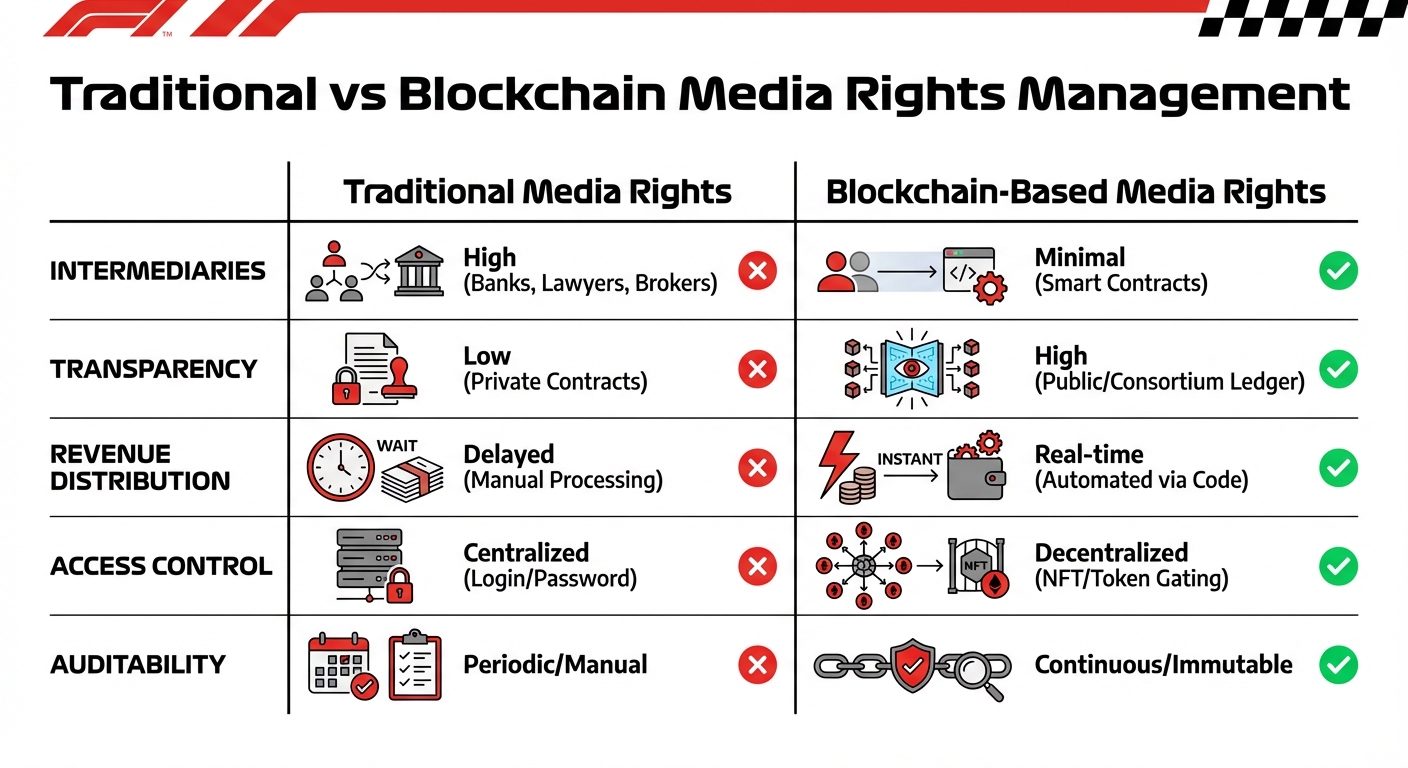
Traditional vs Blockchain-Based Media Rights Management in Formula 1
Formula One's media rights are poised for a transformation. With its track record of embracing advancements in transparency and security, the sport is now exploring how blockchain could reshape broadcasting agreements. Traditionally, these agreements involve lengthy negotiations and multiple intermediaries, but decentralized systems offer a fresh approach: faster transactions, reduced costs, and direct connections between rights holders and fans.
Smart Contracts for Automated Rights Management
At the heart of this shift are smart contracts - self-executing programs that enforce agreements without the need for intermediaries. In the context of F1 media rights, smart contracts can automate licensing processes and instantly distribute revenue, directly benefiting teams, drivers, and broadcasters.
By cutting out intermediaries, blockchain-based agreements significantly lower the transaction costs and fees typically associated with traditional legal and financial systems. As of late 2023, decentralized finance (DeFi) platforms had locked over $20 billion in value, showcasing the growing trust in blockchain's automated systems.
One notable example of blockchain's potential came in May 2021, when the BWT Alpine F1 Team collaborated with Binance to launch fan tokens. These tokens gave supporters access to exclusive content and allowed them to participate in team decisions through decentralized voting. This initiative demonstrated how digital rights could be managed through access tokens, enabling specific holders to unlock behind-the-scenes footage or VIP experiences without manual verification.
"Smart contracts facilitate reliable transactions and agreements between anonymous parties, eliminating the need for intermediaries like central authorities, legal systems, or external enforcement mechanisms." – SoluLab
Another advantage of blockchain is its ability to provide an immutable audit trail. Every access request and transaction is recorded on a secure ledger, ensuring transparency for policy enforcement and violation tracking. In prototype testing, smart contract-based security frameworks showed a 0% success rate for unauthorized access attempts, highlighting their reliability.
Here’s how blockchain-based media rights management stacks up against traditional models:
| Feature | Traditional Media Rights | Blockchain-Based Media Rights |
|---|---|---|
| Intermediaries | High (Banks, Lawyers, Brokers) | Minimal (Smart Contracts) |
| Transparency | Low (Private Contracts) | High (Public/Consortium Ledger) |
| Revenue Distribution | Delayed (Manual Processing) | Real-time (Automated via Code) |
| Access Control | Centralized (Login/Password) | Decentralized (NFT/Token Gating) |
| Auditability | Periodic/Manual | Continuous/Immutable |
Beyond automating contracts, blockchain is also changing how fans access content.
Decentralized Streaming and Broadcasting
Decentralized streaming platforms take blockchain a step further, allowing F1 rights holders to bypass traditional broadcasters and deliver content directly to fans. This direct-to-consumer approach opens up creative pricing models, such as micropayments for specific camera angles or pay-per-view billing for race highlights.
NFTs further enhance this model by granting fans ownership of content, such as live broadcasts or archived footage, which they can sell or transfer. However, challenges remain. Many blockchain-based platforms have user interfaces that require advanced Web3 knowledge, making them less accessible to the average fan. Additionally, traditional broadcasters still hold long-term, high-value contracts with F1 organizations, creating hurdles for decentralized platforms to secure primary broadcasting rights.
For decentralized streaming to gain traction, platforms need to simplify the user experience. The key lies in creating systems that integrate blockchain seamlessly, without requiring users to navigate its complexities. As F1 continues to explore blockchain applications, the success of decentralized media distribution will depend on making these innovations user-friendly while ensuring rights holders enjoy the benefits of transparent, automated systems.
Conclusion
Throughout this article, we’ve explored how blockchain is reshaping the way Formula One handles its media rights. From streamlining payments to ensuring fraud-resistant ticketing and providing transparent ownership records, the technology is driving real change in the sport.
The financial impact speaks volumes. Between 2021 and 2025, fintech and crypto brands funneled over $1 billion into F1 sponsorships, with 2025 alone accounting for $273.6 million across 21 partnerships. Aston Martin’s NFT collection, launched in March 2021, sold out in just 24 hours, paving the way for ongoing revenue through secondary sales. By February 2025, the team also secured F1’s first fully stablecoin-backed sponsorship with Coinbase.
For fans, blockchain has opened up new ways to engage with the sport. The Monaco Grand Prix in May 2023 introduced an NFT-based ticketing system that turned tickets into digital keys, unlocking exclusive perks and creating lasting digital memorabilia. Fan tokens have also brought fans closer to the action, letting them vote on team decisions and enjoy behind-the-scenes content.
Teams and broadcasters are also reaping the rewards. Blockchain’s automated systems mean faster payments and clearer ownership records, reducing friction and improving efficiency.
Looking ahead, the focus will likely shift toward ensuring even greater transparency, delivering exclusive experiences, and fostering deeper fan connections. From bolstering security to enabling real-time revenue streams, blockchain is cementing its role as a transformative force in Formula One’s media landscape. The road ahead promises even more exciting advancements.
FAQs
How does blockchain enhance transparency in managing F1 media rights?
Blockchain technology brings a new level of transparency to managing F1 media rights. It offers a secure, tamper-resistant system to track the ownership and distribution of digital content. This ensures a clear record of origin, minimizes the risk of fraud, and allows all parties involved to verify transactions with confidence.
By incorporating blockchain, F1 organizations can simplify the distribution process, safeguard intellectual property, and ensure rights holders are compensated accurately. This approach not only builds trust but also updates the way media rights are handled in the sport, aligning with modern technological advancements.
How are NFTs being used to enhance fan experiences in Formula 1?
NFTs, or non-fungible tokens, are changing the way Formula 1 connects with its fans by offering one-of-a-kind digital experiences and collectibles. Teams like Aston Martin and Williams Racing have embraced NFTs, giving fans the chance to own exclusive digital memorabilia. These can range from car launch videos to race highlights, adding a new layer of excitement and a sense of personal connection to the sport.
Beyond collectibles, NFTs are opening doors to unique perks. Fans can gain access to exclusive events, earn loyalty rewards, and even have a say in team decisions through blockchain-based fan tokens. On top of that, blockchain ticketing is making event access more secure and transparent, using token-gated systems to streamline the process. With these innovations, Formula 1 is turning fans into active participants, reshaping the traditional spectator experience.
How do smart contracts simplify payments for F1 media rights?
Smart contracts make handling payments for F1 media rights much simpler by automating the distribution of royalties and licensing fees. These blockchain-powered agreements are set up to process payments instantly and with full transparency whenever content is utilized or rights are exchanged.
This approach ensures revenue is allocated quickly and equitably, cutting down on delays, avoiding disputes, and building trust among all parties involved.