How Constructors' Titles Shape F1 Team Legacies
Explains how the F1 Constructors' Championship drives team finances, sponsorships, technical innovation and long-term legacy across Formula 1 eras.
Formula 1's Constructors' Championship is more than just a trophy - it's the backbone of the sport. It defines team success, influences financial rewards, and cements legacies. Here's why it matters:
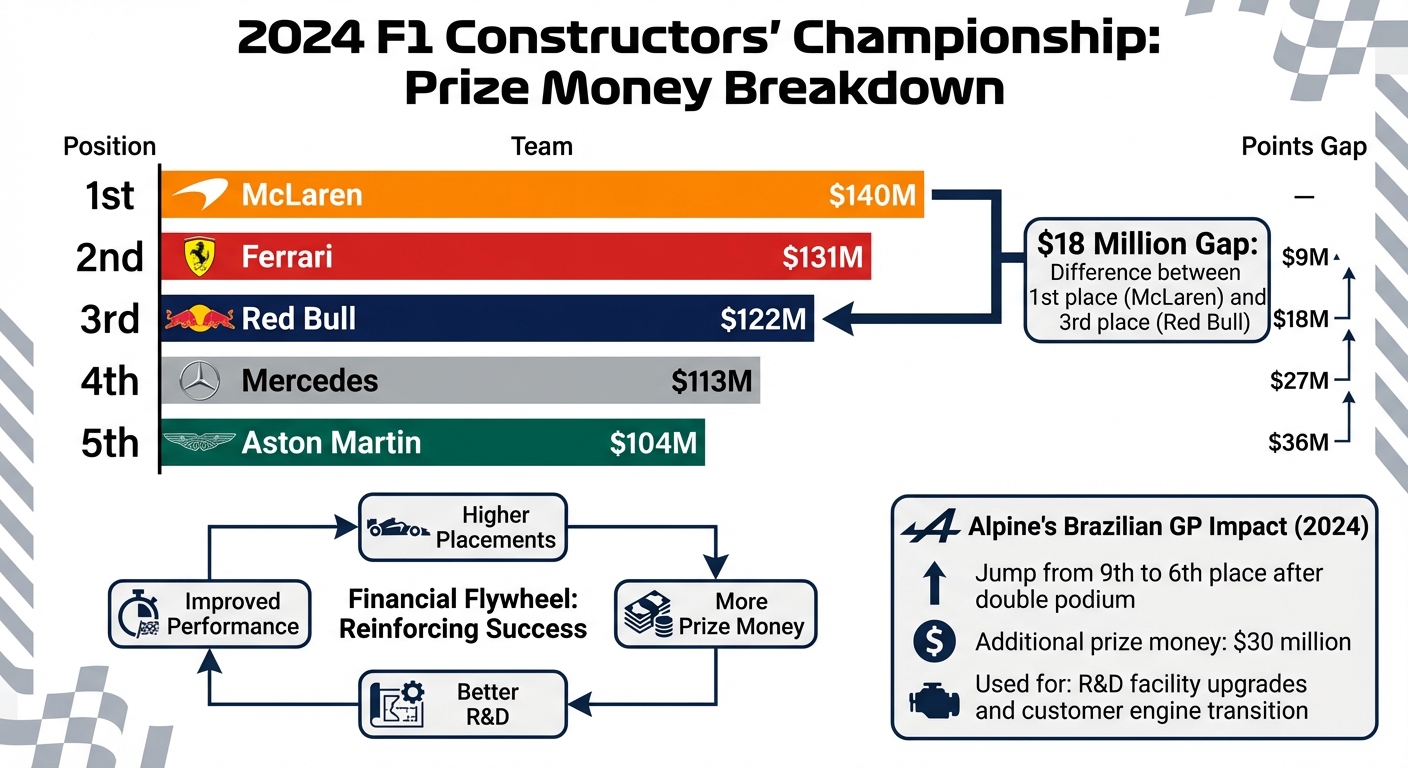
- Financial Impact: Teams earn prize money based on their standings. For example, McLaren's 2024 win brought in $140 million, while Red Bull's third-place finish earned $122 million - a difference of $18 million.
- Team Reputation: Winning builds credibility, attracts sponsors, and secures top talent. Ferrari, with 16 titles, and Mercedes, with eight consecutive wins (2014–2021), are prime examples.
- Technical Progress: Competition drives innovation. From Ferrari's dominance in the Schumacher era to Brawn GP's 2009 "double diffuser", technical ingenuity often defines champions.
- Legacy and Influence: Teams like Ferrari and McLaren benefit from historic success, which boosts fan loyalty and long-term brand strength.
The Constructors' title is more than points; it’s about shaping a team’s future, both on and off the track.
Formula 1 Constructors Champions (1958–2025)
How Constructors' Titles Build Team Reputation
F1 Constructors' Championship Prize Money Distribution 2024
Constructors' Championships do more than just award trophies - they turn racing teams into global powerhouses. These standings act as what sponsors often call the "cleanest scoreboard", showcasing a team's technical prowess and market appeal.
This success creates a cycle that fuels itself. A strong finish in the championship brings in resources, which teams use to enhance their performance. This, in turn, boosts their standings and makes them even more attractive to sponsors. Teams that consistently land in the top three operate in a completely different league, commanding higher sponsorship deals and longer contracts than mid-tier competitors. This reputation doesn’t just draw in sponsors - it lays the groundwork for long-term success, both on and off the track.
Brand Prestige and Global Recognition
Winning championships secures a team's place in motorsport history. Take Ferrari, for instance. With 16 titles, the Italian team has become more than just a racing outfit - it’s a global symbol of speed and engineering excellence. Similarly, Mercedes, with its eight consecutive championships from 2014 to 2021, has established itself as the standard for hybrid-era dominance.
Legacy teams like Ferrari continue to benefit from their historic success long after their last win. For example, Ferrari receives a unique historical significance bonus from Formula One, amounting to at least 5% of the total prize fund, which could rise to 10% if the fund exceeds $1.6 billion.
In December 2024, McLaren Racing broke a 26-year drought by clinching the Constructors' Championship. Under the leadership of CEO Zak Brown and Team Principal Andrea Stella, drivers Lando Norris and Oscar Piastri delivered the victory. This win brought in an estimated $140 million in prize money and marked McLaren’s return to the top tier of Formula One, solidifying its reputation as a premier racing brand.
Sponsorships and Commercial Partnerships
A strong championship finish boosts sponsor confidence and increases contract values. Brands look at factors like visibility, technical expertise, and association with success - all of which are tied to constructors' performance. High standings provide financial stability for teams, helping them maintain sponsorship deals even during periods of weaker on-track performance.
The financial impact of these standings is substantial. In 2024, the difference in prize money between first place (McLaren at $140 million) and third place (Red Bull at $122 million) was $18 million. Over multiple seasons, these gaps add up, giving winning teams a resource advantage they can use to attract premium sponsors.
Even a single race can alter a team's commercial prospects. In November 2024, the Alpine F1 Team jumped from ninth to sixth in the Constructors' Championship after Pierre Gasly and Esteban Ocon secured a double podium at the rain-soaked Brazilian Grand Prix. This result earned Alpine an additional $30 million in prize money, which they allocated to upgrading their R&D facilities and transitioning to a customer engine deal. Such financial boosts also help teams attract top-tier sponsors and talent.
Attracting and Keeping Top Talent
Championship-winning teams are magnets for top talent. These teams offer more than just competitive salaries - they provide access to cutting-edge facilities, larger development budgets, and the prestige of working at motorsport's highest level. This reputation for excellence creates a feedback loop, where success attracts talent, and that talent drives further success.
Championship standings also impact morale and retention across the entire organization. For instance, final rankings determine performance bonuses for factory employees and influence garage positions in the pit lane, which affects efficiency and staff satisfaction. Teams that consistently finish near the top can offer career opportunities that mid-tier teams simply can’t match.
"It was always our priority. Even when there was a call to be made to support one driver or the other, it was always secondary to that – to maximising the constructors' championship." - Andrea Stella, Team Principal, McLaren
This mindset shows how championship-focused teams build reputations as destinations for ambitious individuals. Drivers looking to advance their careers prioritize teams with strong performance trajectories and championship-winning infrastructure. The same logic applies to technical staff, who know that working for a successful constructor means access to better resources and opportunities for growth. A winning culture, built on championship success, forms the backbone of a team's legacy.
Dominant Teams That Defined F1 Eras
Throughout Formula One's history, certain teams have not only claimed championships but also left an indelible mark by dominating entire eras. These periods of supremacy shaped the sport's technical evolution, commercial appeal, and global reach. Ferrari, McLaren, Williams, Red Bull, and Mercedes stand out as teams that defined their times, each setting benchmarks that others aspired to match.
Ferrari: 16 Titles and a Legacy of Excellence
Ferrari is the only team to have competed in every F1 season since the sport's inception in 1950. With 16 Constructors' Championships, Ferrari's legacy is built on consistency and pushing the boundaries of innovation. Their record includes 248 race wins, a staggering 22.60% win rate, and 829 podium finishes - 305 more than their closest rival.
The team’s dominance during the Michael Schumacher era (1999–2004) is particularly noteworthy. Ferrari clinched six consecutive titles during this period, thanks to relentless improvements in both technology and operational efficiency. Their performance at specific tracks also stands out - Ferrari has won the German Grand Prix 21 times, the most wins by any team at a single venue.
Financial stability has played a key role in Ferrari's enduring success. The team benefits from a unique historical significance payment, which ensures they receive at least 5% of F1's commercial rights profits. This financial advantage, combined with their storied achievements, continues to attract top talent and sponsors, ensuring Ferrari remains a powerhouse in the sport.
McLaren and Williams: Titans of the 1980s and 1990s
The 1980s and 1990s saw McLaren and Williams dominate the F1 landscape, leveraging technical ingenuity and strategic partnerships to secure their places in history. McLaren has won 10 Constructors' Championships, while Williams boasts 9 titles.
McLaren's 1988 season with the MP4/4 chassis remains one of the most dominant in F1 history. Ayrton Senna and Alain Prost won 15 of 16 races that year, leading 1,003 out of 1,031 laps. The team clinched the championship in Belgium, with five races still to go. At the Imola Grand Prix, the MP4/4 qualified 3.3 seconds faster than any competitor. This success was driven by partnerships with TAG-Porsche and Honda engines, alongside John Barnard’s revolutionary carbon fiber chassis design.
Williams, on the other hand, thrived on technical innovation, particularly during their partnership with Renault in the 1990s. Between 1992 and 1997, they won 5 titles in 6 years. The FW14B, designed by Adrian Newey, showcased advanced features like active suspension, helping Williams secure the 1992 Constructors' title by a 65-point margin over McLaren. Unlike McLaren, which often relied on superstar driver pairings, Williams set itself apart with groundbreaking aerodynamic designs and driver aids such as traction control. These achievements cemented both teams as enduring icons in F1, with their historical success continuing to influence modern sponsorship and recruitment efforts.
Red Bull and Mercedes: Masters of the Modern Era
The modern era has been defined by two giants: Mercedes-AMG Petronas and Red Bull Racing. These teams have redefined what it means to dominate in Formula One, using cutting-edge technology and strategic brilliance.
Mercedes set the standard with eight consecutive Constructors' Championships from 2014 to 2021 - the longest streak in F1 history. Unlike earlier dynasties that depended on engine suppliers, Mercedes operated as a full works team, controlling both chassis and power unit development. Lewis Hamilton was instrumental in all eight titles, while the team’s V6 Turbo Hybrid engine consistently outperformed the competition.
Red Bull Racing has enjoyed two distinct periods of dominance. The first came during the V8 era (2010–2013), and the second in the ground-effect era (2022–2023). In the 2023 season, Red Bull achieved a jaw-dropping 95.4% win rate, securing 21 victories in 22 races. Led by Team Principal Christian Horner and Chief Technical Officer Adrian Newey, the team amassed 860 championship points and 30 podium finishes. This level of success set new standards for single-season performance.
However, modern dynasties face a constant challenge: adapting to regulation changes. The 2014 hybrid engine rules ended Red Bull’s first streak, while the 2022 aerodynamic changes brought Mercedes’ dominance to a halt. By 2024 and 2025, McLaren had broken the Red Bull-Mercedes stronghold, winning back-to-back titles. They secured the 2025 championship at the Singapore Grand Prix with six races to spare. This resurgence highlights how strategic investment and technical evolution can breathe new life into historic teams, reshaping the competitive landscape once again.
Technical Development Driven by Title Competition
The Constructors' Championship serves as the financial backbone for Formula 1's most groundbreaking technical advancements. Teams at the top of the standings receive larger prize payouts, which they channel into cutting-edge tools like wind tunnels, CFD (Computational Fluid Dynamics) systems, and advanced race simulators. This creates a feedback loop: better results lead to bigger budgets, which fuel faster cars and even higher rankings. For perspective, finishing first instead of third can mean a difference of approximately $18 million - money that directly impacts a team's ability to innovate and compete. These investments not only enhance performance but also secure a team's legacy in the sport.
Major regulatory overhauls often ignite bursts of technical creativity as teams scramble to gain an edge. Take 2009, for example: Brawn GP exploited a loophole in aerodynamic regulations to create the "double diffuser" for their BGP001 chassis. Even with a modest budget compared to larger teams, this innovation propelled them to win eight Grands Prix and claim the Constructors' Championship in their sole season. Similarly, when F1 introduced V6 turbo-hybrid power units in 2014, Mercedes-AMG nailed the integration of engine and chassis, resulting in 16 wins out of 19 races that year and kicking off an eight-year dominance.
Aerodynamics, Engines, and Chassis Design
The relentless pursuit of constructors' titles has pushed teams to develop advanced solutions in aerodynamics, engine technology, and chassis construction. During the turbocharged 1980s, fuel efficiency became a critical focus. McLaren's TAG-Porsche engines were engineered to excel under strict fuel limits while maintaining high power output. At the 1984 Dutch Grand Prix, this technical edge was undeniable - McLaren's cars finished so far ahead that no other team came within a minute of them. That season, they secured 12 wins out of 16 races.
In 1981, John Barnard revolutionized F1 with the introduction of the carbon fiber monocoque chassis on McLaren's MP4/1. This innovation not only improved safety but also enhanced performance, setting a standard that all teams eventually adopted. Combined with the TAG-Porsche turbo engine in the MP4/2, this chassis helped McLaren dominate the mid-1980s.
Fast forward to 2022, and the reintroduction of ground-effect aerodynamics forced teams to rethink their car designs entirely. Ground effect, banned in 1983 due to safety concerns, returned with the goal of reducing "dirty air" and enabling closer racing. Red Bull's RB19 emerged as the standout design under these new rules, securing the 2022 and 2023 titles. Their 2023 season was particularly dominant, with an incredible 95.4% win rate - 21 victories in 22 races.
The financial stakes in these technical battles are immense. A team's final position in the standings can swing their R&D budget by as much as $20 million to $30 million for the following season.
Data Analytics and Race Simulations
While aerodynamic and chassis innovations have historically driven performance, modern championships are increasingly won through data analytics. Today, teams rely on advanced simulations to optimize every aspect of their race strategies. This data-driven approach minimizes unpredictability, allowing teams to consistently extract maximum points from each race weekend. Analysts often refer to this as "pulverizing consistency" - a strategy that thrives on precision rather than one-off breakthroughs.
McLaren's 2024 title-winning season is a prime example. Under Team Principal Andrea Stella, the team introduced a series of upgrades starting at the Miami Grand Prix. These changes, guided by simulations, transformed the MCL38 from a midfield competitor into a championship-winning car by the end of the season. Incremental, carefully validated improvements turned mid-season momentum into ultimate success.
The next frontier in technical development is artificial intelligence. In 2025, Aston Martin's technical lead Adrian Newey began collaborating with an AI partner to optimize the aerodynamic platform for their 2026 car, ahead of a major regulation shift. AI allows teams to test thousands of design variations in the time it would take human engineers to analyze just a handful.
However, data-driven development isn't foolproof. Mercedes' 2022 "zeropod" design concept, based on promising CFD simulations, ultimately fell short in real-world testing. The car experienced severe porpoising issues, a problem the simulations hadn't predicted. This misstep contributed to Mercedes finishing third in the standings, ending their historic dominance. The takeaway? While data analytics are indispensable, they must be rigorously validated through on-track testing to avoid costly errors. These technological leaps not only secure race wins but also cement a team's reputation as a leader in F1 innovation.
Measuring Team Legacy: More Than Title Counts
Championship trophies tell only part of a team's story. A true legacy in Formula 1 is built on much more - sustained excellence, financial strength, and influence that extends beyond the track. While Ferrari's 16 titles set the standard, their legacy also rests on decades of podium finishes, technical breakthroughs, and a fanbase that spans the globe, proving that success in F1 is about more than just numbers.
Performance Metrics and Consistency
Counting titles alone doesn’t always reveal how competitive a team truly is. Metrics like total wins, podium finishes, and points scored across different eras paint a clearer picture of sustained excellence. Take McLaren, for example. Their 10 Constructors' titles reflect an ability to adapt and thrive through various technical regulations - from the turbocharged 1980s to the hybrid era. Their 2025 championship win, which ended a 26-year drought, was a testament to this adaptability. The MCL39 delivered a record-breaking 28 podium finishes, clinching the title six races before the season ended in Singapore.
Consistent performance also fuels a financial "flywheel effect." Higher placements in the Constructors' standings lead to bigger prize payouts, which fund cutting-edge R&D efforts like wind tunnels and CFD systems. These investments then drive better results on the track, creating a cycle of improvement.
But consistency doesn’t just mean winning races - it’s about having both drivers contribute to the team’s success. Red Bull Racing learned this lesson in 2024. Despite Max Verstappen securing his fourth consecutive Drivers' Championship with 437 points, Red Bull finished third in the Constructors' standings. Sergio Perez’s lower contribution - 152 points and an 8th-place finish - left the team short of crucial prize money, costing them around $20 million compared to first place.
"I think you can see the importance of having two drivers scoring on a regular basis in the constructors' championship – it's crucial"
| 2024 Final Position | Estimated Prize Money | Points Gap to First Place |
|---|---|---|
| 1st (McLaren) | $140M | - |
| 2nd (Ferrari) | $131M | $9M |
| 3rd (Red Bull) | $122M | $18M |
| 4th (Mercedes) | $113M | $27M |
| 5th (Aston Martin) | $104M | $36M |
These numbers highlight how on-track performance directly impacts finances, which in turn shapes a team’s ability to stay competitive. But legacy isn’t just about points and prize money - it’s also about the connection teams forge with their fans.
Fan Base and Team Identity
A team’s legacy reaches far beyond the racetrack and into the hearts of its supporters. Ferrari and Red Bull are prime examples of how a loyal fanbase can sustain influence even during less competitive periods. Ferrari’s global following, symbolized by the sea of red at nearly every race, provides a level of commercial stability that’s unmatched. This loyalty even earns Ferrari a historical significance bonus - 5% of the total F1 prize fund - acknowledging their role in shaping the sport's identity.
Red Bull, on the other hand, has built its legacy on a different foundation. Through bold marketing strategies and a youth driver program that has produced numerous race winners, the team has cultivated a younger, energetic fanbase. This connection not only boosts sponsorship revenue but also ensures the team remains attractive to top talent, even in seasons where championships prove elusive.
Commercial Success and Industry Influence
Success on the track doesn’t just bring trophies - it opens doors to lucrative commercial opportunities. Teams that consistently finish near the top convert race-day exposure into long-term sponsorship deals. Corporate partners are drawn to the credibility and visibility that come with being aligned with a winning team.
Beyond sponsorship deals, high standings in the Constructors' Championship provide practical advantages. Teams gain better pit lane positions, more influence over technical regulations, and a stronger voice in F1’s governance. Ferrari’s historical significance bonus is a prime example of how past achievements can translate into financial and political leverage within the sport.
As of March 2026, the current standings show Mercedes leading with 98 points, followed by Ferrari with 67 points and McLaren with 18 points. These positions not only reflect each team’s current performance but also influence their budgets, influence, and legacy for the years ahead.
Conclusion: Constructors' Titles and F1 History
The Constructors' Championship stands as the ultimate measure of team dominance in Formula 1. While individual drivers often steal the spotlight, the team standings reveal which organizations have mastered the sport's intricate blend of technical prowess, operational efficiency, and strategic planning. Ferrari's 16 titles and Mercedes' eight consecutive championships from 2014 to 2021 highlight their dominance during distinct eras of the sport.
Success in the Constructors' Championship also brings tangible benefits. Teams that rank higher can earn about $18 million more in prize money, which fuels cutting-edge research and development - essential for maintaining a competitive edge.
But it’s not just about the money. These championships define a team's legacy in Formula 1. They validate engineering achievements, attract top talent, and enhance brand prestige, which helps secure long-term sponsorship deals. As Christian Horner from Red Bull Racing pointed out:
"I think you can see the importance of having two drivers scoring on a regular basis in the constructors' championship – it's crucial".
This highlights the need for consistent performance across the entire team, not just individual brilliance.
Ultimately, the Constructors' Championship is the backbone of Formula 1. It showcases the teams that have built not only exceptional cars but also enduring legacies. By prioritizing innovation and operational excellence, these teams ensure their place in the annals of F1 history.
FAQs
How is F1 prize money actually calculated?
The prize money in Formula 1 heavily depends on where a team finishes in the Constructors' Championship. Teams that rank higher receive larger payouts, which are vital for funding car development, daily operations, and overall team stability. Beyond this, factors like historical achievements and specific commercial agreements can also impact how the money is distributed. Securing the championship isn’t just about the cash - it elevates a team's reputation, draws in high-profile sponsors, and attracts top-tier talent, all of which are key to long-term success and building a lasting legacy.
Why does the Constructors’ title matter more than the Drivers’ title for teams?
The Constructors’ title in Formula 1 is often regarded as more prestigious than the Drivers’ title. Why? Because it represents the collective effort of the entire team - engineers, designers, mechanics, and drivers - all working in harmony.
This title carries significant weight beyond just bragging rights. It directly influences prize money distribution, attracts sponsorship deals, and secures a team’s competitive edge for the future. Winning it not only boosts financial resources for ongoing development but also cements a team’s reputation as a powerhouse in the sport. In many ways, it’s the ultimate proof of dominance and a defining achievement in Formula 1 history.
How do rule changes suddenly flip which team dominates?
Rule changes in Formula 1 often shake up the competitive landscape by introducing new technical and aerodynamic regulations. These changes force teams to adapt swiftly, requiring significant redesigns of crucial elements like aerodynamics or power units. Teams with robust research and development capabilities - or the ability to pivot quickly - frequently find themselves better positioned to succeed. History shows how major shifts, such as the introduction of hybrid engines in 2014, can completely alter the balance of power. Such changes have allowed struggling teams to climb the ranks while making it harder for dominant teams to hold onto their advantage.