Evolution of F1 Tire Technology: Role of Warmers
A concise history of F1 tire warmers, their impact on grip, safety and strategy, and how regulations and new tire tech are driving a phase-out.
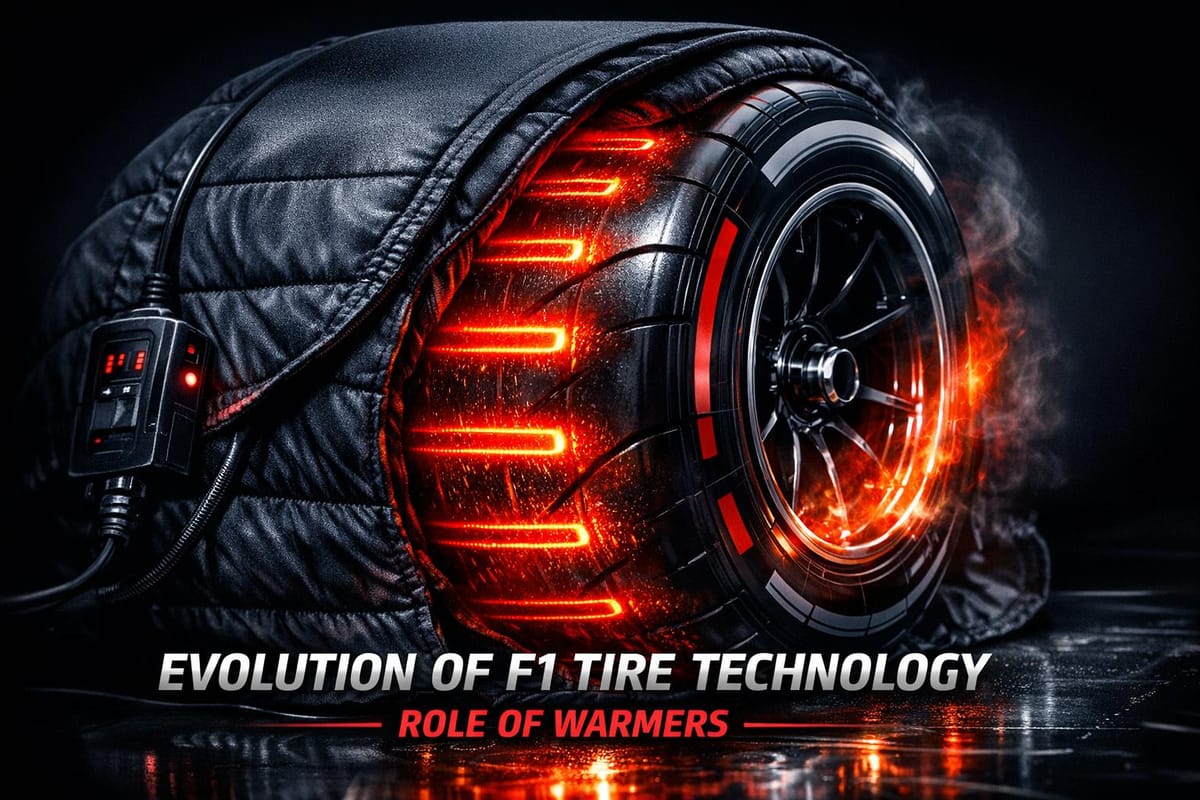
In Formula 1, managing tire temperature is critical for performance and safety. Tires must operate within a specific temperature range (194°F–230°F) to provide optimal grip. To address this, teams developed tire warmers, which preheat tires before they hit the track. This ensures drivers can push their cars immediately after pit stops and reduces risks associated with cold tires, like brittle rubber and unpredictable handling.
Tire warmers debuted in 1974 as makeshift hotel duvets and evolved into advanced electric blankets by 1985. These devices heat the tire tread, sidewalls, and rims evenly, stabilizing pressure and improving performance. However, their environmental impact and high energy use have sparked debates. The FIA is gradually reducing the use of tire warmers, pushing for compounds that perform across broader temperature ranges.
Key takeaways:
- Why tire warmers matter: They improve grip, reduce warm-up times, and enhance safety.
- Current challenges: High energy use and cost.
- Future direction: Phasing out warmers while developing new tire technologies.
The future of tire warmers in F1 remains uncertain, but their impact on racing is undeniable.
Why Formula 1 TYRE BLANKETS Cost £22,000
The Development of F1 Tire Technology
Formula 1 tires have come a long way, evolving from basic rubber compounds to highly engineered systems. This progression paved the way for innovations like tire warmers, which became crucial for managing the increasingly complex designs.
The Early Years: Bias-Ply Tires and Limited Grip (1950s-1960s)
In the early days of Formula 1, bias-ply tires were the standard. These tires used layers of fabric cords arranged diagonally, creating a structure that was more forgiving at the limit but lacked consistent grip. The rubber would deform under load, leading to unpredictable handling. Drivers had to contend with these grip variations, making precision a constant challenge.
The Introduction of Slicks and Radial Tires (1970s)
The 1970s marked a turning point in tire technology. In 1971, slick tires - characterized by their smooth, groove-free surface - were introduced. These tires maximized contact with the track, improving grip by allowing the rubber to mold into surface irregularities.
Another milestone came in 1977 when Michelin debuted radial tire technology alongside the Renault RS01. Unlike bias-ply tires, radials had plies running perpendicular to the travel direction, resulting in a more stable and consistent contact patch. The performance benefits were undeniable: Carlos Reutemann claimed the first Formula 1 victory on radial slicks at the 1978 Brazilian Grand Prix, driving a Ferrari 312T2 equipped with Michelin radials. Jody Scheckter later secured a World Championship on radial tires, solidifying their place in the sport. However, radials presented their own challenges, requiring smaller slip angles and demanding greater precision from drivers. By the early 1980s, radial tires had completely replaced bias-ply designs, setting the stage for further advancements in tire technology.
Modern Compounds and Advanced Tire Design (2000s-Present)
Today’s Formula 1 tires are engineering marvels, crafted from a sophisticated mix of materials. The carcass is made of nylon and polyester weaves, built to endure extreme forces: 4G longitudinal, 5G lateral, and over a ton of aerodynamic load at speeds of 155 mph (250 km/h).
The introduction of a single tire supplier reshaped the sport. Bridgestone held the role until Pirelli took over in 2011. After a decade of grooved tires (1998–2008), slicks made a comeback in 2009. In 2011, Pirelli introduced compounds designed to degrade intentionally, creating narrower performance windows. This added an element of unpredictability to races and made pit strategies more complex. Andrew Green, Technical Director at Racing Point, described the challenge:
"The tyres have a very narrow working window and it is a real challenge to keep them in that window from the start of the stint to the end of a stint".
In 2022, Formula 1 made another shift, adopting 18-inch low-profile tires to replace the traditional 13-inch wheels. This change brought the sport closer to road car technology. Pirelli now supplies around 50,000 tires annually to Formula 1, and even a slight variation in tire pressure - just 0.2 kg/cm² (about 2.8 psi) - can have a major impact on performance.
The Development of Tire Warmers in F1
Origins and Early Use of Tire Warmers
The journey of tire warmers in Formula 1 started with a bit of ingenuity. At the 1974 Canadian Grand Prix, teams stumbled upon a quick fix to keep their tires warm before the race - they grabbed duvets from their hotel rooms and wrapped them around the tires right in the pit lane. It was a simple, makeshift solution, but it marked the first recorded attempt at tire pre-heating in the sport.
This improvised method revealed a major advantage: warmer tires meant better grip and improved safety. Cold tires are stiff and brittle, making them difficult to handle and prone to losing grip. Additionally, maintaining the right pressure is critical to tire performance, especially under the immense aerodynamic loads of an F1 car.
By 1985, improvisation gave way to innovation. Mike Drury of MA Horne introduced the first dedicated 240-volt electric tire blankets to the F1 paddock. Unlike the earlier solutions - like black plastic liners or hotel bedding - these electric blankets directly heated the tire tread, offering a more consistent and effective approach. Teams like Ferrari and Williams quickly adopted this technology, and MA Horne became a go-to supplier for elite teams. This marked a turning point, laying the groundwork for the advanced systems we see today.
Technical Advancements in Tire Warmers
From those early experiments, tire warming technology has evolved dramatically. Modern systems are designed to provide precise and even heating, meeting the ever-changing FIA standards. Unlike the first electric blankets that focused only on the tread, today’s tire warmers heat the entire tire, including the sidewalls and the internal rim. This ensures a consistent temperature across the entire assembly, which is crucial for performance. Advanced materials like Kevlar cords prevent overheating, while carbon sheets distribute heat evenly across the surface.
Temperature control has also become far more advanced. Modern tire warmers connect to thermostatic control boxes, enabling engineers to monitor and fine-tune the heating process with remarkable accuracy. These systems can bring tires to the perfect temperature within 1.5 to 2 hours. According to Mark Drury of MA Horne:
"The teams realise how much of a difference tyre pressures make to the handling of the car. We developed our product to cover a larger area of the tyre in an effort to speed up the process of getting the pressures up to operating temperatures".
Regulations have played a big role in pushing innovation further. In 2022, the FIA introduced new rules reducing the maximum heating temperature for slick tires from 212°F (100°C) to 158°F (70°C), while intermediate tires were capped at 140°F (60°C). These changes are part of broader efforts to improve sustainability in the sport, challenging manufacturers to create more efficient heating systems.
The cost of this technology reflects its importance. A single set of professional F1 tire blankets costs around $2,750 (£2,200), and teams typically require 36–40 sets per season. While it's a hefty investment, the performance benefits make it an essential part of any competitive racing team's arsenal.
How Tire Warmers Affect Performance, Safety, and Strategy
Improved Grip and Reduced Warm-Up Times
Tire warmers have changed the game when it comes to getting F1 cars up to speed. By heating tires to 176–212°F (80–100°C) before they hit the track, drivers enjoy immediate grip as soon as they leave the pit lane. This eliminates the need for those cautious warm-up laps, as the heated rubber is already pliable and ready to mold to the track surface. On the flip side, cold tires - those below 158°F (70°C) - can lose up to 20% of their grip, making them far less effective.
This advantage is particularly crucial during pit stops. With tires already at their optimal temperature, drivers can push hard right out of the pits, a key factor in pulling off the "undercut" strategy. This tactic involves pitting earlier than a rival to gain track position with fresh, hot tires. Additionally, pre-heating helps stabilize tire pressure, which increases by 0.1 bar for every 18°F rise in temperature. Maintaining the right pressure is vital, especially when F1 cars generate up to 1,760 pounds of aerodynamic load. These benefits not only enhance performance but also allow for bolder, more aggressive racing strategies.
Safety Benefits of Tire Warmers
Tire warmers don’t just improve performance - they’re also a critical safety tool. Without pre-heated tires, handling becomes unpredictable, and cars are much harder to control at racing speeds. Cold tires lack the flexibility needed to grip the track, making them a hazard for drivers.
This isn’t just a Formula 1 issue. In May 2023, during the WEC 6 Hours of Spa, Toyota driver Brendon Hartley and Ferrari driver Antonio Fuoco both crashed shortly after exiting the pit lane. Investigations by the FIA and ACO linked these incidents to the absence of tire pre-heating. As a result, officials temporarily lifted the ban on tire warmers for the 24 Hours of Le Mans to prioritize driver safety.
There’s also a structural risk with cold tires. Lower internal pressures mean less sidewall support, which can be dangerous during high-speed cornering when lateral forces can hit 4–5g. Pre-heating ensures the tires are strong enough to handle these extreme forces right from the start.
The Role of Tire Warmers in Pit Stops and Race Tactics
Tire warmers play a pivotal role in race strategy, blending performance and safety to give teams a strategic edge. Teams remove the blankets just seconds before a pit stop to retain as much heat as possible. This ensures the driver can attack immediately on their out-lap, making the undercut one of the most effective tactical moves in F1.
In contrast, series like IndyCar, which don’t use tire warmers, see a different dynamic. As Racecar Engineering explains:
"The lack of tyre blankets in IndyCar actually generates more excitement around the pitstop windows. The offset of cold, new tyres against hot, heavily worn tyres constantly changes the effectiveness of the undercut or overcut".
F1 teams also use warmers for pre-race "heat cycles", which help cure the synthetic rubber compounds for peak performance. Without this preparation, drivers would need to cautiously build tire temperature over the first few laps - a clear disadvantage. Pre-heated tires also reduce the risk of flat-spotting under braking, a common issue with cold tires. Considering that each set of tires costs $2,750 and teams use 36–40 sets per season, managing tire temperature is a crucial part of race success.
Debates and Rule Changes Around Tire Warmers
Environmental and Cost Concerns
Tire warmers have become a hot topic in Formula 1 as the sport strives for carbon neutrality. These devices, which require 1 to 2 hours of continuous power to heat tires to their optimal temperature, are energy-intensive. With each team needing 36 to 40 sets, the financial and operational burden adds up quickly. For smaller teams, the costs don’t stop at the purchase - they also have to account for maintenance, electricity, and transporting the equipment to every race.
However, critics of banning tire warmers argue that cold tires could lead to more accidents, increasing the need for repairs and replacements - potentially offsetting the environmental benefits. This concern has led regulators to take a closer look at how tire warmers fit into the future of F1.
FIA Regulations and the Future of Tire Warmers
To address these concerns, the FIA and Pirelli have opted for a gradual phase-out of tire warmers. Advances in tire technology are now shaping regulatory decisions. In 2021, the FIA lowered the maximum pre-heat temperatures from 212°F (100°C) for front tires and 176°F (80°C) for rear tires to a uniform 158°F (70°C) over a two-hour period. A further reduction to 122°F (50°C) was proposed, and while a total ban was initially planned for 2024, it has been pushed back to at least 2025 due to negative feedback during testing.
Current rules also limit teams to seven sets of tire blankets per car for slick tires, aiming to reduce energy usage. Mario Isola, Head of F1 at Pirelli, highlighted the challenges this creates:
"We have to design tyres with compounds able to work at 20°C and at 120°C, which is the risk".
Without pre-heating, tire pressure can rise by more than 12 psi from cold to hot, compared to 6–7 psi in Formula 2. This variability complicates tire construction and could shift race strategies, potentially favoring an overcut instead of the more common undercut.
Cold Tires vs. Heated Tires: Performance Comparison
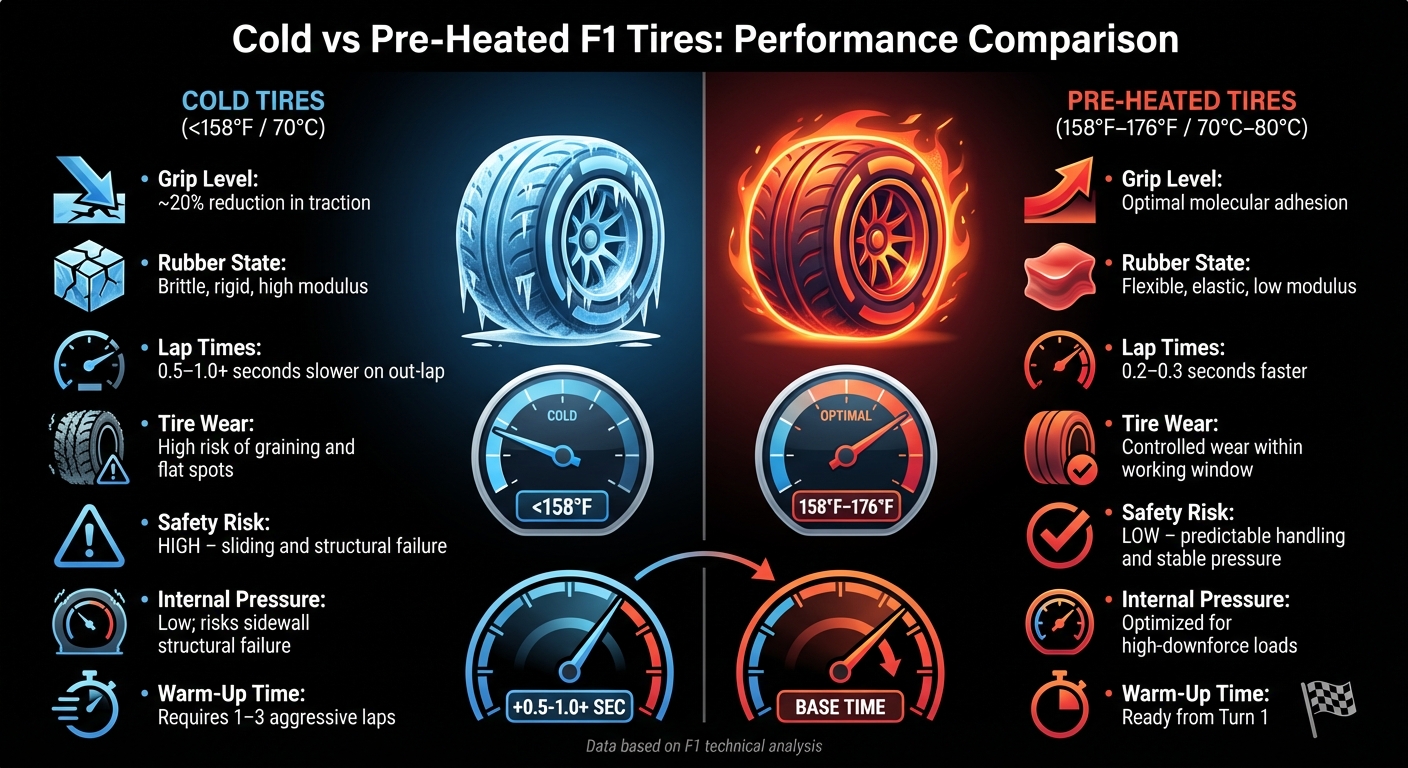
Cold vs Pre-Heated F1 Tires Performance Comparison
Cold tires can reduce grip by about 20% compared to pre-heated ones. When tire temperatures dip below 158°F (70°C), the rubber hardens, making it less pliable and unable to adapt to the track surface. This leads to erratic handling, especially at high racing speeds.
In contrast, pre-heated tires - warmed to an optimal range of 158°F to 176°F (70°C–80°C) before hitting the track - offer immediate grip. This allows drivers to push hard right from the first turn without needing cautious warm-up laps. The result? A lap time advantage of approximately 0.2 to 0.3 seconds during the early stages of a stint. Beyond the performance edge, these pre-heated tires also contribute to improved safety.
Tire temperature isn't just about speed - it’s a critical safety factor. Cold tires, with their lower internal pressure, are more vulnerable to structural failures under high aerodynamic loads. The sidewalls may not provide adequate support, making the car's handling unpredictable. Additionally, cold tires are prone to graining, where bits of rubber peel off, further reducing traction. These factors highlight why maintaining proper tire temperatures is essential for both performance and driver safety.
Performance Comparison Table
| Metric | Cold Tires (<158°F / 70°C) | Pre-Heated Tires (158°F–176°F / 70°C–80°C) |
|---|---|---|
| Grip Level | ~20% reduction in traction | Optimal molecular adhesion |
| Rubber State | Brittle, rigid, high modulus | Flexible, elastic, low modulus |
| Lap Times | 0.5–1.0+ seconds slower on out-lap | 0.2–0.3 seconds faster |
| Tire Wear | High risk of graining and flat spots | Controlled wear within working window |
| Safety Risk | High – sliding and structural failure | Low – predictable handling and stable pressure |
| Internal Pressure | Low; risks sidewall structural failure | Optimized for high-downforce loads |
| Warm-Up Time | Requires 1–3 aggressive laps | Ready from Turn 1 |
These comparisons make it clear why tire warmers continue to play a crucial role in Formula 1's technical setup, balancing performance and safety in a high-stakes environment.
The Future of F1 Tire Technology and Temperature Management
New Technologies in Tire Temperature Management
Formula 1 is steering toward a future where traditional tire warmers might become obsolete. Pirelli is working on tire compounds that can perform effectively across a wide temperature range - from 68°F (20°C) to 248°F (120°C). Mario Isola of Pirelli elaborates:
"We have to design tyres with compounds able to work at 20°C and at 120°C, which is the risk".
An intriguing alternative to tire warmers is rim heating. This method transfers heat from the brake discs, which can reach temperatures as high as 2,192°F (1,200°C), to the tires through specially designed wheel rims. These rims utilize features like turbulators and unique surface finishes to optimize heat transfer. For context, every 18°F (10°C) increase in rim temperature leads to a roughly 1.8°F (1°C) rise in the tire carcass temperature.
Without pre-heating, tire pressures can jump significantly - from around 20 psi to over 30 psi. To counteract this, teams are experimenting with gas mixtures, such as nitrogen or carbon dioxide, to stabilize pressure as tires heat up. These developments, alongside the FIA’s gradual restrictions on tire warmers, aim to balance performance with sustainability goals. Together, they represent a shift in how teams manage tire temperatures while adapting to future environmental standards.
Balancing Performance, Safety, and Environmental Goals
The evolution of F1 tire technology is deeply tied to the sport's broader push for carbon neutrality. Eliminating tire warmers aligns with these environmental objectives, but the transition isn’t without challenges. Safety remains a critical concern. For example, the World Endurance Championship’s attempt to ban tire warmers in 2023 faced setbacks. After high-profile accidents at Spa were linked to cold tires, the decision was reversed for the 24 Hours of Le Mans. Ironically, severe accidents caused by cold tires could lead to higher carbon emissions from repairs, potentially offsetting the environmental benefits of removing warmers.
To address these complexities, the FIA has opted for a phased approach instead of an outright ban. Maximum blanket temperatures have already been reduced from 212°F (100°C) to 158°F (70°C), with further cuts to 122°F (50°C) under consideration before a full phase-out. This gradual process gives Pirelli time to refine tire compounds that can perform without pre-heating, while teams adjust their strategies. In 2023, the FIA decided to keep tire blankets for the foreseeable future after drivers raised concerns about unpredictable performance in cooler conditions.
These regulatory changes are also reshaping race strategies. Without warmers, the traditional "undercut" strategy - where drivers pit early to gain an edge with fresh, warm tires - might lose its effectiveness. Instead, teams may lean toward an "overcut" approach, allowing drivers to stay out longer as cold tires require more time to reach optimal performance. This shift is already evident in series like IndyCar and Formula 2, which operate without tire blankets. The result? More varied pitstop tactics and tighter competition on the track. As Formula 1 teams adapt, the absence of traditional tire warmers could redefine race-day strategies and add a new layer of unpredictability to the sport.
Conclusion
Back in 1985, Mike Drury introduced the first 240-volt electric tire warmers, a far cry from the earlier days when racers improvised with hotel duvets. Since then, tire warmers have evolved into advanced systems capable of heating not just the tread but also the sidewalls and internal rim .
The advantages are undeniable. Cold tires simply don’t perform at racing speeds, and pre-heating ensures stability in tire pressure, avoiding fluctuations that can exceed 12 psi.
However, the future of tire warmers is now under scrutiny. Formula 1’s push toward carbon neutrality has raised questions about the energy consumption of these devices. The FIA’s gradual reduction of maximum blanket temperatures - from 212°F (100°C) to 158°F (70°C) - illustrates the balancing act between environmental goals and safety. Meanwhile, the World Endurance Championship’s brief 2023 ban on tire warmers, which was reversed after cold-tire crashes at Spa, highlights the risks of eliminating pre-heating altogether.
Looking forward, Pirelli is working on tire compounds designed to function across a wider temperature range, from 68°F to 248°F (20°C to 120°C). This development could be a game-changer, but F1 is at a crossroads. Alternatives like rim heating are being explored, but any shift will take time. Whether tire warmers are phased out entirely or replaced with new technologies, their impact on modern F1 is undeniable. They’ve played a pivotal role in enhancing performance and keeping drivers safe at speeds over 186 mph (300 km/h).
In the years ahead, F1 faces the challenge of maintaining its competitive edge while adapting to environmental and technological demands. For now, tire warmers remain a crucial link between the sport’s high-performance standards and its sustainability ambitions.
FAQs
Why is Formula 1 phasing out tire warmers, even though they improve safety?
Formula 1 is taking steps to eliminate tire warmers, aiming to cut down on energy use and reduce costs. These devices, which consume several kilowatts of electricity per set, add significantly to the sport's carbon footprint. Phasing them out aligns with F1's broader commitment to becoming more environmentally conscious. On top of that, tire warmers come with a hefty price tag - about $2,900 per set - and teams go through dozens during a single race weekend, making them a major financial burden.
To address safety concerns, the FIA and Pirelli are working together to make this transition smoother. They’re gradually lowering the maximum temperatures allowed for tire warmers while also developing new tire compounds designed to perform well without pre-heating. Although some drivers worry that this shift might lead to more early-lap incidents, the potential for a greener and more cost-efficient future in racing makes the change worth pursuing.
How do modern F1 tires perform without tire warmers?
Modern F1 tires need to hit their sweet spot - 175–210°F - to deliver peak grip. Without tire warmers, though, they start off much cooler, with lower pressure and less stickiness. To get them up to temperature, drivers have to get aggressive during their out-laps. They rely on hard acceleration to heat up the rear tires and weave side-to-side to bring the fronts up to speed.
When the weather is cooler, this task becomes even trickier. Drivers might struggle with reduced confidence in corners, experience faster tire wear, and face a greater risk of losing control - especially during those critical first laps. While today’s tire compounds can eventually reach their ideal temperature, they don’t perform as well right out of the gate compared to pre-heated tires. This slower warm-up period means sluggish lap times and less grip early on.
What environmental issues are linked to using tire warmers in Formula 1?
Tire warmers play a crucial role in Formula 1, heating tires to their ideal operating range of 176–212°F before cars hit the track. However, their use has sparked concerns due to the environmental toll they take. These devices draw a considerable amount of electricity, and with each car requiring 36–40 sets of tires per race weekend, the energy consumption adds up quickly - especially when powered by fossil-fuel-based energy grids. On top of that, the materials used in tire warmers, such as heat-resistant fabrics and Kevlar cords, create waste that needs to be either recycled or discarded after races.
To address these concerns, Formula 1 has pledged to eliminate tire warmers entirely by 2024 as part of its broader sustainability initiatives. In the lead-up to this ban, the FIA and Pirelli have been gradually lowering the maximum temperature limits for tire warmers, aiming to reduce energy consumption while teams adapt to the upcoming changes. These measures are part of a larger effort within motorsport to cut down on energy use and waste, showcasing the industry's commitment to being more environmentally conscious.