Behind F1 Freight Budgets: How Teams Prepare
How F1 teams manage $8–$20M freight budgets: air vs sea, duplicate kits, logistics partners, AI and sustainable fuels under the $140M cap.
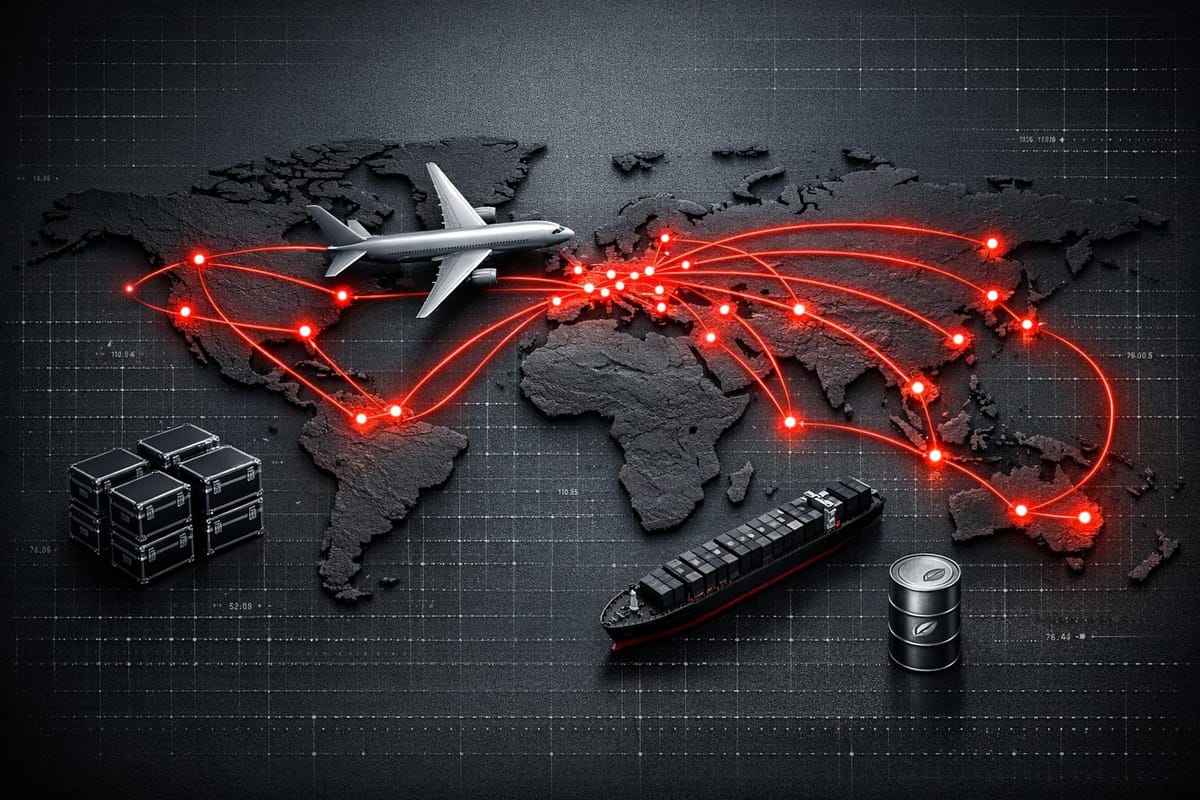
Formula 1 logistics is a massive operation, with teams moving up to 55 tons of equipment across five continents during a nine-month season. Freight costs are a growing concern due to inflation and the $140 million budget cap introduced in 2022. Here's how teams manage these challenges:
- Scale: Each race involves transporting cars, engines, tools, and hospitality setups. DHL handles up to 2,000 tons of freight per event.
- Transport Modes: Air freight is fast but expensive, while sea freight is cheaper but slower. Teams use a mix of both to balance costs and timing.
- Challenges: Back-to-back races, customs delays, and rising fuel prices create logistical hurdles.
- Budgets: Freight can cost $8–$20 million per season, with air freight alone reaching $1 million per race.
- Future Trends: Sustainable fuels, better scheduling, and AI-based logistics are helping reduce costs and emissions.
F1 teams rely on careful planning, rotating equipment sets, and expert partners like DHL to stay on schedule and within budget.
F1 LOGISTICS: The INSANE operation behind Every F1 Race
The Scale of F1 Freight Operations
F1 teams manage an enormous logistical challenge, moving 44 to 55 tons of equipment per team to each race - equivalent to the weight of several fully loaded semi-trucks. Over an entire season, DHL oversees the transport of up to 2,000 tons of freight, covering more than 74,500 miles across five continents in just nine months.
The items transported are incredibly varied. Teams ship chassis components, engines, pit tools, and even hospitality setups. Add to that 330,000 pounds of broadcast equipment, 22,000 pounds of electronic gear, 400 miles of wiring, and around 60 computer screens. For example, McLaren unpacks nine 40-foot containers within 24 hours to prepare for a race weekend.
For races outside Europe, known as "flyaway races", DHL uses five to seven Boeing 777 freighters to deliver critical items like cars, engines, and essential parts. These cars are carefully disassembled and packed into custom protective pods, with a single Boeing 777 capable of carrying approximately 40 pods. In contrast, European races rely on expansive truck convoys for overland transport.
To avoid delays, teams maintain five to six duplicate kits of non-essential equipment - like garage setups and hospitality furniture - that are shipped in 120 ocean containers. These items typically arrive 14 days before a race and are removed within a week after the event. This intricate system highlights the logistical hurdles and financial decisions teams face throughout the season.
Main Freight Challenges for F1 Teams
One of the toughest hurdles for F1 teams is managing back-to-back race schedules. Double-headers and triple-headers, where races happen on consecutive weekends, leave minimal room for error. Equipment must be dismantled, shipped across continents, and reassembled in mere days.
For instance, in March 2022, Haas F1 faced delays during pre-season testing in Bahrain. A technical issue grounded their cargo plane in Istanbul, pushing back their vehicle shipment by two days. Similarly, during the 2021 season, bad weather disrupted air cargo deliveries to Rio de Janeiro during a triple-header spanning Mexico, Brazil, and Qatar. This forced DHL and teams into a race against the clock to set up the paddock.
Customs regulations add further complexity. With most teams based in the UK, post-Brexit procedures now require more paperwork, fees, and time for shipments to Europe. Teams rely on ATA Carnets, which act as "merchandise passports", allowing tax-free and duty-free imports for up to a year.
Another challenge is balancing cost and speed. Air freight is fast and reliable but comes with a hefty price tag, while sea freight is cheaper and more environmentally friendly but can take over 90 days and is prone to delays. With the FIA's $140 million budget cap in place, teams must carefully weigh these trade-offs, as any delays or cost overruns can have ripple effects on their operations.
Freight Budget Breakdown: What Teams Spend
Freight expenses are a major part of the $140 million budget cap implemented by the FIA in 2022. Unlike travel costs for personnel, freight expenses are fully included in the cap. Rising fuel prices and global inflation have nearly doubled freight costs in recent years, placing additional strain on teams. Christian Horner, Red Bull Racing's Team Principal, explained:
"Freight is close to doubling this year... when you consider that freight is something that is currently within the cap, we need to find a sensible allowance."
| Transport Mode | Typical Use Case | Lead Time | Cost/Sustainability Profile |
|---|---|---|---|
| Air Freight | Cars, engines, urgent spares | 7–14 days | High cost, high carbon footprint |
| Sea Freight | Hospitality, furniture, non-critical kits | 90+ days | Lower cost, more sustainable |
| Road (Trucks) | European circuit logistics | 7–10 days | Standard for regional movement |
| Rail | Long-haul continental (e.g., US/Canada) | Variable | Lower emissions than road |
Air freight is reserved for critical items like chassis, engines, and spare parts that cannot afford delays. Sea freight is used for bulkier, non-urgent items like hospitality setups, while road transport dominates within Europe. Rail is emerging as a more sustainable option for long-distance moves, especially in regions like North America.
With freight costs eating into budgets that could otherwise go toward car performance improvements, teams are under constant pressure to refine their logistics strategies. Ross Brawn, F1's former Managing Director, emphasized this financial strain:
"I think the inflationary increase needs to be reviewed because, when these rules were developed, inflation was relatively low and predictable. Now it's high and unpredictable."
The sheer scale and complexity of F1 freight operations demand meticulous planning. Every decision, from transport mode to timing, directly impacts team budgets and race preparedness.
How Teams Manage Freight Budgets
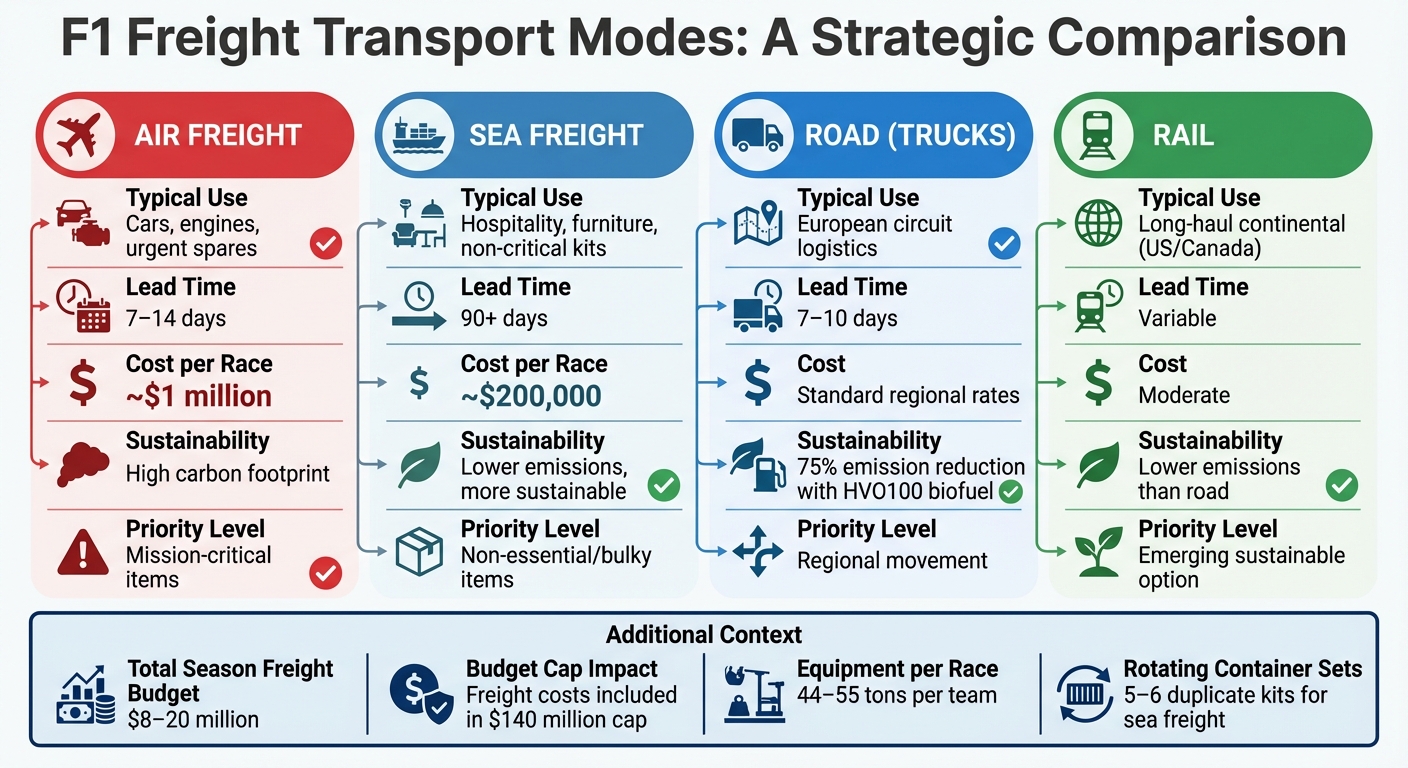
F1 Freight Transport Modes: Cost, Speed, and Sustainability Comparison
Managing freight budgets in Formula 1 is no small feat. Teams juggle the challenge of moving approximately 50 tons of equipment per Grand Prix while staying within a $140 million budget cap - freight costs included. With logistics often making up 10–20% of overall industry expenses, a team’s seasonal logistics budget typically falls between $8 million and $20 million.
Strategic Planning for Freight
To tackle this, teams rely on meticulous planning. They use a hybrid logistics strategy, splitting items into two categories: "mission-critical" and "non-essential/bulky." Mission-critical gear like chassis, engines, and specialized tools are flown to race locations, costing close to $1 million per race. Meanwhile, bulkier items such as hospitality setups and catering equipment take the slower, cheaper route by sea for around $200,000 per race.
To offset the slower pace of ocean shipping, teams use a clever system of rotating sea freight containers. These containers - five or six identical sets - "leapfrog" between race locations. So, while one set is in use, another is already on its way to the next destination.
Air vs. Sea Freight: Making the Right Call
The decision between air and sea freight depends on cost, timing, and risk. Teams prioritize shipments based on urgency and importance. High-priority items often travel via dedicated air charters, while less critical shipments use commercial services. For example, a last-minute aerodynamic upgrade might be transported as oversized baggage on a passenger flight. On the other hand, heavier, non-urgent components are sent by sea, with bookings made 90+ days in advance. Airfreight, however, typically gets confirmed 30–45 days before departure.
Looking ahead, by 2026, many teams are expected to adopt AI-based logistics systems. These systems will analyze factors like risk, cargo value, and historical data to recommend the best shipment methods and routes. This forward-thinking approach begins with detailed pre-season planning, ensuring resources are allocated efficiently.
Pre-Season Planning: Laying the Groundwork
Effective freight management starts well before the racing season kicks off. Teams follow a phased timeline to streamline operations:
- Long-term (90+ days): Book sea freight for non-critical items and reserve commercial airline seats for essential staff to lock in lower rates.
- Mid-term (30–45 days): Finalize air freight bookings for critical equipment, arrange passenger charters, and secure ATA Carnets to simplify customs clearance.
- Short-term (7–14 days): Finalize shipping manifests, customs paperwork, and ground handling plans.
To further optimize costs, teams categorize their staff into groups - on-track personnel, support staff, and hospitality teams - assigning different travel schedules and baggage allowances. For back-to-back races in close regions, like Bahrain and Saudi Arabia, equipment is often reused to reduce shipping needs and expenses.
Partnering with Logistics Experts
In addition to internal strategies, partnerships with specialized logistics providers play a crucial role. Industry leaders like DHL and CEVA offer expertise in multi-modal transport (land, sea, and air), customs navigation, and cost-effective shipping solutions. For instance, Scuderia Ferrari teamed up with CEVA Logistics in 2022 for road and ocean transport of their equipment.
These partners also bring advanced technology to the table. Tools like 5G-enabled GPS trackers, IoT sensors for monitoring fragile cargo, digital manifests, and electronic Air Waybills simplify the process and improve efficiency.
A notable example occurred in November 2023, when McLaren Racing collaborated with DP World for the Las Vegas Grand Prix. They used a mix of rail, biofuel trucks, and electric trucks to transport freight from Austin to Las Vegas. This approach cut greenhouse gas emissions by 75% with biofuel trucks, while electric trucks used in the city reduced energy consumption by up to 50% compared to traditional methods.
Planning for Unexpected Costs
Even with meticulous planning, rising inflation and supply chain disruptions have almost doubled transportation costs in recent years. These increases have a direct impact on parts and personnel budgets under the $140 million cap. To counter these challenges, teams are now focusing on creating solid contingency plans. Christian Horner, Team Principal at Red Bull Racing, summed up the issue:
"Freight is close to doubling this year... we need to find a sensible allowance that takes into account these inflationary costs, because it has a one-on-one effect on parts and people".
What Drives Freight Costs Up
Several factors contribute to the rapid rise in freight expenses. Fuel price fluctuations significantly affect air and road transport costs, while geopolitical instability can lead to sudden route changes and availability issues. Weather events, such as high winds that close ports, often force teams to adjust schedules by 5–10 days or even restart logistics from their home base. Mark Baker, Head of Sea Freight & Infrastructure at McLaren, highlights the need for flexibility:
"Ultimately, you cannot predict everything, so you've got to give yourself the margins to compensate".
Customs delays also pose a hidden risk. Errors in paperwork or regulatory holdups can leave critical components stuck at borders, necessitating expensive emergency air charters or alternative transport methods.
Expert Views on Contingency Planning
To mitigate these risks, teams build in 5–10 day buffers and keep duplicates of essential spares. Redundancy planning is another key strategy, where parts are sent via different flights or routes to avoid a single point of failure. For urgent components developed mid-week at the factory, teams often skip standard freight altogether, opting instead to have personnel carry them as oversized baggage on passenger flights.
Teams have also pushed for budget cap adjustments through the F1 Commission to address unexpected freight cost spikes. Every dollar spent on unplanned logistics cuts into resources that could be used for performance upgrades. These contingency efforts not only protect current operations but also pave the way for smarter and more sustainable freight strategies in the future.
The Future of F1 Freight Operations
Formula One is reimagining its freight operations, with a strong focus on reducing emissions and adopting digital solutions. Since logistics contribute significantly to the sport's carbon footprint, F1 teams and organizers are exploring ways to make transporting equipment worldwide more efficient and environmentally friendly. The ambitious goal of achieving Net Zero Carbon by 2030 is driving changes in areas like fuel use and race scheduling, paving the way for a closer look at how these efforts are reshaping the sport.
Reducing Carbon Footprint in Freight
F1 has already made notable progress in cutting emissions tied to its freight operations. In 2024, the sport partnered with DHL and Qatar Airways to use Sustainable Aviation Fuel (SAF) for flyaway events. This shift reduced carbon emissions per flight by about 80% compared to traditional jet fuel, saving over 8,000 tCO₂e during the season - a 19% drop in air freight emissions. Road transport has also seen improvements. DHL expanded its fleet of biofueled trucks from 18 to 37 in 2024, all powered by hydrotreated vegetable oil (HVO100), which cuts emissions by 75% compared to diesel.
The Mercedes-AMG PETRONAS F1 Team took this a step further in 2025 by introducing the all-electric Mercedes-Benz eActros 600 to transport race cars. The truck covered 1,083 miles from Brackley to the Dutch Grand Prix at Zandvoort. Alongside HVO100-powered trucks, this initiative avoided over 410 tCO₂e during European races.
Race calendar adjustments are also playing a key role. Starting in 2026, events like the Canadian Grand Prix will take place earlier in the summer, while Monaco will move to June. This restructuring creates a more cohesive European season, eliminating an entire transatlantic crossing for freight. Stefano Domenicali, Formula 1's President & CEO, highlighted the benefits:
"The change will make the future flow of our calendar not only more sustainable, but logistically more sensible for our teams and personnel"
. Additionally, from 2025, all European Grands Prix will implement low-carbon energy systems, including solar power, battery storage, and HVO, aiming for a 90% reduction in emissions. These steps not only reduce the environmental impact but also help teams manage costs more effectively.
New Technologies in Freight Management
Technology is revolutionizing how F1 teams handle freight. IoT sensors and RFID trackers now provide real-time updates on the location and condition of freight crates. If a container experiences excessive force during transport, teams are immediately alerted and can deploy backup parts as needed.
Digital tools are also optimizing logistics. Artificial Intelligence analyzes factors like risk and cargo value to recommend the best mix of air, sea, rail, and road transport. This predictive approach helps teams balance speed, cost, and carbon emissions. Meanwhile, blockchain technology and digital documentation, such as Electronic Air Waybills (e-AWB), are streamlining customs processes, reducing delays at borders.
Mark Baker, Head of Sea Freight & Infrastructure at McLaren Racing, explained this shift:
"People always think we are going 100mph and trying to get from A to B as quickly as possible, but in a lot of cases, we are actually trying to slow things down. One, to save emissions, and two to reduce our storage costs"
.
On-site 3D printing is another game-changer. Teams can now produce replacement parts directly at race venues, cutting freight volumes and responding more quickly to unexpected damage during practice sessions.
These advancements are making F1 freight operations more efficient, agile, and environmentally friendly. They not only align with sustainability goals but also improve cost predictability and operational efficiency for teams.
Conclusion: Main Lessons on F1 Freight Budgets
Managing freight in Formula 1 is all about striking the right balance between cost efficiency, operational needs, and adaptability. Teams rely on a hybrid transport model, where large, less critical items like hospitality equipment are sent via sea freight well in advance, while high-priority components are flown using air freight. This approach helps reduce costs significantly, as sea freight is much cheaper than air freight, especially for long-distance shipments.
Planning is key to avoiding disruptions. Teams secure sea freight bookings over 90 days ahead and finalize air charters 30–45 days in advance. A centralized logistics office coordinates everything - from booking to customs clearance - ensuring smooth operations, accurate documentation, and quick responses to any delays.
Digital tools also play a major role in managing budgets under the $140 million cap. To reduce risks, teams send duplicate mission-critical spares along separate routes, avoiding reliance on a single shipment. As Christian Horner, Team Principal at Red Bull Racing, pointed out:
"Freight is close to doubling this year".
To handle these rising costs, teams use contingency funds, diversify transport routes, and leverage technology like real-time IoT tracking and AI-based optimization. These tools not only enhance precision but also align with F1's push toward net-zero goals, ensuring the level of accuracy required for world-class competition.
FAQs
What freight costs are included in the $140 million budget cap?
Freight costs, which fall under the $140 million budget cap, cover the transportation of team equipment and materials. With rising expenses in this area, these costs have sparked significant discussion. There’s even talk of possible adjustments to the cap to help teams manage these growing challenges.
How do teams decide what goes by air versus sea?
Formula One teams decide between air and sea freight by weighing speed, cost, and cargo type. Air freight is the go-to for urgent, high-value items like spare parts because of its quick delivery, even though it comes with higher costs and strict weight limits. On the other hand, sea freight is slower but much more budget-friendly, making it perfect for bulkier shipments that aren't time-sensitive. This balance helps teams handle their budgets while ensuring everything arrives where it needs to be for race day.
How do teams handle surprise delays without blowing the cap?
Formula One teams handle unexpected delays while staying within the $140 million budget cap for 2022 by relying on contingency planning and adaptive financial strategies. They set aside contingency funds specifically for unforeseen expenses, such as freight delays or logistical hiccups. Teams also incorporate buffer times into their schedules and maintain close coordination with logistics providers. If delays arise, they may shift resources or tweak spending in other areas to ensure compliance with the financial limits.