F1 Recruitment: How to Transition from Other Fields
Move into F1: match transferable skills, tailor your resume, gain motorsport experience, network, and prepare for interviews.

Breaking into Formula 1 isn’t just for engineers or drivers. Teams need professionals in fields like finance, marketing, IT, logistics, and hospitality. If you excel in high-pressure environments, your skills may align with F1’s needs. Here’s how to make the transition:
- Identify transferable skills: Project management, coding, data analysis, and global operations are highly valued. Non-technical roles like HR, finance, and marketing also play key roles.
- Tailor your resume: Highlight achievements and tools relevant to F1, such as MATLAB, CAD, or budget management.
- Gain motorsport experience: Volunteer at local tracks, freelance in motorsport media, or participate in competitions like Formula Student.
- Research teams and roles: Explore career portals of F1 teams and suppliers. Remote and non-technical jobs are also available.
- Network strategically: Use LinkedIn or motorsport groups to connect with professionals and learn about opportunities.
F1 recruitment is competitive, but persistence, preparation, and showcasing your passion can help you secure a role in this fast-paced industry.
F1 Team Organizational Structure and Key Departments
1. Match Your Current Skills to F1 Requirements
Skills That Transfer Across Industries
Formula 1 thrives on precision, speed, and teamwork, making it an environment where professionals who excel under pressure can shine. If you have experience in project management, data analysis, or global operations, chances are your skills align well with the demands of F1.
For engineers, the connection is even more direct. Expertise in tools like CAD, MATLAB, or CNC programming translates seamlessly to roles in racetrack engineering or design. Aerospace engineers bring knowledge of aerodynamics, while mechanical engineers contribute to composite design and performance analysis. The constant stream of data in F1 also calls for specialists in coding, data science, and statistical analysis.
But it’s not all about technical expertise. F1 teams function like high-powered global corporations, requiring professionals from diverse fields. If you’ve managed multi-million-dollar budgets in finance, negotiated sponsorships in marketing, or coordinated complex logistics, there’s a place for your skills. IT specialists, HR professionals, legal advisors, media experts, and even catering managers play essential roles behind the scenes.
And don’t underestimate the importance of soft skills. F1 recruiters look for individuals who can adapt quickly, stay resilient, and thrive under pressure. Whether you’ve handled tight deadlines in aerospace, managed crisis communications, or organized intricate supply chains, those experiences build the mindset F1 teams value.
The key is to translate these abilities into the language of F1 job postings.
Connect Your Experience to F1 Job Descriptions
Once you’ve identified your transferable skills, the next step is to connect them to specific F1 roles. Start by carefully analyzing job postings to understand what teams are looking for. Many positions don’t require prior motorsport experience - they’re more interested in proven expertise in your field. For example, a buyer role may prioritize negotiation and relationship-building skills over knowledge of racing. Similarly, systems engineers need infrastructure management and coding skills that are applicable across industries.
Tailor your experience to align with F1 departments. If you’re an aerospace engineer, highlight your work in simulation and design, which directly relates to aerodynamics roles. Logistics managers can emphasize their ability to coordinate international shipments and manage complex travel arrangements - skills crucial for moving operations between race weekends. Finance professionals, on the other hand, should focus on budget management and commercial awareness, especially when targeting roles like Senior Associate Finance Partner for Production at teams like McLaren Racing.
Creating a skills translation table can help bridge the gap. List the tools and proficiencies you use and match them to F1 requirements. For instance, if you’re a machinist skilled in CNC programming, you’re well-suited for manufacturing roles. Data analysts with experience in telemetry tools can transition into performance analysis, while those with high-end hospitality backgrounds might find opportunities in guest relations at race events.
Finally, remember that non-technical roles can serve as valuable entry points. These positions not only let you contribute immediately but also help you build internal networks and gain insights into team operations. Over time, they can pave the way for more specialized roles within F1.
2. Research F1 Teams and Available Positions
How F1 Teams Are Organized
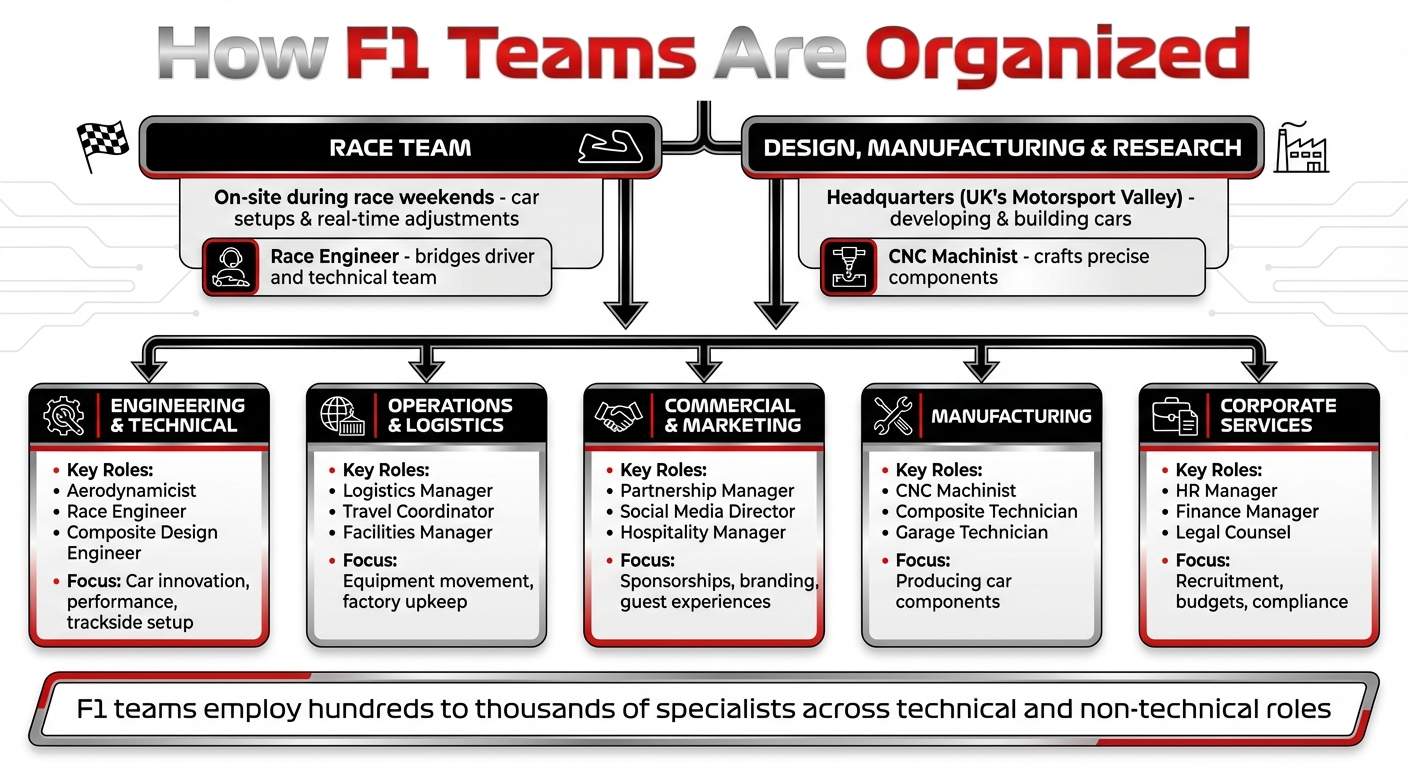
Formula 1 teams operate like finely tuned corporations, with hundreds - sometimes thousands - of specialists working toward one shared objective: winning. These teams are split into two main areas: trackside operations and factory-based departments.
The Race Team handles everything on-site during race weekends, from car setups to real-time adjustments. Meanwhile, the Design, Manufacturing, and Research departments stay at headquarters - often in the UK’s "Motorsport Valley" - developing and building the cars. A key figure in this setup is the Race Engineer, who acts as the bridge between the driver and the technical team, translating driver feedback into actionable setup changes. Back at the factory, specialists like Andrew Scrowther, a CNC Machinist at McLaren Racing, focus on crafting precise car components without traveling to the races.
Beyond the technical aspects, F1 teams rely on strong business operations. The Commercial & Marketing teams manage sponsorships and brand visibility, while Operations & Logistics ensure the smooth global transport of equipment. Corporate Services oversee critical areas like recruitment and financial management. For example, Christianna Petsa, Senior Associate Finance Partner for Production at McLaren Racing, exemplifies how financial experts play a direct role in production.
| Department | Key Roles | Primary Focus |
|---|---|---|
| Engineering & Technical | Aerodynamicist, Race Engineer, Composite Design Engineer | Car innovation, performance, and trackside setup |
| Operations & Logistics | Logistics Manager, Travel Coordinator, Facilities Manager | Equipment movement, factory upkeep |
| Commercial & Marketing | Partnership Manager, Social Media Director, Hospitality Manager | Sponsorships, branding, and guest experiences |
| Manufacturing | CNC Machinist, Composite Technician, Garage Technician | Producing car components |
| Corporate Services | HR Manager, Finance Manager, Legal Counsel | Recruitment, budgets, and compliance |
This structure opens doors for a wide range of professionals, from engineers to those pursuing non-technical or remote roles.
Remote and Non-Technical Jobs in F1
Not every F1 job involves being trackside. Many roles focus on digital marketing, software development, and administrative support, all based at team headquarters. For instance, software engineers design data analysis tools that are essential during race weekends, while IT specialists maintain the systems connecting factory operations to trackside Mission Control. Meanwhile, digital marketing teams manage social media and fan engagement from behind the scenes.
If you’re looking for opportunities, specialized platforms like MotorsportJobs.com and FormulaCareers.com list openings across the motorsport industry. Most teams, such as Red Bull Racing, Mercedes-AMG Petronas, McLaren, and Aston Martin, also have dedicated career portals featuring professional roles, graduate programs, and internships. The Formula Careers "F1 Team Hub" is another helpful resource, providing direct links to team recruitment pages.
Don’t forget about F1’s suppliers and partners. Companies like Pirelli (tire supplier) and RACE Software (suspension systems) hire specialists who contribute to F1 operations without being directly employed by the teams. Networking platforms like LinkedIn are also valuable tools - especially the LinkedIn Student Support Group for motorsport careers, which boasts nearly 8,000 members, including industry insiders. Keep in mind that applications for placements and internships often open a year in advance, so planning ahead is essential.
3. Create an F1-Focused Resume and Portfolio
Once you’ve familiarized yourself with the roles and team structures in Formula 1, it’s time to craft an application that stands out. Your resume and portfolio should reflect the unique demands of the F1 world, showcasing both your skills and passion for motorsport.
Customize Your Resume for F1 Applications
Your resume should speak the language of Formula 1. Use concrete examples and quantify your achievements wherever possible. For instance, mention accomplishments like “reduced production time by 15%” or “managed a $250,000 budget”. Highlight your expertise in tools such as MATLAB or CAD, especially if you’re coming from an automotive background, and focus on areas like speed, aerodynamics, and performance.
F1 thrives on quick decision-making and meeting tight deadlines, so be sure to include examples that demonstrate these abilities. Teamwork and communication are equally critical - emphasize your ability to collaborate effectively under pressure. Incorporating motorsport-specific terms like telemetry, vehicle dynamics, or logistics orchestration can help align your experience with the needs of F1 teams.
For non-technical roles in areas like finance, HR, IT, or legal, highlight your business acumen. Formula 1 teams operate like high-performance corporations, and your ability to navigate complex, fast-paced environments will be a major asset. As Nick Gerrell, a recruiter at Gerrell & Hard, puts it:
"If you're a clock-watcher who doesn't welcome the prospect of travel... or periods of intensity in your workload... F1 is probably not for you!"
Finally, show your enthusiasm by including motorsport-related projects that demonstrate your dedication to the field.
Include Motorsport-Related Personal Projects
Personal projects are a fantastic way to showcase your passion and hands-on experience. Participation in Formula Student (IMechE) is especially prized by F1 recruiters. Often described as a mini-F1, this competition involves designing, building, and racing a car, offering invaluable experience. Nick Gerrell notes:
"Most people I've met in F1 have been involved with Formula Student in some way"
If you’ve participated, highlight your specific contributions and quantify your results. For example, mention improvements like reducing vehicle weight or enhancing performance.
If Formula Student isn’t on your resume, there are other ways to demonstrate your commitment. Activities like sim racing, local karting, or freelance motorsport work can also make an impact. For engineering portfolios, include projects that feature simulation tools, telemetry data analysis, or aerodynamic optimization. Non-technical candidates can spotlight motorsport-related work such as managing social media for racing teams, designing liveries, or motorsport photography. As Formula Careers wisely advises:
"Your merit is your most powerful connection"
These projects show that you’re not just relying on classroom knowledge - you’re actively gaining practical experience in the world of motorsport.
4. Network and Gain Motorsport Experience
With your polished resume ready, the next step is to grow your network and gain hands-on experience in motorsport.
In the world of Formula 1, networking is about forming genuine, mutually beneficial relationships. It's not just about landing a job - it’s about showing real curiosity and interest in others. As career coach Caroline Adams puts it:
"If you're not curious and excited to hear what they have to say, it's not the right person".
This approach lays the groundwork for meaningful connections and opportunities to gain practical experience.
Connect with F1 Professionals
A great place to start is the Formula Careers LinkedIn Student Support Group, which boasts nearly 8,000 members, including aspiring professionals and industry insiders. When reaching out to professionals on LinkedIn, personalize your message. Mention a specific detail about their career that aligns with your goals and request a focused 30-minute conversation. Avoid generic phrases like "pick your brain".
These informational interviews are invaluable. They can uncover insights about company culture and industry challenges that aren't listed in job descriptions. Plus, they give you a chance to share your own expertise. A thoughtful follow-up can often lead to a quicker response. Remember, networking is a two-way street - you can also provide value by sharing perspectives from your own field or offering insights on current trends.
Volunteer or Freelance in Motorsport
Getting involved at the grassroots level is a great way to build credibility and demonstrate your passion for motorsport. Volunteering at local karting tracks is an excellent starting point. You could assist with mechanics, logistics, or even photography. As Tom Jeffries from Autosport explains:
"You'll likely have to do some work for free in the lower tiers to gain that crucial knowledge and experience".
For those interested in non-technical roles, consider freelancing in areas like motorsport media, photography, or social media management. These roles not only help you build a portfolio but also allow you to connect with professionals in the paddock. Another option is track marshaling, which offers direct exposure to race team operations.
One standout example from 2024 involved a student who reverse-engineered a Red Bull F1 front wing as a summer project. They shared their work on LinkedIn, earning over 2,500 likes and direct engagement from top-tier motorsport professionals.
These experiences not only demonstrate your dedication to motorsport but also position you for success in the F1 application process.
5. Navigate the Application and Interview Process
Once you've built your network and gained motorsport experience, it’s time to tackle the application and interview process. Formula 1 teams receive thousands of applications from around the world, so you’ll need a combination of strategic preparation and persistence to stand out.
Prepare for F1 Interview Formats
F1 interviews are designed to test how well you perform under pressure and how quickly you can think on your feet. The exact format depends on the role, but you can expect a mix of technical and behavioral questions aimed at evaluating your problem-solving skills and resilience.
For example, performance engineers might be tasked with analyzing telemetry data to identify ways to improve lap times or fine-tune systems like brake bias. Controls engineers could face challenges involving the setup of intricate systems, such as gearboxes, to ensure both reliability and performance. Aerodynamicists are often tested on their understanding of aerodynamic surfaces and their ability to bring fresh ideas to the table.
Proficiency in tools like MATLAB, CAD, and simulation software is often essential, but equally important is your ability to communicate effectively with multinational teams. FlowRacers emphasizes:
"Formula 1 teams only hire the best team members because of how competitive they need to be themselves".
Teams also pay close attention to how you handle feedback and criticism, so it’s crucial to demonstrate adaptability and composure in high-pressure scenarios. Once you've fine-tuned your interview strategies, be prepared to face setbacks and keep pushing forward.
Stay Persistent After Rejections
Even with thorough preparation, rejections are a common part of the F1 recruitment process. A rejection doesn’t necessarily reflect your abilities - it might simply be a matter of timing. Many F1 roles remain filled for years, so it’s not unusual to wait a considerable amount of time before a similar opportunity arises.
Use every rejection as a learning opportunity. If feedback is provided, take it seriously to improve your next application. If not, revisit your resume and make sure it highlights your hands-on motorsport experience and technical expertise. F1 teams often prioritize practical experience in junior categories (like F2, F3, or F4) or even local karting over academic achievements alone.
The key is to keep refining your skills, stay active in your motorsport network, and continue applying. Breaking into Formula 1 requires persistence and determination - qualities that are just as important as technical know-how in this fiercely competitive field.
6. Learn from Professionals Who Made the Switch
Career Transition Success Stories
F1 has a long history of attracting talent from unexpected places. Take Oliver Marler, for instance. He spent five years as a Physical Education teacher and Head of Year 9 before stepping into the world of motorsport. After gaining experience in automotive training and project management for seven years, he joined McLaren Applied in August 2022 as a Product Manager for Training and Engineering Support. His role? Training F1 and NASCAR teams on ATLAS data analysis software. Marler’s teaching background, especially his knack for presenting to large groups, gave him a unique edge in a field where technical experts often lack strong communication skills. Reflecting on his career shift, Marler shared:
"I never knew that McLaren Applied would need somebody to teach their products. I kick myself now, years later, for not realising that possibility sooner".
Other inspiring stories include Christianna Petsa, who transitioned from finance into a Senior Associate Finance Partner role at McLaren Racing, and Emily Billingham, who left school early to pursue timekeeping through Motorsport UK. Today, she works as a Systems Analyst for the FIA. Then there’s Cleo Collins, who swapped her family business for a career in motorsport after attending a track day. She climbed the ranks to become a No. 2 mechanic at Alpine. Similarly, Filippo Giussani leveraged his expertise to secure a role as a CFD Software Developer at Aston Martin. These individuals brought finance skills, data analysis, mechanical know-how, and software development expertise to carve out thriving careers in F1.
These examples highlight how entry-level roles can be the stepping stones to a rewarding career in motorsport.
Accept Entry-Level Roles and Show Enthusiasm
If these stories teach us anything, it’s the value of starting small and showing genuine passion for motorsport. Breaking into F1 often means beginning at the ground level. For Marler, the journey began with a casual chat at a pub, which led to an opportunity in the automotive industry. He took the initiative to set up professional telemetry software for sim racing projects, showcasing his hands-on expertise to potential employers.
Starting with early roles can provide the kind of practical experience that’s crucial for excelling in F1’s competitive world. Kenny, an engineer at McLaren F1, stresses the importance of finding your niche:
"Find something you enjoy doing and become really good at it – that's how you can specialise and find your way into F1. Everyone in F1 is a specialist in some area".
The secret lies in identifying your strengths and demonstrating how they align with F1’s demanding environment. Whether you’re an IT expert pivoting to data analysis or a logistics professional applying your skills to F1’s intricate global operations, your unique perspective can make a difference. Modern F1 teams function like large corporations, requiring a range of expertise beyond just engineering. By starting in a junior position, showcasing enthusiasm, and honing your specialized skills, you can set yourself apart in this high-performance industry.
Conclusion: Start Your F1 Career Journey
Breaking into the world of Formula One isn’t a sprint - it’s more like a marathon that demands focus, persistence, and careful planning. Success starts with aligning your skills to the diverse needs of F1, crafting a motorsport-centered portfolio, and building meaningful connections. Whether your background is in data science, project management, logistics, or finance, there’s a place for you in an industry that thrives on more than just engineering expertise.
The competition for F1 roles is fierce, drawing talent from across the globe. This makes it essential to continuously refine your skills. Teams aren’t just looking for technical know-how; they also value strong communication abilities and the resilience to perform under high pressure. Staying informed about advancements - like aerodynamic innovations, the shift toward electric powertrains ahead of 2026, or mastering data analytics to process the immense telemetry generated by F1 cars - can give you a real edge. Combine this knowledge with hands-on motorsport experience to stand out.
Networking, too, is a game-changer. Take the Formula Careers LinkedIn Student Support Group, for example - it connects nearly 8,000 students and professionals, showing how shared enthusiasm can lead to unexpected doors opening. Beyond networking, gaining practical experience - whether volunteering at karting events, freelancing in grassroots motorsport, or showcasing your projects online - can make your profile more visible in this competitive arena.
Starting out often means accepting entry-level roles and learning from early setbacks. As Formula Careers wisely states:
"Your passion for motorsport is your most powerful fuel. Combine that with dedication, continuous learning, and strategic action, and you'll be well on your way".
Many F1 professionals began their journeys in junior positions, proving their worth through specialized skills and an unrelenting drive to succeed.
Your Formula One career starts with the first step you take today. Whether it’s refining your resume, reaching out to industry professionals, or gaining hands-on experience, each action brings you closer to the grid. In this merit-driven world, every purposeful move matters.
FAQs
What skills do I need to transition into a non-technical role in Formula 1?
Formula 1 teams place a high priority on problem-solving abilities, strong teamwork, and a proactive attitude for non-technical roles. If you can demonstrate how you’ve navigated complex challenges, worked effectively with diverse teams, and shown initiative in your past roles - even outside of engineering - you’ll have a better chance of standing out.
Other qualities that matter include effective communication, adaptability, and solid stakeholder management. These skills are critical for positions in areas like marketing, finance, HR, hospitality, and media. Having a genuine enthusiasm for F1, a willingness to quickly grasp technical concepts, and being comfortable in a fast-paced, ever-changing environment can give you an extra edge over other candidates.
How can I transition into Formula 1 if I’m from a different industry?
Breaking into the world of Formula 1 from a different industry starts with finding roles that fit your current skill set. F1 teams are always on the lookout for talent in areas like engineering, logistics, marketing, finance, and data analysis. Consider how your expertise - whether it’s in project management, software development, or supply chain coordination - can bring a fresh perspective to these departments.
Building hands-on experience is the next step to establishing credibility. Get involved with local karting clubs, amateur racing events, or university motorsport teams to familiarize yourself with how the industry operates. Taking on short-term projects or completing relevant courses, such as those in aerodynamics or telemetry analysis, can also show your commitment and help you stand out in a competitive field.
When it comes to job applications, craft your résumé and cover letter to emphasize transferable skills like teamwork, problem-solving, and adaptability. Networking is equally important - engage with professionals through industry webinars, podcasts, or LinkedIn groups. Demonstrating passion and a genuine eagerness to learn can leave a strong impression on recruiters. For more tips, check out F1 Briefing, a great resource for expert advice on entering the motorsport industry.
How can I effectively network to transition into the F1 industry?
To build connections in the Formula 1 world, start by pinpointing the teams, departments, or sponsors that match your skills and career aspirations. Attending events like Grand Prix weekends, technical conferences, or industry meetups is a great way to meet professionals in the field. Be prepared - bring a professional business card or have your digital contact information ready, maintain open and confident body language, and follow up soon after meeting someone.
Take advantage of platforms like LinkedIn and Twitter to share your thoughts on F1 topics such as race strategies or technical developments. Joining conversations and tagging relevant professionals can highlight your expertise and help you connect with others in the industry. Offering your skills - whether it’s in data analysis, engineering, or content creation - to support projects or collaborations can also showcase your value and create opportunities in this competitive space.
Don’t overlook the sponsor ecosystem in F1, which spans industries like technology, finance, and lifestyle. Building relationships with these brands can offer alternative ways to enter the sport. When engaging with potential partners, come prepared with clear ideas for collaboration and a plan to follow up. This positions you as a proactive and resourceful candidate in a high-stakes industry.