F1 Teams Cutting Single-Use Plastic: Key Initiatives
Seven F1 teams are eliminating single-use plastics with refill stations, circular manufacturing and renewable energy to support the sport’s net-zero goals.
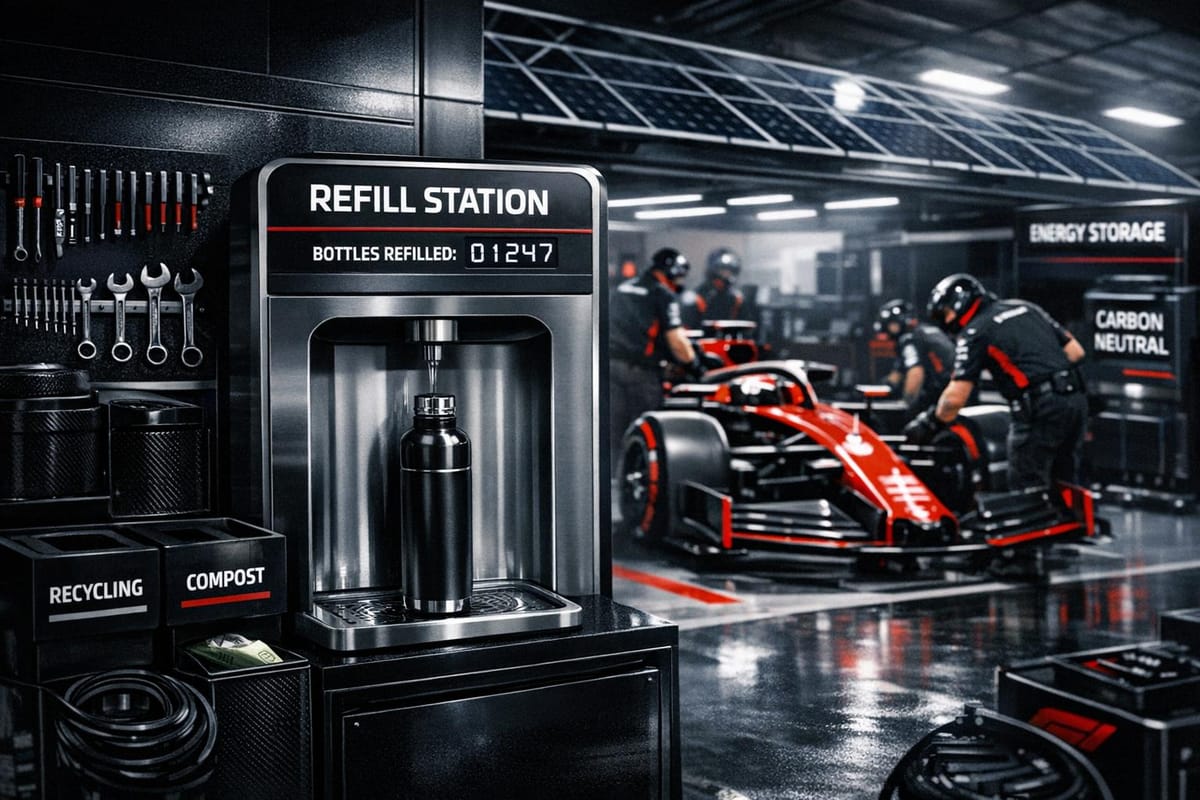
Formula 1 is racing toward a cleaner future, aiming for a net-zero carbon footprint by 2030 and eliminating single-use plastics at all Grand Prix events by 2025. Here’s how seven teams are tackling plastic waste:
- Mercedes-AMG Petronas: Introduced refillable bottles, water stations, and uses 100% renewable electricity at its headquarters.
- Alpine: Phased out plastic bottles and cutlery while achieving top environmental certifications for its factories.
- Sauber: Launched the "Kick Out Plastic" campaign, eliminating single-use plastics and preparing for its transformation into the Audi factory team.
- RB (Racing Bulls): Replaced plastic bottles with reusable containers and eliminated plastic cutlery, contributing to a 13% carbon footprint reduction across F1.
- Haas: Removed single-use plastics, downsized its pit wall to cut freight weight, and transitioned to renewable energy at its UK office.
- Williams: Focuses on circular economy principles, uses recycled materials, and generates renewable energy onsite.
- McLaren: Removed single-use plastics, pioneered recycled carbon fiber testing, and launched a handbook to promote sustainable manufacturing.
All teams now hold FIA’s highest environmental accreditation, and F1 continues to innovate with sustainable fuels and waste management systems. Challenges remain, such as logistics and hydration for remote staff, but the sport is steadily reducing its environmental impact.
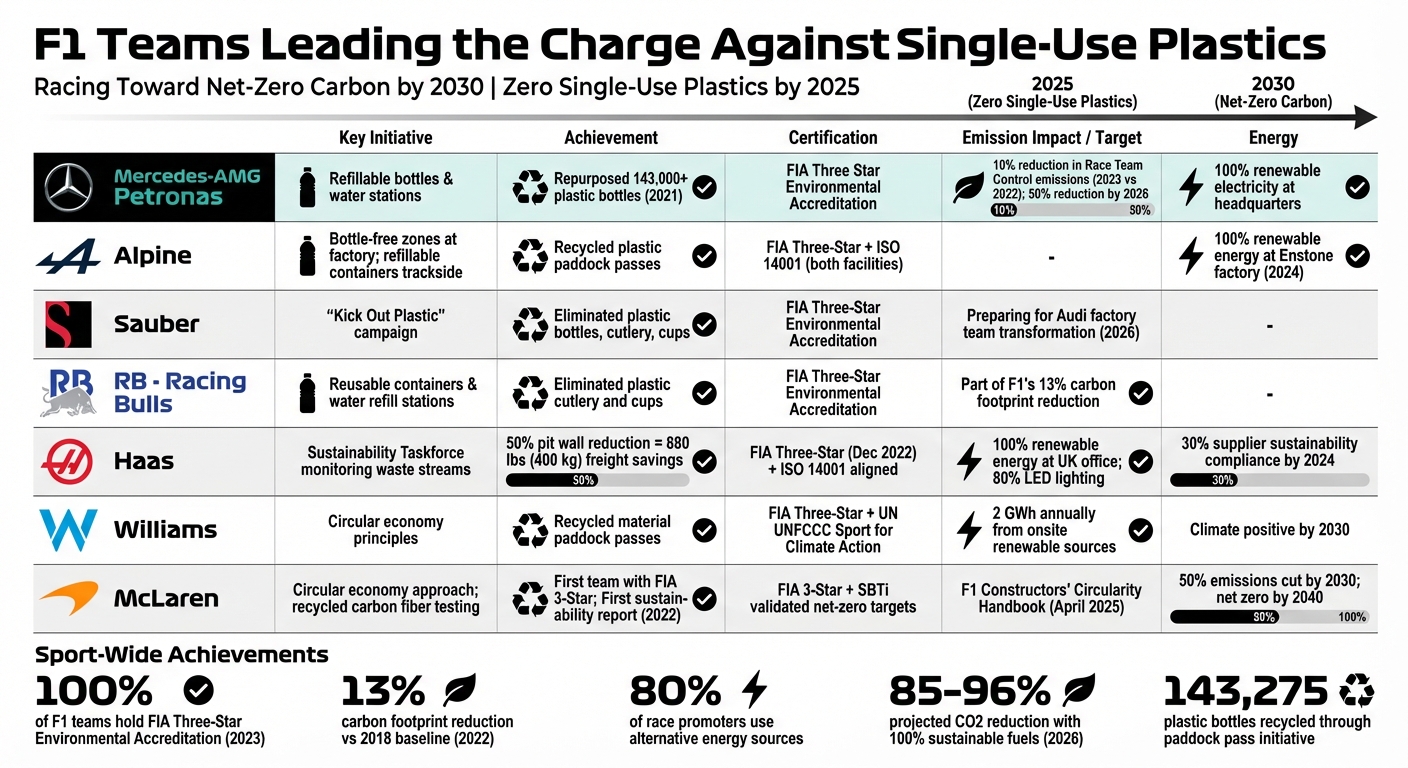
F1 Teams Single-Use Plastic Reduction Initiatives and Environmental Certifications Comparison
1. Mercedes-AMG Petronas
Reducing Plastic Waste
Mercedes-AMG Petronas has taken steps to cut down on single-use plastics by introducing refillable bottles and setting up water refill stations throughout the paddock. This initiative builds on a sport-wide program that repurposed more than 143,000 plastic bottles during the 2021 season. These changes reflect a commitment to practical solutions that align with respected environmental standards.
Recognized Sustainability Efforts
The team's environmental efforts are guided by a comprehensive sustainability strategy. They hold the FIA Three Star Environmental Accreditation, the highest certification from the FIA, which complies with the internationally recognized ISO 14001 environmental standard. Their approach is built around three key pillars: Net Zero, Responsible Resource Consumption, and Ecological Protection. The plastic reduction efforts fall under the Responsible Resource Consumption pillar, showcasing how waste management fits into the bigger picture of sustainability.
Mercedes-AMG Petronas also aligns its goals with the United Nations Sustainable Development Goals (UN SDGs), using these as a roadmap for setting priorities across Environment, Social, and Governance (ESG) areas. Alice Ashpitel, the team's Head of Sustainability, highlighted this focus:
"As part of our commitment to transparency, we focus on three pillars of environmental sustainability: Net Zero, Responsible Resource Consumption, and Ecological Protection".
Cutting Emissions
In 2023, Mercedes-AMG Petronas managed to reduce their Race Team Control emissions by 10% compared to 2022, thanks to better waste and resource management practices. They’re aiming for a 50% reduction by 2026. Their environmental efforts go beyond reducing plastic waste, incorporating the use of 100% renewable electricity at their Brackley headquarters and HVO100 sustainable biofuel for logistics.
2. Alpine

Plastic Reduction Initiatives
Alpine has taken clear steps to cut down on single-use plastics in both its factory and trackside operations. At its Enstone factory, the team introduced bottle-free zones to minimize plastic waste. Starting in 2021, they swapped out single-use plastic water bottles for refillable containers for all team members at racetracks. They also began using paddock passes made from recycled plastic. Beyond that, Alpine has worked to phase out single-use plastic cutlery and cups at trackside events, aligning with Formula 1's goal of eliminating single-use plastics at all Grand Prix events by 2025.
Sustainability Certifications
Alpine's efforts are backed by a strong commitment to meeting top environmental standards. In 2023, the team earned the FIA Three-Star Environmental Accreditation, the highest recognition granted by Formula 1's governing body. Both its Enstone facility in the UK and the Viry-Châtillon site in France have also achieved ISO 14001 Environmental Management certification, showcasing adherence to globally recognized environmental practices. Highlighting the importance of these milestones, Otmar Szafnauer, Team Principal of the BWT Alpine F1 Team, shared:
"We are pleased to announce our FIA Three-Star Environmental Accreditation. It is a great step forward in our environmental roadmap. We are now working towards securing ISO 14001 accreditation for Enstone, which sits within the framework of Alpine's Sustainability Strategy."
Emission Reduction Impact
Alpine has also made strides in reducing emissions. Since 2024, its Enstone factory has operated entirely on renewable energy. The team has joined forces with Eni to explore advanced energy solutions and test biocarbon fuels. These initiatives are central to Alpine's decarbonization roadmap, which includes certifications tailored to specific sites to help lower its overall environmental impact.
3. Sauber
Plastic Reduction Initiatives
Sauber has joined the growing list of F1 teams taking steps to reduce plastic waste. Through its "Kick Out Plastic" campaign, the team has committed to eliminating single-use plastics across its operations. This includes phasing out plastic water bottles, cutlery, and cups from trackside activities, aligning with Formula 1's goal of removing these items from Grand Prix events by 2025. Additionally, Sauber has opted for recycled materials in areas like paddock passes, further demonstrating its dedication to reducing plastic waste.
Unique Strategies
The "Kick Out Plastic" campaign isn't just about cutting waste - it’s also a way for Sauber to connect with fans and stakeholders who share their vision for a cleaner future. As the team prepares for its transformation into the Audi factory team in 2026, sustainability remains a core focus. Sauber is leveraging its current resources to stay committed to these environmental goals, even during this pivotal organizational transition.
4. RB (Racing Bulls)
Plastic Reduction Initiatives
RB has embraced F1's directive to cut out single-use plastics at trackside events. In 2021, the team made a significant shift by replacing single-serve water bottles with reusable containers and setting up water refill stations at race circuits. These efforts align with F1's broader mission to reduce plastic waste. Additionally, RB eliminated single-use plastic cutlery and cups, opting instead for sustainable alternatives. They also began using paddock passes made from recycled plastic, contributing to the sport-wide initiative. All these steps support F1's ambitious goal of ensuring that by 2025, 100% of waste generated at Grand Prix events will be reused, recycled, or composted. RB’s actions demonstrate their commitment to F1’s larger sustainability goals and highlight practical efforts that bolster their environmental credentials.
Sustainability Certifications
RB has earned and continues to uphold the FIA Three-Star Environmental Accreditation, the highest environmental recognition granted by F1’s governing body. By 2023, RB became part of the first motorsport championship where every team achieved this top-tier accreditation. On top of that, RB operates under F1’s ISO 20121:2012 certified framework, which focuses on sustainable event management practices.
Emission Reduction Impact
While RB’s individual contributions to emission reductions aren’t singled out, their collective efforts have bolstered F1’s overall progress toward net-zero carbon emissions. F1 recorded a 13% drop in its total carbon footprint compared to 2018 levels, a milestone made possible through joint initiatives from all teams, including RB. Notably, RB’s work in cutting down plastic waste plays an essential role in F1’s "Net Zero Carbon by 2030" plan, which aims for at least a 50% absolute reduction in emissions by 2030.
5. Haas
Plastic Reduction Initiatives
Haas is actively contributing to Formula 1's broader sustainability goals with its own focused approach to cutting waste and improving supply chain practices. The team has established a Sustainability Taskforce, bringing together experts from management, finance, logistics, procurement, and marketing. This group monitors waste streams and sets clear goals, particularly targeting the reduction of single-use materials. It plays a key role in shaping Haas's overall environmental strategy.
In 2021, Haas took a major step by eliminating single-use plastic bottles for its racetrack staff. The team also participated in the paddock pass initiative, which successfully recycled around 143,275 bottles. Looking ahead, Haas aims to achieve 30% sustainability compliance among its core suppliers by the end of 2024.
Another standout move came at the beginning of the 2023 season when Haas reduced its pit wall size by 50%. This change cut freight weight by 880 pounds (400 kg), significantly lowering transport-related emissions.
Sustainability Certifications
In December 2022, Haas earned the FIA Three-Star Environmental Accreditation, the highest environmental accolade awarded by Formula 1's governing body. This certification is aligned with the globally recognized ISO 14001 environmental management standards and requires teams to regularly report on their environmental performance. Former Team Principal Guenther Steiner expressed his pride in this achievement:
"I'm very proud of the team for achieving FIA Three-Star Environmental Accreditation".
By 2023, Haas stood among all Formula 1 teams that had achieved this top-tier accreditation, marking a major milestone for the sport. The team also adheres to frameworks like the Energy Saving Opportunity Scheme (ESOS) and Streamlined Energy and Carbon Reporting (SECR), further demonstrating its commitment to sustainable practices.
Unique Strategies
Haas doesn’t stop at certifications - it goes beyond with practical, forward-thinking initiatives. The team actively evaluates the environmental performance of its core contractors, sharing guidelines and exchanging knowledge to encourage sustainable practices across its network.
In addition, Haas's UK office in Banbury has been running entirely on renewable energy since October 2022. The team has also replaced 80% of the facility's lighting with energy-efficient LED systems. These efforts extend Haas's environmental impact well beyond its immediate operations, reflecting its commitment to driving meaningful change.
6. Williams

Plastic Reduction Initiatives
Williams Racing is working hard to cut down on single-use plastics at the track, including water bottles, cutlery, and cups. Since 2021, their sustainability strategy - outlined in the Impact Report 2025 - has guided their environmental and governance efforts. In line with Formula 1's broader sustainability goals, the team has also introduced paddock passes made from recycled materials. These steps are part of their journey toward formal recognition of their eco-friendly practices.
Sustainability Certifications
Williams holds the FIA Three-Star Environmental Accreditation, the top certification for environmental management in Formula 1. They are also part of the United Nations' UNFCCC Sport for Climate Action Framework. The team has set an ambitious goal to go beyond carbon neutrality and become "climate positive" by 2030. Former CEO Jost Capito emphasized this commitment, saying:
"As a team, we wanted to push the envelope and be the pacesetter for sustainability in global motorsport and in the wider automotive industry. So today we are making the commitment to be climate positive by 2030".
Unique Strategies
Williams sets itself apart by integrating circular economy principles into its operations rather than just banning specific items. Their sustainability framework is built around five key areas: Climate Action, Biodiversity Stewardship, Sustainable Innovation, Industry Access for All, and Purpose-Driven Leadership. A standout initiative is their focus on life-cycle management for racing cars, with a Life Cycle Assessment (LCA) planned for completion by the end of 2024.
At their headquarters in Grove, Oxfordshire, Williams generates energy onsite using 100% carbon-free renewable sources, producing up to 2 GWh annually. They also run the "Williams STEM Experience", which offers free Formula 1-themed educational programs for kids aged 8 to 16. This connects their environmental goals with efforts to inspire the next generation. Highlighting their broader vision, the team has said:
"Our ambition to be World Championship level extends beyond the racetrack to every part of our business".
7. McLaren
Plastic Reduction Initiatives
McLaren has taken a proactive stance against single-use plastics in its Formula 1 operations, removing them entirely from trackside activities. This aligns with the sport’s ambition to eliminate these materials at all Grands Prix by 2025. The team encourages a sustainability-first mindset, empowering its staff to find ways to cut waste in their daily routines. As part of the F1-wide paddock pass initiative, McLaren repurposed plastic bottles, while staff now rely on refillable bottles, supported by strategically placed water refill stations. These efforts highlight McLaren’s broader commitment to reducing waste and meeting measurable environmental goals.
Sustainability Certifications
McLaren has set the bar high in motorsport by becoming the first team to earn the FIA 3-star Environmental Accreditation, the top recognition for environmental management in the sport. Additionally, the team’s net-zero goals have been validated by the Science-Based Targets initiative (SBTi), with plans to cut carbon emissions by half by 2030 and achieve net zero by 2040. In June 2022, McLaren further solidified its leadership by publishing its first annual sustainability report, making it the first global motorsport franchise to do so.
Unique Strategies
McLaren’s approach goes beyond certifications, focusing on groundbreaking strategies to lead in environmental responsibility. One standout effort is its circular economy approach, which prioritizes minimizing resource use and extending material lifecycles instead of simply banning specific items. In 2023, the team tested recycled carbon fiber on its F1 cars, and in April 2025, it collaborated with Deloitte UK and the FIA to launch the F1 Constructors' Circularity Handbook. This handbook provides a step-by-step guide for teams to measure and enhance the sustainability of chassis manufacturing. McLaren’s Director of Sustainability, Kim Wilson, explained:
"If we can encourage all teams to measure their circularity, we can collectively influence the technical regulations to improve sustainability without compromising performance".
McLaren’s commitment to sustainability isn’t confined to the racetrack. In early 2024, the team joined forces with the Great Barrier Reef Foundation as part of its Climate Contribution Programme. Driver Oscar Piastri and McLaren’s sustainability team collaborated with the foundation in Australia to scale efforts for restoring coral reefs and ocean habitats. Summing up McLaren’s philosophy, CEO Zak Brown stated:
"Sustainability doesn't have a chequered flag. It's a long journey and we're working to influence global conversations, partner values and fan activities, while advocating for regulatory change in our industry".
Inside F1's first-ever recycled carbon fibre trial #USGP
Advantages and Challenges
F1's push toward reducing plastic and achieving sustainability brings both benefits and hurdles. By 2022, the sport had already cut its total carbon footprint by 13% compared to its 2018 baseline - a clear sign of progress.
Operational changes have also led to efficiency improvements. For instance, Haas downsized its pit wall by 50% in 2023, cutting 880 lbs (400 kg) from its freight weight. Teams are also adopting circular economy practices to make their supply chains more resilient, focusing on reducing resource use while maximizing material reuse. Kim Wilson, McLaren's Director of Sustainability, highlighted the strategic edge of this approach:
"If we can encourage all teams to measure their circularity, we can collectively influence the technical regulations to improve sustainability without compromising performance".
But the road isn't without obstacles. One pressing issue is hydration for remote trackside staff, like camera operators, who often work far from central hubs. High-capacity water pouches are being introduced to replace single-use bottles. Smaller teams face additional hurdles, such as Haas's goal to engage 30% of its core suppliers in sustainable practices by the end of 2024. Meanwhile, the ever-expanding F1 calendar, covering more than 20 countries, adds immense logistical challenges, particularly in ensuring consistent waste management and recycling systems at each venue.
Transparency in data collection remains a cornerstone of these efforts. McLaren's circularity strategy emphasizes the need for standardized metrics to make sustainable practices scalable across the sport. Larger teams, like McLaren, stress the importance of accurate data on waste and emissions throughout the supply chain. To address this, McLaren collaborated with Deloitte and the FIA to create the F1 Constructors' Circularity Handbook. This resource provides teams with a unified methodology for calculating circularity metrics in chassis manufacturing.
| Challenge Area | Large-Budget Teams | Small-Budget Teams | Sport-Wide Impact |
|---|---|---|---|
| Infrastructure | Sustainability directors; annual reporting | Taskforces with external consultants | FIA accreditation standards for all |
| Logistics | Advanced freight optimization; biofuel trucks | 50% pit wall reduction (880 lbs saved) | 75% of race promoters used renewable energy in 2023 |
| Supply Chain | Full value chain audits | 30% supplier engagement by 2024 | Recycled plastic paddock passes |
| Innovation | Recycled carbon fiber testing; circularity guides | Downsizing for efficiency | 13% carbon footprint reduction (2022 vs. 2018) |
These examples highlight the mix of progress and obstacles F1 faces in its sustainability journey. Tackling these challenges is key to reaching net-zero goals, underscoring the importance of innovation and a commitment to transparent, data-driven solutions.
Conclusion
McLaren Racing has taken the lead in Formula 1's efforts to reduce plastic waste and prioritize sustainability. They were the first team to earn FIA 3-star Environmental Accreditation and have their net-zero targets validated by the Science-Based Targets initiative. In April 2025, McLaren Racing partnered with Deloitte UK and the FIA to launch the F1 Constructors' Circularity Handbook, introducing a standardized way to measure circularity in chassis manufacturing. This move has set a high bar for other teams on the grid.
Mercedes-AMG Petronas has also made strides by optimizing logistics. Their use of HVO100 biofuel cut emissions by 67%, saving 339 tCO2e, while Sustainable Aviation Fuel certificates accounted for an additional reduction of 6,695 tCO2e.
Today, all F1 teams hold FIA 3-star accreditation, and 80% of race promoters have adopted alternative energy sources. Looking ahead, the anticipated switch to 100% sustainable fuels in 2026 is expected to bring an 85–96% reduction in CO2 emissions compared to fossil fuels.
Moving forward, the focus will be on standardizing circularity metrics, further investing in Sustainable Aviation Fuel to address 19% of air freight emissions, and reorganizing the race calendar to reduce transatlantic travel. As FIA Single-Seater Director Nikolas Tombazis explained:
"In the longer term, our ambition is for the Handbook to be used more widely, and to influence future regulations and innovation in this space".
Together, these initiatives highlight Formula 1's dedication to improving operations while driving toward a more sustainable future.
FAQs
What are F1 teams doing to eliminate single-use plastics by 2025?
Formula 1 has pledged to eliminate single-use plastics at all Grand Prix events by 2025, a key part of its We Race As One initiative. To achieve this, teams are swapping disposable items for reusable or recyclable options. For instance, staff now use refillable water bottles, with refill stations set up at every venue - an effort that has significantly cut down on waste. Even paddock passes have undergone a transformation, now made from recycled materials, reducing the need for thousands of plastic bottles each year.
Teams are also making strides in sustainability within their supply chains. McLaren, collaborating with Deloitte, has played a role in developing the FIA's Circularity Handbook, a guide to minimizing plastic waste in manufacturing and logistics. Haas, on the other hand, is working with suppliers to adopt reusable packaging and aims to have 30% of its vendors aligned with sustainable practices by the close of 2024. These combined efforts are not only steering F1 toward its 2025 plastic-free goal but also contributing to its larger mission of reaching net-zero emissions by 2030.
How do sustainability certifications support F1 teams' environmental goals?
Sustainability certifications offer F1 teams a way to independently validate their environmental initiatives, ensuring they align with established standards. Take the MoneyGram Haas F1 Team, for example - they earned the FIA Three-Star Environmental Accreditation in December 2022. This recognition reflects their efforts in areas like reducing waste, improving energy efficiency, and creating more sustainable supply chains. These certifications not only help teams track their progress and pinpoint areas needing improvement but also demonstrate their dedication to sustainability to fans, sponsors, and regulators.
On top of that, certifications encourage consistency across the sport by standardizing data collection and reporting. Tools like the FIA-commissioned Circularity Handbook - developed in collaboration with McLaren Racing and Deloitte - provide a common framework for monitoring material usage, recycling rates, and carbon footprints. This unified approach plays a key role in Formula One's mission to reach net-zero emissions by 2030, while also helping teams adapt to evolving environmental standards and maintain their credentials.
What steps are F1 teams taking to reduce their environmental impact from logistics?
Formula 1 teams are taking meaningful steps to reduce logistical emissions as part of the sport's push toward sustainability. Since 2019, the race calendar has been reorganized to group events by region, cutting down on the need for long-haul flights. For instance, the Japanese Grand Prix is now scheduled alongside other races in the same area, which helps significantly reduce travel-related emissions.
Teams are also improving how they transport equipment. Mercedes-AMG Petronas, for example, has been a leader in using sustainable aviation fuel (SAF) and bio-fuel blends for their freight trucks, with plans to expand these eco-friendly practices. Additionally, F1 is shifting more of its freight from air to sea and fine-tuning logistics to shrink its carbon footprint even further. All of these efforts are part of Formula 1's broader mission to reach net-zero emissions by 2030.