F1 Turbo Cooling: Challenges and Solutions
Examines how F1 teams control extreme turbo and hybrid heat using intercoolers, high‑pressure coolant and aerodynamic trade-offs ahead of 2026 changes.
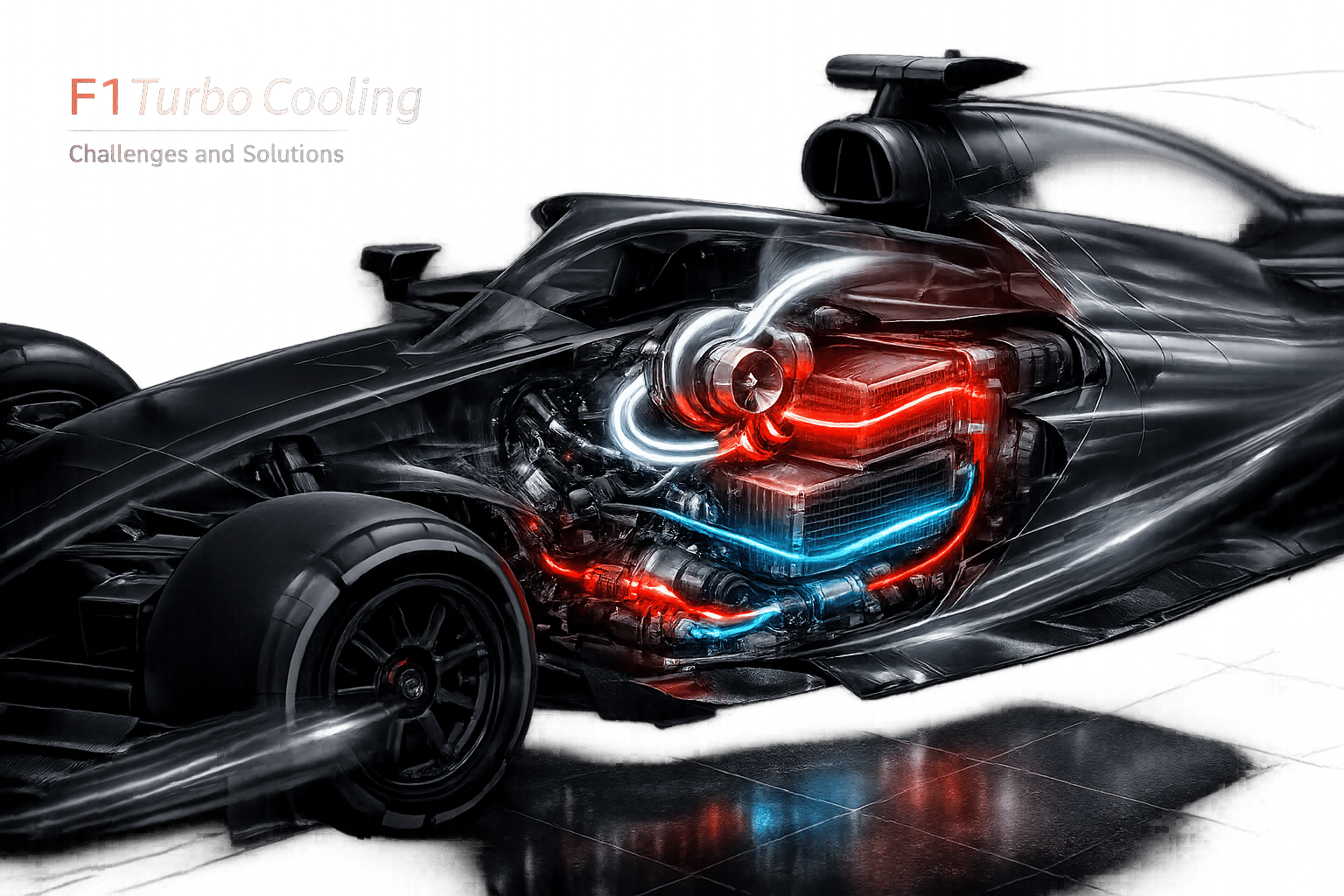
Managing heat in Formula 1 turbochargers is a critical engineering challenge. Why? Turbochargers and hybrid systems in F1 engines generate immense heat, which, if not controlled, can reduce power, damage components, and compromise reliability. Cooling systems - like radiators and intercoolers - are key to keeping engines efficient and reliable, but they also create aerodynamic drag, affecting performance. Teams must balance these trade-offs to stay competitive.
Key takeaways:
- Turbocharged F1 engines produce over 1,000 horsepower but generate extreme heat.
- Overheating reduces power and risks engine failure, especially in high-stress races.
- Teams use advanced cooling methods, like water-to-air intercoolers and high-pressure fluids, to manage heat.
- Aerodynamic efficiency is critical, with designs tailored to each team's strategy.
The 2026 regulations will bring new challenges, with the removal of the MGU-H and a shift toward more electric power. Teams will need to refine their cooling systems further to maintain performance and reliability.
Heat Generation and Cooling Problems in F1 Turbo Systems
Heat from Hybrid Power Units
At the core of Formula 1's thermal challenges lies the 1.6L V6 turbocharged engine. This Internal Combustion Engine (ICE) alone releases an immense amount of heat - about 90 kW into the water cooling system and another 30 kW into the oil circuit. But that’s just the beginning. The hybrid systems, which include the turbocharger, add another layer of complexity. When the turbocharger compresses intake air through adiabatic compression, the air temperature skyrockets before reaching the cylinders.
The hybrid components, such as the Motor Generator Units (MGU-K and MGU-H), battery pack, and control electronics, also contribute to the heat load. Among these, the MGU-H stands out since it directly harvests energy from exhaust heat. While these systems operate at much lower temperatures - around 122°F (50°C) - than the ICE, they are highly sensitive to external conditions. On particularly hot race days, they can quickly approach their thermal limits, which affects both efficiency and durability.
How Overheating Affects Performance and Reliability
When temperatures rise beyond manageable levels, the impact on performance and reliability is immediate. Hotter intake air means less oxygen, which reduces engine power output. At the same time, the heat weakens aluminum crankcases, degrades engine oil, and stresses electronics to the point of failure.
Thermal expansion adds another layer of risk. As metal components heat up, they expand, tightening the already precise tolerances between moving parts. This can lead to seizing or loosening of critical fasteners. Craig Scarborough puts it bluntly:
Not coping with the expected cooling demands is a sure fire way not to finish a race or finish compromised by a loss in performance or failed sub-system.
These internal stresses push engineers to develop aerodynamic solutions that balance cooling and performance.
Environmental and Aerodynamic Limitations
Excessive heat doesn’t just stress internal components - it also forces teams to make tough aerodynamic trade-offs. While improving cooling can enhance reliability, it increases drag and reduces downforce, which slows lap times. The issue becomes even more pronounced in specific conditions. For instance, turbulent air during close racing reduces cooling efficiency, and high ambient temperatures at circuits like Singapore or Bahrain push systems to their breaking point.
To address these challenges, engineers rely on lap time simulations to fine-tune cooling requirements for each track. They carefully balance the thermal demands of the car with the aerodynamic penalties of larger cooling outlets. Some teams even use asymmetric cooling setups, with different-sized outlets on each sidepod to address the varying heat loads of the ICE and the energy recovery systems. These compromises directly shape the unique cooling designs discussed in the next sections.
How To Cool An F1 Car | F1 TV Tech Talk | Crypto.com

Cooling Solutions Developed by F1 Teams
Formula 1 teams have tackled the challenge of managing extreme heat with a variety of cutting-edge methods, spanning from advanced intercooler designs to liquid cooling systems and refined thermal management techniques.
Improvements in Intercooler Technology
Since 2014, the adoption of water-to-air intercoolers has reshaped cooling strategies in Formula 1. Mercedes and Ferrari led the way by prioritizing compact design over maximum cooling efficiency. Placing these systems in front of the engine, rather than in the sidepods, allowed for tighter packaging. Though slightly heavier and less efficient in raw cooling terms, these systems ensure stable charge air temperatures, even during low-speed scenarios like grid starts. As Scarborough explains, this consistency is critical for performance.
Modern innovations have gone beyond traditional radiator setups. For instance, the Red Bull RB20 employs a V-shaped internal configuration, where the charge cooler and radiator are stacked vertically. This design sharpens the car’s aerodynamic profile. Meanwhile, teams using Honda power units have shifted their cooling systems to the centerline of the car, mounting large saddle-style coolers above the power unit. This approach minimizes sidepod size and reduces drag. As experts Matt Somerfield and Giorgio Piola point out:
If Red Bull had not worked hard to alter the cooling arrangements hidden beneath the bodywork, then there would have been no scope for the designers to make such radical alterations [to the RB20 sidepods].
These advancements in intercooler placement and design have paved the way for further innovation in liquid cooling systems.
Liquid Cooling Systems and High-Pressure Fluids
To enhance cooling efficiency, F1 teams pressurize their water-glycol coolant systems to over 2.5 bar. This raises the boiling point to approximately 248°F (120°C), creating a greater temperature difference between the coolant and the surrounding air. The result? Smaller radiators that can dissipate the same amount of heat while reducing aerodynamic drag and improving airflow to the rear of the car.
Radiator setups are also carefully engineered, with lower-temperature units placed before higher-temperature ones to optimize airflow. Some teams even use separate oil circuits for turbochargers, allowing them to operate under different temperature and pressure conditions compared to the main engine oil system. Cooling pipework has also become increasingly specialized, combining rigid aluminum or molded carbon fiber pipes with smaller titanium tubes for maximum efficiency.
Beyond mechanical upgrades, teams have refined thermal management systems to address heat more strategically.
Thermal Management and Anti-Lag Methods
The MGU-H plays a dual role as both an energy recovery device and a tool for thermal management. By electronically maintaining turbine speeds, it eliminates the need for traditional anti-lag systems, which rely on fuel dumping and generate excess heat in the exhaust. This approach not only reduces thermal stress but also captures energy that would otherwise be wasted.
However, the 2026 regulations will phase out the MGU-H, meaning teams will have to revert to conventional anti-lag systems. These systems, while effective, are expected to introduce additional thermal challenges.
Team-Specific Cooling Approaches and Performance Comparison
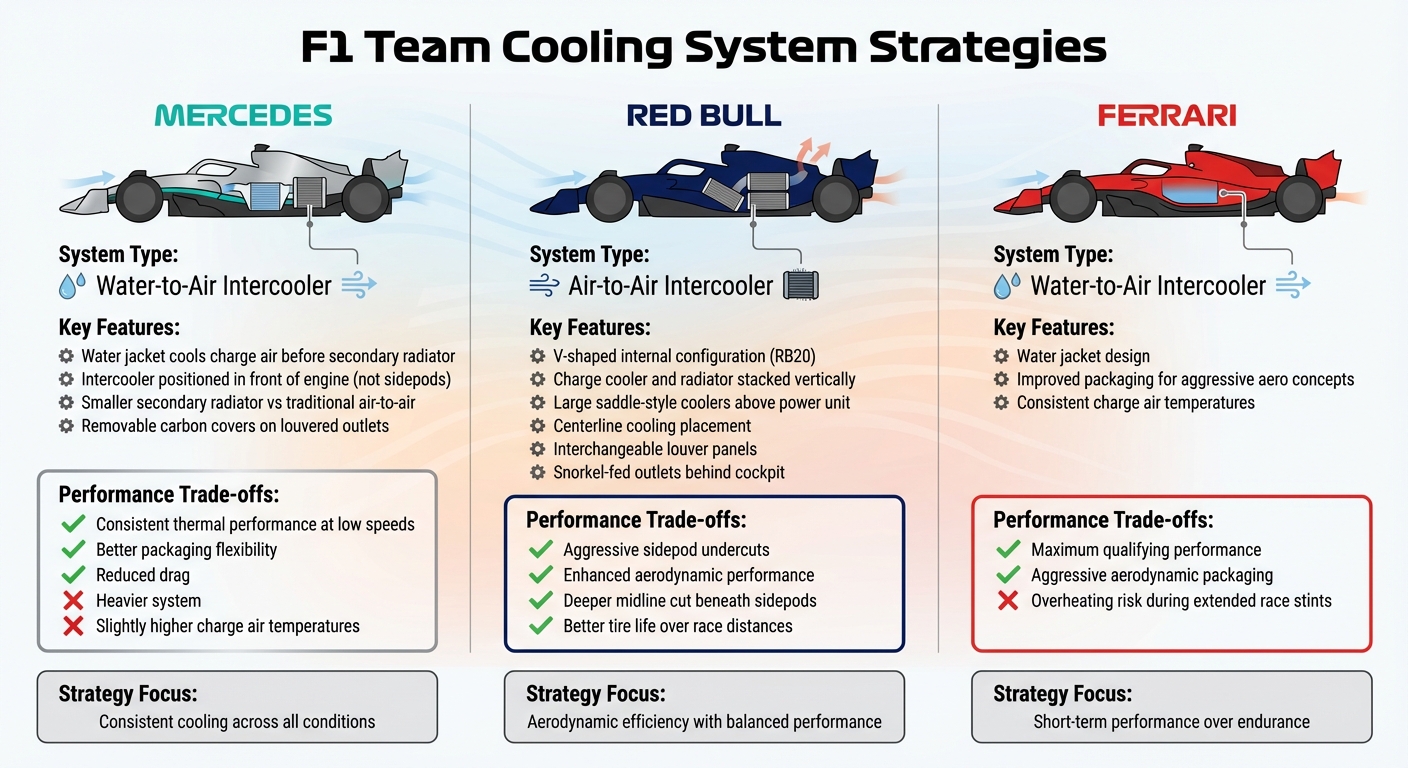
F1 Team Cooling System Strategies Comparison: Mercedes vs Red Bull vs Ferrari
After examining general solutions, it's clear that Formula 1 teams have developed tailored cooling systems that align with their unique design philosophies and power unit partnerships.
Mercedes: Low-Temperature Radiator Design

Mercedes introduced a water-to-air intercooler system during the hybrid era, a move that set it apart. This system uses a water jacket to cool the charge air before sending it to a secondary radiator. The design allows the intercooler to sit in front of the engine rather than taking up space in the sidepods, providing aerodynamic benefits. While this setup is heavier and results in slightly higher charge air temperatures compared to air-to-air systems, it excels in maintaining consistent thermal performance, especially in low-speed scenarios.
The secondary radiator is much smaller than traditional air-to-air intercoolers, which reduces drag and allows for better packaging flexibility. Mercedes fine-tunes the balance between cooling and drag by using removable carbon covers on louvered outlets. These covers are kept in place during qualifying for reduced drag and removed during pit stops to enhance cooling. This strategy has also helped the team manage front tire temperatures effectively toward the end of stints. As Craig Scarborough explains:
In terms of cooling and weight, the water-to-air set up is less efficient, it's heavier, and the charge air temperature is higher. But the temperature is more consistent, especially when the car is running slower, such as when it's sat on the grid, because the primary cooling is the water and not the passing airflow.
On the other hand, Red Bull has taken a completely different approach, prioritizing aerodynamic efficiency in its cooling layout.
Red Bull: Air-to-Air Intercooler Strategy

Red Bull's cooling system reflects its focus on aerodynamic innovation. In February 2024, the team revealed the RB20 with a bold V-shaped internal configuration. This setup stacks the charge cooler and radiator vertically within the sidepods, as illustrated by Giorgio Piola. This arrangement allows for a deeper midline cut beneath the sidepods, enhancing aerodynamic performance. Additionally, the system features interchangeable louver panels and snorkel-fed outlets behind the cockpit to direct airflow efficiently.
The team also employs large saddle-style coolers positioned above the power unit, a design choice influenced by its Honda power unit partnership. By relocating the cooling components to the car's centerline, Red Bull achieves more aggressive sidepod undercuts while placing mass higher within the chassis. The result? Red Bull's thermal management strikes a balance between Mercedes' consistent cooling and Ferrari's immediate performance focus. This approach has led to better tire life over race distances without compromising warm-up performance.
Ferrari, however, opts for a different balance, prioritizing short-term performance over endurance.
Ferrari: Water-to-Air Intercooler System
Ferrari also employs a water-to-air intercooler system, though the specifics remain tightly held secrets. Like Mercedes, Ferrari uses a water jacket design to improve packaging for its aggressive aerodynamic concepts. This system ensures consistent charge air temperatures. However, Ferrari's approach leans heavily toward maximizing qualifying performance, which sometimes leads to overheating during extended race stints.
These varied cooling strategies underscore how F1 teams navigate the trade-offs between performance, aerodynamics, and reliability in the face of extreme thermal demands.
Conclusion: Managing Performance, Reliability, and Engineering Progress
Turbocharger cooling in Formula 1 presents a tough engineering challenge. Teams must juggle performance, reliability, and aerodynamic efficiency. Craig Scarborough sums it up perfectly:
Cooling aids reliability but costs in performance, with added weight and aerodynamic drag.
This trade-off shapes critical design choices, like deciding between air-to-air and water-to-air intercoolers or finding the best radiator placement.
Modern F1 power units generate enormous heat, requiring high-pressure coolant systems (over 2.5 bar), specially designed asymmetric outlets, and adjustable bodywork panels to manage airflow and temperature effectively.
Looking ahead to the 2026 regulations, thermal management becomes even more essential. The shift to a 50/50 power split between the internal combustion engine and electric components means cooling systems for MGUs and batteries will need to be even more efficient. These changes highlight a broader evolution in how teams approach thermal management, with success in this area likely to provide a critical performance edge.
Advanced intercooler and cooling technologies being used today pave the way for future developments. As teams refine water-to-air and air-to-air intercooler strategies, they continue to push the limits of performance. Improved thermal efficiency will directly enhance electrical output, with precise temperature control translating into faster lap times, greater reliability, and stronger championship results.
FAQs
Why does turbo cooling affect aerodynamics?
Turbo cooling systems affect a car's aerodynamics by adding aerodynamic drag. The ducts and radiators involved in these systems interfere with the airflow around the vehicle, which can lower its efficiency and performance.
What’s the real difference between air-to-air and water-to-air intercoolers?
The key distinction is in how these systems cool compressed air before it reaches the engine. Air-to-air intercoolers rely on ambient airflow to reduce heat, making them most effective at higher speeds where airflow is plentiful. On the other hand, water-to-air intercoolers use a liquid coolant to absorb heat, which is then cooled by a radiator or heat exchanger. This setup provides steady performance even in situations with limited airflow or when temperatures are high. Formula 1 teams make their choice based on factors like cooling requirements, aerodynamics, and how the system fits within the car's design.
How will the 2026 rules change turbo and hybrid cooling needs?
The 2026 F1 regulations are set to remove the MGU-H, a component critical for managing exhaust heat and energy recovery. With its elimination, teams will face new challenges in dealing with the extra heat generated by turbochargers and hybrid systems. To stay competitive, they’ll need to rethink how they dissipate heat efficiently. This could mean developing advanced cooling methods or completely redesigning their cooling systems to ensure reliability, maintain performance, and strike a balance between weight and aerodynamics under the updated rules.