Hamilton vs. Verstappen: Last-Lap Showdowns
Analyze last-lap F1 tactics, tire management, cornering, DRS and pressure handling to see how contrasting styles decide races like Bahrain and Abu Dhabi.
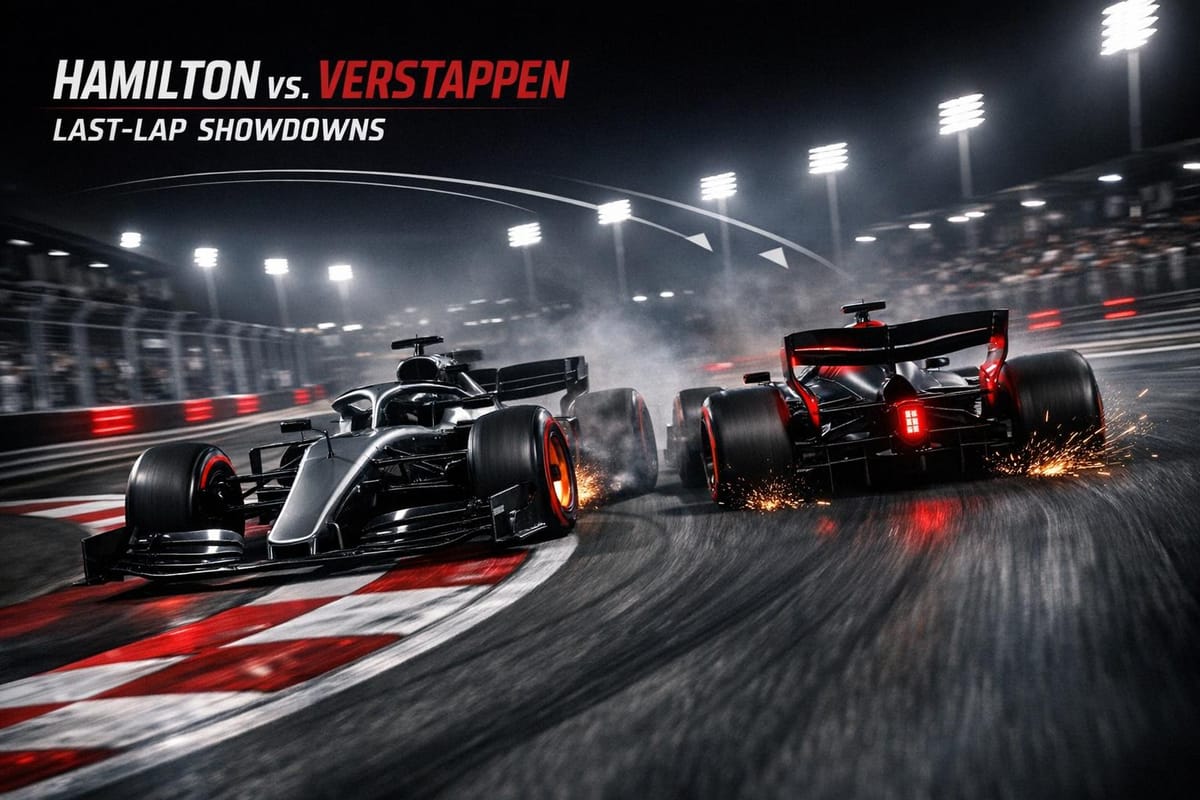
The rivalry between Lewis Hamilton and Max Verstappen is among Formula One's most intense. Their contrasting styles - Hamilton's calculated precision versus Verstappen's bold aggression - have created unforgettable final-lap battles. Key moments like the 2021 Abu Dhabi Grand Prix and the Bahrain opener showcase their differences in tire management, cornering, and straight-line strategies, often deciding race and championship outcomes.
Key Highlights:
- Driving Styles: Hamilton focuses on tire conservation and steady pace, while Verstappen relies on aggressive late braking and high-speed cornering.
- Tire Management: Hamilton’s methodical approach minimizes degradation, while Verstappen pushes tires to their limit for short-term gains.
- Straight-Line Speed: Hamilton uses precise DRS timing, while Verstappen pairs DRS with daring overtakes.
- Pressure Handling: Hamilton thrives on patience and consistency under pressure; Verstappen excels with fearless, high-stakes moves.
This rivalry blends skill, strategy, and risk-taking, defining modern Formula One and captivating fans worldwide.
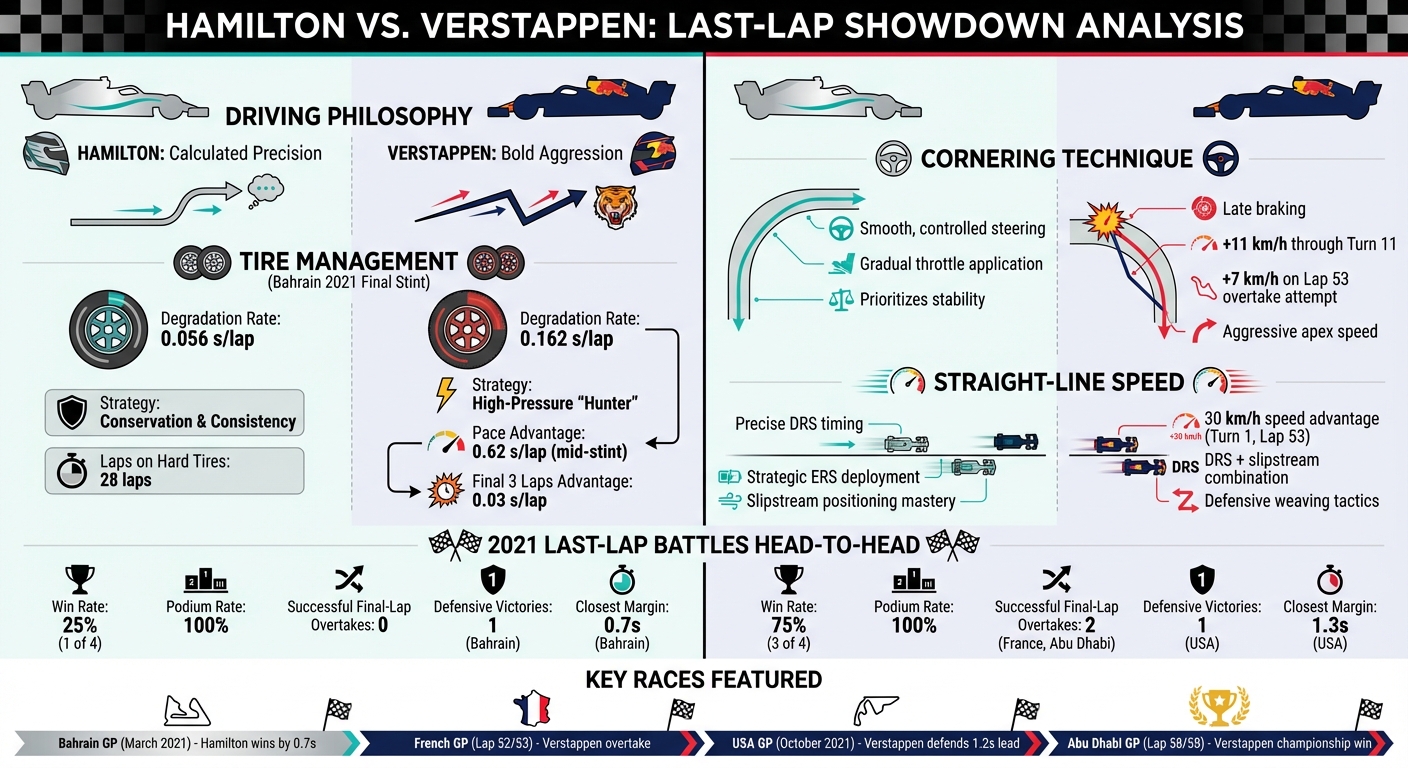
Hamilton vs Verstappen Racing Styles Comparison: Key Performance Metrics
Hamilton vs Verstappen: Title Fight Finale | 2021 Abu Dhabi Grand Prix
Tire Management in the Final Laps
Tire management during the closing laps of a race can make or break a championship. Lewis Hamilton and Max Verstappen employ strikingly different approaches to tire strategy, and these choices often dictate the outcome of their battles. Let’s break down their contrasting methods.
Hamilton's Tire Conservation Strategy
Hamilton excels at squeezing every ounce of performance from his tires without overworking them. A perfect example of this was during the March 2021 Bahrain Grand Prix. In the final stint of the race, Hamilton managed to complete 28 laps on hard tires with an impressively low degradation rate of 0.056 seconds per lap. To put that into perspective, Lance Stroll, on the same tire compound, experienced a much higher degradation rate of 0.141 seconds per lap.
Hamilton achieves this by carefully warming up new tires, ensuring they deliver consistent performance over time. This method allows him to maintain a steady pace, even when rivals are closing in on fresher rubber. It’s a calculated approach that prioritizes long-term track position over short bursts of speed.
Verstappen's High-Pressure Tire Usage
On the other side of the spectrum, Verstappen adopts a bold and aggressive style, often referred to as the "hunter" strategy. During the same Bahrain Grand Prix, Verstappen demonstrated his ability to close a 7.6-second gap in just 11 laps by pushing his fresh tires to their absolute limit. His degradation rate, however, was much higher at 0.162 seconds per lap, giving him an average advantage of 0.62 seconds per lap over Hamilton during that stretch.
But this approach comes with risks. By the time Verstappen reached the final three laps, his pace advantage had dropped to just 0.03 seconds per lap as his tires neared their performance threshold.
"I just didn't have the tyres anymore to attack." – Max Verstappen, F1 Driver, Red Bull Racing
Verstappen’s strategy is backed by Red Bull’s high-downforce car design, which supports aggressive driving. However, this method often leads to the tires "hitting the cliff", where grip is lost abruptly, leaving little room for error in the final moments.
Cornering Techniques at High Speed
Mastering high-speed cornering is a critical factor in racing success, and few drivers demonstrate this better than Lewis Hamilton and Max Verstappen. Their contrasting techniques reflect not only their individual driving styles but also the unique setups of their cars.
Hamilton's Smooth Cornering Method
Hamilton's style is all about precision and stability. He uses smooth, controlled steering to handle oversteer, ensuring his car remains balanced through corners. His throttle control is equally measured - he applies power gradually to maintain traction, even if it means sacrificing a fraction of a second.
Take the March 2021 Bahrain Grand Prix, for example. Telemetry showed Hamilton battling oversteer in Turn 10, forcing a significant steering correction. This adjustment cost him around 0.3 seconds compared to Verstappen in that corner alone.
"The correction means Hamilton has to be more cautious on throttle, while Verstappen is able to apply throttle earlier and get better acceleration off the corner." – Jonny Reynolds and Jamie May, Data Analysts
This calculated approach contrasts sharply with Verstappen's more aggressive technique, which prioritizes speed over caution.
Verstappen's Aggressive Cornering Style
Verstappen's method is built around late braking and apex speed. He dives into corners with remarkable aggression, aiming to carry as much speed as possible. During the Bahrain Grand Prix, he was clocked carrying 11 km/h more speed through Turn 11 and an additional 7 km/h during his Lap 53 overtaking attempt.
His success often hinges on late braking and quick, sharp steering adjustments. For instance, at the October 2025 Mexico City Grand Prix, Verstappen braked much later than Hamilton into Turn 1, claiming the inside line and securing the apex. Meanwhile, Hamilton struggled, locking his front-left tire at Turn 4.
This bold approach thrives when his car has optimal grip and a high-downforce setup to stabilize the rear. However, it’s a double-edged sword. When tire wear sets in or turbulent air disrupts traction, Verstappen’s speed advantage can quickly fade, as seen in the closing laps of Bahrain.
These differing strategies not only define their cornering styles but also influence how each driver capitalizes on straight-line speed and DRS opportunities in critical moments.
Straight-Line Speed and DRS Usage
When it comes to their head-to-head battles, Hamilton and Verstappen's strategies for straight-line speed and DRS (Drag Reduction System) usage often draw the line between victory and defeat. On the final lap, these differences become especially critical, as both drivers know how to exploit DRS and slipstreams to the fullest - but their methods couldn't be more distinct.
Hamilton's Slipstream Positioning
Hamilton approaches DRS with a calculated, almost surgical precision. His focus lies on positioning and timing rather than brute force. A key part of his strategy involves manipulating his location relative to the DRS detection line - the point that determines who gets the DRS advantage on the next straight.
One of the most notable examples of this occurred during the December 2021 Saudi Arabian Grand Prix. In a dramatic moment, Verstappen slowed down significantly before the detection line, trying to ensure he was behind Hamilton to gain DRS for the upcoming straight. Hamilton, fully aware of the move, refused to take the bait.
"That meant he would've DRS'd back past, follow me through the last corner and then DRS me into Turn 1. So that was a tactic." – Lewis Hamilton, Driver, Mercedes
Hamilton's tactical approach extends beyond just DRS. Telemetry from March 2021 revealed how he adjusted his ERS (Energy Recovery System) deployment to carefully manage energy on the straights. This method prioritizes consistency and control over sheer acceleration, allowing him to maintain a steady edge in high-pressure situations.
On the other hand, Verstappen's style on the straights is all about aggression and seizing opportunities.
Verstappen's Aggressive Cornering Style
Verstappen takes a much more forceful approach to DRS, using it as a weapon to create speed differentials and execute bold overtaking moves. His strategy often involves combining DRS with slipstreaming to build momentum, followed by daring late-braking maneuvers that leave little room for error. A vivid example of this came during the Bahrain Grand Prix in 2021. On Lap 53, Verstappen achieved a 30 km/h speed advantage heading into Turn 1, thanks to DRS and a tow from Hamilton, though his overly aggressive dive-bomb attempt forced him off-track.
"Verstappen arrives at Turn 1 with a 30 km/h speed advantage thanks to opening his DRS and getting a tow from Hamilton." – Jonny Reynolds and Jamie May, Data Analysts, Formula 1
But Verstappen's dominance on the straights goes beyond DRS usage. He often sacrifices the ideal racing line in corners, running deeper into turns to maximize acceleration onto the next straight. Additionally, he's been known to use defensive weaving to disrupt a rival's slipstream, as seen during the controversial final lap of the 2021 Abu Dhabi Grand Prix. When executed properly, these tactics give Verstappen a critical edge in straight-line speed battles.
Performance Under Pressure
When the stakes are high, Lewis Hamilton and Max Verstappen approach pressure with very different strategies. Their contrasting styles have led to some of the most intense and memorable finishes in modern Formula 1, with each relying on unique psychological and technical strengths to handle last-lap battles.
Hamilton's Measured Approach
Hamilton's strength under pressure lies in his precision and experience. Rather than taking unnecessary risks, he focuses on calculated moves, using defensive positioning and patience to stay ahead. A great example of this came during the Bahrain Grand Prix in March 2021. In the closing laps, Hamilton managed to fend off Verstappen by expertly deploying his energy reserves and forcing Verstappen into an error at Turn 4. Verstappen, attempting an outside pass, went off track. Despite gaining a 0.6-second advantage before Turn 4, Verstappen lost it in the high-speed corners as his tires degraded and turbulent air disrupted his pace.
This ability to stay composed and force rivals into mistakes highlights Hamilton's focus and control. He rarely cracks under pressure, instead relying on his consistency to outlast opponents. Verstappen, on the other hand, takes a much bolder approach.
Verstappen's Risk-Taking Under Pressure
Verstappen thrives in high-pressure moments with aggressive moves that test the limits of his car. During the United States Grand Prix in October 2021, he demonstrated this by holding off Hamilton, who was closing in with fresher tires. Despite Hamilton having an 8-lap tire advantage and cutting down an 8.8-second gap, Verstappen managed his tire energy skillfully and maintained a 1.2-second lead to secure the win.
"You always have to keep believing. I kept on pushing the whole race." – Max Verstappen, Red Bull Racing
Verstappen's risk-taking extends beyond his driving style. He often makes bold strategic calls, like opting for soft tires during late-race safety car situations, as he did in Abu Dhabi 2021, while Hamilton stuck with older hard compounds. He also uses psychological tactics, such as manipulating DRS zones or brake-testing rivals, to gain an edge. For instance, in the final laps of the Bahrain race, the pace difference between Hamilton and Verstappen narrowed to just 0.03 seconds, illustrating how tight their battles can be.
These contrasting approaches - Hamilton's calculated precision versus Verstappen's aggressive risk-taking - are what make their duels so electrifying to watch. Each driver brings a unique style to the fight, creating some of the most unforgettable moments in Formula 1.
Head-to-Head Statistics
The tactical differences between Hamilton and Verstappen become strikingly clear when you examine their head-to-head numbers. Looking at the last-lap battles during the 2021 season - Bahrain, France, the United States, and Abu Dhabi - each driver's strengths come into focus. Verstappen came out on top in three of these four critical races (a 75% success rate), including a decisive pass on Hamilton in France (Lap 52 of 53) and his championship-clinching move in Abu Dhabi (Lap 58 of 58). On the other hand, Hamilton's lone victory in these moments came in Bahrain, where he defended fiercely and crossed the line just 0.7 seconds ahead.
Both drivers showcased incredible consistency, finishing on the podium in all four races. In the U.S. Grand Prix, Hamilton managed to cut down an 8.8-second gap after his final pit stop but couldn't maintain the blistering pace of 1.2 seconds per lap needed to overtake Verstappen. The table below captures the key metrics from these head-to-head clashes.
Comparison Table: Hamilton vs. Verstappen
| Metric | Lewis Hamilton | Max Verstappen |
|---|---|---|
| Win Rate (2021 Last-Lap Battles) | 25% (1 of 4) | 75% (3 of 4) |
| Podium Finish Rate | 100% | 100% |
| Successful Final-Lap Overtakes for Win | 0 | 2 (France, Abu Dhabi) |
| Defensive Victories | 1 (Bahrain) | 1 (USA) |
| Closest Winning Margin | 0.7 s (Bahrain) | 1.3 s (USA) |
| Tire Degradation Rate (Bahrain, final stint) | 0.056 s/lap | 0.162 s/lap |
These statistics highlight their contrasting approaches. Verstappen’s ability to execute late-race overtakes underscores his aggressive style, while Hamilton’s skill in tire management and defensive driving shines through in moments of high pressure. Together, these elements paint a vivid picture of their rivalry on the track.
Conclusion
The thrilling last-lap battles between Lewis Hamilton and Max Verstappen highlight two contrasting approaches to racing, each rooted in a distinct philosophy. Hamilton's calculated style, built on exceptional tire management and strategic patience, stands in stark contrast to Verstappen's bold, high-pressure tactics that push his car to its limits while staying just within the rules. These competing strengths have come to define their legacies on the track.
From tire conservation to daring overtakes, their rivalry showcases a balance of power where neither approach consistently overshadows the other. In Bahrain, Hamilton's cool-headed defense earned him victory by a razor-thin margin of 0.7 seconds. Meanwhile, Verstappen's fearless aggression secured wins at events like the French and Abu Dhabi Grands Prix. This clash of styles - Hamilton's smooth precision versus Verstappen's calculated risk-taking - has not only shaped modern racecraft but also reignited global enthusiasm for Formula One.
"That is what good drivers do: they make the difference compared to other fast drivers but not as good." - Max Verstappen, Driver, Red Bull Racing
Hamilton's mastery of strategy can neutralize raw speed, while Verstappen's bold instincts can dismantle even the most solid defenses. Together, their rivalry continues to push the boundaries of what's possible in Formula One's most intense moments.
FAQs
How do tire “degradation rates” affect last-lap pace?
Tire degradation plays a crucial role in determining last-lap performance in Formula 1. As tires wear down, they lose grip, leading to slower lap times and diminished traction. Drivers face a constant challenge: push hard for speed or manage their tires to maintain performance. When degradation is high, lap times can drop significantly, directly affecting overtaking opportunities and race outcomes - especially during those nail-biting last-lap duels where every split second counts.
What causes a driver to lose DRS at the detection line?
When a driver loses DRS at the detection line, it usually happens because the rear wing flap doesn't reach the necessary opening angle. This might be caused by braking, accelerating, or sudden movements that upset the aerodynamic balance. It could also result from a malfunction in the DRS system or if it's deliberately turned off.
Why does dirty air hurt late-race overtakes?
Dirty air, caused by turbulent airflow from the car ahead, interferes with the aerodynamics of the car behind. This disruption reduces downforce, grip, and overall stability, making it tougher to brake late, maintain speed through corners, and pull off clean overtakes. The problem becomes even more pronounced in the later stages of a race, where reduced aerodynamic performance and handling issues heighten the risk of errors - especially in high-speed corners or during crucial overtaking maneuvers.