History of F1 Tire Suppliers
Tire tech shaped Formula 1's performance, safety and strategy — from 'tire wars' to one supplier focused on planned degradation and greener materials.
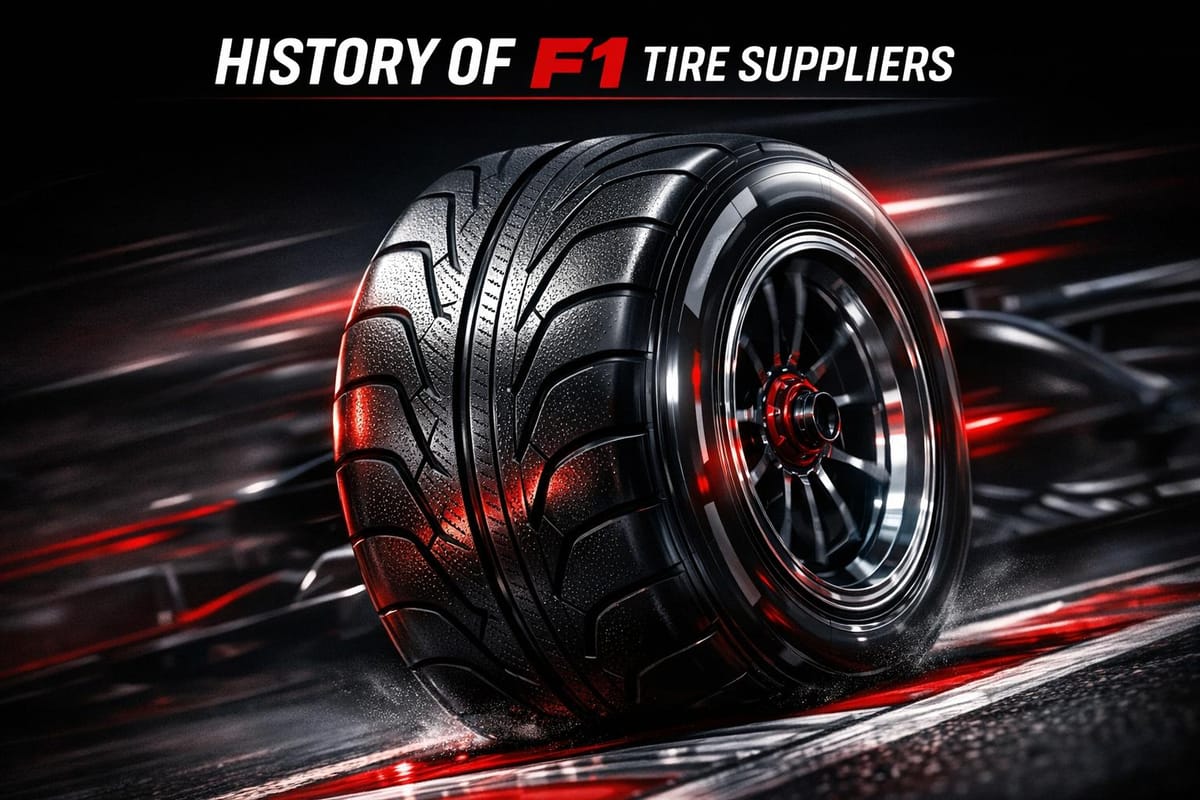
Tires are the only part of an F1 car that touches the track, making them critical for performance, safety, and race strategies. Over decades, suppliers like Goodyear, Bridgestone, Michelin, and Pirelli have shaped the sport with innovations like slick tires, radial technology, and high-degradation compounds.
Key takeaways:
- Multi-supplier eras (1950s–2006) drove rapid tire advancements but led to high costs and safety risks.
- The single-supplier model (2007–present) prioritizes fairness, safety, and controlled costs.
- Pirelli, the current supplier, focuses on tires designed for degradation to promote pit strategy.
Quick Comparison
| Era | Key Suppliers | Notable Features |
|---|---|---|
| 1950s–1970s | Dunlop, Firestone, Pirelli | Early tire tech, slick tires introduced |
| 1970s–1998 | Goodyear | Slick tires, radial advancements |
| 1997–2006 | Bridgestone, Michelin | Tire wars, grooved tires introduced |
| 2011–Present | Pirelli | Single supplier, high-degradation tires |
Tires have evolved from basic designs to key tools in shaping race outcomes and supporting F1’s push toward sustainability.
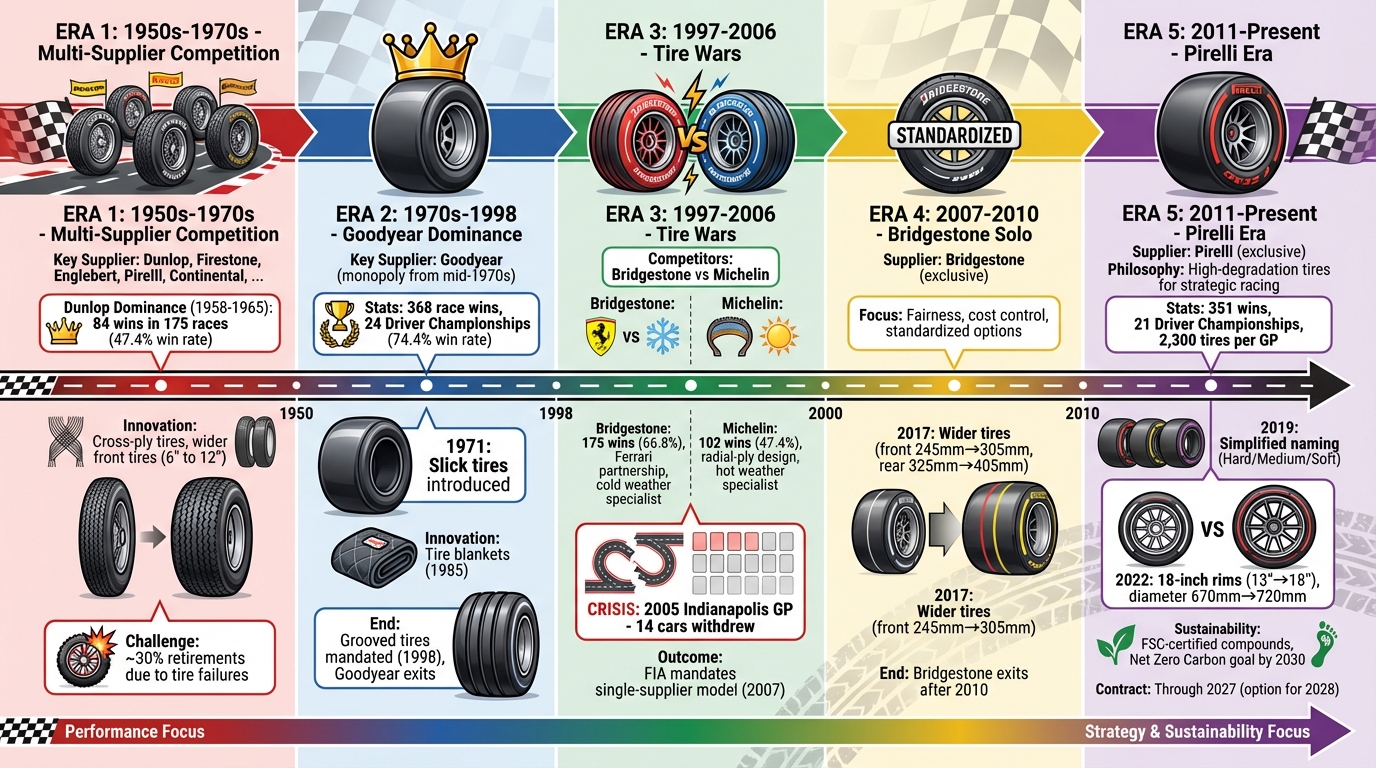
Evolution of F1 Tire Suppliers from 1950s to Present
Multi-Supplier Competition (1950s–1970s)
Post-War Beginnings: Pirelli, Dunlop, Firestone, and Englebert
In Formula 1's early days, cars relied on tires that were barely different from standard street models. This led to a significant number of retirements - about 30% - due to tire failures. Between 1950 and 1953, brands like Pirelli, Firestone, Dunlop, and Englebert vied for dominance. Pirelli claimed the first F1 victory at the 1950 British Grand Prix, while Englebert celebrated a win at Monaco in 1955. Continental also made a brief impact, securing a win at the 1954 French Grand Prix.
Tire suppliers initially relied on road tire technology, but the increasing speeds and sharper cornering demands of the sport quickly exposed its limitations. This spurred a wave of innovation, as manufacturers raced to develop designs better suited to the unique challenges of F1.
Dunlop's Dominance and Technical Progress
By the late 1950s, financial pressures forced some competitors to withdraw, leaving Dunlop to dominate the scene. Between 1958 and 1965, Dunlop achieved an impressive 47.4% win rate, racking up 84 victories in 175 races. During this period, its tires helped secure 8 Driver and 9 Constructor World Championships.
Dunlop's success was rooted in its technical advancements. The company refined cross-ply tire construction, creating stiffer sidewalls that were more resistant to punctures. It also widened front tires from about 6 inches (15 cm) to over 12 inches (30+ cm) and introduced staggered tire sizes, which significantly improved handling.
However, as Dunlop pushed the boundaries of tire technology, new competitors like Goodyear began to emerge, setting the stage for a more intense rivalry.
Goodyear's Entry and Global Competition
Goodyear entered the F1 arena in 1965, bringing cutting-edge research and development to the table. The company made an immediate impact, securing a win in its debut season. By 1973, Goodyear-equipped cars claimed victory in every race, and by 1976, its tires dominated the grid.
The competition between Goodyear, Dunlop, and Firestone - who collectively won 49 races from 1950 to 1975 - drove rapid advancements in tire technology. Teams began to see their choice of tire supplier as a strategic weapon, often switching brands to gain an edge over rivals.
This era of fierce competition among multiple suppliers set the stage for future breakthroughs, including the introduction of slick tires and radial technology, which would revolutionize the sport in the years to come.
Goodyear's Dominance (1970s–1998)
Slick Tires and Mechanical Grip
Goodyear changed the game in Formula 1 back in 1971 at the Spanish Grand Prix with the introduction of slick tires. These tires maximized the contact patch with the track, arriving just as engineers were starting to master the use of downforce to keep cars glued to the asphalt. Between 1973 and 1977, Goodyear tires were on every single Grand Prix-winning car.
As ground-effect cars like the Lotus 79 emerged in the late 1970s, Goodyear adjusted its tire construction to handle the extreme G-forces these designs produced. Then came the turbocharged engines of the 1980s, pushing over 1,000 horsepower. Goodyear developed tire compounds tough enough to handle the massive torque these monsters unleashed.
By the 1990s, Goodyear had the F1 tire market to itself as rivals like Michelin and Pirelli stepped away. The company continued pushing boundaries, creating softer compounds during the refueling era. These tires allowed drivers to go all-out between pit stops. As three-time World Champion Jack Brabham put it:
They were always able to come up with something new. They always had several compounds to try and a fantastic effort to make sure we had the best we could possibly have.
Goodyear's knack for innovation made it the undisputed leader in F1 tire technology. But as the sport evolved, new rules would soon shake things up.
Grooved Tires and Goodyear's Departure
In 1998, the FIA introduced a major change: slick tires were replaced with grooved ones - three grooves in the front and four in the rear - to slow cars down and improve safety. Goodyear saw this as a step backward and decided not to invest in developing tires under the new regulations. F1 champions Jacques Villeneuve and Damon Hill criticized the move, arguing that grooved tires were actually less safe, as they were more prone to spinning than slicks.
Goodyear bowed out of Formula 1 after Michael Schumacher delivered their final victory at the 1998 Italian Grand Prix. The company shifted its focus to NASCAR and endurance racing instead. With Goodyear gone, Bridgestone stepped in as the sole tire supplier for the 1999 and 2000 seasons, ushering in a new era of single-supplier dominance in F1.
Bridgestone vs Michelin: The Tire Wars (1997–2006)
Bridgestone's Entry and Early Performance
Bridgestone made its Formula 1 debut in 1997, bringing a sharp focus on improving grip through advanced rubber polymer technology. When Goodyear exited the sport after the 1998 season, Bridgestone became the sole tire supplier for the 1999 and 2000 seasons, achieving an impressive 175 race wins with a 66.8% win rate during this period. However, the competition heated up in 2001 when Michelin re-entered F1 with a game-changing radial-ply tire design. Unlike traditional cross-ply tires, Michelin's radial-ply construction featured plies running directly from side to side, creating more flexible sidewalls and a larger contact patch. This innovation gave their tires better grip, challenging Bridgestone's early dominance.
Michelin's Return and Intense Competition
From 2001 to 2006, the rivalry between Bridgestone and Michelin became a defining feature of Formula 1. Michelin's radial-ply tires performed exceptionally well in hot and damp conditions, offering superior grip during single-lap qualifying. However, they often wore out faster during races. On the other hand, Bridgestone's compounds were built for durability, excelling in colder weather and over long stints, although they sometimes struggled to heat up quickly.
This fierce competition spurred rapid technical advancements. Both manufacturers developed tires specifically tailored to the needs of their partner teams. Bridgestone worked closely with Ferrari, with technicians stationed at Ferrari's Maranello headquarters and Ferrari engineers collaborating in Japan. This partnership proved highly effective, as evidenced by Michael Schumacher's remarkable 2002 season, where he secured a podium finish in every race. The collaboration's success prompted McLaren to switch to Michelin, fearing they were being treated as a secondary priority by Bridgestone.
The rivalry reached a boiling point at the 2005 United States Grand Prix in Indianapolis. Michelin's tires failed to handle the extreme lateral forces of the banked Turn 13, leading to Toyota's Ralf Schumacher suffering a tire failure during Friday practice. Michelin officials, Pierre Dupasquier and Nick Shorrock, informed the FIA that their tires could not safely last beyond 10 laps. As a result, all seven Michelin-equipped teams, totaling 14 cars, withdrew after the formation lap. Only six Bridgestone-shod cars - representing Ferrari, Jordan, and Minardi - competed in the race, with Michael Schumacher taking the win. The event severely damaged Formula 1's reputation.
| Feature | Bridgestone | Michelin |
|---|---|---|
| Primary Focus | Advanced rubber polymers | Radial-ply construction |
| Weather Performance | Strong in cold conditions | Excels in heat and damp weather |
| Strategy Strength | Durable over long stints | Faster in single-lap qualifying |
| Lead Partner | Ferrari | Renault / McLaren |
| Total Wins (1997–2006) | 175 wins (66.8% win rate) | 102 wins (47.4% win rate) |
Single Supplier Model: Bridgestone's Final Years
As the rivalry reached its peak, growing costs and the performance disparities between teams prompted the FIA to step in. To level the playing field, the governing body introduced a single-supplier model starting in 2007. Michelin, unwilling to operate under this new framework, withdrew from Formula 1 after the 2006 season - a year when Fernando Alonso and Renault clinched both championships on Michelin tires.
Bridgestone became the exclusive tire supplier from 2007 to 2010, standardizing tire options across all teams. This move simplified strategic decisions and allowed the FIA to better manage competition and performance equity. However, by the end of 2010, Bridgestone decided to leave Formula 1, shifting its focus to road car tire development. With Bridgestone's exit, the curtain closed on an era defined by intense tire wars and relentless innovation.
The Pirelli Era (2011–Present)
Pirelli's Selection and Early Years
When Bridgestone left Formula 1 after the 2010 season, Pirelli stepped up as the exclusive tire supplier starting in 2011. The FIA tasked Pirelli with creating high-degradation tires to encourage unpredictable racing, a concept inspired by the multi-stop 2010 Canadian Grand Prix. Unlike the past, when tire makers focused on durability, Pirelli’s approach deliberately emphasized wear. For instance, a medium compound tire might lose about 0.05 seconds per lap as it degrades, forcing teams to carefully plan pit stops and manage tire usage.
Mario Isola, Pirelli's Motorsport Director, explained this philosophy:
"In the past with [a] tire war, I believe that sometimes, the final result of the race was defined too much by the tires. We need to be sure that the final classification is for the best driver first, and the best car second. Not the best tire."
To simplify things for fans, Pirelli revamped its tire naming system in 2019. Instead of using terms like "Hypersoft" or "Superhard", they adopted a straightforward Hard, Medium, and Soft naming convention for each race weekend. Behind the scenes, though, the compounds (ranging from C1 to C5, with C6 added in 2025) still vary depending on the circuit. This change made the sport's complex strategies easier to follow while paving the way for further advancements in safety and performance.
Regulation Changes: Wider Tires and 18-Inch Rims
Pirelli’s era has been marked by significant technical changes. In 2017, wider tires were introduced to improve grip and performance. Front tires expanded from 245 mm (9.6 in) to 305 mm (12 in), while rear tires grew from 325 mm (12.8 in) to 405 mm (15.9 in). The overall diameter also increased slightly, from 660 mm to 670 mm. These updates contributed to faster lap times, with an average drop of 5 to 6 seconds compared to the 2016 season.
In 2022, Formula 1 made a major shift from 13-inch to 18-inch rims, increasing the overall tire diameter to 720 mm (28.3 in). This move brought F1 technology closer to modern road car standards. However, it also required teams to redesign their suspension systems, as the new tires featured stiffer, low-profile sidewalls.
Mario Isola shared insights into the development process:
"With the 18-inch tires, we decided to introduce a complete new family of compounds... New polymers - obviously there is a lot of confidentiality around that - but let's say new ingredients in general that were not available, and they give us a better behavior of the car more in line with the expectation of the driver [and] less overheating."
| Feature | Pre-2017 Dimensions | 2017–2021 Dimensions | 2022–Present (18-inch era) |
|---|---|---|---|
| Front Tire Width | 245 mm (9.6 in) | 305 mm (12 in) | 305 mm (12 in) |
| Rear Tire Width | 325 mm (12.8 in) | 405 mm (15.9 in) | 405 mm (15.9 in) |
| Tire Diameter | 660 mm (26 in) | 670 mm (26.4 in) | 720 mm (28.3 in) |
| Rim Diameter | 13 inches | 13 inches | 18 inches |
These changes highlight Formula 1's ongoing efforts to balance performance improvements with safety considerations.
Safety, Strategy, and Incidents
Pirelli’s innovations have also introduced new challenges in terms of safety and strategy. As car performance has improved, the forces acting on tires have increased significantly. In 2023, Pirelli reported a 15% rise in load on both axles compared to 2022. This led to the introduction of a new tire construction at the British Grand Prix in July 2023, aimed at better handling fatigue.
The 2020 British Grand Prix at Silverstone brought these issues into sharp focus. In the final laps, Lewis Hamilton, Valtteri Bottas, and Carlos Sainz Jr. all experienced front-left tire failures. Pirelli attributed the failures to an early Safety Car, which led to a 40-lap stint under extreme forces on 2020-spec cars.
More recently, at the 2023 Qatar Grand Prix, Pirelli identified tread and carcass separation issues during long runs on a track with high-speed pyramid kerbs. To ensure safety, the FIA limited tire stints to 18 laps, forcing teams into a three-stop strategy. Simone Berra, Pirelli's Chief Engineer, explained:
"We thought it was better not to increase pressures too much for the benefit of the sport".
In 2025, Pirelli supplies 2,300 tires per Grand Prix, covering six slick compounds (C1 to C6) as well as intermediates and full wets. Each tire is designed to last approximately 300 km (186 miles). The C1 compound prioritizes durability with reduced grip, while the newer C6 offers maximum grip but wears out faster.
This delicate balance between performance, safety, and strategy continues to define Pirelli’s role in Formula 1.
Comparing Tire Supplier Eras
Performance Data and Championship Results
The history of Formula 1 tire suppliers is rich with standout performances and championship victories. Goodyear leads the pack with an impressive 368 race wins and 24 Driver Championships between 1964 and 1998. This dominance equates to an extraordinary 74.4% win rate during their tenure. Pirelli follows closely with 351 wins and 21 Driver Championships, achieved over three distinct periods in the sport.
Bridgestone contributed to 175 race victories and 11 championships, while Michelin amassed 102 wins and 6 championships during their time in F1. Dunlop, one of the early players in the sport, secured 83 wins and 8 championships before leaving F1 in 1977.
The eras of these suppliers reveal unique stories. For instance, in 1973, Goodyear achieved total dominance by winning every race that season. Similarly, during the 2002 Bridgestone-Michelin rivalry, Bridgestone’s tailored development for Ferrari’s F2002 chassis enabled Michael Schumacher to finish on the podium in every race that year.
Technical Developments by Supplier
Tire suppliers have played a pivotal role in shaping F1’s technological evolution. Each company introduced innovations that changed the game:
- Dunlop made waves in 1958 with the R5 racing tire, which used nylon reinforcement to cut weight by 12 pounds. They also pioneered synthetic rubber compounds in the 1960s, improving heat resistance and durability.
- Firestone changed dry-weather racing in 1971 by debuting the first slick tires at the Spanish Grand Prix.
- Goodyear followed with the introduction of tire blankets in 1985, allowing teams to preheat tires to 70–90°F (21–32°C) for optimal grip right from the start.
- Michelin revolutionized tire construction in 1978 when Carlos Reutemann won the Brazilian Grand Prix on radial tires. These tires featured flexible sidewalls and a stabilizing belt, offering a larger contact patch and superior grip compared to traditional cross-ply designs.
- Bridgestone spearheaded the shift to grooved tires in 1998, aimed at reducing grip and slowing cornering speeds. They also introduced a two-compound system in 2007, marking tires with distinct colors to clarify strategies for fans.
- Pirelli made headlines in 2022 by transitioning F1 cars from 13-inch to 18-inch rims, increasing tire diameter from 26.4 inches (670 mm) to 28.3 inches (720 mm). This required over 10,000 hours of testing and simulations to create 30 different specifications. Pirelli has also taken strides toward sustainability, introducing Forest Stewardship Council–certified racing tires as part of their goal to achieve net-zero carbon emissions by 2030.
These innovations laid the groundwork for the strategic shifts that came with the transition to a single-supplier model.
Multi-Supplier vs Single-Supplier: Pros and Cons
The shift from a competitive, multi-supplier era to the current single-supplier model has significantly influenced F1’s technical and strategic landscape. During the multi-supplier period, intense competition drove rapid advancements. Suppliers often formed exclusive partnerships with top teams - such as Bridgestone with Ferrari and Michelin with Renault - customizing tires to suit specific chassis designs. While this approach delivered performance gains, it also came with high costs and increased safety risks, as evidenced by the infamous 2005 Indianapolis incident.
The single-supplier model, introduced in 2007, aimed to control costs and level the playing field. Paul Hembery, Pirelli's Director of Motorsport, explained the rationale:
We wouldn't rule out a tyre war at this moment, but at this current time I don't think there is a huge appetite to spend large sums of money developing tyres to go faster.
Under this system, the FIA sets specific performance requirements, including high degradation, to promote strategic pit stops and keep races unpredictable.
| Multi-Supplier Era | Single-Supplier Era |
|---|---|
| Innovation driven by competition | Standardized costs for all teams |
| Tires tailored to specific cars | Uniform tire performance across the grid |
| Large performance gaps between suppliers | Easier regulation of speeds |
| High development expenses | Focus on sustainability and road relevance |
| Greater safety risks from aggressive development | Controlled degradation to enhance strategy |
Reliability has improved under the single-supplier model. In the early 1950s, tire blowouts and overheating caused around 30% of race retirements. Today, Pirelli tires are designed to last approximately 186 miles (300 km) with predictable wear patterns. However, this reliability comes at the expense of raw performance, as tires are now intentionally engineered to degrade faster to encourage strategic variability and add excitement to races.
Every Tyre Manufacturer in Formula 1 History Explained
Conclusion: What F1's Tire Supplier History Teaches Us
When you look at the history of Formula 1 tire suppliers, one thing becomes clear: tires are just as important as horsepower or aerodynamics. Over the years, tire technology has evolved to meet the demands of both competition and sustainability. For example, modern F1 tires now use FSC-certified compounds, reflecting a shift toward more eco-conscious practices.
This journey through tire development shows how priorities have changed. In the past, the focus was on raw performance, but today, safety and strategy play a much larger role. The transition from multiple tire suppliers to a single-supplier model in 2007 highlights this shift. The "tire wars" of earlier decades brought innovations like radial tires, but they also pushed manufacturers to the brink, sometimes compromising safety. A stark reminder of this came during the 2005 United States Grand Prix, when 14 cars withdrew after the formation lap due to safety concerns with Michelin's tires.
Nowadays, tires aren't just about speed. They play a strategic role in races and connect F1 technology to everyday cars. For instance, the 2022 move to 18-inch rims - tested extensively for performance - mirrors the design of modern road car tires. This change, along with F1's commitment to achieving Net Zero Carbon by 2030 through bio-based materials and recycling programs, reflects a growing emphasis on sustainability and relevance to everyday driving.
The future of F1 tire technology is already taking shape. Digital tools like virtual prototyping and AI are making tire development faster and more efficient. With Pirelli's current contract extending through 2027, with an option for 2028, future tires will need to strike a balance between strategic unpredictability, environmental goals, and transferring technology to road cars. As history shows, every leap in tire innovation reshapes how teams approach racing.
From Goodyear's record 368 race wins to Michelin's introduction of radial tires in 1977 and Pirelli's focus on high-degradation strategies, tire suppliers have always been a driving force in F1. They are the unseen architects of competition, and their role will only grow as the sport tackles new challenges. Whether it’s on the track or on the road, the evolution of tire technology continues to shape the future of performance and sustainability.
FAQs
Why does Formula 1 use a single tire supplier instead of multiple manufacturers?
Formula 1 shifted to a single tire supplier system to prioritize safety, cost control, and fair competition. In the past, tire manufacturers like Dunlop, Goodyear, Michelin, and Bridgestone fiercely competed in what were known as 'tire wars.' These battles often gave certain teams a performance edge, but they also brought challenges like inconsistent grip, higher failure rates, and serious safety risks.
With the move to a single supplier, the FIA ensures all teams use tires built to uniform safety and performance standards. This approach minimizes the chances of high-speed tire failures and creates a more even playing field for all participants. It also keeps costs in check, as teams no longer need to pour resources into custom tire development. Since 2011, Pirelli has served as the exclusive supplier, delivering consistent tire options and allowing the sport to channel its energy into other areas of technical progress.
How have tire advancements shaped race strategies in Formula 1?
Tires have always been a game-changer in Formula 1, heavily influencing race strategies over the years. Back in the early days, tires were narrow and wore out quickly, which meant teams had to focus on conserving grip and minimizing pit stops. Things began to shift in the 1960s when wider tires and different sizes for the front and rear were introduced, giving drivers better handling and allowing for more daring cornering. By the 1970s, slick tires - those without tread patterns - emerged, offering significantly more grip. However, these advancements came with a trade-off: faster wear, which made pit stops and tire strategies more intricate.
The game took another turn with the arrival of a single tire supplier - first Bridgestone in 2007, followed by Pirelli in 2011. This standardization brought a new layer of strategy. Teams now had to make the most out of the provided compounds, each with distinct performance and durability traits. Modern F1 races demand careful planning: when to switch tire compounds, how to balance speed with tire longevity, and the challenge of managing tire temperatures. Today, tire management is as crucial as engine power and aerodynamics in determining who crosses the finish line first.
How have F1 tire suppliers shaped the sport over the years?
The history of Formula 1 tire suppliers can be broken down into three distinct eras, each leaving its mark on the sport’s evolution. In the early days of F1 (1950s through the early 2000s), multiple manufacturers like Pirelli, Dunlop, and Firestone battled it out, fueling rapid advancements. This period gave us innovations like staggered tire sizes, slick tires for better grip, and eventually grooved tires designed to curb speeds.
Between 2007 and 2010, Bridgestone became the sole tire supplier. This simplified the competition by offering a smaller range of durable compounds, shifting the focus away from tire wars and toward car design and overall performance. It also helped cut costs for teams.
Since 2011, Pirelli has taken over as the exclusive supplier, introducing high-degradation tires to make strategy a critical part of racing. Teams now have to carefully manage tire wear and pit stops, striking a balance between speed and endurance. Recent changes, such as wider tires and larger sidewalls, have improved safety and mechanical grip, adding to the excitement of modern F1 racing.