How Delta Time Shapes Pit Stop Strategies
How pit-stop delta time shapes undercut/overcut choices, Safety Car tactics, and circuit-specific strategy using telemetry and simulations.
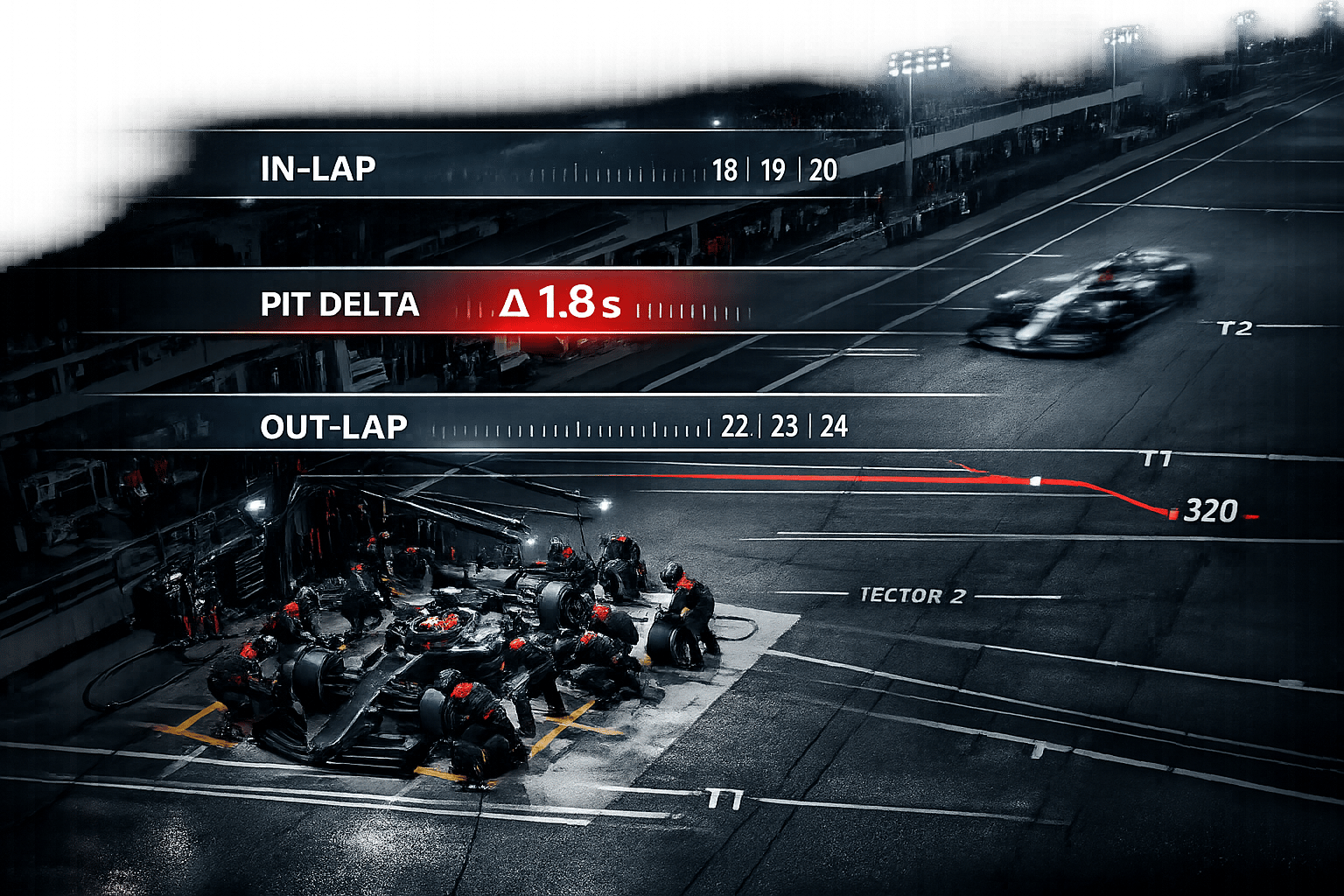
Formula 1 pit stops aren’t just about speed; they’re about timing. Delta time - the total time a driver loses during a pit stop - plays a critical role in shaping race strategies. It’s not just the seconds spent changing tires but also the time lost slowing down, driving through the pit lane, and re-accelerating. On most tracks, this adds up to 20–25 seconds, though it varies by circuit layout.
Here’s what you need to know:
- Delta time impacts strategy decisions: Teams use it to plan undercuts (pitting early for fresh tires) or overcuts (staying out longer to gain track position).
- Safety Cars reduce delta time: Under Safety Car conditions, pit stops cost less time, creating opportunities for strategic gains.
- Circuit-specific factors matter: Tracks like Monaco have shorter delta times due to compact layouts, while circuits with long pit lanes, like Silverstone, see higher deltas.
- Advanced tools refine strategy: Teams leverage telemetry, simulations, and machine learning to calculate the best pit windows.
Delta time isn’t just a number - it’s the foundation for decisions that can make or break a race.
F1 Pit Stop Delta Time: Key Statistics and Circuit Comparisons
Calculating Delta Time Across Different Circuits
The Delta Time Calculation Method
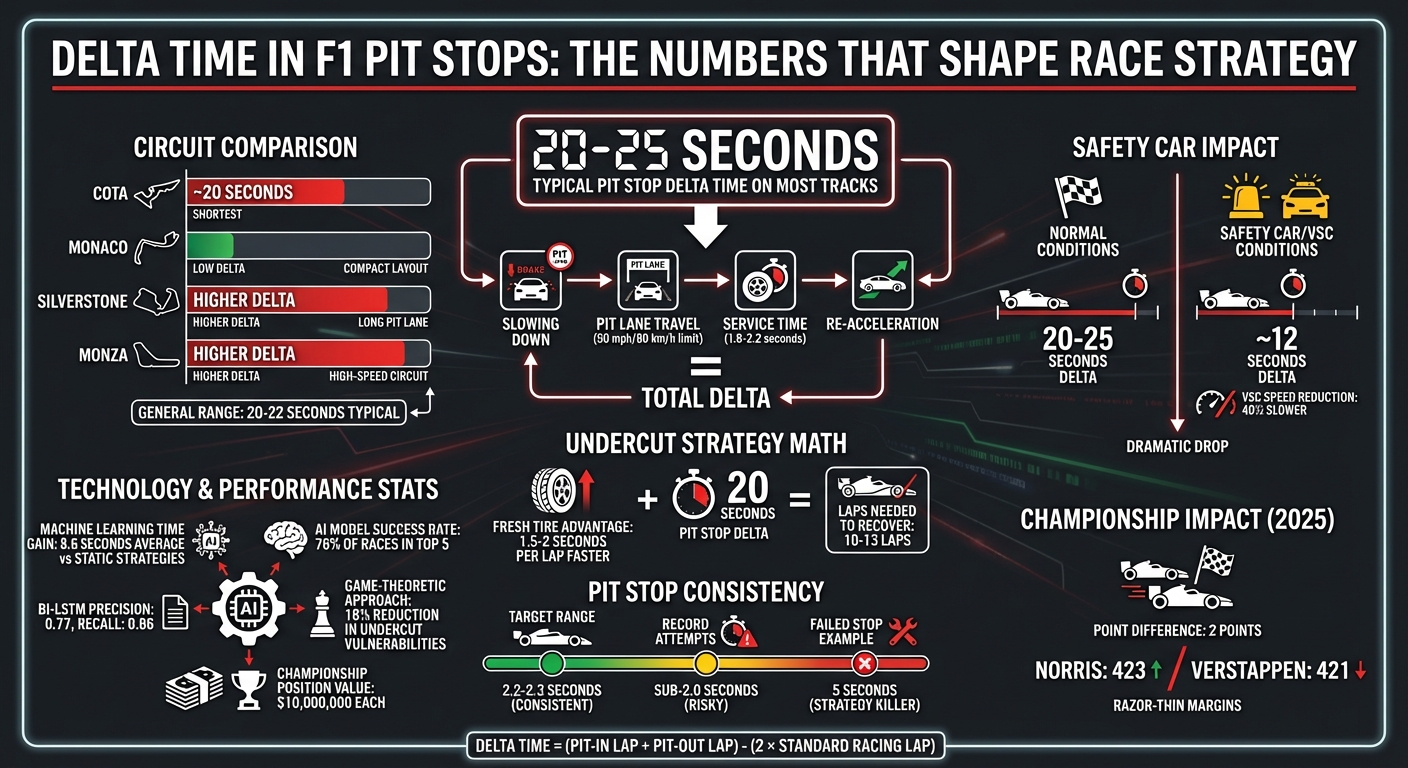
Teams rely on a straightforward formula to determine pit-loss time: (Pit-In Lap Time + Pit-Out Lap Time) - (2 × Standard Racing Lap Time). This formula measures the full impact of a pit stop by comparing the time it takes to complete two laps - one entering and one exiting the pits - against the time required for two uninterrupted racing laps at full speed.
Several elements factor into this calculation: slowing down to the pit lane speed limit (50 mph or 80 km/h), traveling through the pit lane at that restricted speed, the stationary service time (usually between 1.80 and 2.2 seconds), and accelerating back to race pace. On high-speed circuits like Monza, the time loss is more pronounced because of the significant speed reduction required.
While this formula establishes a baseline, the actual delta time varies greatly depending on the unique characteristics of each circuit.
How Delta Time Changes by Circuit
The design of a circuit plays a major role in how much time is lost during a pit stop. For example, the Circuit of The Americas (COTA) has one of the shortest pit-loss times of the season, averaging about 20 seconds under green flag conditions. Monaco, with its tight and compact layout, minimizes the distance penalty despite its lower speed limit. On the other hand, tracks with particularly long pit lanes can see delta times rise well above the usual 20–22 second range.
Pit lane length is one of the biggest factors influencing these variations. Some circuits feature pit lanes exceeding 1,640 feet (500 meters), while others are significantly shorter. The layout of pit lane entries and exits also impacts delta time. For instance, some designs allow drivers to bypass certain corners when entering or leaving the pits, reducing the overall time penalty. Conversely, tracks where the pit lane runs parallel to a long straight often incur higher deltas, as cars on the track maintain full racing speed while those in the pits are restricted to the regulated speed limit.
F1's Pit Stop Time Loss Explained
Delta Time in Undercut and Overcut Strategies
Building on the basics of pit stop delta time, let’s dive into how these time margins influence the undercut and overcut strategies in racing.
Using Delta Time for Undercuts
For an undercut to work, fresh tires need to provide enough speed to offset the time lost during a pit stop. Teams calculate how many laps it will take to recover the lost time by analyzing the lap-time advantage of fresh tires. For example, if new tires are 1.5 to 2 seconds per lap faster than worn ones, and the pit stop delta is about 20 seconds, a driver would need roughly 10 to 13 laps to make up the difference.
On tracks with high tire degradation, like Spain and Hungary, the gap between lap times on old versus new tires widens significantly. This makes the undercut a powerful attacking strategy. A great example is the 2012 Spanish Grand Prix, where Pastor Maldonado used an undercut to leapfrog Fernando Alonso. By pitting early and taking advantage of the fresh tire speed, Maldonado gained the lead and went on to win the race[16,17]. This highlights how precise delta time calculations can determine the best moment to pit.
However, there’s a catch. If fresh tires take too long to warm up, the undercut can backfire. In such cases, an early pit stop may allow rivals to maintain their advantage while their tires are at peak performance.
How Overcuts Work with Delta Time
The overcut takes a different approach, focusing on staying out longer to maximize performance. Instead of relying on fresh tire speed, this strategy exploits the delay caused by a competitor’s pit stop and the time it takes their new tires to warm up[21,22]. If a driver on older tires can maintain competitive lap times while their opponent struggles during their out-lap, they can gain track position without stopping first. Like the undercut, the overcut hinges on accurate delta time calculations to succeed.
Circuits with low tire degradation often favor the overcut. Stable tire performance allows drivers to stay out longer and capitalize on their competitor’s slower out-laps. Tracks like Monaco, where overtaking is notoriously difficult, make this strategy particularly effective because holding track position is crucial.
That said, the overcut isn’t without risks. A sudden drop in tire performance can erase any potential gains, as the time lost on worn tires can outweigh the benefits of delaying the stop. Teams must keep a close eye on tire conditions and time their pit stops carefully to avoid losing ground.
Safety Cars and Delta Time
Lower Delta Time Under Safety Cars
Pit stops normally cost Formula 1 teams about 20–25 seconds. But when a Safety Car or Virtual Safety Car (VSC) comes into play, this time loss drops significantly. The usual pit stop time includes slowing down to enter the pit lane, traveling through it (at 50 mph or 37 mph in Monaco), the service itself, and accelerating back onto the track - all of which combine to create the baseline "delta" time.
Under Safety Car or VSC conditions, the field is required to slow down - by as much as 40% under VSC rules. This means cars on track lose their speed advantage, and the pit stop "penalty" can shrink from 20 seconds to around 12 seconds. Teams often refer to this as a "cheap" or even "free" stop.
"Under a Safety Car, the market shifts. The pack is circulating slowly, which means the effective delta for stopping can drop dramatically." - RaceMate Blog
The type of neutralization - full Safety Car or VSC - also impacts strategy. A full Safety Car bunches up the entire field, giving every driver the same reduced delta. On the other hand, a VSC is more timing-sensitive. If a driver is near the pit entry when the VSC is deployed, they can dive in and gain a big advantage. But if they've just passed the pit lane, they’ll have to complete almost an entire lap at reduced speed, losing much of the potential benefit.
This dynamic makes Safety Car periods a critical moment for teams to rethink their strategies and exploit the reduced delta time to their advantage.
Adapting Strategy for Safety Car Periods
With delta times slashed during Safety Car periods, teams shift their focus to precise pit timing and tire management. To prepare for these moments, teams calculate "Safety Car windows" ahead of time, allowing drivers to pit immediately without waiting for radio confirmation.
However, the decision to pit isn’t just about saving time - it’s also a balance between gaining fresh tires and maintaining track position. On circuits with high tire degradation and multiple overtaking zones, teams often take the cheaper stop, as the advantage of new tires usually translates into overtakes. But on tight, narrow tracks like Monaco, where passing is extremely difficult, teams may prioritize track position and stay out on older tires. A perfect example of how critical these decisions can be is the 2025 Drivers' Championship, where a mere 2 points separated Lando Norris (423) and Max Verstappen (421) - a single Safety Car strategy call made all the difference.
Operational risks also come into play. If both team cars pit at the same time, the second car might face delays waiting for the pit box to clear. Tire selection for the restart is another key factor. Teams must weigh how quickly a compound warms up. If they choose a tire that takes too long to reach its optimal temperature, any time saved during the Safety Car pit stop could be lost when faster-warming tires allow competitors to attack on the restart.
Safety Car periods are not just interruptions - they’re opportunities for strategic brilliance, where every decision can have far-reaching consequences.
Tools for Optimizing Delta Time
Real-Time Delta Simulations
Formula 1 teams use cutting-edge telemetry systems to monitor delta time during the race. Sensors placed across the car collect data on speed, throttle position, brake pressure, and g-forces in real time. This information flows directly to the pit wall, where strategists analyze it to spot performance issues - like losing time in specific corners - that could indicate tire wear or other concerns. This helps teams decide when a pit stop might be necessary.
Advanced machine learning models, such as Bi-LSTM (Bidirectional Long Short-Term Memory), are also part of the equation. For instance, a 2025 study by researchers from the Mercedes-AMG PETRONAS Formula 1 team and Imperial College London showcased an explainable reinforcement learning system using Proximal Policy Optimization (PPO). This approach delivered an average time gain of 8.6 seconds compared to static strategies and ranked in the top five for roughly 76% of the races analyzed. The Bi-LSTM model achieved a precision of 0.77 and a recall of 0.86 in predicting the best pit-stop windows under real-race conditions.
In addition, teams rely on Monte Carlo simulations and virtual strategy models to explore thousands of potential race scenarios. These simulations factor in variables like tire wear, fuel levels, and traffic conditions after a pit stop. Tools like "RaceMate /simulate" allow strategists to test different approaches, such as one-stop versus two-stop strategies, based on real-time track conditions. The insights from these simulations feed into predictive models, helping teams pinpoint the ideal moment for a pit stop.
Predicting Optimal Pit Windows
Combining telemetry and simulation data, teams determine the best pit windows by weighing delta time against race position. One key factor is "pit loss time", which measures the time lost in the pit lane compared to staying on track. During practice sessions, teams calculate this metric to identify windows where a driver can rejoin the race ahead of competitors. Even shaving off fractions of a second from pit-loss time can make a big difference, allowing for earlier pit stops or more flexibility with undercut and overcut strategies.
Predictive tools also adjust instantly to changes in race conditions. For example, when a Safety Car or Virtual Safety Car is deployed, these systems recalculate the shortened pit delta - dropping from 20–25 seconds to around 12 seconds - and evaluate whether pitting at that moment offers an edge. Many teams pre-program Safety Car scenarios into their software, enabling drivers to pit immediately without waiting for radio instructions.
Delta Time Case Studies
2021 US Grand Prix Strategy Decisions
The 2021 United States Grand Prix at Circuit of the Americas highlighted how precise delta calculations can shape pit strategies. Teams had to choose between one-stop and two-stop strategies, with the pit lane delta - the total time a pit stop costs - playing a pivotal role in determining the best course of action. This case study showcases how these calculated deltas directly influence decision-making in high-pressure scenarios.
At COTA, timing was everything. Teams pinpointed ideal pit windows that allowed drivers to rejoin the track in "clean air", enabling faster lap times. By analyzing pit-loss times during practice sessions, teams uncovered narrow opportunities where a pit stop wouldn’t result in losing track position. In many cases, even a fraction of a second in delta optimization made the difference between a successful undercut and falling behind key competitors.
Conclusion: Delta Time's Impact on F1 Strategy
Delta time has become the backbone of modern F1 pit strategy, influencing every critical decision during a race. Whether it’s an undercut, an overcut, or a move during a Safety Car period, precise delta calculations are what give teams the edge. Even shaving off a few tenths in pit lane delta can unlock new strategic possibilities. As Matt Youson explains, trimming pit-loss time by just tenths of a second can open up crucial pit windows.
With championship positions valued at roughly $10,000,000 each, teams are investing heavily in cutting-edge tools to refine their strategies. AI-driven models and real-time telemetry have revolutionized pit window predictions, while game-theoretic approaches have slashed undercut vulnerabilities by nearly 18%.
But it’s not just about speed - it’s about consistency. Charlie Hooper, McLaren's Operations Director, highlights this balance:
"It's no-good breaking a world record if the next pit stop is five seconds! We make it clear to the crew that meeting our consistency targets... will ultimately lead to the best on track performance."
This is why teams prioritize dependable 2.2–2.3 second pit stops over chasing sub-2.0 second records. One poorly executed stop, stretching to five seconds, could derail an entire race strategy. This principle becomes even more critical during Safety Car periods.
Safety Car scenarios drastically compress delta time, reshaping strategies in an instant. With the field circulating at reduced speeds, the effective delta plummets, making pit stops far less costly in terms of track position. Teams must quickly assess the circuit type - whether it’s a track like Monaco, where holding position is paramount, or Silverstone, where new tires can lead to overtaking opportunities. The best teams rely on a combination of circuit-specific data, tire performance projections, and restart dynamics to make razor-sharp, split-second decisions that often define championship outcomes.
From real-time telemetry to simulation-driven tactics, delta time stands as the cornerstone of modern F1 strategy, dictating how races are won or lost.
FAQs
What makes pit delta time change from track to track?
Pit delta time varies from track to track because of differences in track layout, pit lane length, and specific conditions unique to each circuit. These elements affect how long it takes for a car to enter, complete its stop, and exit the pit lane, adding a layer of complexity to pit stop strategies for every race.
How do teams know if an undercut will actually work?
Teams figure out if an undercut strategy will pay off by diving into real-time delta time data. With advanced telemetry systems and predictive models, they calculate whether a pit stop can help close the gap to rivals and secure a time edge. These tools are essential for forecasting race outcomes and fine-tuning strategy on the fly.
When is a Safety Car pit stop worth it?
When deciding whether to make a pit stop during a Safety Car period, the key is simple: Does the time saved on track exceed the time spent in the pits? Several factors come into play here, like gaining positions through an undercut, steering clear of traffic, and ensuring the timing works with your tire strategy and overall race plan. Ultimately, the choice hinges on the race's unique circumstances and whether it offers a chance to improve your position on the track.