How F1 Teams Manage Tire Temperatures
How teams use tire blankets, brake heat, driver techniques and real-time telemetry to keep F1 tires in the 90–110°C range for optimal grip and longevity.

In Formula 1, tire temperature management is critical for performance and strategy. Tires perform optimally within a range of 80°C–110°C (176°F–230°F), where they provide maximum grip. Falling below this range reduces grip by up to 20%, while exceeding it risks overheating and blistering. Teams use tools like tire blankets, brake heat transfer, and real-time data to maintain this balance.
Key insights include:
- Pre-Race Prep: Tire blankets heat slick tires to 70°C (158°F), while rim heating from brakes provides additional warmth. Compound selection (Hard, Medium, Soft) depends on track conditions.
- Driver Techniques: Weaving and hard braking warm tires, while "lift and coast" cools them.
- Engineering Adjustments: Brake ducts and airflow configurations control heat transfer to rims and tires.
- Real-Time Monitoring: Sensors track temperatures and pressures, guiding pit stops and strategy.
F1 teams rely on a mix of driver skill, mechanical adjustments, and data-driven decisions to keep tires in their optimal range, ensuring peak performance and longevity throughout the race.
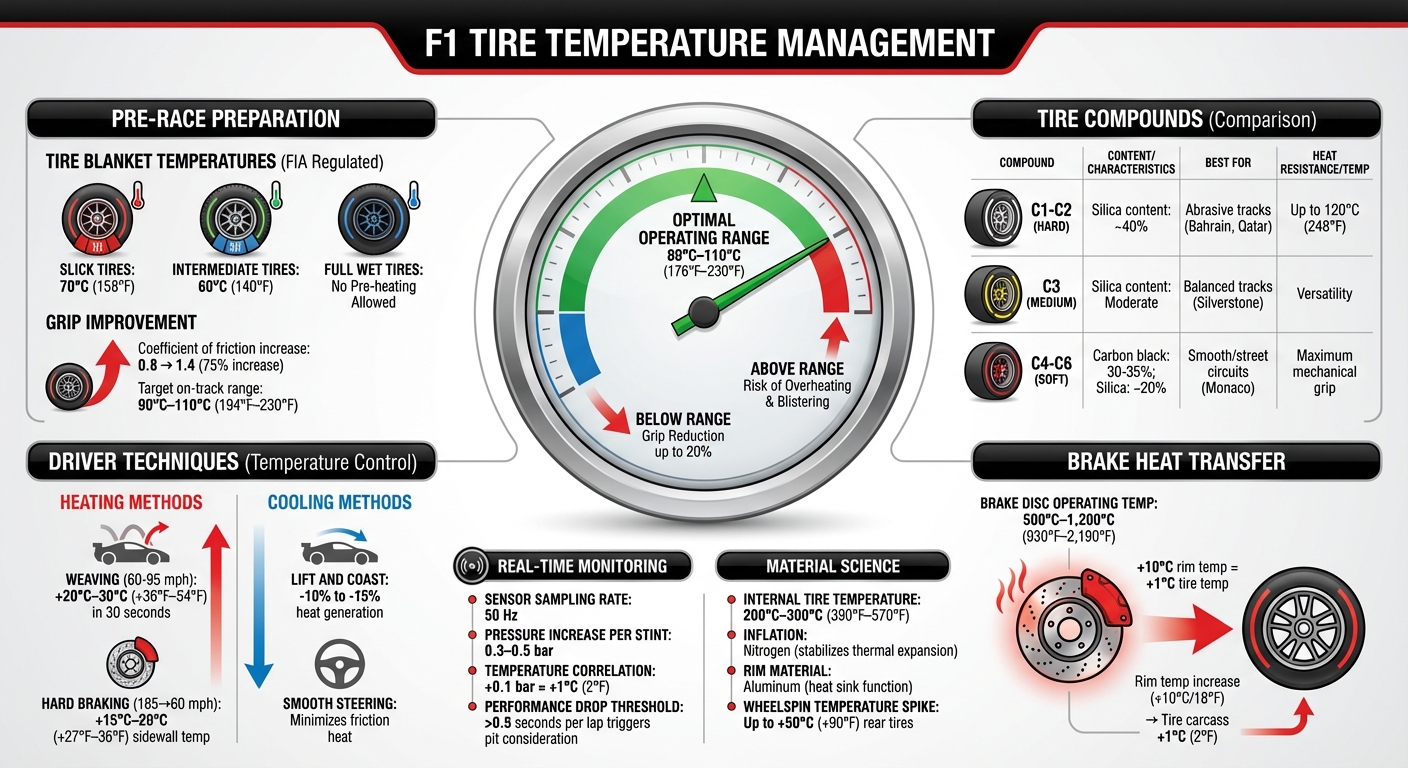
F1 Tire Temperature Management: Optimal Ranges and Key Metrics
McLaren’s GENIUS Tyre Trick Explained

Pre-Race Preparation: Getting Tires Ready for the Track
Before the first lap even begins, F1 teams dedicate countless hours to preparing their tires for peak performance. Skipping this step can be costly - cold tires lose up to 20% of their grip right out of the gate.
Tire Blankets and Pre-Heating Methods
Tire blankets are a critical part of this preparation. These high-tech wraps, equipped with heating coils and conductive gel, are designed to warm the tires evenly. They’re connected to a thermostatic control box, which carefully regulates the temperature [12, 13]. The objective? Heat the tires to a range where the rubber becomes pliable enough to deliver maximum grip [12–14].
According to FIA rules, tire blanket temperatures are capped at 70°C (158°F) for slick tires and 60°C (140°F) for intermediates [9, 12, 13]. For full wet tires, pre-heating isn’t allowed at all [12, 13]. Once on the track, tires need to reach their optimal working range of 90°C to 110°C (194°F to 230°F). At these temperatures, the tire’s grip improves dramatically, with the coefficient of friction jumping from around 0.8 to 1.4 - a 75% increase.
Another method teams use is rim heating. Here, heat generated by the brakes warms the rims, which then transfer heat to the tires. While a 10°C rise in rim temperature only increases the tire temperature by about 1°C, in the competitive world of F1, even a single degree can make a difference.
Of course, pre-heating is only part of the equation. Choosing the right tire compound for the track conditions is equally important.
Choosing the Right Compound for Track Conditions
Once the tires are pre-heated, selecting the best compound becomes the next critical step. Pirelli supplies six dry compounds - C1 (the hardest) to C6 (the softest) - but only three are chosen for each race weekend, designated as Hard, Medium, and Soft [4, 8]. The choice depends on factors like track abrasiveness, ambient temperature, and the circuit’s layout.
Harder compounds, such as C1 and C2, are ideal for abrasive tracks like Bahrain or Qatar, where high friction generates extreme heat. These tires contain up to 40% silica, which helps them resist blistering even when temperatures soar to 120°C (248°F). Softer compounds, like C4 to C6, are better suited for smoother circuits like Monaco, where mechanical grip is key. These tires use 30–35% carbon black to enhance traction on cooler surfaces.
Track temperature also plays a huge role. Darker asphalt, rich in bitumen, absorbs sunlight quickly, heating up faster and potentially pushing softer compounds beyond their effective range [3, 4]. To tackle this, teams run advanced simulations that account for different ambient and track temperatures. These simulations help predict which compound will perform best within the ideal temperature window of 90°C to 110°C. During Friday practice sessions, teams conduct long stints to gather tire degradation data, which helps refine their strategy based on actual conditions [1, 11].
| Compound | Typical Track Type | Silica Content | Key Characteristic |
|---|---|---|---|
| C1–C2 (Hard) | Abrasive (e.g., Bahrain, Qatar) | ~40% | High heat resistance |
| C3 (Medium) | Balanced (e.g., Silverstone) | Moderate | Versatility and durability |
| C4–C6 (Soft) | Smooth/Street (e.g., Monaco) | ~20% | Maximum mechanical grip |
Managing Tire Temperatures During the Race
At the start of a race, teams aim to keep tire temperatures between 194°F and 230°F (90°C–110°C). Why? Because falling below this range reduces grip, while exceeding it can lead to blistering and damage.
How Drivers Manage Tire Temperatures
Drivers have several techniques to control tire temperatures, both to heat them up and cool them down. For instance, weaving at speeds of 60–95 mph can raise tread temperatures by 36°F–54°F (20°C–30°C) in just 30 seconds. Similarly, hard braking - from 185 mph to 60 mph - can increase sidewall temperatures by 27°F–36°F (15°C–20°C).
On the flip side, when tires get too hot, drivers often use a "lift and coast" method, which reduces heat generation by 10%–15%. Smooth steering also helps by minimizing sliding, which can otherwise increase friction and add unwanted heat.
Eric Blandin, Deputy Technical Director at Aston Martin, highlights the importance of brake balance in managing tires:
"Brake balance is something that drivers can change dynamically depending on how the car feels during a race... It's something they can play with to help manage tyre performance."
Brake bias adjustments are another critical tool. Shifting the brake balance forward generates more heat in the front brakes, which then transfers to the wheel rims. For every 18°F (10°C) rise in rim temperature, the tire carcass temperature increases by about 2°F (1°C). Additionally, drivers tweak differential settings and engine braking to manage energy transfer to the rear tires, avoiding wheelspin that can spike rear tire temperatures by as much as 90°F (50°C).
These driving techniques work hand-in-hand with mechanical adjustments, including airflow management, to maintain optimal tire performance.
Brake Ducts and Airflow: A Key to Heat Management
Brake ducts are vital for more than just cooling the braking system - they play a major role in tire temperature control. Carbon brake discs, which can operate at temperatures between 930°F and 2,190°F (500°C–1,200°C), act as a controllable heat source.
Teams use carbon fiber drums and internal fairings to regulate how much heat flows from the brakes to the wheel rims. This is especially important for the front tires, which are undriven and require additional help to maintain the right temperature. As James Key, McLaren's Technical Director, explains:
"On the fronts you typically try and transfer heat from the brakes into the wheel rim... it's the only way you've got to try and maintain front temperature."
In contrast, rear assemblies are designed with insulation to keep brake heat away from the rims, protecting the driven tires from overheating.
Track-specific demands also influence how teams configure airflow. For example, circuits with heavy braking require more cooling to preserve brake performance, while cooler tracks may call for redirecting airflow to heat the rims. Ferrari's 2022 design, which exposed the brake disc within the carbon drum, allowed for more heat transfer to the rims - great for qualifying but risky for race-day overheating. Meanwhile, teams like Red Bull and Mercedes use internal fairings to precisely control airflow, extending tire life during long stints.
Real-Time Data: The Engineers’ Secret Weapon
Beyond driver techniques and mechanical tweaks, modern F1 teams rely heavily on real-time data to guide their strategies. Wireless pressure sensors and thermal monitoring systems, sampling data at 50 Hz, provide engineers with a constant stream of information about tire conditions.
As tires heat up, the air inside expands, raising pressure by 0.3–0.5 bar per stint. Each 0.1 bar increase corresponds to about a 2°F (1°C) rise in temperature. This data helps engineers distinguish between surface temperature - affected by sliding and friction - and the bulk temperature, which reflects the core heat of the rubber. Understanding this distinction is crucial for evaluating tire performance.
Andrew Shovlin, Chief Race Engineer at Mercedes, underscores the importance of this monitoring:
"During the race, we're constantly monitoring the tyre temperatures and wear rates, and using that information to make decisions about when to pit and which tyres to fit."
With this data, teams can make calculated decisions, such as timing pit stops for undercuts or overcuts. If tire heat causes a performance drop of more than 0.5 seconds per lap, an early pit stop might be necessary. On tracks like Baku, where tire surface temperatures can drop by around 54°F (30°C) along the 1.4-mile main straight, teams must also account for rapid temperature changes that can affect grip in the following braking zones.
Advanced Technology for Temperature Control
In Formula 1, keeping tires within the ideal temperature range of 194°F–230°F (90°C–110°C) is a delicate balance that goes beyond driver skill and mechanical tweaks. Teams depend on cutting-edge materials and real-time data systems to achieve this. From the chemical design of the tires to predictive models that shape race strategies, these technologies form a vital part of tire management, working seamlessly alongside split-second adjustments and strategic driving.
Heat-Absorbing Materials and Protective Coatings
Materials science plays a huge role in managing tire temperatures. Pirelli, for instance, fine-tunes tire compounds with precise ratios of silica and carbon black. Harder compounds (C1-C2) feature higher silica content, making them more resistant to heat on abrasive tracks. On the other hand, softer compounds (C4-C6) use more carbon black, helping them heat up quickly and deliver better grip. Inside the tires, aramid-reinforced belts ensure they hold their shape even at internal temperatures between 390°F and 570°F (200°C–300°C).
To further control heat, nitrogen is used to inflate tires instead of regular compressed air. This helps stabilize thermal expansion and minimizes the risk of overheating. Aluminum wheel rims act as heat sinks, absorbing energy as tires wear down during a stint. Additionally, carbon fiber drums and shrouds surrounding brake components manage heat transfer. These systems handle temperatures as high as 930°F to 1,830°F (500°C–1,000°C), ensuring that heat from the brake discs doesn’t overheat the rims or tires.
Data Analysis and Predictive Modeling
Data analysis and predictive modeling are just as critical as material innovations. Before every race, teams run thermodynamic simulations to map out tire wear under different track and ambient conditions. These models help engineers design the best cooling setups for each race. During the race, thermal sensors in the wheel rims collect data at a frequency of 50 Hz, feeding real-time information into predictive systems. This allows teams to forecast tire degradation and estimate how much performance remains.
Advanced models also help engineers calculate internal tire temperatures, which are key to making performance decisions. As Mario Isola, Pirelli's Head of Car Racing and F1, explains:
"What we would like is the temperature of the bulk of the compound, as it is the heart of the rubber. However, we don't have tools capable of doing this. You can point an infrared sensor at the carcass, but the surface temperature can change a lot."
Conclusion: The Science Behind Tire Temperature Control
Controlling tire temperatures in Formula 1 is a fine-tuned process that starts well before the race begins and continues with every lap on track. Teams use advanced thermodynamic simulations to predict how factors like weather and track conditions will influence tire performance. Before each session, they preheat slick tires using electric blankets, raising them to an optimal range of 70°C–80°C (158°F–176°F). This preheating ensures the tires are ready to deliver maximum grip from the moment the race starts.
But preparation doesn’t stop there. On race day, drivers and engineers employ a variety of techniques to maintain tire performance. Drivers use controlled weaving and lift-and-coast maneuvers to manage heat levels, while engineers fine-tune brake bias to distribute thermal energy between the front and rear axles. Brake duct designs also play a role, either capturing heat from the brake discs - where a 10°C (18°F) rise in rim temperature can increase tire temperature by about 1°C (roughly 2°F) - or releasing excess heat to avoid overheating and tire wear.
During the race, real-time infrared data feeds into predictive models that help teams make critical decisions, such as when to pit and which tires to choose. Andrew Shovlin, Chief Race Engineer at Mercedes AMG F1, describes the process:
"During the race, we're constantly monitoring the tyre temperatures and wear rates, and using that information to make decisions about when to pit and which tyres to fit. It's a complex puzzle."
This intricate system relies on the seamless integration of materials science, aerodynamics, and data analytics. Each element works together to keep tires within their ideal performance range. As Mike Krack, Team Principal at Aston Martin F1, explains:
"Managing tire temperatures is a crucial part of any Formula 1 race weekend. It's a delicate balancing act that requires close collaboration between the drivers, engineers, and tyre technicians."
FAQs
How do F1 teams choose which tire compound to use during a race?
F1 teams put a lot of thought into choosing the right tire compounds for each race. Pirelli, the official tire supplier, offers three dry-weather compounds for every Grand Prix. These are selected after studying the circuit’s surface, grip levels, layout, and the expected air and track temperatures. From there, teams dive into the details - using past race data, simulations, and driver feedback to match the tire choice with their race strategy.
Safety is another major factor. Teams must follow FIA safety guidelines while also considering the unique challenges of each track, like high-speed corners or heavy braking zones. The ultimate aim? Finding the perfect balance between performance, durability, and the ability to adapt to whatever race day throws their way.
How do F1 drivers manage tire temperatures during a race?
F1 drivers rely on a mix of techniques to manage tire temperatures during a race. They might tweak brake pressure and bias to control heat transfer, ease off the throttle, or give it a quick tap for better balance. Adjusting cornering speed or fine-tuning steering inputs also helps minimize tire strain.
To warm up the tires, drivers often weave or 'scrub' them, while coasting by lifting off the accelerator is a common method to cool them down.
These methods are essential for keeping tires in their ideal temperature range, as both overheating and underheating can drastically affect grip and tire longevity on the track.
How do F1 teams use real-time data to manage tire temperatures during a race?
Real-time telemetry plays a key role in managing tire temperatures in Formula 1. Each car constantly transmits data on tire temperature, pressure, and wear to the team’s engineers. This helps them track how close the tires are to their ideal temperature range - typically between 194°F and 230°F - where they perform at their peak. Even minor temperature shifts can affect lap times, so teams rely on this data to make critical decisions, such as tweaking driving styles, adjusting camber settings, or timing pit stops.
Engineers don’t just rely on live data; they also compare it with historical trends to anticipate tire wear and adapt strategies during the race. This might involve using tire-saving techniques or fine-tuning tire blanket temperatures before a pit stop to ensure the new tires warm up quickly. By converting raw telemetry into real-time decisions, teams can respond to changing conditions and get the most out of their cars on the track.