How F1 Teams Set Fuel Usage Thresholds
Teams model and adjust fuel use with telemetry, ERS, and driving techniques to balance speed, weight, and race finish.
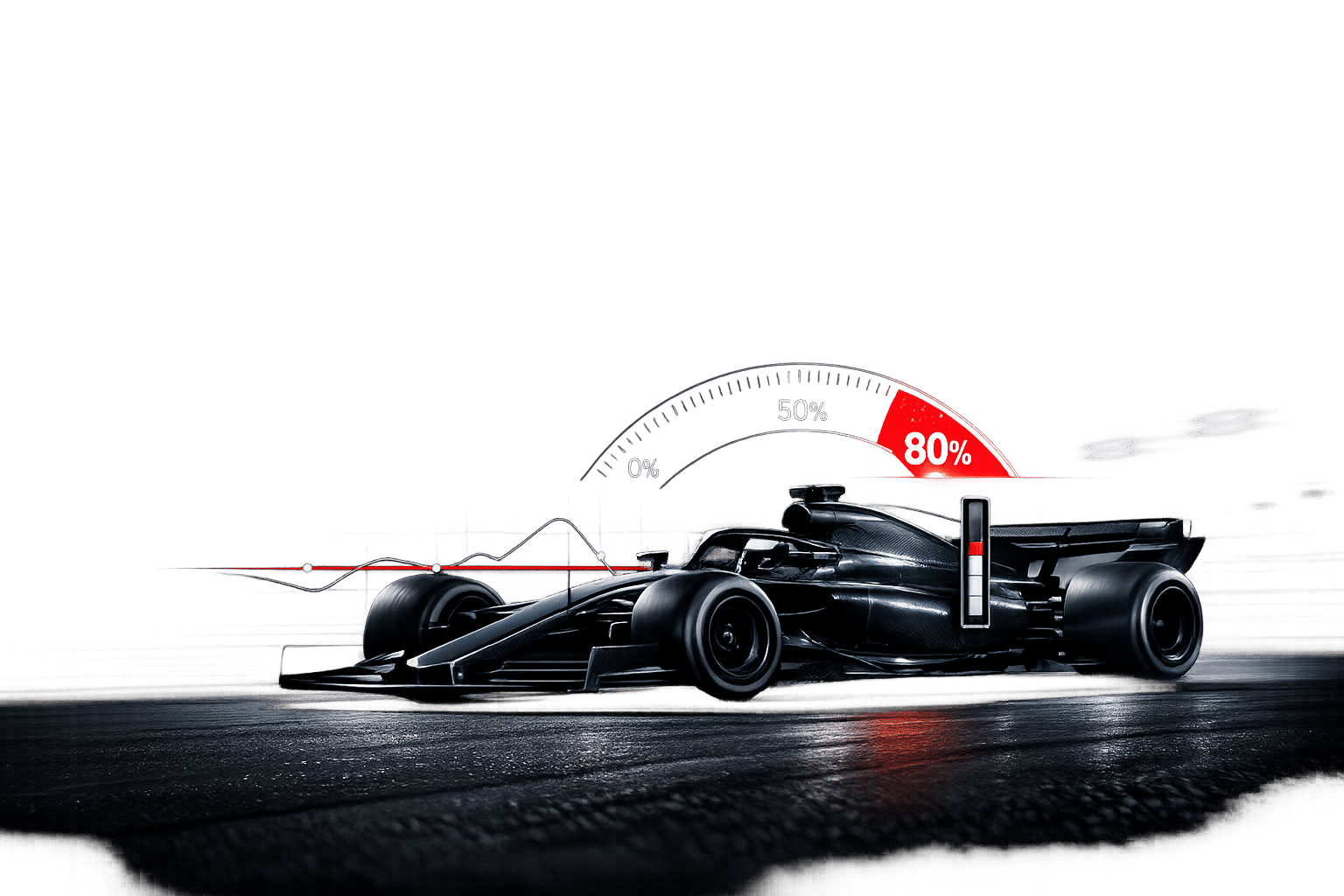
Managing fuel in Formula One is a balancing act between speed and efficiency. Teams calculate precise fuel thresholds pre-race and adjust strategies in real-time to ensure cars finish the race while staying competitive. Here's how they do it:
- Fuel Weight vs. Speed: Starting with less fuel makes the car lighter and faster but requires careful fuel-saving during the race. Every 10 kg of fuel adds about 0.3–0.35 seconds per lap.
- Hybrid Power Units: Modern F1 cars use a mix of fuel and electrical energy from systems like the MGU-K and MGU-H, allowing teams to save fuel strategically.
- Track-Specific Strategy: Factors like altitude, safety car likelihood, and circuit layout influence how much fuel teams start with.
- Real-Time Adjustments: Engineers use telemetry to monitor fuel usage and make live strategy changes, such as lift-and-coast or short-shifting, to conserve fuel without losing performance.
- Upcoming Changes (2026): F1 will switch from fuel mass limits to energy-based limits (3,000 MJ/h), reflecting the move to advanced sustainable fuels and a 50/50 power split between combustion and electrical energy.
Fuel strategy is critical to race performance, requiring constant monitoring and precise execution to balance speed, weight, and efficiency.
Pre-Race Planning: Modeling Fuel Consumption
Before race day, F1 teams dive into thousands of simulations to estimate baseline fuel usage. These simulations rely on intricate scenario trees that factor in variables like Safety Car periods and tire wear. Using advanced tools like Canopy and Michelin, strategy teams calculate the ideal fuel-saving percentage for each lap, balancing the benefits of a lighter car against the time lost from conserving fuel later in the race. These findings directly influence the thresholds set for real-time telemetry during the race.
Track-specific factors, such as altitude, also play a major role in fuel consumption. For example, Mexico City's high altitude means thinner air, which reduces drag and leads to lower fuel usage compared to circuits at sea level.
Using Track Data and Race Simulations
Teams analyze circuit layouts to forecast fuel burn. Everything from elevation changes to corner types and braking zones affects how much fuel a car will consume over the race distance. At Singapore, for instance, each kilogram of fuel adds about 2.5 seconds due to frequent acceleration and braking. In contrast, Spa’s long straights result in only 1.5 seconds per kilogram. These differences influence how aggressively teams may choose to underfuel their cars.
Historical data is another key resource for fuel strategy. Singapore, with its consistent 100% Safety Car record, often sees teams starting with 2 kg less fuel than the calculated requirement, banking on "free" laps under neutralization. In October 2024, Rowland Jowett of Canopy Simulation illustrated how starting aggressively to shed weight early, followed by a 4% fuel-saving strategy in the final laps, could save 1.57 seconds over the race distance at Singapore.
"Adding power makes you faster on the straights. Subtracting weight makes you faster everywhere."
– Colin Chapman, Founder, Lotus Cars
Pre-race simulations also pinpoint specific "lift points" in corners and short-shift strategies, which are shared with drivers ahead of the race. This detailed preparation lays the groundwork for in-race fuel adjustments.
Incorporating Tire and ERS Strategies
Fuel models don’t operate in isolation - they integrate tire wear and ERS (Energy Recovery System) strategies. High tire degradation often leads to smoother throttle application, which naturally reduces fuel consumption. Teams must predict how different compounds will wear and adjust fuel calculations accordingly.
ERS deployment also plays a significant role in fuel usage. While the MGU-K (Motor Generator Unit-Kinetic) is capped at 2 MJ per lap, the MGU-H (Motor Generator Unit-Heat) operates without limits. Teams plan periods of increased electrical deployment during specific phases of the race, reducing reliance on the internal combustion engine and conserving fuel.
Adjusting for External Variables
External factors like weather, wind, and temperature can disrupt even the most sophisticated fuel models. Headwinds increase drag and fuel usage, while tailwinds help conserve fuel. Higher temperatures reduce air density, which can lower fuel consumption but may require adjustments to engine cooling systems, impacting overall efficiency.
Slipstream opportunities are another consideration. Following another car in its "tow" reduces the power needed to maintain speed, which not only saves fuel but also boosts ERS harvesting. Strategy teams also build in fuel buffers for formation laps, cool-down laps, and unpredictable situations like intense wheel-to-wheel battles or stronger-than-expected headwinds.
Here’s a quick look at how various factors influence pre-race fuel modeling:
| Variable | Impact on Pre-Race Fuel Modeling |
|---|---|
| Track Elevation | Higher altitudes (e.g., Mexico City) reduce air density and drag, lowering fuel usage. |
| Safety Car Probability | High likelihood (e.g., Singapore) encourages teams to start with less fuel, anticipating "free" saving laps. |
| Wind/Weather | Headwinds increase drag and fuel burn; wet conditions slow lap times and reduce fuel consumption. |
| Tire Degradation | Greater wear requires smoother throttle use, which indirectly lowers fuel usage. |
| ERS Strategy | Increased electrical deployment reduces reliance on the internal combustion engine, saving fuel. |
Compliance with FIA Fuel Regulations
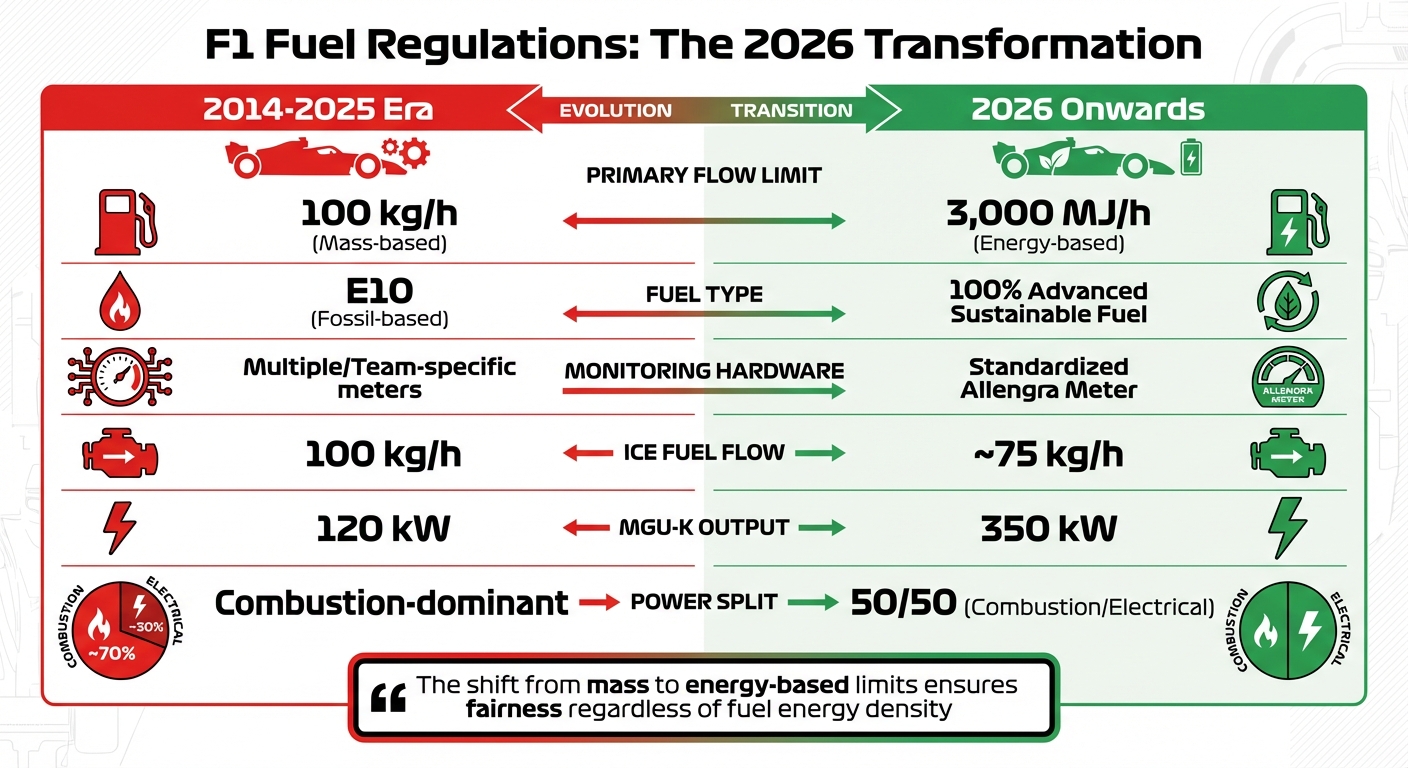
F1 Fuel Regulations Comparison: 2014-2025 vs 2026 Onwards
Formula One's fuel rules set strict boundaries for all teams. Between 2014 and 2025, the FIA enforced a mass-based fuel flow limit of 100 kg/h, effectively placing a ceiling on engine output, no matter how much fuel was in the tank. This pushed teams to focus on extracting as much energy as possible per kilogram of fuel. To ensure compliance, the FIA requires the use of an ultrasonic fuel-flow meter - supplied by Allengra - which provides identical data to both the FIA and the teams.
The FIA takes the accuracy of these measurements very seriously. Teams are forbidden from using any device or method that could alter the fuel-flow meter's temperature. Nikolas Tombazis, the FIA's Single-Seater Director, made this clear:
"Innovation is welcome, ingenuity is expected – but exploitation of measurement systems will not be tolerated"
This strict approach ensures that all competitors operate under the same rigorous standards.
These regulations not only ensure fairness but also have a direct impact on race strategies.
Understanding Fuel Flow Limits
The 100 kg/h fuel flow cap, which applies above 10,500 RPM, is constantly monitored by the onboard Allengra sensor. This sensor sends real-time data to both the team's pit wall and FIA race control. Below this RPM threshold, fuel flow naturally decreases, creating a strategic balancing act for teams. They must weigh the benefits of high engine performance against the increased fuel consumption that comes with operating at higher RPMs. Even if a car has plenty of fuel left, the engine cannot exceed the flow limit, making the Energy Recovery System (ERS) a key tool for supplementing power when fuel flow is restricted.
As the sport evolves, the upcoming energy-based regulations are set to redefine how teams manage fuel and power.
Energy-Based Limits in the Hybrid Era
In 2026, Formula One will transition from a mass-based fuel limit to an energy-based system. Instead of measuring fuel by weight, the FIA will enforce an energy flow cap of 3,000 MJ/h. This change aligns with the sport's adoption of 100% Advanced Sustainable Fuels, which can differ in energy density depending on their feedstock. By focusing on energy rather than mass, the new system ensures that no team gains an edge simply by using fuel with a higher energy content per kilogram. Fuel suppliers like Aramco and PETRONAS will compete on equal footing.
Under the new rules, compliance will be calculated by the car's electronic control unit (ECU), using fuel samples pre-certified by an independent body. To ensure fairness, the FIA will use a "fingerprint" method to confirm that fuel used during a race matches the certified samples. Alongside this shift, the maximum internal combustion engine (ICE) fuel flow will drop from 100 kg/h to roughly 75 kg/h, reflecting the new focus on a 50/50 power split between combustion and electrical energy. Additionally, the MGU-K's output will increase significantly, from 120 kW to 350 kW, fundamentally altering how teams manage energy and fuel during races.
These changes will introduce new strategic challenges, requiring teams to rethink their fuel and energy deployment during each race.
| Regulation Period | Primary Flow Limit | Fuel Type | Monitoring Hardware |
|---|---|---|---|
| 2014–2025 | 100 kg/h (Mass) | E10 (Fossil-based) | Multiple/Team-specific meters |
| 2026 onwards | 3,000 MJ/h (Energy) | 100% Advanced Sustainable Fuel | Standardized Allengra Meter |
Real-Time Fuel Management During Races
Telemetry and Live Data Analysis
Pre-race plans lay the groundwork, but it’s the real-time data during a race that ensures teams stay within strict FIA fuel limits. Using telemetry, engineers constantly refine these plans as the race unfolds. They monitor live data streams that include fuel flow rates, battery charge levels, and lap-by-lap consumption. This data helps track the "fuel delta" - the difference between actual fuel use and the pre-race model. If a driver has a fuel surplus ("to the good"), they can push harder. If they're short, they’ll need to conserve.
The interplay between fuel and battery energy is like a seesaw. When drivers harvest more energy through the MGU-K during braking, they can rely on electrical power for corner exits, which reduces fuel consumption. Telemetry helps engineers maintain this balance while staying within FIA limits. They use this data to identify moments to save fuel without losing track position. Radio communications are essential here. For instance, a command like "Target +2" means the driver has two laps' worth of extra fuel, while "Delta minus one" signals a one-lap fuel deficit requiring immediate conservation. Instructions such as "Strat 7, SOC high" tell the driver to adjust to a leaner engine mode while maximizing battery recovery. These decisions are made lap by lap, adapting to the race’s dynamic nature, ensuring pre-race strategies align with real-time demands.
Adjusting Strategies for Race Scenarios
Safety Car and Virtual Safety Car periods are golden opportunities for saving fuel. The slower speeds during these periods allow teams to build a fuel surplus, which can then be used aggressively during restarts. Engineers use these moments to recalibrate their fuel strategies, often turning a deficit into an advantage.
When it comes to overtaking or undercut attempts, teams must decide when to prioritize fuel use and when to conserve. The focus during critical in-laps and out-laps is always on maximum power, with full ERS deployment to support pit strategies. However, when stuck behind slower cars or caught in traffic, drivers can switch to leaner engine settings and focus on recovering electrical energy. As sports writer Dominika Jordan puts it:
"The optimal save is one unnoticed by competitors."
Tracks like Monza, Spa, Baku, and Montreal, with their long sections of full-throttle racing, require especially careful fuel management. Small changes in conditions - like headwinds or cooler air - can throw off fuel calculations, forcing teams to rethink their strategies mid-race. On these high-consumption circuits, every 10 kg of fuel adds roughly 0.3 to 0.35 seconds per lap, making precise management critical.
Dynamic Adjustments and End-of-Race Strategies
As the race nears its conclusion, teams fine-tune their tactics, leveraging live telemetry data to make critical adjustments.
Lift-and-Coast Techniques
In Formula One, lift-and-coast is a well-known fuel-saving method. Here’s how it works: drivers ease off the throttle 50–150 meters before a braking zone. This allows the car’s aerodynamic drag to slow it down naturally, which also helps cool the brakes and tires. Engineers provide exact guidance, such as "Lift and coast 100 meters", to ensure precision. The trade-off? It typically costs just fractions of a second per lap but delivers noticeable fuel savings.
Another technique, short-shifting, pairs well with lift-and-coast. By shifting gears earlier than the engine's peak power range, drivers keep RPMs lower. This reduces fuel consumption and enhances traction, especially on worn tires. When combined with leaner engine maps - adjusting ignition timing and fuel injection - teams can stretch their fuel reserves without losing much performance.
These strategies are crucial for keeping enough fuel in reserve for the race’s critical final moments.
Reserving Fuel for Final Attacks
Teams often start races with less fuel than what’s needed to finish at full power - typically 5 to 8 kg lighter. Why? A lighter car is faster in the early stages. Throughout the race, drivers use techniques like lift-and-coast, slipstreaming, and taking advantage of Safety Car periods to save fuel. This ensures they have enough reserves for a final push.
Managing the "fuel delta" becomes a key focus during the race. Instructions like "Target +2" tell drivers they have two laps’ worth of extra fuel, giving them the green light to use richer engine modes for an aggressive attack. On the flip side, "Delta minus one" signals the need to conserve. Starting in 2026, new features like "Overtake Mode" and a manual "Boost" button will give drivers even more control over how they deploy their saved fuel during those all-important final laps. The real challenge? Striking the perfect balance between maintaining speed early on and conserving enough fuel for a strong finish.
Conclusion
Modern F1 race strategy revolves around fuel usage thresholds, shaped by a combination of pre-race simulations and real-time adjustments. These thresholds guide the split-second decisions that can make or break performance during a race.
Teams rely on advanced simulators and real-time telemetry to predict and adapt to changing variables. With hybrid power units, there’s a delicate balance between fuel consumption and the deployment of electrical energy from the ERS. Choices like lift-and-coast, short-shifting, or going on the attack are all grounded in meticulous data analysis.
The weight-to-performance trade-off plays a pivotal role, often leading teams to underfuel cars. This strategy, driven by the fact that every 10 kg less fuel can save 0.3 to 0.35 seconds per lap, forces teams to take calculated risks. They often bank on Safety Cars or fuel-saving measures to make up the difference, requiring constant monitoring and real-time adjustments.
As F1 looks toward 2026, the introduction of 100% sustainable fuels and energy-based limits set at 3,000 MJ/h will challenge teams to push their data-driven strategies even further. While the regulations may evolve, the core principles of precise modeling, on-the-fly adjustments, and turning fuel data into winning strategies will remain at the heart of the sport. In a world where every fraction of a second counts, mastering fuel thresholds is not just important - it’s a necessity.
FAQs
How do teams decide how much to underfuel a car?
Teams intentionally underfuel cars to make them lighter, which enhances acceleration and handling during the early stages of a race. This approach is a calculated gamble, aiming to boost performance while managing the risk of running out of fuel - especially since refueling during races is prohibited.
To make these decisions, teams weigh several factors, including the total fuel allowance, their overall race strategy, and unpredictable elements like safety car deployments or changing weather conditions. Drivers often use fuel-saving techniques, such as lifting and coasting (easing off the throttle before braking), to stretch their fuel supply while staying within FIA regulations.
What is “fuel delta,” and how is it used on the radio?
"Fuel delta" refers to the gap between the planned fuel consumption and the actual fuel used during a race. Teams often mention this term over the radio to help drivers manage their fuel more effectively. Depending on the situation, they might advise drivers to adjust their driving style, such as lifting off the throttle earlier or coasting, to ensure fuel usage aligns with the race strategy.
How will the 2026 energy limit change fuel strategy?
The 2026 energy limit will require F1 teams to rethink their fuel strategies, focusing on striking the right balance between hybrid energy recovery and fuel usage. This shift could mean more intentional fuel-saving tactics and smarter energy management throughout races, as teams work to stay competitive under these tighter restrictions.