How FIA Regulates Energy Recovery Systems
Clear guide to FIA ERS rules and 2026 changes: MGU-K power jump, energy limits, safety upgrades, homologation, telemetry monitoring and enforcement.
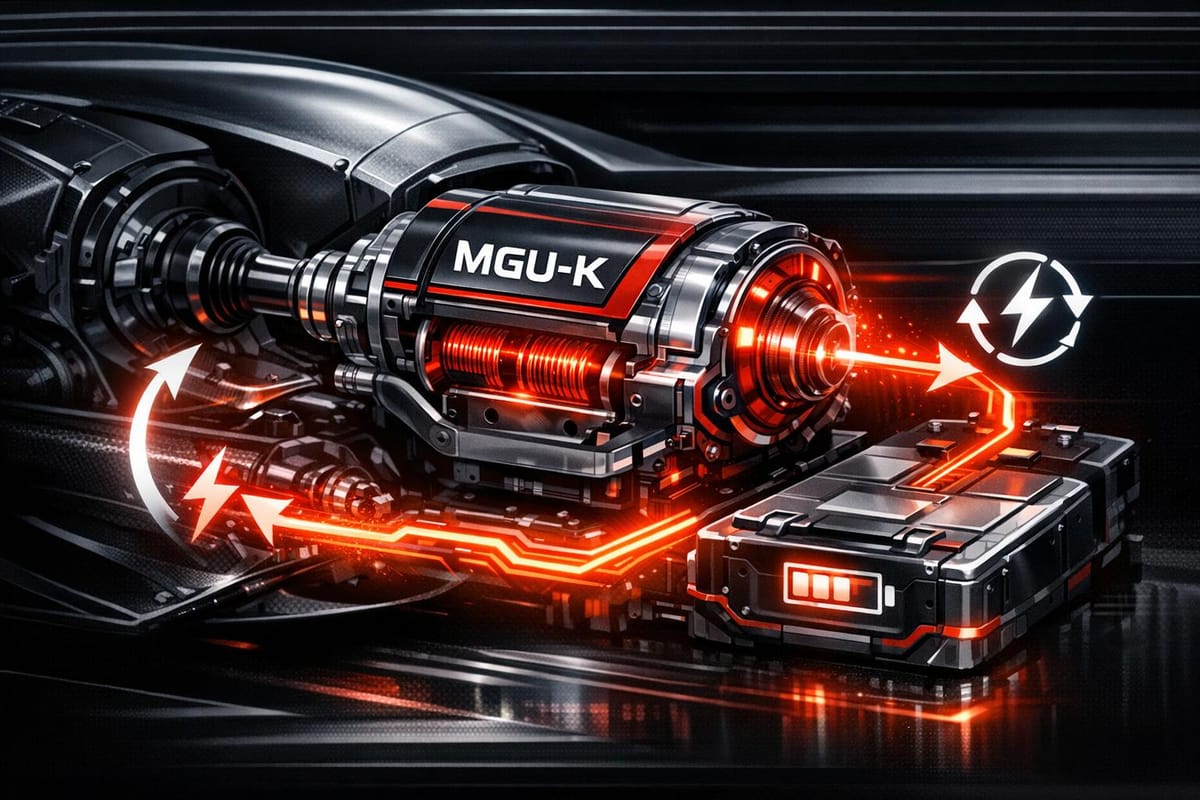
Formula One's Energy Recovery Systems (ERS) are tightly controlled by the FIA to ensure fair competition, safety, and cost management. These systems recover energy during braking, store it in high-voltage batteries, and redeploy it for performance boosts. Starting in 2026, major changes will reshape ERS technology:
- MGU-K Power Increase: Output will jump from 120 kW to 350 kW, nearly tripling its capacity.
- Energy Recovery Boost: Energy captured during braking will double to 8.5 megajoules per lap.
- 50/50 Power Split: Internal combustion engines (ICE) will contribute less power, shifting to an even balance with electric power.
- New Modes: Drivers will access "Boost Mode" and "Overtake Mode" for enhanced performance.
The FIA also enforces strict technical limits, safety standards, and a homologation process to ensure compliance. Teams must navigate these rules while innovating to stay competitive. By 2026, the removal of the MGU-H and the introduction of 100% sustainable fuels will further simplify and modernize power units, aligning with evolving industry trends.
These regulations are not just about keeping the sport competitive - they push teams to develop cutting-edge hybrid systems while maintaining safety and controlling costs.
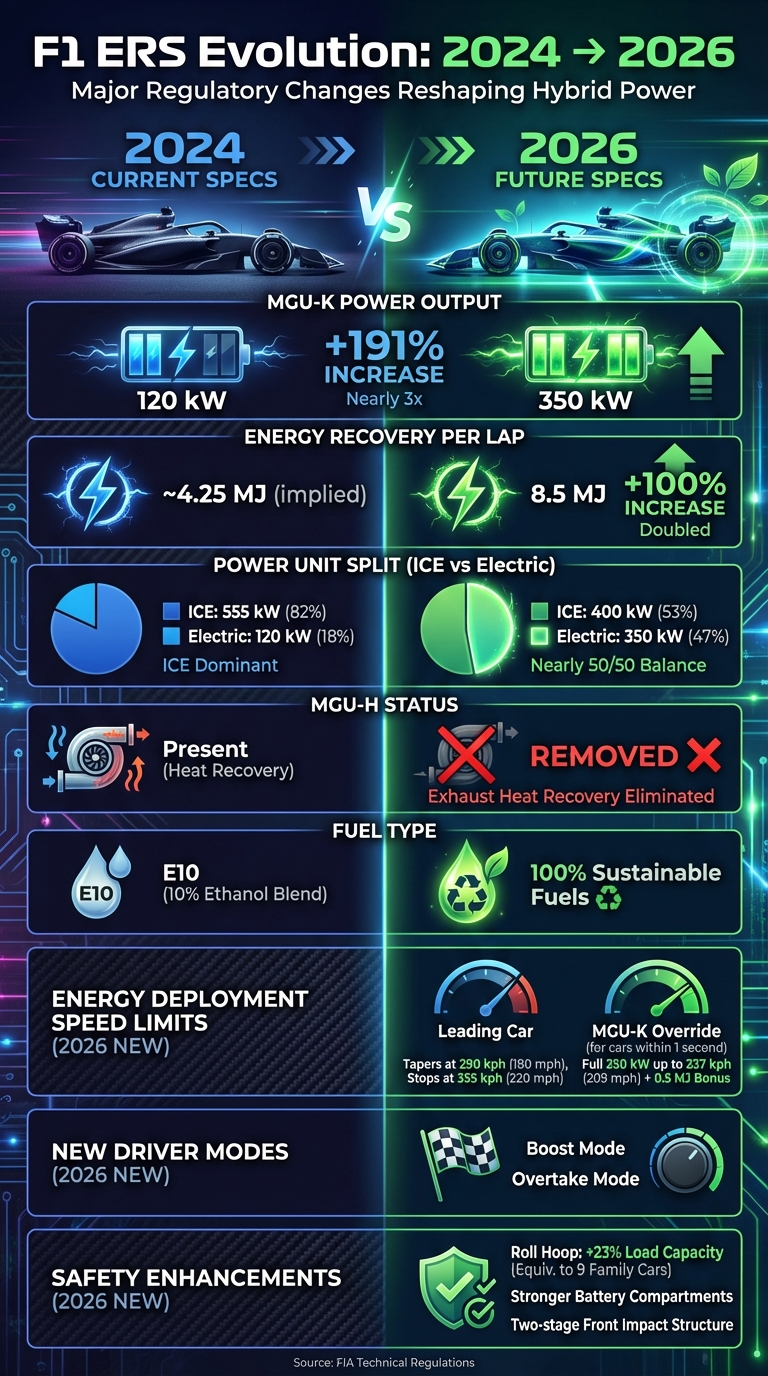
F1 ERS Technical Specifications: 2024 vs 2026 Regulations Comparison
The 2026 Regulations Explained | F1 TV Tech Talk | Crypto.com

FIA Regulations on ERS: Technical and Operational Rules
The FIA's guidelines for Energy Recovery Systems (ERS) lay out key parameters like the MGU-K's power output and energy recovery limits. Currently, the MGU-K is capped at 120 kW, but this will rise to 350 kW in 2026 as the internal combustion engine (ICE) power decreases from about 555 kW to 400 kW. This shift aims to achieve a nearly equal split between petrol and electrical power, significantly impacting both race strategies and car development. Below, we break down the technical restrictions, safety protocols, and upcoming changes shaping these rules.
Technical Limits on ERS Components
The FIA imposes strict caps on power output, energy storage, and deployment to maintain competitive balance. Starting in 2026, energy recovery capacity will double to 8.5 MJ per lap. While this provides drivers with more energy, it also demands careful battery management throughout a race.
The rules also govern when and how stored energy can be deployed. For instance, in 2026, energy deployment for a leading car will taper off at about 290 kph (180 mph) and stop entirely at around 355 kph (220 mph). Meanwhile, a car chasing within one second of the leader can activate the "MGU-K Override", deploying the full 350 kW of power up to roughly 337 kph (209 mph) and gaining an additional 0.5 MJ of energy. This system works alongside aerodynamic aids like DRS to encourage overtaking.
Safety Standards for ERS Design
Safety is a top priority for ERS systems, given the high-voltage batteries and extreme power levels involved. The FIA enforces rigorous safety standards, such as robust insulation and crash-resistant designs, to protect drivers and track personnel. For the 2026 season, new regulations will require stronger structures around the fuel cell and battery compartments, along with stricter side-intrusion protections. Additionally, the front impact structure will now separate in two stages, offering better protection during secondary impacts.
The roll hoop, which sits above the driver's head, will also see improvements. It must now withstand 23% more load - equivalent to the weight of nine family cars. These upgrades aim to ensure that even in severe crashes, the energy recovery system remains secure.
2026 ERS Regulation Changes
Several updates for 2026 aim to simplify components and cut costs. One major change is the complete removal of the MGU-H, which previously recovered energy from exhaust gases. Lawrence Barretto, F1 Correspondent & Presenter, explains:
"The revamp of the power unit does mean it's the end of the expensive and complex MGU-H (a heat recovery system), which lacked road relevance and added weight".
Eliminating the MGU-H streamlines the hybrid system and reduces development expenses.
Another major shift is the introduction of 100% sustainable fuels derived from sources like carbon capture and municipal waste. Combined with the enhanced MGU-K output, these changes aim to create a power unit that aligns more closely with environmentally conscious practices and commercial automotive trends. Teams will also gain access to new energy management modes designed to improve overtaking opportunities.
How Teams Comply with FIA ERS Regulations
Teams must carefully design, test, and monitor their Energy Recovery Systems (ERS) to meet the stringent standards set by the FIA.
Designing ERS Systems within FIA Limits
The design phase starts with translating FIA regulations into specific technical requirements. To achieve this, teams use advanced modeling tools like GT-Suite, which simulate powertrain performance and energy recovery processes. A key focus is integrating the Motor Generator Unit-Kinetic (MGU-K) - responsible for capturing energy during braking - into the existing power unit architecture.
To maximize performance, teams employ a "bang-bang" control strategy, which optimizes ERS power output during acceleration. This requires tailoring ERS deployment and energy harvesting strategies to the unique characteristics of each track, adjusting sector by sector. Research conducted in 2019 demonstrated that a well-planned ERS deployment could shave approximately 0.27 seconds off a lap time. Moreover, modern F1 power units achieve over 50% thermal efficiency, a significant leap compared to the roughly 40% efficiency of standard road-going hybrid vehicles.
Once the design process is complete, the systems undergo rigorous testing to ensure they meet FIA standards.
Testing and Homologation Process
Before an ERS system can see competitive use, it must pass the FIA's homologation process. Teams are required to submit detailed technical documentation and adhere to strict quality control guidelines outlined by the FIA. Laboratory testing follows, conducted at FIA-recognized facilities, where the system's durability, accuracy, and functionality are evaluated under simulated conditions. Key components like fuel flow meters (Technical List n°44/45) and on-board torquemeters (Technical List n°89) must either be homologated or meet specific FIA standards before installation.
Once laboratory testing is complete, the equipment is tested on certified competition circuits. Only after passing these assessments does the ERS system receive official FIA certification, allowing it to be used in international races. This rigorous process ensures every ERS component aligns with both performance and safety regulations. Even after certification, teams employ real-time monitoring during races to maintain compliance.
Real-Time Monitoring During Race Weekends
During race weekends, teams rely on an extensive network of over 300 sensors embedded in each car, sampling data at an impressive rate of 1,000 Hz. Simultaneously, the FIA receives a parallel telemetry feed from every car, allowing officials to monitor compliance in real time. As Rishabh Jaiswal explains:
"The FIA (Fédération Internationale de l'Automobile) receives a parallel telemetry stream for real-time compliance monitoring - checking fuel usage, ERS deployment, and rule infractions".
This constant stream of data enables teams to make rapid adjustments to stay within performance and safety limits. Over the course of a single race weekend, an F1 car can generate between 1 and 1.5 terabytes of data. Additionally, cars are outfitted with lateral safety lights that display the current ERS status, allowing marshals and FIA officials to verify the system's safety in real time.
To prevent unauthorized changes, onboard computer systems are inspected at the start of the season, and any software modifications require prior FIA approval. This ensures that ERS deployment strategies remain within regulatory bounds.
Real-time data monitoring plays a vital role in upholding the integrity of ERS systems throughout the race weekend, ensuring both compliance and safety for teams and officials alike.
How the FIA Enforces ERS Compliance
The FIA employs a thorough, multi-step process to ensure compliance with ERS (Energy Recovery System) regulations. This system combines real-time telemetry monitoring, physical inspections, and strict penalties to uphold fairness in Formula 1. The enforcement process begins well before the cars hit the track and continues even after the race concludes.
FIA Monitoring and Telemetry Systems
The FIA relies on advanced IVT sensors to keep a close watch on energy transfers between the MGU-K (Motor Generator Unit-Kinetic) and the Energy Store. These sensors ensure that power outputs stay within the allowed limits. This real-time monitoring works alongside the onboard systems outlined earlier to guarantee continuous compliance.
One key focus of this system is detecting "bang-bang" strategies - where teams push for maximum power during acceleration. By analyzing how energy is recovered during braking and used across different sectors of the track, FIA officials can spot any deviations from the rules.
Scrutineering and Post-Race Inspections
Before any racing begins, FIA officials physically seal critical ERS components, such as the Energy Store and Control Electronics. These seals are designed to prevent tampering or unauthorized modifications throughout the race weekend.
After the race, the FIA conducts detailed inspections, comparing logged ERS data with telemetry collected during the event. For example, in August 2021, Sebastian Vettel was disqualified from the Hungarian Grand Prix because his car failed to provide the mandatory one-liter fuel sample during post-race checks. This incident highlights how seriously the FIA enforces its technical rules.
Penalties for ERS Violations
If irregularities are uncovered during monitoring or inspections, the FIA imposes strict penalties to preserve fair competition. ERS violations can lead to consequences ranging from grid penalties to outright disqualification. Drivers are allowed a limited number of ERS components per season - usually four each of the MGU-K, MGU-H, Energy Store, and Control Electronics. Exceeding this limit results in a 10-place grid penalty for the first infraction. Additionally, any technical violations confirmed during post-race checks can lead to disqualification from the event's results.
Conclusion: Understanding FIA ERS Compliance
The FIA's ERS regulations serve as a cornerstone for balancing performance, safety, and innovation in Formula One. By setting strict benchmarks - like the 2026 mandate for 100% sustainable drop-in fuels - the governing body ensures fair competition while pushing teams to pioneer engineering advancements that resonate beyond the racetrack.
Staying compliant isn’t just about avoiding penalties; it’s also a strategic opportunity. The 2026 regulations, for instance, will triple electric braking power, reshaping race strategies and introducing new modes tailored to challenges like overtaking. This level of oversight not only preserves the integrity of the sport but also attracts major players like Audi and Ford, drawn by the promising 50-50 energy split.
These regulations highlight Formula One’s role as a testing ground for sustainable technology. The shift to fully sustainable fuels and the development of more powerful hybrid systems by 2026 place F1 at the cutting edge of automotive progress. With these changes, compliance becomes a gateway to innovation, directly influencing team strategies and the future direction of the sport. Dive deeper into these transformations on F1 Briefing to see how they continue to redefine Formula One’s competitive edge.
FAQs
How will removing the MGU-H affect team strategies and costs in 2026?
Starting in 2026, Formula 1 power units will drop the MGU-H (Motor-Generator Unit-Heat), which currently captures heat from the turbocharger and converts it into electrical energy. Teams will instead rely entirely on the MGU-K (Motor-Generator Unit-Kinetic) for energy recovery. With the MGU-K capable of delivering more power, teams will need to rethink how they manage energy - balancing increased output with fuel-flow restrictions and battery capacity. This change will make precise energy deployment even more critical, especially during overtaking and defensive maneuvers.
The removal of the MGU-H also simplifies thermal management systems. High-temperature cooling loops and additional components will no longer be required, leading to lighter cars and reduced aerodynamic drag. Designers can take advantage of this by optimizing airflow and trimming overall vehicle mass, which could improve performance.
On the financial side, eliminating the MGU-H significantly cuts costs for power unit suppliers. Manufacturing, testing, and development expenses will drop by millions of dollars each year. This change also simplifies the supply chain and lowers the financial entry barriers for new players like Audi, Honda-Aston Martin, and Ford-Red Bull. By focusing on kinetic energy recovery rather than complex heat-recovery systems, Formula 1 aims to create a more even playing field while encouraging efficiency and innovation.
What safety measures ensure Energy Recovery Systems (ERS) are safe in Formula 1?
The FIA enforces strict safety rules for Energy Recovery Systems (ERS) to safeguard drivers, teams, and track personnel. These guidelines, laid out in the Power Unit Technical Regulations, are designed to ensure that ERS components operate safely and avoid dangerous electrical issues during use or maintenance.
Here are some of the key safety measures:
- Voltage limits are set to prevent the system from overloading.
- Electrical isolation and protective barriers ensure high-voltage circuits are separated from the chassis and areas accessible to the driver.
- Automatic shutdown systems are in place to cut power immediately if a fault is detected.
- Thorough testing and certification are required for all ERS components before they can be used in a race.
These regulations allow ERS technology to deliver top-tier performance while keeping safety at the forefront, a vital aspect of modern Formula 1 engineering.
How do the updated ERS rules support F1's sustainability goals?
The 2026 power unit regulations bring a major shift in Formula 1 by placing a greater emphasis on the Energy Recovery System (ERS). These changes aim to boost the use of harvested electrical energy while cutting back on internal combustion reliance. With upgraded MGU-K and MGU-H units and increased energy storage capacity, teams will be able to recover and deploy up to 350 kW of electric power per lap - a jump of about 30% compared to current systems. This improvement not only reduces fuel consumption during races but also cuts CO₂ emissions, aligning with the FIA's ambitious target of achieving net-zero carbon emissions in Formula 1 by 2030.
To ensure these advancements are both effective and practical, the regulations impose strict energy flow limits and mandate lightweight battery systems designed for efficient energy storage and reuse. This approach minimizes each race's environmental footprint while preserving the high-speed, action-packed racing fans love. By blending cutting-edge technology with environmental awareness, these updated ERS rules position Formula 1 as a trailblazer in sustainable motorsport.