How Regulation Changes Impact F1 Car Evolution
F1's 2026 rules reshape car design: lower weight, less drag, 50/50 combustion-electric power, 100% sustainable fuel, active aero, and higher budget caps.

Formula 1 car design is shaped by regulations that balance safety, performance, and cost. Over the decades, major rule changes have forced teams to rethink their strategies, driving constant innovation. Key highlights include:
- Weight Changes: Cars have doubled in weight since 1961, but the 2026 rules reduce the minimum weight by 30 kg to 768 kg.
- Aerodynamics: A 30% reduction in downforce and 55% cut in drag in 2026 will impact car designs significantly.
- Power Units: A 50-50 power split between combustion engines and electric motors begins in 2026, alongside the removal of the MGU-H.
- Sustainable Fuel: All cars will run on 100% advanced sustainable fuel from 2026.
- Active Aero: New adjustable wings will replace DRS, improving overtaking and energy efficiency.
- Budget Caps: Spending limits (rising to $215 million in 2026) have leveled the playing field, allowing smaller teams to compete more effectively.
The 2026 regulations aim to improve competition, cut emissions, and push technical boundaries while keeping costs manageable. These changes will challenge teams to innovate within strict guidelines, ensuring the sport remains dynamic and competitive.
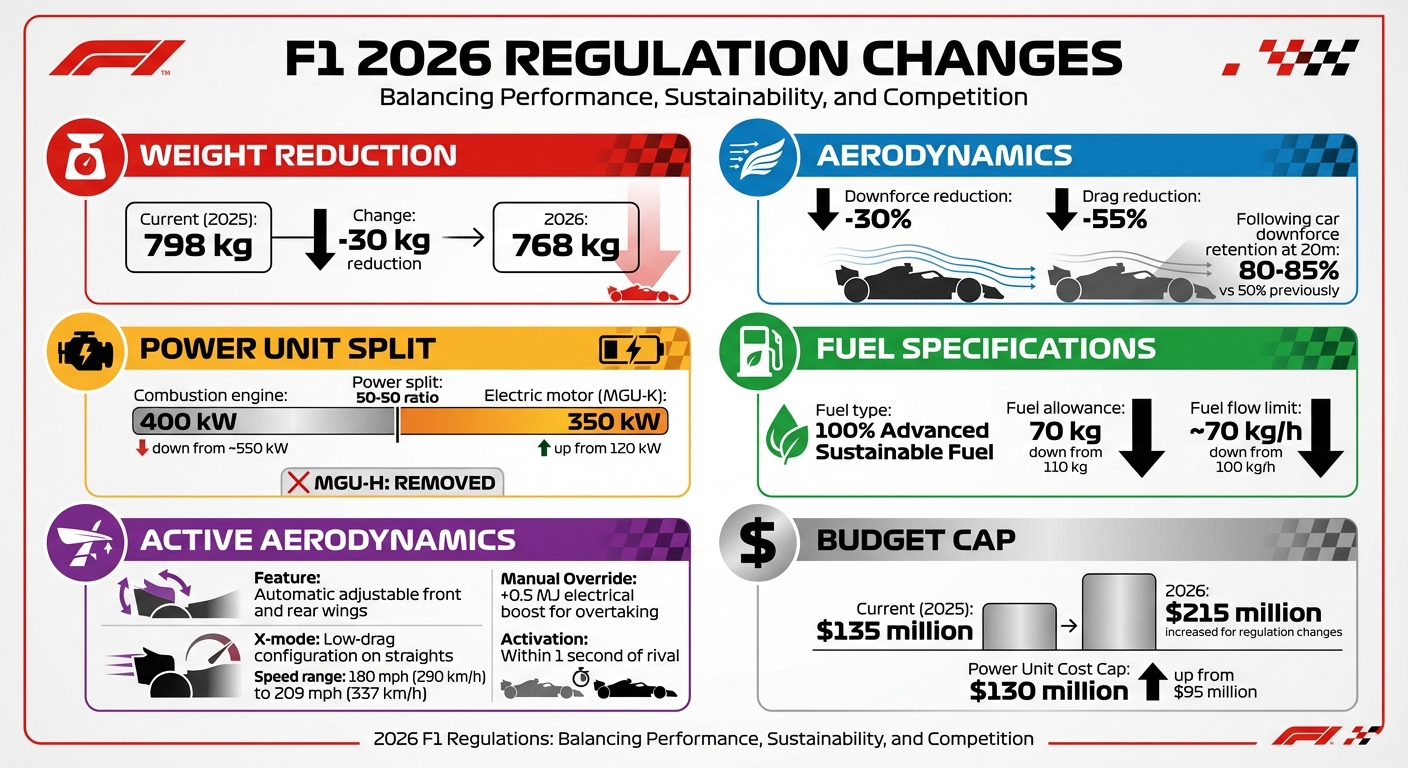
F1 2026 Regulation Changes: Key Technical Specifications and Performance Metrics
Everything You Need To Know About the Formula 1 2026 Regulations
Major Historical Regulation Changes and Their Effects
Formula 1’s technical rulebook has seen dramatic changes over the years, each forcing teams to rethink their designs and strategies. Three key periods stand out for their lasting influence: the rear-engine shift in the late 1950s and early 1960s, the ground effect ban in 1983, and the safety-driven reforms of the 1990s. These regulatory changes not only reshaped car design but also altered the competitive landscape.
The Rear-Engine Revolution (1950s-1960s)
In F1’s early days, cars featured front-mounted engines, resulting in bulky, heavy machines that prioritized raw power over agility. This all changed when the Cooper Car Company moved the engine behind the driver, creating lighter, more maneuverable cars that were also easier to repair and refine.
A major regulation shift in 1961 reduced engine capacity from 2.5 liters to 1.5 liters and set a minimum car weight of 450 kg. These changes favored the lightweight rear-engine designs over the traditional front-engine models. Ferrari quickly adapted, dominating the 1961 season with its 156 "Sharknose", which won five of the seven championship races. The rear-engine layout soon became the norm, allowing smaller teams - often called the "garagistes" - to challenge established manufacturers. By 1962, Lotus introduced an aluminum sheet monocoque chassis, replacing the heavier steel frames. This lighter, stronger design paved the way for future aerodynamic advancements.
The Ground Effect Era and Its Ban (1970s-1980s)
Ground effect technology, which used Venturi tunnels and side skirts to create negative pressure under the car, revolutionized F1 in the late 1970s. This innovation significantly boosted cornering speeds, but by the early 1980s, safety concerns grew. In 1983, the FIA banned ground effect by mandating flat undertrays between the wheels and raising the minimum car weight to 540 kg.
Teams had to act quickly. Brabham, led by designer Gordon Murray, developed the arrow-shaped BT52 in just six weeks. The car debuted at the 1983 Brazilian Grand Prix, and Nelson Piquet went on to win that year’s Drivers’ Championship. Without the aerodynamic downforce from ground effect, teams shifted their focus to improving mechanical grip and turbocharged engine performance. The transition from aluminum to carbon fiber chassis also provided the structural strength needed for the new flat-bottom designs. These changes marked a turning point, with safety becoming a central concern heading into the 1990s.
1990s Speed-Control Reforms
The tragic events of the 1994 San Marino Grand Prix led the FIA to implement sweeping safety reforms. Among these was the banning of electronic driver aids like active suspension, traction control, and anti-lock braking systems. This move aimed to return greater control to the driver and reduce the influence of software on performance.
In 1998, additional measures reduced the maximum car width from 2 meters to 1.8 meters and introduced grooved tires - three grooves on the front tires and four on the rear - to limit mechanical grip. Adrian Newey’s move from Williams to McLaren highlighted the importance of top-tier designers during this era. His MP4-13 design adapted brilliantly to the new narrow-track, grooved-tire regulations, helping McLaren secure the 1998 championship.
Modern Regulation Changes: 2000s to Present
The 21st century ushered in a wave of technical regulations aimed at balancing performance, safety, and cost. These modern reforms zeroed in on specific technologies and aerodynamics to keep racing exciting while managing expenses.
2009: KERS and Aerodynamic Overhauls
The 2009 season brought sweeping changes. The FIA banned nearly all auxiliary aerodynamic devices - like winglets, flick-ups, and chimneys - leaving the front and rear wings as the primary sources of downforce. To shake things up further, front wings became wider and lower, while rear wings were made narrower and taller. To compensate for the reduced aerodynamic grip, slick tires replaced grooved ones, offering significantly more mechanical grip.
That year also introduced the optional Kinetic Energy Recovery System (KERS), which allowed teams to convert braking energy into an 80-horsepower boost per lap. However, integrating KERS came with trade-offs, as it increased the minimum car weight to 605 kg. Teams faced a tough choice: embrace KERS or focus on aerodynamic efficiency.
Brawn GP, born from Honda's exit, capitalized on a loophole by developing a double diffuser that produced far more downforce than its competitors. This innovation helped Jenson Button secure six wins in the first seven races, ultimately leading to both championship titles for the team. Meanwhile, McLaren and Ferrari poured resources into KERS but struggled early on due to aerodynamic shortcomings. These pivotal changes laid the groundwork for more dramatic redesigns in the following years.
2017: Wider Chassis and Higher Downforce
After years of relatively stable regulations, 2017 marked a return to wider cars, ending the narrow-track era introduced in 1998. Car widths increased from 1.8 meters to 2.0 meters, paired with wider tires and extended chassis dimensions to boost downforce and speed. The minimum weight also climbed to 728 kg to accommodate the larger components.
The results were immediate - 2017 cars shattered 11 lap records across various circuits. Beyond speed, the revamped rules ignited tighter competition. Ferrari, led by Sebastian Vettel, mounted their strongest challenge in years against Mercedes, but the Silver Arrows ultimately retained both titles. These changes set the stage for the next major overhaul.
2022: Ground Effect Revival and Simplification
In 2022, ground effect made a comeback after nearly 40 years. Instead of relying on intricate upper bodywork, downforce was now generated through sealed Venturi tunnels in the underbody. To further reduce the disruptive "dirty air" behind cars, the FIA removed bargeboards and simplified wing designs.
Another major change was the introduction of 18-inch wheel rims with low-profile Pirelli tires, replacing the long-standing 13-inch standard. The minimum car weight also jumped to 798 kg. These updates improved how cars followed each other: vehicles trailing 20 meters behind retained 80%-85% of their downforce - compared to just 50% previously - although this dropped to 70% as they got closer.
FIA Single-Seater Director Nikolas Tombazis commented on the evolution:
The front wing end plates morphed into shapes that permitted quite a lot of outwash.
Red Bull Racing, guided by Adrian Newey - one of the few designers with experience from the original ground effect era - excelled under the new rules. Their dominance peaked in a record-breaking 2023 season, winning 21 out of 22 races. These aerodynamic advancements have reshaped the competition, especially as teams now navigate within tighter budget constraints.
Budget Caps: How Spending Limits Changed F1 Development
Before and After Budget Caps
For years, Formula 1 was a financial free-for-all. Teams like Mercedes, Ferrari, and Red Bull poured hundreds of millions more into their operations than their midfield competitors, creating a massive gap in performance. Bigger budgets meant more engineers, more advanced wind tunnel testing, and countless component iterations - essentially buying dominance on the track.
That all changed with the introduction of the budget cap. By 2025, the spending limit is set at $135 million, forcing top teams to streamline their operations and reassign staff. Meanwhile, midfield teams could finally compete on a more equal financial footing. This shifted F1’s focus from a "spending race" to an "efficiency race" - success now depends on making every dollar count.
Looking ahead to 2026, the budget cap increases to $215 million to account for sweeping regulation changes. Similarly, the Power Unit Cost Cap will rise from $95 million to $130 million, as manufacturers like Audi, Ferrari, and Mercedes work on new engines for the upcoming 50-50 internal combustion-electric hybrid systems. Chris Medland, Special Contributor, summed it up well:
The vast scale of the changes are an enormous challenge for all of the teams, and as you can imagine, they do not come without a significant amount of cost as well.
These financial limits have reshaped how teams operate and approach development, driving noticeable shifts in performance.
Effects on Midfield Teams and Development
The budget cap has forced teams to rethink how they spend their resources, and the results have been striking. During the 2024 and 2025 seasons, McLaren - a Mercedes customer team led by Zak Brown and Andrea Stella - rose from the midfield to the top of the standings. They claimed the 2024 Constructors' Championship (their first in over 25 years) and the 2025 Drivers' title with Lando Norris. This remarkable turnaround proved that careful planning and aerodynamic ingenuity could rival the might of factory teams under cost restrictions.
Teams have adopted more calculated development strategies to stretch their budgets. For example, in July 2024, McLaren tested a new floor during Friday practice at the British Grand Prix but delayed racing it. They waited until the Belgian Grand Prix to fully implement it, ensuring they had all the necessary data to maximize its impact. On the other hand, Red Bull Racing took a different path. In June 2024, they introduced a revised edge wing early at the Austrian Grand Prix, opting for immediate performance gains rather than waiting for a complete update package.
But the upcoming 2026 regulations bring fresh challenges. The focus on works integration - where factory teams design their power units and chassis as a cohesive system - could give manufacturers a significant edge. Pablo Elizalde of Motorsport Magazine explained:
A customer team seeking to win under the new rules may need either a superior chassis concept that offsets inherent compromises, or a power unit supplier willing to tailor hardware unusually closely to its needs.
This dynamic echoes past regulation overhauls, where financial and technical constraints reshaped the competitive landscape. While budget caps have narrowed the financial gap, the 2026 technical regulations may create new hurdles for customer teams like McLaren. They’ll need to adapt their aerodynamic designs to fit third-party power units, a disadvantage compared to factory teams that co-develop both systems from the ground up.
2026 Regulation Changes and Future Trends
Sustainability and Green Technology Requirements
The 2026 Formula 1 season marks a bold shift toward environmentally conscious racing. For the first time, all cars will run exclusively on 100% Advanced Sustainable Fuel - eliminating fossil carbon entirely. This fuel must be derived from sources like non-food biomass, municipal waste, or carbon capture technologies. Chris Medland, a Special Contributor, outlined the rigorous sourcing criteria:
Advanced Sustainable Fuel is one where the molecules have to be extracted from an advanced sustainable feedstock... anything second-generation that is not in competition with the food chain.
This change isn’t just about fuel - it’s forcing a complete overhaul of engine design. Combustion engine output will decrease from approximately 550 kW to 400 kW, while the MGU-K (electric motor) output will jump from 120 kW to 350 kW. This creates a near 50-50 power split between combustion and electric systems. Additionally, fuel allowances drop from 110 kg to 70 kg, and fuel flow limits are reduced from 100 kg/h to about 70 kg/h. Teams that can quickly adapt to the unique combustion properties of the new fuel will gain a competitive edge, especially in the early part of the season.
Another major shift is the removal of the MGU-H, a complex and expensive component, which simplifies power units and lowers barriers for new manufacturers like Audi and Ford. This has already led to exciting moments, such as Kimi Antonelli becoming Formula 1's youngest polesitter and winning the Chinese Grand Prix under the new rules in March 2026.
These changes in fuel and power dynamics demand a fresh approach to integrating engines and chassis. Beyond the propulsion system, aerodynamic tweaks and weight reductions are also reshaping car design, showcasing the relentless innovation sparked by regulation updates.
Active Aero and Lightweight Materials
The 2026 regulations don’t stop with fuel and power unit changes. The introduction of active aerodynamics is a key feature designed to work alongside the increased reliance on electric power. These systems are aimed at mitigating performance losses caused by the new fuel and engine rules. Both front and rear wings will now adjust automatically, switching to a low-drag "X-mode" on straights to conserve battery energy. Simone Resta, Deputy Technical Director at Mercedes, explained how this impacts drivers:
Every driver will operate movable front and rear wings in tandem, harnessing the extra energy for overtaking maneuvers.
Replacing the old DRS system, a new Manual Override System offers an extra +0.5MJ of electrical boost for passing. When a car closes within one second of a rival, the leading car's power reduces after reaching 180 mph (290 km/h), while the chasing car can deploy the boost up to 209 mph (337 km/h).
Weight reductions also play a crucial role in performance. The minimum car weight drops from 1,759 lbs (798 kg) to 1,693 lbs (768 kg), although the MGU-K assembly weight increases from 15 lbs (7 kg) to 35 lbs (16 kg) to handle the higher electrical output.
However, teams still face tight design constraints. Rob Marshall, Design Chief at McLaren, pointed out that teams have control over only about 5.9 to 7.9 inches (150-200mm) of the car’s length for true innovation. This limited freedom gives factory teams like Ferrari, Mercedes, and Audi - who design both engines and chassis - a clear advantage over customer teams that must adapt to third-party power units.
Conclusion: How Regulations Continue to Drive F1 Design
Formula 1's evolution has always been steered by regulation changes. From the 1983 ban on ground effects to the 1989 prohibition of turbo engines, the FIA has consistently adjusted the rules to balance safety, performance, and cost. Every shift forces teams to reimagine and refine their designs, fueling innovation and keeping the competition unpredictable.
The upcoming 2026 regulations are a continuation of this legacy. These modern rules focus on making races more competitive, like ensuring cars retain 90% of their downforce when trailing another car at 20 meters. At the same time, safety measures are being strengthened, such as requiring the principal roll structure to endure 20g of load - a 25% increase from current standards.
Financial limits are also reshaping how teams operate. Simplifying power units by removing the MGU-H reduces costs and lowers entry barriers for new manufacturers like Audi and Ford. Meanwhile, the budget cap is increasing to $215 million to accommodate the technical changes.
Despite these constraints, F1 engineers continue to find innovative ways to push boundaries. As Rob Marshall, McLaren's Design Chief, explains:
You kind of think there's a lot of freedom but when you actually draw it out there's not that much because there are boxes you have to stay within.
Inside these "boxes", teams uncover the performance gains that can decide championships.
As previously discussed, the future of F1 design lies in integrating advanced technologies like sustainable fuels and active aerodynamics. The FIA’s commitment to progress - whether through 100% sustainable fuels, a balanced 50-50 power split between combustion and electric systems, or cutting-edge aerodynamic solutions - ensures Formula 1 remains a hub of innovation and intense competition. As the FIA puts it:
If Formula 1 has a defining characteristic it is a relentless urge to move forward, to put behind it the successes or failures of the past and to look forward to the next weekend, the next session, the next race.
Regulations will continue to be the driving force behind the sport's evolution, shaping both strategy and design for years to come.
FAQs
Will the 2026 rules make cars faster or slower?
The 2026 rules aim to make F1 cars quicker by introducing updates to aerodynamics, power unit design, and other technical aspects. Teams are already working hard to refine aerodynamic setups and find performance advantages within the framework of these new regulations.
How will active aero replace DRS in 2026?
Beginning in 2026, Formula 1 will introduce active aerodynamics to replace the current Drag Reduction System (DRS). This new system will automatically adjust elements like the car's wings in real time, optimizing airflow and increasing downforce - all without requiring any action from the driver.
The goal? To encourage more organic overtaking, create closer competition on the track, and enhance safety. This shift also reflects Formula 1's ongoing commitment to pushing boundaries in technology and aligning with its broader vision for innovation and environmental responsibility.
Do budget caps really help smaller teams win?
Budget caps are designed to create a more balanced competition by restricting how much teams can spend, giving smaller teams a better chance to compete with wealthier rivals. While these caps help prevent top teams from overspending, success still hinges on how effectively teams allocate their resources, push innovation, and refine their car designs. Bigger teams often maintain an edge thanks to their established infrastructure and deep expertise. So, while budget caps make the competition tighter, they don't necessarily mean smaller teams will dominate or win regularly.