How Safety Cars Change F1 Race Strategies
Explore how Safety Cars impact F1 strategies, influencing pit stops, tire management, and race dynamics, with historical examples and insights.
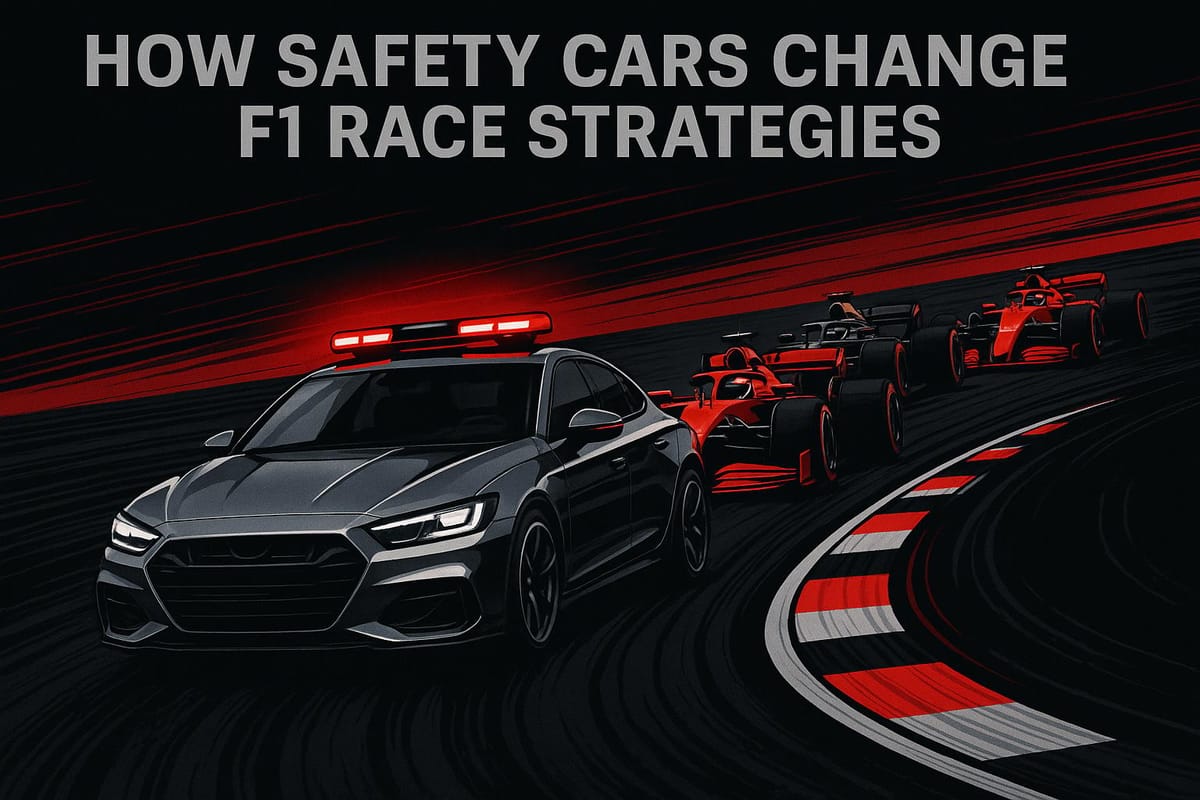
When a Safety Car is deployed in Formula 1, it resets the race dynamics, erasing time gaps and bunching up the field. This forces teams to make quick decisions about pit stops, tire choices, and track position. The slower speeds during these periods reduce lap times by up to 60% and cause tire temperatures to drop significantly, creating challenges for restarts.
Key points:
- Pit Stops: Safety Cars reduce pit stop time penalties, making them more advantageous.
- Tire Management: Temperatures can drop by up to 40°C, affecting grip during restarts.
- Field Compression: Leaders lose their gap advantage, while others gain opportunities to overtake.
- Safety Car vs. Virtual Safety Car: The former bunches up the field, while the latter maintains existing gaps, impacting strategy differently.
These moments can decide races, as seen in historic events like the 2021 Abu Dhabi Grand Prix. Teams that anticipate and execute decisions effectively during Safety Car periods often gain a critical edge.
Formula One Safety Car Race Strategy - Explained
Safety Cars vs Virtual Safety Cars: Understanding the Differences
Formula One uses two distinct systems to handle dangerous track conditions, and each one comes with its own strategic implications. Knowing how these systems work is essential for understanding how teams adjust their pit stop timing and tire strategies during a race.
What is a Safety Car?
The Safety Car is a physical vehicle that enters the track to lead the field at a slower speed. When deployed, all drivers must fall in line behind it, which eliminates the gaps between competitors. This "bunching up" effect can have a huge impact on race strategies.
The speed reduction under a Safety Car is dramatic. For example, during the 2010 Canadian Grand Prix, Lewis Hamilton completed a lap behind the Safety Car in 2:02.231, compared to his normal race pace of 1:18.135. That’s about 60% longer per lap. To put it in perspective, cars usually take Turn 3 in Montreal at around 125 kph (78 mph), but under the Safety Car, they slow to just 45 kph (28 mph). Top speeds drop from over 300 kph (186 mph) to 255 kph (158 mph), and drivers make only 50 gear changes per lap instead of the typical 80.
Safety Car periods usually last about four laps, giving teams enough time to execute strategic pit stops while the field stays neutralized. However, these extended periods also cause tire temperatures to drop significantly, which can make restarts particularly tricky.
What is a Virtual Safety Car (VSC)?
The Virtual Safety Car works differently - there’s no physical car on the track. Instead, drivers receive electronic signals instructing them to slow down to a specific delta time. Unlike the Safety Car, the VSC maintains the existing gaps between cars, keeping the race order intact.
VSC periods are shorter, typically lasting just one to two laps. This shorter duration means tire temperatures don’t drop as much, making restarts less challenging compared to those following a full Safety Car period.
One major difference is that the VSC doesn’t bunch up the field. Drivers maintain their original gaps, which limits the potential for gaining a significant advantage during pit stops. In contrast, the bunching effect under a full Safety Car can make pit stops much more advantageous.
Safety Car vs Virtual Safety Car: Key Differences
Each system presents unique challenges and opportunities for teams. Here’s a side-by-side comparison:
| Feature | Safety Car (SC) | Virtual Safety Car (VSC) |
|---|---|---|
| Field Impact | Bunches cars together | Maintains existing gaps |
| Duration | Around 4 laps | 1–2 laps |
| Pit Stop Advantage | Significant time savings possible | Minimal advantage due to preserved gaps |
| Tire Temperature Drop | Large drop due to slower speeds | Smaller drop due to higher speeds |
| Restart Difficulty | More challenging with cold tires | Easier with manageable tire temperatures |
| Position Changes | High potential for shifts | Minimal impact on race order |
Under a full Safety Car, the slower speeds and bunched-up field can lead to significant position changes, especially during pit stops. Teams can take advantage of the reduced time penalty for pitting while the field is neutralized. On the flip side, the slower pace and longer duration can cause tire temperatures to drop by as much as 40°C (72°F), making restarts difficult as drivers struggle to regain grip.
The VSC, with its shorter duration and higher speeds, results in less dramatic tire temperature drops. Restarts are generally smoother, and since the gaps between cars are preserved, position changes are less common. Pit stops during a VSC don’t offer the same time-saving benefits as they do under a full Safety Car.
Teams must adapt their strategies depending on whether a Safety Car or VSC is deployed. As noted by F1 Briefing, quick decision-making and data analysis are critical for staying competitive in these mid-race scenarios. The differences between these systems play a crucial role in shaping race outcomes, especially when it comes to pit stops and tire management.
Pit Stop Strategy During Safety Car Periods
The arrival of a Safety Car on track can completely change the dynamics of a race, turning pit stops into high-stakes opportunities. Teams that excel at timing and executing these stops can gain an edge, while hesitation or missteps can lead to costly setbacks. Let’s dive into how timing and strategy shape pit stops during these critical moments.
The Safety Car Pit Window: When to Stop
A "Safety Car pit window" refers to the ideal moment for a driver to pit during a Safety Car period, minimizing time lost and maximizing track position. Normally, a pit stop takes around 20–25 seconds, but during a Safety Car period, this drops to just 10–12 seconds as lap speeds slow significantly. Teams keep a close eye on race conditions to identify this narrow window of opportunity. To stay ready, they run simulations and prepare pit crews so drivers can act immediately when the window opens.
Deciding whether to pit or stay out isn’t simple - it’s a balancing act influenced by tire wear, fuel levels, and track position. For instance, a driver in fifth place with worn tires might gain multiple positions by switching to fresh rubber, while a leader on newer tires might choose to stay on track to maintain their advantage. Fuel load is another factor; cars carrying more fuel are heavier and slower on restarts. A pit stop to refuel can lighten the car and boost performance. Teams rely on historical data and lightning-fast calculations to make these calls. This delicate decision-making process often leads to contrasting strategies, like the undercut and overcut.
Undercut vs. Overcut Decisions Under Safety Car
The undercut - pitting early to gain an advantage with fresh tires - becomes especially effective during a Safety Car period, as the field is tightly bunched, reducing the time lost in the pit lane. On the other hand, the overcut - staying out longer on older tires - might be the better choice if a driver can maintain position until the race restarts.
A prime example of this strategic duel occurred at the 2021 Abu Dhabi Grand Prix. During a late Safety Car period, Max Verstappen’s Red Bull team chose to pit for fresh soft tires, while Lewis Hamilton’s Mercedes team kept him out on older tires. Verstappen’s fresh tires gave him the edge to overtake Hamilton on the final lap, a move that ultimately decided the championship.
Adding to the complexity, Safety Car regulations can limit pit lane access immediately after deployment, and the pit exit light system dictates when cars can rejoin the track. These rules force teams to think on their feet. To stay ahead, many teams now use advanced strategy tools and simulations to predict scenarios and refine their responses.
In modern Formula 1, quick thinking is everything. Experts agree that the margin between victory and defeat often hinges on how well teams anticipate rivals’ moves and adapt during Safety Car periods. Teams with detailed contingency plans and flawless communication tend to seize these moments, outperforming those caught off guard.
Tire Management During Safety Car Periods
After adjusting pit stop strategies, another key aspect of race performance comes into play: managing tire temperatures during Safety Car periods. Keeping tires within their optimal temperature range during these slower laps is essential for maintaining competitiveness.
How Tire Temperature Drops Affect Performance
F1 tires function best at temperatures above 212°F (100°C). However, during Safety Car conditions, tire temperatures can drop by as much as 72°F (40°C). This happens because lap times are about 60% longer, and drivers spend significantly less time at full throttle - dropping from over 50% during normal racing to just 2% under Safety Car conditions.
The effects of this cooling were evident during the 2023 Canadian Grand Prix. Lewis Hamilton clocked a lap time of 2:02.231 under the Safety Car, but immediately after the restart, his time improved to 1:18.135, even though the tires were still cold. Later in the race, as his tires warmed up, he managed a lap time of 1:16.296. This drastic difference highlights how tire temperature directly impacts performance and the importance of in-car techniques to regain heat quickly.
Methods to Keep Tire Temperature Up
Drivers employ several techniques to combat tire cooling during Safety Car periods:
- Weaving on track: This creates friction and generates heat in the tires.
- Strategic braking: Heat from the brake discs transfers to the tires, helping them stay warm.
- Acceleration and braking cycles: Controlled bursts of acceleration and braking maintain tire heat.
- Telemetry monitoring: Teams use real-time data to track tire temperature, pressure, and surface conditions, allowing adjustments as needed.
Additionally, brake temperatures are closely monitored, as the heat they generate can be channeled to warm the tires. Recent rule changes, such as restrictions on tire-warming devices and limits on certain maneuvers behind the Safety Car, have made these driver techniques even more critical. Poor tire management during a restart can lead to reduced grip, brake lock-ups, and difficulty in defending or attacking positions - issues that can cost valuable time or even result in on-track incidents.
The table below highlights the performance differences caused by tire temperature changes:
| Condition | Tire Temperature | Grip Level | Lap Time | Gear Shifts | WOT Time (%) |
|---|---|---|---|---|---|
| Normal Racing | >212°F (100°C) | High | ~1:16 | ~80 | >50 |
| Safety Car Period | Drops up to 72°F (40°C) | Low | ~2:02 | ~50 | ~2 |
| Post-Safety Car Restart | Below optimal | Reduced | ~1:18 | ~80 | >50 |
The Canadian Grand Prix example underscores just how critical tire management is during Safety Car periods. Historical data from the 2010 F1 season shows that around 8% of all laps were run behind the Safety Car. This makes mastering tire temperature management a vital skill for championship success - just as crucial as nailing the timing of pit stops.
Race Restarts: Opportunities and Risks
The restart phase in Formula One racing introduces a blend of opportunity and danger, building on the challenges of managing tire temperatures. When the Safety Car pulls into the pits, the field, previously spread out, suddenly compresses. This creates a high-stakes environment where overtaking chances multiply, but so do the risks - moments that can significantly influence championship standings.
How Field Compression Changes Restart Dynamics
Field compression reshapes the race, erasing the natural gaps that develop over time and forcing drivers into close-quarters combat. This leads to intense battles across the grid, with every move carrying strategic weight for championship outcomes.
This phase is often marked by the "concertina effect", where sudden changes in speed ripple through the tightly packed field, increasing the likelihood of collisions. The race leader has the unenviable task of controlling the restart pace while fending off challenges from behind. To prevent rivals from gaining a slipstream advantage, leaders often employ unpredictable acceleration patterns, adding another layer of complexity.
Both Lewis Hamilton and Fernando Alonso have stressed the importance of precision during restarts. According to them, success hinges on a delicate balance of aggression, caution, and tactical thinking.
For drivers, field compression means a sudden shift in priorities. Those who had a comfortable lead now find themselves defending their positions, while those further back see fresh opportunities to climb the ranks. The first few corners after a restart often become chaotic battlegrounds, with multiple position changes happening in mere seconds.
From a team perspective, this phase demands quick strategic adjustments. Position changes can alter championship standings in an instant, making Safety Car restarts some of the most dramatic moments in the sport. These dynamics also tie directly into how regulatory changes have shaped modern restart strategies.
Rule Changes and Their Effects on Strategy
Recent rule changes, particularly those governing lapped cars, have added new layers of complexity to restart strategies. Whether lapped cars are allowed to unlap themselves before a restart can significantly affect track positioning, creating both opportunities and dilemmas for teams.
A prime example of how these rules can influence outcomes is the controversial 2021 Abu Dhabi Grand Prix. In the final laps, Max Verstappen closed in on Lewis Hamilton after a Safety Car period. The decision to allow certain lapped cars to unlap themselves gave Verstappen the chance to attack on the final lap, ultimately leading to his victory and the World Championship.
These rule adjustments have pushed teams to develop contingency plans for various restart scenarios. For instance, the process of allowing lapped cars through can delay the restart, impacting tire and brake temperatures. While the extra time might help with tire warming, it also allows competitors to refine their strategies, adding another layer of unpredictability.
The timing of the Safety Car's return to the pits has become more predictable, but this predictability requires teams to make decisions faster than ever. Real-time data, rival strategies, and procedural updates must be communicated clearly and quickly. In these moments, effective communication can be the difference between a successful restart and a disastrous one.
| Restart Risk Factor | Impact Level | Primary Cause | Mitigation Strategy |
|---|---|---|---|
| Cold Tires | High | Temperature drop up to 104°F (40°C) | Aggressive weaving and braking |
| Field Compression | Very High | Crowded field packed together within seconds | Defensive positioning and communication |
| Rule Uncertainty | Medium | Lapped car procedures | Multiple contingency plans |
The 2020 Tuscan Grand Prix is a stark reminder of how risky restarts can be. A major crash during the restart, caused by sudden acceleration and braking in the midfield, showcased how quickly things can unravel when cars are bunched together on cold tires.
To navigate these challenges, teams rely heavily on real-time data and sophisticated simulations to refine their restart tactics. In a sport where every second counts, a well-executed restart can make or break a championship campaign.
How Safety Cars Have Changed Race Results Throughout F1 History
Safety Cars have played a pivotal role in shaping Formula 1 race outcomes, turning the tide of competitions and creating moments that define championships. Since their formal reintroduction in 1993, Safety Car deployments have become more frequent, reflecting stricter safety measures and teams' growing ability to use these periods to their advantage. Over the years, these interventions have transformed the sport, often turning predictable races into thrilling spectacles.
Famous Races Decided by Safety Cars
The 2021 Abu Dhabi Grand Prix is a prime example of how a Safety Car can change everything. A late deployment led to a crucial pit stop for fresh tires, allowing Max Verstappen to seize the championship in a dramatic final-lap showdown. This moment underscored how a single Safety Car period can redefine the stakes at the highest level of the sport.
Another unforgettable instance occurred at the 2008 Singapore Grand Prix. Fernando Alonso, starting 15th on the grid, seemed out of contention. But after Nelson Piquet Jr.'s crash triggered a Safety Car, Alonso’s team executed a perfectly timed pit stop that catapulted him to the front. He went on to secure a surprising victory, though the race later became infamous due to the "Crashgate" scandal.
The 2014 Bahrain Grand Prix also showcased the transformative power of a Safety Car. A late deployment compressed the field, setting up an electrifying battle between Mercedes teammates Lewis Hamilton and Nico Rosberg. What had been a straightforward race turned into a gripping duel, leaving fans on the edge of their seats.
| Race | Year | Safety Car Impact | Result Change |
|---|---|---|---|
| Abu Dhabi Grand Prix | 2021 | Late deployment; fresh tires for Verstappen | Championship decided on final lap |
| Singapore Grand Prix | 2008 | Well-timed pit stop during Safety Car period | Alonso moved from 15th to 1st |
| Bahrain Grand Prix | 2014 | Field compression led to an intense battle | Processional race transformed |
These races highlight how Safety Cars have not just influenced results but also redefined race strategies and created unforgettable moments in F1 history.
How Safety Car Strategies Have Changed Over Time
Over the years, teams have shifted from reacting to Safety Car deployments to proactively planning for them, sometimes anticipating these interventions several laps in advance. Modern teams continuously analyze data to predict when a Safety Car might be deployed, allowing them to make split-second decisions. When drivers hear the phrase, "You are in your Safety Car window", they know their pit crew is already prepared to act without delay.
Changes in regulations have also significantly impacted Safety Car strategies. For instance, since 2011, Safety Car speed limits are enforced over two laps instead of one, giving all teams a fair chance to pit before the Safety Car fully takes control. Additionally, the pit lane exit light now remains green during Safety Car periods, and cars are restricted from entering the pits unless they are changing tires. These rules have introduced new layers of strategy, forcing teams to carefully weigh tire choices against track position.
The increased frequency of Safety Car deployments has led to a fundamental shift in race preparation. Teams now plan for multiple scenarios involving Safety Cars, using advanced simulations and real-time data to refine their strategies. This level of preparation has made the ability to exploit Safety Car periods as critical to success as outright speed, further emphasizing the tactical depth of modern Formula 1 racing.
Conclusion: Managing the Unpredictable Impact of Safety Cars
Safety Cars bring a unique challenge to Formula 1 teams, testing their ability to adapt and plan under unpredictable circumstances. While no one can foresee exactly when a Safety Car will be deployed, the most successful teams prepare for a range of possibilities well in advance - sometimes planning for scenarios two, three, or even five laps ahead. This level of preparation is just as important as fine-tuning pit stops and tire strategies, which we’ve already explored.
The numbers highlight why mastering Safety Car periods is so important. Back in 2010, eight percent of all F1 laps were run behind the Safety Car. Fast forward to 2022, and Safety Car deployments surged by 40% compared to previous record years. This increase means teams that fail to adapt during these moments risk falling behind their competitors. These interruptions compress racing windows, forcing teams to make split-second decisions that can make or break their race strategies.
When drivers hear the phrase, "You are in your Safety Car window", it signals that their team has calculated the optimal move and is ready to act. The best teams treat Safety Car periods not as chaotic interruptions but as opportunities. They use historical data and predictive models to anticipate outcomes and fine-tune strategies for different track conditions. This data-driven approach, paired with precise execution, can significantly influence race results.
Ultimately, the ability to plan ahead and adapt during Safety Car deployments is a critical skill in Formula 1. Teams that excel in proactive decision-making - whether it’s timing an undercut or overcut during field compression - gain a competitive edge. In a sport where every millisecond matters, these strategic choices can be just as decisive as pure speed when it comes to winning championships.
FAQs
How do F1 teams decide whether to pit during a Safety Car period?
During a Safety Car period, teams face the challenge of making quick decisions about whether to pit or stay on track. This choice hinges on several factors: the time saved during a pit stop at reduced speeds, the condition of the driver’s tires, and the overall race strategy, including track position and the number of laps left in the race.
Pitting during a Safety Car can be a smart move because it typically takes less time than a regular pit stop - cars are moving slower, which minimizes the gap lost to rivals. On the flip side, staying out might be wiser if maintaining track position is crucial or if the tires are holding up well. To navigate these high-stakes moments, teams lean on real-time data and advanced simulations, carefully weighing immediate benefits against the bigger picture of their race plan.
How do Safety Cars and Virtual Safety Cars impact F1 race strategies?
Safety Cars and Virtual Safety Cars (VSC) have a big influence on F1 race strategies, but they affect races in very different ways. When a Safety Car comes out, it physically slows down the entire field, bringing all the drivers closer together. This often opens the door for teams to tweak their pit stop plans, taking advantage of the reduced time loss during stops. The result? Sudden and dramatic changes in race order and strategy.
On the other hand, a Virtual Safety Car slows the pace across the track without physically grouping the cars. This means the gaps between drivers stay the same. While teams can still adjust their strategies during a VSC, the chances to gain track position are much smaller compared to a full Safety Car. In both cases, teams need to act fast, making sharp decisions to manage tires and secure the best possible race positions.
How do F1 drivers keep their tires at the right temperature during a Safety Car period for a strong restart?
During a Safety Car period in Formula 1, drivers focus intensely on keeping their tires at the right temperature to ensure maximum grip and performance when the race resumes. To do this, they often weave their cars from side to side, creating friction that helps maintain tire heat. Along with this, they may perform quick bursts of acceleration and braking, which not only warms the tires but also keeps the brakes at an optimal temperature.
This process is essential because cold tires lose grip, making it harder to control the car during restarts. At the same time, teams keep a close eye on real-time tire data, offering drivers guidance on how to adjust their approach. This ensures the tires are ready for action while avoiding unnecessary wear.