How Teams Use Data to Improve Overtaking
Data and AI now shape every overtake in Formula 1, using telemetry, simulations and tire metrics to time DRS/ERS, pit stops and energy deployment.
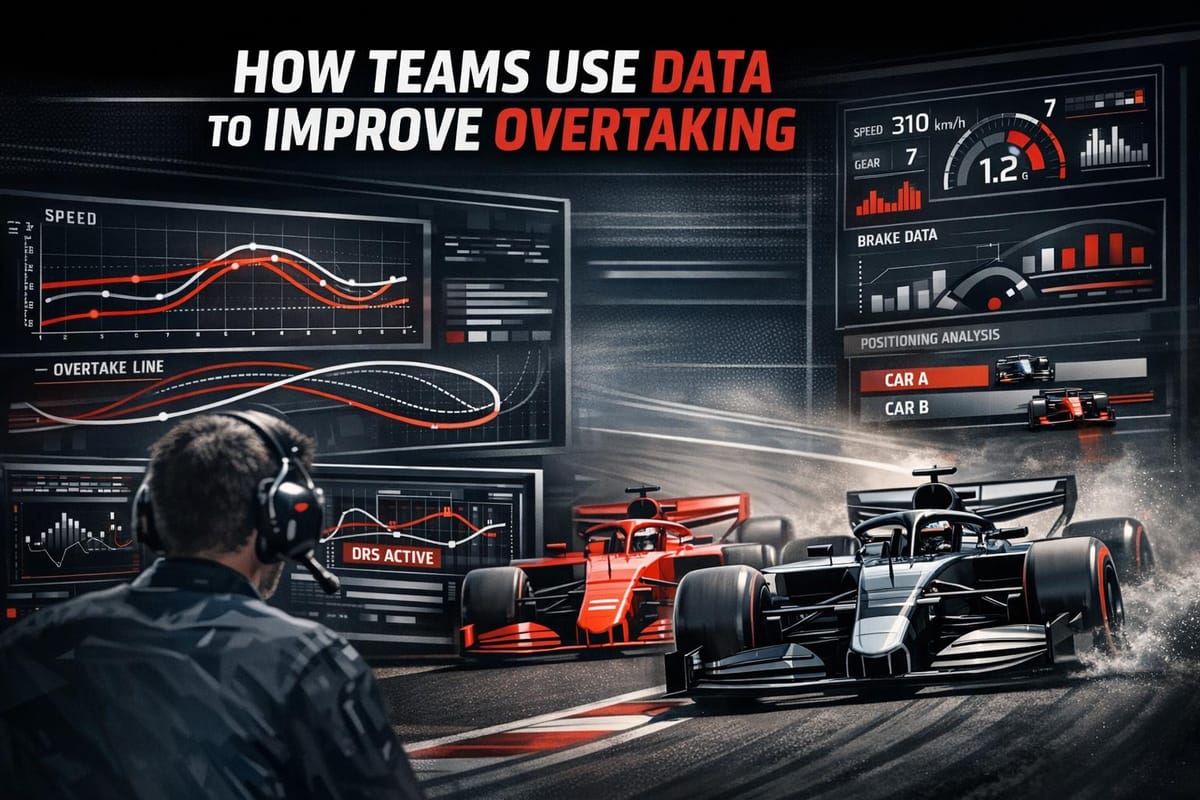
Formula One teams rely on billions of data points and advanced AI models to refine overtaking strategies. By analyzing real-time telemetry from over 300 sensors, historical race data, and tire degradation metrics, teams make precise decisions on when and how to overtake. Key tools like the Drag Reduction System (DRS) and Energy Recovery System (ERS) provide speed and power boosts, but their effectiveness depends on data-backed timing.
- 2024 saw an 11% drop in overtakes, making data-driven strategies more important.
- AI models now predict overtaking scenarios with 95% accuracy, combining human expertise with machine learning.
- Tire condition accounts for 20% of strategic importance, surpassing factors like fuel levels and track position.
- Teams use simulations to test thousands of race scenarios, optimizing pit stops, tire management, and energy deployment.
From using digital twins to leveraging cloud-based analytics, data is transforming overtaking into a precise science. With upcoming 2026 regulations introducing active aerodynamics and manual energy systems, teams must continue evolving their approach to stay competitive.
📉 New data: Why overtaking in F1 has got MUCH worse
Data Sources Teams Use for Overtaking Analysis
Formula One teams rely on a variety of data streams to find opportunities for overtaking and to fine-tune their race strategies. Together, these sources provide a detailed view of car performance, competitor behavior, and track conditions throughout the race weekend.
Telemetry Data from Car Sensors
F1 cars are equipped with sensors that fall into five main categories: thermal, pressure, inertial, control, and displacement. These sensors continuously collect performance data, which plays a crucial role in strategy.
For example, tire sensors monitor heat, pressure, and degradation, helping teams calculate the "pace delta" required for overtaking. Meanwhile, engine and mechanical data - like temperatures and gear shift timing - ensure the car can endure the stress of an overtaking maneuver. Real-time telemetry also feeds digital twins of the car, allowing teams to run aerodynamic simulations on the fly.
A great example of telemetry in action occurred at the 2019 British GP. Mercedes used real-time tire wear and fuel data to time a critical pit stop during a safety car period. Similarly, at the Brazilian GP that same year, Red Bull's data-driven approach resulted in a record-breaking 1.82-second pit stop, helping them maintain track position.
Timing and Historical Race Data
In addition to live sensor data, historical timing information is essential for shaping race strategies. While telemetry focuses on real-time performance, historical data helps teams predict and refine their plans.
About a week before a race, teams dive into circuit-specific performance data and pit-stop deltas to build a baseline strategy. This includes analyzing factors like pit loss times and comparing in-lap versus out-lap performance to decide whether an undercut or overcut strategy is more viable.
"Typically, about a week before a race, we start pulling together the main variables - how the tyres degrade over time, how much time is lost in pit stops, which drivers perform better at which circuits, and the underlying pace of the cars and teams." - Neil Martin, Strategist, Ferrari/McLaren/Red Bull
Teams often run tens of millions of simulations before a race to identify weak points and assess risks. During the race, GPS-based timing data provides real-time gaps to rivals, helping strategists pinpoint "traffic windows" where a driver can rejoin the track in clean air after a pit stop. Advanced models, like deep learning algorithms trained on F1 telemetry data, have reached a precision of 0.77 and a recall of 0.86 in forecasting optimal pit stop timing.
A standout example of timing data in action was the 2009 Chinese Grand Prix. Under wet conditions and a safety car, Red Bull strategist Neil Martin noticed that cars pitting early were losing significant time - about 40 seconds - due to spray and poor visibility. By staying out, Red Bull capitalized on clean air, allowing Sebastian Vettel and Mark Webber to secure the team's first-ever 1–2 finish.
Tire Degradation and Race Pace Metrics
Tire metrics are another critical piece of the puzzle when it comes to overtaking.
One key metric is tire energy, which reflects the power applied to each tire and indicates the rate of degradation. Teams track the base pace of a new tire and compare it to its degradation rate (performance drop per lap) to find the "crossover point" - the moment when a car on fresh tires becomes fast enough to overtake a rival.
"The optimal pit stop decisions can be determined by estimating the tyre degradation of these compounds, which in turn can be computed from the energy applied to each tyre, i.e. the tyre energy." - Jamie Todd, Department of Computing, Imperial College London
Grip differential also plays a major role in overtaking. For example, a 10% drop in grip for both cars can increase the likelihood of a successful overtake by over 15.33%. In the 2021 season, a car needed a 1.06-second pace advantage for a 20% chance of overtaking per lap. However, with the reduced aerodynamic wake introduced in the 2022 regulations, that required delta dropped to just 0.42 seconds. To refine these calculations, teams are increasingly using AI tools, such as deep learning and gradient-boosted tree models (like XGBoost), to predict tire energy and degradation in real time.
Key Metrics for Overtaking Strategies
Once teams have gathered and analyzed their data, they zero in on specific metrics that shape decisions about attacking or holding position on the track.
DRS Zone Performance
The Drag Reduction System (DRS) gives an attacking car a speed boost of about 10.5 to 16.8 mph over the defending car. Teams carefully evaluate real-time telemetry to determine if this advantage, combined with the aerodynamic "slipstream" effect, is enough to execute a pass.
Engineers keep a close eye on the critical 1-second DRS activation threshold by tracking GPS data in real time. Additionally, they assess how drivers use their Energy Recovery System (ERS), which delivers around 160 HP for 33 seconds per lap. The synergy between DRS and ERS deployment often decides whether a driver successfully overtakes or falls short.
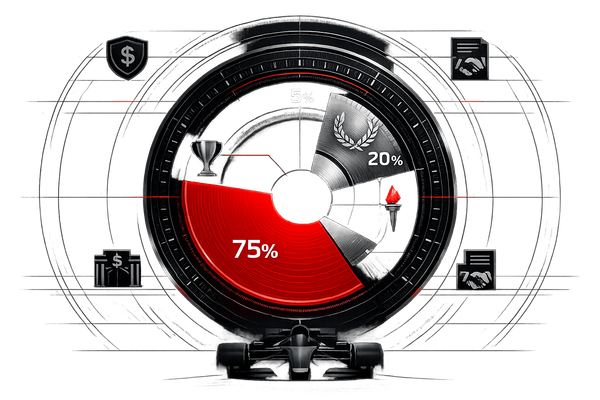
Take the Red Bull Ring in 2025 as an example: Zone 1 on the main straight had a 75% success rate for overtakes when DRS was activated. Insights like this help teams pinpoint which zones are prime for passing and which only narrow the gap without enabling a full maneuver.
Undercut and Overcut Effectiveness Analysis
Pit stop strategies - whether undercutting or overcutting - are another critical focus. The undercut leverages fresh tires to gain an advantage during a rival's pit stop, while the overcut uses clean air and extended tire life to achieve the same goal.
Teams compare lap times of worn tires versus fresh ones to decide the best course of action. They also factor in "pit loss", the total time spent entering, stopping, and exiting the pit lane. Higher pit loss times often favor fewer stops, whereas rapid tire wear pushes teams toward more aggressive multi-stop approaches.
At the Qatar Grand Prix in October 2023, McLaren set a world record with a 1.80-second pit stop for Lando Norris. This, combined with pinpoint strategy simulations, helped Norris climb from 10th on the grid to a 3rd-place podium finish. Dan Keyworth, McLaren's Director of Business Technology, highlighted the importance of precision:
"Everybody's doing everything in their power to find milliseconds. And that's what makes the difference between winning and losing".
Similarly, at the Azerbaijan Grand Prix in September 2024, Oscar Piastri secured victory by "going long" and successfully defending against Charles Leclerc. Despite ranking only 18th in speed trap data, Piastri's strategic tire management proved decisive.
Metrics from these strategies, combined with driver positioning data, create a comprehensive view of race dynamics.
Driver Position Relative to Race Projections
Teams also analyze driver positioning to predict overtaking opportunities, using a "standardized rank" to compare a driver’s current position against their expected performance. By factoring in real-time telemetry and pit strategy data, this metric helps teams determine if a driver is underperforming or maximizing their car's potential.
The standardized rank is calculated by comparing a driver’s current standing to their expected position based on the weekend’s fastest lap. A positive difference signals that a driver has strong potential to recover positions.
This analysis weighs several factors: tire age accounts for 20%, the gap to the car ahead for 11%, fuel level (affecting weight and cornering speed) for 10.5%, track position for 10%, and throttle application patterns for 9%. AI models use these inputs to recommend whether a driver should hold position or attempt an overtake for better race outcomes.
Another key metric is the "gap convergence rate", which measures how quickly a trailing car is closing in on the leader. This real-time data informs decisions about when to deploy ERS, anticipate DRS activation, or predict if an overtaking move will be possible within the next few laps.
Technologies That Enable Overtaking Analysis
Modern racing strategies rely heavily on advanced technologies to turn raw data into actionable decisions. Behind every overtaking move on the track lies a sophisticated system that processes vast amounts of telemetry in real time. These tools help engineers provide drivers with precise, split-second guidance.
AI and Machine Learning Applications
Artificial intelligence and machine learning play a pivotal role in analyzing live telemetry data - such as speed, throttle input, ERS deployment, and gap distances. These models help categorize situations into strategic options like "Hold Position", "Attempt Overtake", or "Apply Pressure". Transformer-based architectures, which have surpassed LSTMs in handling complex, multi-layered decisions, are now a key part of this evolution. While LSTMs excel at simpler tasks, such as determining when to activate DRS with a 94% AUC, Transformers handle broader strategy questions more effectively.
In June 2025, researcher Siddhant Gaikwad introduced the "DRS Decision AI", a Transformer model with 1.36 million parameters that achieved a 95% F1 Grade in strategic predictions. This model analyzed telemetry over 50-timestep windows and accurately forecasted key moments during the 2025 Austrian Grand Prix. For example, it predicted Oscar Piastri's pole position based on McLaren’s low-drag setup and estimated a 75% success rate for overtakes in the Red Bull Ring’s first DRS zone.
AI-powered digital twins further enhance decision-making by simulating potential race scenarios. These simulations evaluate outcomes like traffic after pit stops or the risks tied to failed overtakes. A Bidirectional LSTM model used for pit strategy demonstrated a precision of 0.77 and a recall of 0.86 in identifying optimal pit windows. By combining AI insights with simulation tools, teams can refine strategies in real time.
Simulation Tools for Race Strategy
Cloud-based simulation platforms have revolutionized how teams test overtaking scenarios. These systems run virtual "Overtaking Laps", where a simulated car chases down and passes a "Dynamic Lap", helping determine the precise pace advantage needed for a successful overtake.
In January 2022, Rowland Jowett of Canopy Simulations led a groundbreaking "overtaking fundamentals study" at the Austin circuit. By simulating thousands of overtakes, the study quantified the impact of the 2022 regulation changes. It revealed that reducing aerodynamic wake from 46% to 18% increased overtaking probability from 20% to 92% for cars with consistent grip advantages. Interestingly, the study also found that heavier cars (1,000 kg vs. 800 kg) had an easier time overtaking in simulated conditions.
Pre-race simulations allow teams to evaluate variables like engine power, vehicle mass, and aerodynamic wake. For instance, a 2021-spec car required a 1.06-second pace advantage for a 20% chance of overtaking, while a 2022-spec car needed only a 0.42-second advantage.
AWS and Real-Time Analytics
Cloud-based analytics platforms further enhance decision-making during races. These systems connect trackside engineers with factory-based "race support" centers, where powerful computing resources run thousands of simulations per second to refine strategies. AWS has significantly boosted simulation efficiency, tripling CFD (Computational Fluid Dynamics) throughput and cutting processing times by 50%.
McLaren Racing demonstrated the potential of these tools by securing back-to-back Constructors' Championships in 2024 and 2025. Using advanced simulation technology developed with Deloitte, McLaren processed thousands of simulations per second. Engineers at the McLaren Technology Centre received real-time data from the car in as little as 52 to 290 milliseconds, enabling them to provide immediate strategic feedback to the pit wall.
These platforms also support dynamic scenario testing, such as calculating the success probability of undercuts based on live traffic and tire wear data. AWS-powered insights like Overtaking Probability predict position changes on each lap, while the Battle Forecast estimates how many laps it will take for a car to reach DRS range.
Case Studies: Data-Driven Overtaking Examples
These examples show how data analytics transforms race strategies into successful overtaking maneuvers.
Mercedes' Bahrain Undercut Strategy
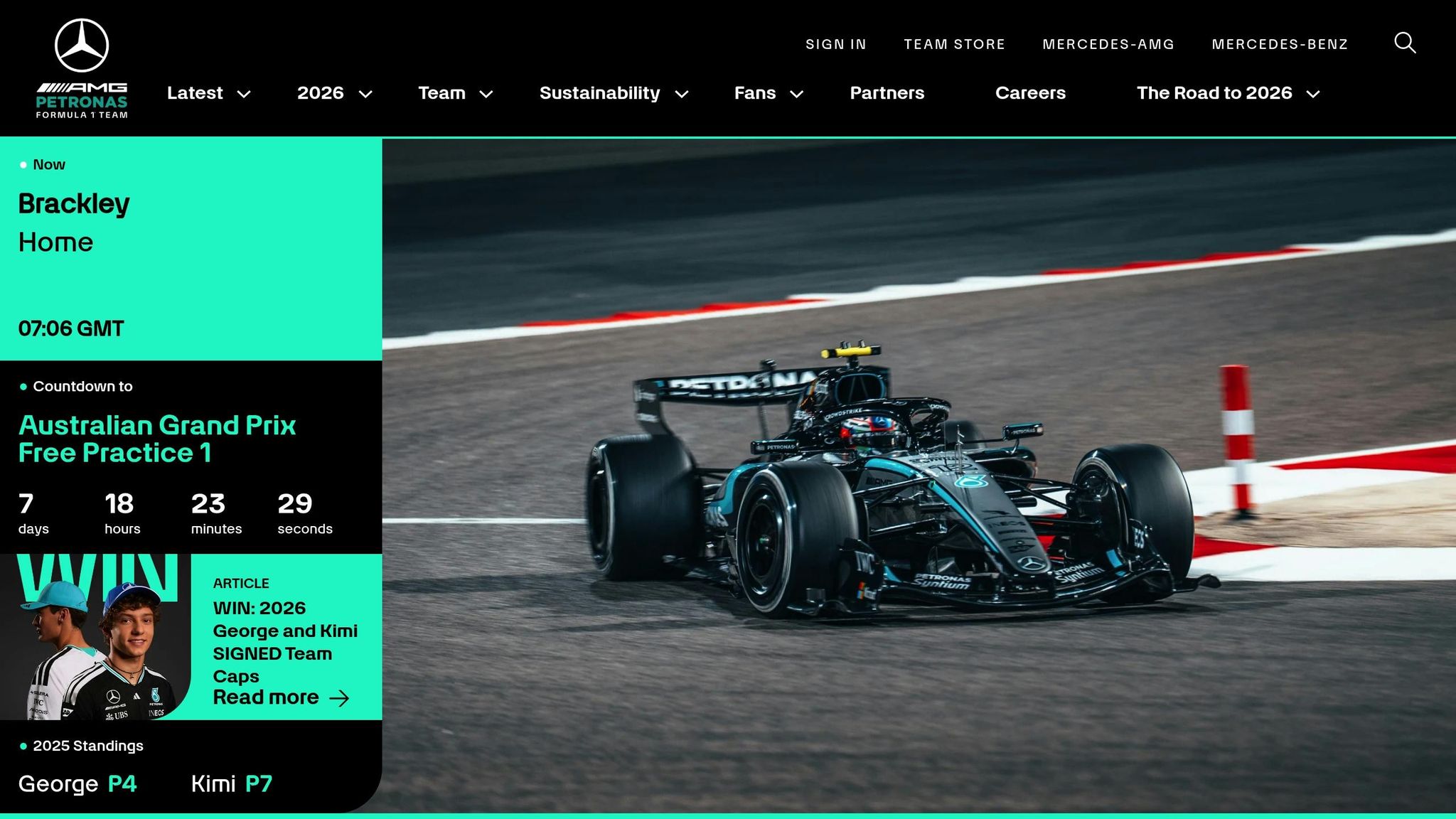
During the Bahrain Grand Prix, Mercedes used real-time telemetry and pre-race simulations to perfectly time an early pit stop. This strategy capitalized on the fresh-tire advantage, which can provide a speed boost of 0.8–1.2 seconds per lap. Success relied on predicting competitors' tire degradation and allowing the driver to immediately maximize the advantage. This level of precision demonstrates how data sharpens strategic decisions - a concept that Red Bull has also mastered.
Red Bull's DRS Exploitation Strategies
Red Bull has taken overtaking to the next level by combining multiple data streams to optimize their use of DRS (Drag Reduction System). They assess DRS effectiveness as a key performance metric, with Max Verstappen achieving a top score of 0.95, thanks to his superior straight-line speed and positioning. Their strategy also weighs factors like tire age (20%), fuel levels (10.5%), and gap management (11%) to ensure overtakes are efficient and sustainable. By analyzing this data, drivers can conserve energy and focus on high-probability DRS opportunities. In 2016, Verstappen broke records with 78 overtakes in a single season - 60 of which were completed while racing for Red Bull.
Ferrari's Tire Data-Driven Adjustments
Ferrari relies on real-time telemetry to monitor tire wear and pinpoint "compound cross-overs" - moments when switching to a different tire compound offers better performance. Engineers analyze fuel-corrected lap times, accounting for a 0.03-second loss per kilogram of fuel burned, to isolate the tire's performance. At the November 2025 Las Vegas Grand Prix, Charles Leclerc started ninth and overtook Oscar Piastri using this data-driven approach. Ferrari's pit wall tracked Piastri's front tire graining through visual cues and telemetry while advising Leclerc to preserve his Medium tires. This helped him maintain a pace advantage and execute a clean overtake. Known as "offset grip", this strategy leverages a 0.6–0.9 second advantage when a driver has a 12- to 15-lap tire delta, enabling decisive moves like lunges into Turn 1 or cutbacks.
However, even the best data can lead to errors if misinterpreted. At the August 2022 Hungarian Grand Prix, Ferrari's data suggested Medium tires could last 30 laps. Yet, they pitted Leclerc after just 19 laps, switching to Hard tires that were 1 second slower per lap. This misstep cost him track position and a chance at the podium.
The Future of Data in Overtaking Strategies
F1 Overtaking Rules: 2021 vs 2022 vs 2026 Regulations Compared
F1 teams are gearing up for a new era where data takes center stage in overtaking strategies. With advancements in technology and upcoming regulatory shifts, teams will need faster analysis and smarter predictive tools to stay competitive. Here's a closer look at the key areas shaping this transformation.
Impact of Ground Effect Aerodynamics
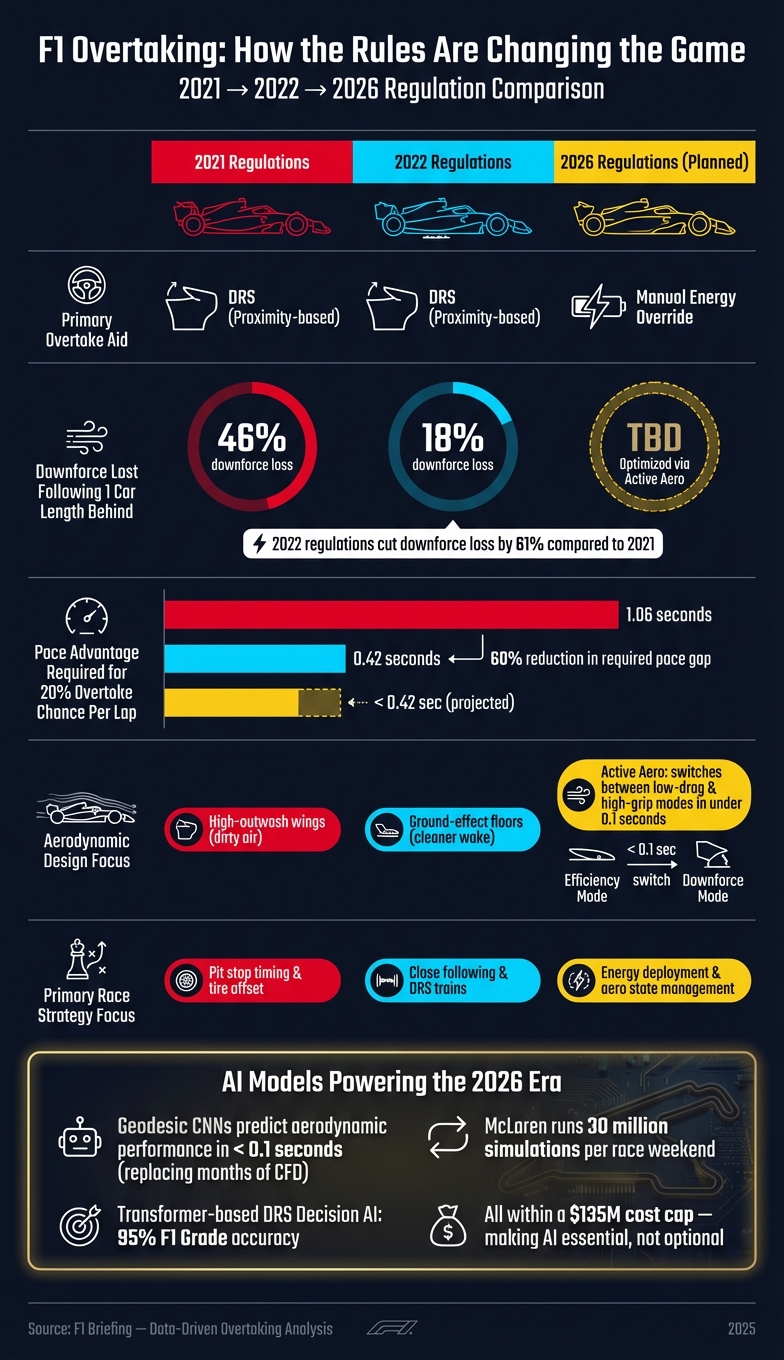
The introduction of ground-effect aerodynamics in 2022 has revolutionized how teams approach overtaking. Cars now lose just 18% of their downforce when following one car length behind, a massive improvement from the 46% loss under the 2021 rules. This change allows drivers to stay closer to the car ahead, creating more opportunities to overtake.
To put it into perspective, the pace advantage required for a 20% chance of overtaking per lap has dropped significantly - from 1.06 seconds to just 0.42 seconds. This tighter margin has shifted team focus toward simulations that optimize performance in these close racing scenarios, where even minor differences in speed or positioning can make all the difference.
Evolving Machine Learning Models
Machine learning is becoming a critical tool for predicting overtaking opportunities. Teams are moving beyond simple rule-based systems to advanced models like Bidirectional LSTMs and GRUs, which can analyze how early-race decisions impact overtaking chances later on. For example, a Bi-LSTM model trained on F1 telemetry data achieved impressive results: 0.77 precision, 0.86 recall, and an F1-score of 0.81 in forecasting strategy outcomes.
Reinforcement learning is also making strides in wheel-to-wheel racing scenarios. Models designed for overtaking maneuvers have achieved an 87% success rate, compared to 56% for those focused solely on speed. McLaren, for instance, conducts an average of 30 million simulations per race weekend. As Jude Hunt, a Data Scientist at McLaren Racing, explains:
"No human would be able to trawl through all of it - it'd take a person years to just get through a single race weekend. These AI models, on the other hand, can trawl through it in seconds".
The rapid evolution of these predictive tools is essential as teams prepare for the next wave of regulatory changes.
Future Regulation Changes and Data Adaptation
The 2026 regulations are set to introduce major changes, including the elimination of proximity-based DRS in favor of active aerodynamics and a manual energy override system. Instead of relying on a one-second detection zone, drivers will have to manage energy deployment manually to complete overtakes. This will require teams to model intricate energy dynamics between competing cars.
Active aerodynamics will add another layer of complexity. These systems will switch between low-drag (efficiency) and high-grip (downforce) modes in under 0.1 seconds, demanding real-time optimization. Additionally, the ERS system, which currently delivers around 160 horsepower for 33 seconds per lap, will become the primary overtaking tool.
To prepare, teams are adopting advanced technologies like geodesic Convolutional Neural Networks, which can predict aerodynamic performance in under 0.1 seconds. This replaces months of computational fluid dynamics (CFD) simulations. These AI-driven digital twins enable engineers to test thousands of design and race scenarios well before the 2026 cars hit the track.
| Parameter | 2021 Regulations | 2022 Regulations | 2026 Regulations (Planned) |
|---|---|---|---|
| Primary Overtake Aid | DRS (Proximity-based) | DRS (Proximity-based) | Manual Energy Override |
| Aerodynamics | High-outwash wings | Ground-effect floors | Active Aero (Efficiency/DF modes) |
| Downforce Loss (1 car length) | 46% | 18% | TBD (Optimized via Active Aero) |
| Strategy Focus | Pit stop/Tire offset | Close following/DRS trains | Energy deployment/Aero state |
With the $135 million cost cap in place, these AI tools are not just helpful - they’re essential. They allow teams to run countless simulations without the need for costly physical tests or wind tunnel sessions. As the sport evolves, data will remain the cornerstone of race strategy, especially when it comes to mastering overtaking.
Conclusion
Overtaking in Formula One has transformed from relying on gut instinct to becoming a finely tuned, data-driven art. Modern drivers and teams juggle factors like ERS deployment, tire wear, and fuel levels to seize the perfect moment - down to the millisecond.
In 2022, regulation changes made a massive impact by cutting downforce loss from 46% to just 18% at one car length. Teams quickly adapted, using real-time simulations to capitalize on this advantage. McLaren, for instance, demonstrated the power of rapid data processing, transmitting information in just 52 milliseconds and running thousands of simulations per second. This precision played a key role in their back-to-back Constructors' Championships in 2024 and 2025.
With the $135 million cost cap limiting physical testing, teams now lean heavily on AI simulations and digital twins to stay ahead. These tools have become essential for refining strategies and car performance within strict budget constraints.
Looking ahead, the 2026 regulations will push the boundaries of data usage even further. Teams that embrace explainable AI and transformer-based models - capable of predicting outcomes and delivering actionable insights - will gain a critical edge. This shift is set to redefine how race strategies are developed and executed.
As explored here, Formula One is evolving into a sport where data is as important as speed. For F1 Briefing readers, understanding these strategies provides a glimpse into the cutting-edge innovations driving the future of racing.
FAQs
What data matters most for overtakes?
Key elements for overtaking in Formula 1 involve real-time telemetry, driver positioning, and the unique conditions of each track. Teams closely monitor crucial aspects like DRS (Drag Reduction System) activation zones, vehicle speed, tire degradation, and G-forces as they unfold during the race. Using advanced predictive analytics, they process millions of data points every second to fine-tune strategies and execute overtaking moves with pinpoint accuracy.
How do teams decide when to use DRS and ERS?
Teams rely on real-time data and strategy to determine the best moments to activate DRS (Drag Reduction System) and ERS (Energy Recovery System). DRS is used in designated zones when a driver is within one second of the car ahead, helping reduce drag and boost speed for overtaking. Meanwhile, ERS is carefully managed to balance energy recovery and deployment. Whether during braking, overtaking, or defending, teams use telemetry and predictive models to ensure the system is used effectively for maximum performance.
How will 2026 rules change overtaking strategy?
The 2026 Formula 1 regulations are set to shake up how overtaking works on the track. With technical and regulatory updates on the horizon, the way teams approach passing maneuvers will evolve significantly.
One of the standout changes is the shift to increased electrical power and a more evenly balanced hybrid system. These adjustments will directly affect how cars handle and how energy is managed during a race. Drivers will need to adapt to these new dynamics, as energy deployment and car control will play an even bigger role in overtaking.
Teams will also lean heavily on data analytics to refine their strategies. Tools like telemetry and AI will help monitor tire wear, energy usage, and track conditions in real time. This means overtaking will become less about instinct and more about careful, calculated decisions, making every pass on the track a precise and strategic move.