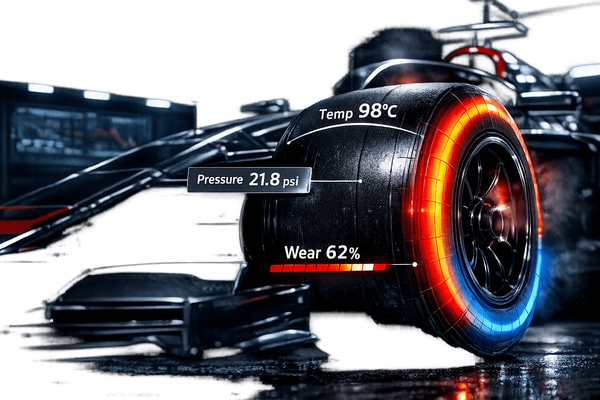
How Tire Heat Shapes F1 Race Strategies
Tire temperatures control grip, wear and pit strategy; how teams target a 90–110°C sweet spot to optimize stints and race decisions.
Tire heat is one of the biggest factors in Formula 1 strategy. Why? Because managing tire temperatures directly impacts grip, tire life, and pit stop timing. Here's a quick breakdown of how it works:
- Optimal range: F1 tires perform best between 90–110°C (194–230°F). Below 80°C (176°F), grip drops significantly. Above 120°C (248°F), tires degrade quickly.
- Compound choice: Softer tires heat up faster but wear out sooner. Harder tires are more durable but take longer to reach their ideal temperature.
- Key strategies: Teams adjust tire pressures, camber angles, and even brake cooling systems to control heat. During races, drivers use techniques like "lift-and-coast" to manage overheating or warm up cold tires.
For example, at the 2024 Singapore Grand Prix, teams strategically used Medium and Hard compounds to handle challenging track temperatures, with some drivers stretching tire stints up to 49 laps.
Managing tire heat isn’t just about speed - it’s about balancing performance and tire preservation to outsmart competitors. Every decision on the track, from pit stops to driving style, revolves around keeping those tires in their sweet spot.
Pirelli F1 Tyres: Temperature and Strategy for Peak Performance

How Tire Temperature Affects Performance
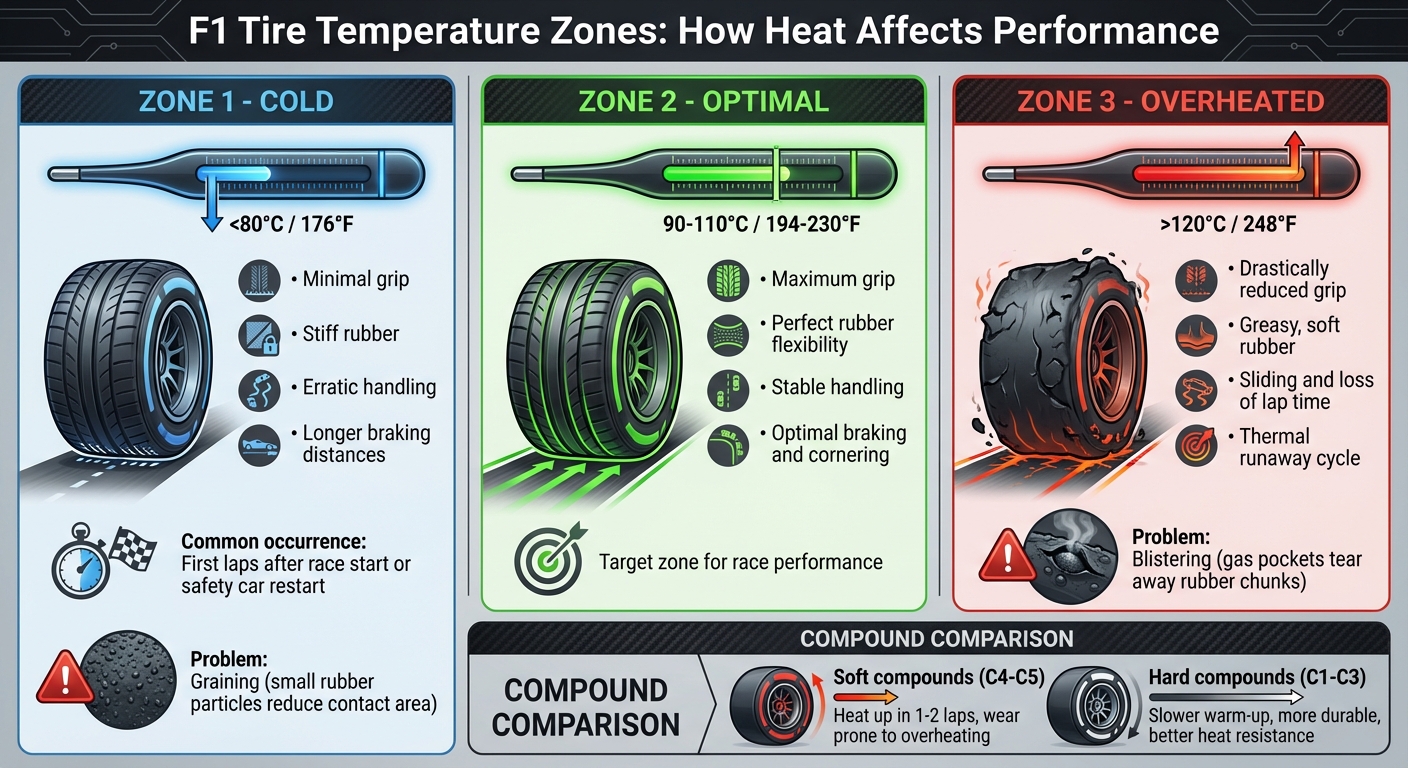
F1 Tire Temperature Zones and Performance Impact
Temperature Ranges: Cold, Optimal, and Overheated
Tires behave differently depending on their temperature, and their performance can be categorized into three main zones. When the temperature is below 80°C (176°F), the rubber remains stiff, unable to properly grip the track's surface. In this "cold" state, grip is minimal, handling becomes erratic, and braking distances grow longer. These conditions are particularly tricky during the first laps of a race or after a safety car restart.
The sweet spot for tire performance lies between 90–110°C (194–230°F). At this temperature range, the rubber achieves the perfect balance of flexibility and stiffness. This allows for maximum contact with the road, stable handling, and dependable performance during hard braking and high-speed cornering.
When tire temperatures exceed 120°C (248°F), they enter the "overheated" zone. At this point, the rubber softens excessively, becoming greasy and drastically reducing grip. This leads to sliding, which generates even more heat in a vicious cycle often called thermal runaway. In such cases, drivers may lose significant lap time and need to back off for a few laps to let the tires cool.
These temperature zones are driven by how heat interacts with the rubber at a molecular level.
The Physics Behind Heat and Tire Behavior
Heat plays a critical role in how tires perform. At the molecular level, increasing temperatures enhance the rubber's viscoelastic properties, allowing it to deform and recover efficiently. This flexibility helps the tire grip the road by interlocking with its microtexture, increasing friction through adhesion and hysteresis.
However, when the temperature strays too far from the optimal range, problems arise. If tires are too cold, a condition known as graining can occur. This happens when the tread slides instead of fully gripping the surface, creating small rubber particles that reduce the tire's contact area. On the other hand, when tires get too hot, blistering can develop. This occurs when excessive internal heat forms gas pockets beneath the tread, causing chunks of rubber to tear away. Both graining and blistering can severely impact performance, often leading to early pit stops.
The type of tire compound plays a significant role in how these thermal effects unfold.
Soft vs Hard Compounds: Temperature Differences
Different tire compounds respond to heat in unique ways. Pirelli’s lineup, ranging from C1 to C5 (with C6 being introduced in 2025 for select tracks), is designed to handle varying thermal conditions. Softer compounds, like C4 and C5, heat up quickly - often reaching their ideal temperature range within just one or two laps. These tires provide exceptional grip but are prone to overheating and wearing out faster, especially on hot tracks or in heavy traffic.
Harder compounds, such as C1 through C3, take longer to warm up but are much more durable under intense heat. In scorching conditions, teams often choose harder compounds to prevent rapid degradation. A balanced approach is common, with teams selecting a mix of compounds to combine quick warm-up times with durability for longer stints.
This temperature sensitivity is a key factor in race strategy. Softer tires are ideal for qualifying laps, where quick heat-up and peak grip are crucial. For longer race stints, especially on hot days, harder compounds are preferred to ensure consistent performance under sustained stress.
How Teams Control Tire Heat During Races
Pre-Race Setup Changes
Before the race kicks off, teams fine-tune their setups to keep tire heat in check. One of the most crucial adjustments involves tire pressure. Teams start with the minimum pressure allowed and refine their targets using simulations, practice sessions, and thermal camera data. Typically, warm tire pressures settle around 180 kPa (26 psi), which helps reduce tire flex and friction. This balance keeps operating temperatures manageable while ensuring the tires maintain enough grip on the track.
Camber angles play a big role in distributing heat evenly across the tire's width. Ideally, the temperature difference between the inner and outer edges stays within 5–10°C (9–18°F). Negative camber, which tilts the top of the tire inward, increases the contact patch during cornering, generating extra heat - useful on cooler or smoother tracks. However, on hotter or more abrasive circuits, teams tone down aggressive camber settings to avoid overheating and blistering the tire shoulders. Suspension tweaks also come into play - softer setups make the tires work harder, generating more heat, while anti-roll bars help even out temperatures between the left and right sides.
Brake cooling is another critical factor. Larger brake ducts are used to cool the brakes, reducing the amount of heat transferred to the tires. Meanwhile, adjustments to front toe-in and rear toe-out increase tire scrub, which helps quickly generate heat - especially useful after pit stops or during qualifying runs.
These pre-race changes lay the groundwork for managing tire heat during the race itself.
In-Race Adjustments and Driver Methods
Once the race begins, drivers and engineers use dynamic strategies to keep tire temperatures in the sweet spot. One key tool is brake bias adjustment. Shifting the bias forward lowers rear brake temperatures, which in turn reduces heat in the rear tires. Conversely, after a safety car period, shifting the bias slightly rearward can help warm up cold rear tires faster.
Drivers also use the lift-and-coast technique to manage heat. By lifting off the throttle early and braking gently, they can reduce both brake and engine temperatures, which limits heat transfer to the tires. This method not only cools overheated tires but also conserves fuel, offering a dual benefit.
Throughout the race, the goal is to keep tire temperatures within the optimal range of 90–110°C. Drivers adjust their cornering techniques to minimize sliding, while engineers monitor live temperature data to provide guidance on engine modes and hybrid system deployment. These adjustments ensure balanced rear tire traction and help maintain consistent performance.
How Tire Heat Influences Race Strategy Decisions
Pit Stop Timing and Stint Planning
In Formula 1, managing tire heat is a science, and it directly shapes pit stop strategies and stint planning. Teams rely on real-time telemetry, which streams an astonishing 1.1 million data points per second from each car, to monitor tire temperatures and performance trends. This data powers thermal imaging systems and predictive tools that map out tire degradation curves. When tire temperatures climb beyond 120°C (248°F), blistering accelerates rapidly. On the flip side, temperatures dropping below 80°C lead to a significant loss of grip. Engineers use this information to pinpoint the exact lap when performance is likely to drop off, ensuring pit stops are timed to maximize tire life without risking sudden grip loss.
For example, at the 2024 Singapore Grand Prix, the sweltering track temperatures posed a major challenge. Teams had to carefully manage tire heat, with most drivers starting on the Medium (C4) compound. The goal was to strike a balance between maintaining tire life and delivering competitive lap times on the demanding Marina Bay street circuit.
After a pit stop, the challenge shifts to bringing the tires up to their optimal temperature range, which typically takes 1–3 laps. While tire warmers preheat the rubber to 70–100°C (158–212°F), drivers need to fine-tune this further. Engineers provide real-time advice over the radio, guiding drivers to use smooth inputs for stability while scrubbing the tires to generate extra heat on low-energy circuits. Missteps during this crucial phase can cost valuable seconds per lap until the tires stabilize.
Track-Specific Heat Challenges
Tire performance is also heavily influenced by the unique demands of each circuit. High-energy tracks, like Silverstone, with its long, fast corners, generate intense heat from sustained lateral forces. These conditions often push tire temperatures past 120°C, forcing teams to opt for harder compounds, such as C3 or C4, to withstand the heat. Abrasive track surfaces add another layer of complexity, accelerating wear through friction and requiring compounds that can handle both mechanical and thermal stress. On the other hand, low-energy circuits, like Monaco, present a completely different challenge. Here, softer compounds and aggressive camber settings are necessary to generate enough heat in the tires through slow-speed corners, ensuring adequate grip.
Ambient and track temperatures further complicate tire management. Warmer conditions speed up the initial tire warmup and improve grip, but they can also lead to graining or blistering if the tires are overworked. At the 2024 Singapore Grand Prix, the cooler night-time conditions created a unique scenario. Fourteen drivers started on Medium compounds, leveraging the lower temperatures to manage heat buildup during extended stints. To adapt to these varying conditions, teams adjust everything from compound selection to camber angles and toe settings, aiming to keep tire edge temperature differences within 5–10°C (9–18°F) for balanced wear and performance.
Recent Advances in Tire Heat Management
New Heat Control Technologies
Formula 1 teams are constantly refining passive thermal management techniques to stay within FIA regulations while gaining a competitive edge. For instance, innovations in brake duct designs now allow teams to carefully manipulate airflow. This helps tires warm up faster during out-laps or avoid overheating during prolonged high-speed runs. Another breakthrough comes from advancements in wheel drum engineering, where phase-change materials are being used. These materials melt at an ideal tire temperature - typically between 90–110°C (194–230°F) - to regulate heat effectively. McLaren, for example, has incorporated these materials into their wheel drums, borrowing techniques from advanced road tire technologies to create a regulation-compliant cooling system.
Real-time thermal imaging and predictive modeling are also transforming how teams manage tire heat. By monitoring temperatures across various tire compounds, teams can feed this data into advanced algorithms that predict tire degradation. This technology identifies the critical moments when grip starts to deteriorate - whether due to tires staying too cool below 80°C (176°F) or overheating beyond 120°C (248°F). Armed with this data, engineers can optimize pit stop timing with incredible precision.
These innovations have also influenced Pirelli's approach to tire compound strategies.
Pirelli's Tire Development Approach
Pirelli's tire development focuses on achieving the perfect balance between warm-up speed, peak grip, and durability. Their compounds - such as the C3 (Hard), C4 (Medium), and C5 (Soft) - are designed to quickly reach the optimal temperature range of 90–110°C while minimizing thermal degradation under stress. This balance is especially vital on circuits that place extreme heat demands on tires. For instance, at the 2024 Singapore Grand Prix, Pirelli avoided using the ultra-soft C6 compound, recognizing its tendency to overheat on the challenging Marina Bay street circuit.
The effectiveness of this strategy was on full display in Singapore. The C4 Medium compound showcased impressive thermal stability, enabling teams to execute one-stop strategies with stints lasting up to 49 laps - even without a Safety Car intervention. This level of thermal resilience gave teams the flexibility to extend stints and fine-tune pit stops, directly impacting race strategies on circuits known for high temperatures.
Conclusion: Why Tire Heat Management Matters in F1
In Formula 1, managing tire heat is a game-changer. To achieve peak performance, teams need to keep tire temperatures within the sweet spot of 90–110°C (194–230°F). Staying in this range allows drivers to maintain qualifying-level pace over longer stints, execute undercut and overcut strategies with precision, and steer clear of the dreaded performance drop caused by overheating or excessive wear.
These temperature thresholds now influence nearly every strategic decision on race day. Teams factor tire heat data into their planning, treating it as a key variable from the start lights to the checkered flag. Predictive models help strategists anticipate how tire temperatures will evolve, guiding decisions on pit stop timing and stint lengths to minimize degradation and maximize performance. Recent races highlight how maintaining thermal stability has enabled teams to stretch stints and successfully pull off flexible one-stop strategies.
Advancements in technology and strategy have turned tire heat management into a powerful tool. From phase-change materials to thermal imaging and adaptive driving techniques like lift-and-coast, teams now have the means to dynamically adjust their approach as track conditions change. Combined with driver skill and tactical precision, this transforms tire heat from a simple setup factor into a critical weapon in the fight for victory.
FAQs
How do F1 teams choose the right tire compounds for each track?
F1 teams carefully choose tire compounds by evaluating several crucial elements, including the track's surface, its layout, and the expected temperature. They also factor in weather predictions and past data on tire performance to anticipate how various compounds will perform during the race.
The objective is to strike the perfect balance between grip and durability, aiming for peak performance while keeping pit stops to a minimum. This process plays a pivotal role since selecting the right tires can have a major impact on race strategies and results.
How do F1 drivers manage tire temperatures during a race?
F1 drivers use several techniques to keep their tires at the right temperature for peak performance and grip. One key method involves fine-tuning their brake and throttle inputs to manage heat buildup effectively. They also adjust steering angles during cornering to minimize unnecessary stress on the tires.
On top of that, drivers tweak their driving style, striking a balance between smooth and aggressive maneuvers. This helps them avoid overheating or letting the tires cool down too much. By paying close attention to these elements, they can make their tires last longer and keep their performance sharp throughout the race.
How does managing tire heat impact F1 pit stop strategies?
Managing tire temperatures plays a key role in determining F1 pit stop strategies. To perform at their best, tires must stay within a specific temperature range. When tires overheat, they lose grip, wear out faster, and compromise the car's performance. On the flip side, if tires are too cold, traction and handling suffer.
To counter these challenges, teams keep a close eye on tire temperatures and carefully plan pit stops to swap out tires before their performance declines significantly. This becomes even more critical during long stints or in scorching conditions, where overheating can quickly lead to tire degradation and impact the race's outcome.