How Wireless Telemetry Works in F1
Explore how F1 teams collect, encrypt, and stream real-time car data from hundreds of sensors—covering transmission, security, challenges, and future tech like 5G and AI.
Wireless telemetry in Formula 1 allows teams to monitor and analyze real-time data from their cars during races. With over 250 sensors generating 150,000 data points every second, this system tracks everything from tire temperatures to engine performance. Teams use this data to prevent mechanical failures, refine race strategies, and optimize car and driver performance. The process involves encrypted wireless transmission via RF networks, with data streamed live to pit walls and headquarters for immediate decision-making. Challenges include bandwidth limits, latency during international races, and cybersecurity threats, but advancements like 5G, AI, and faster Wi-Fi promise to improve efficiency. Telemetry is a cornerstone of F1's success, shaping how teams compete and innovate.
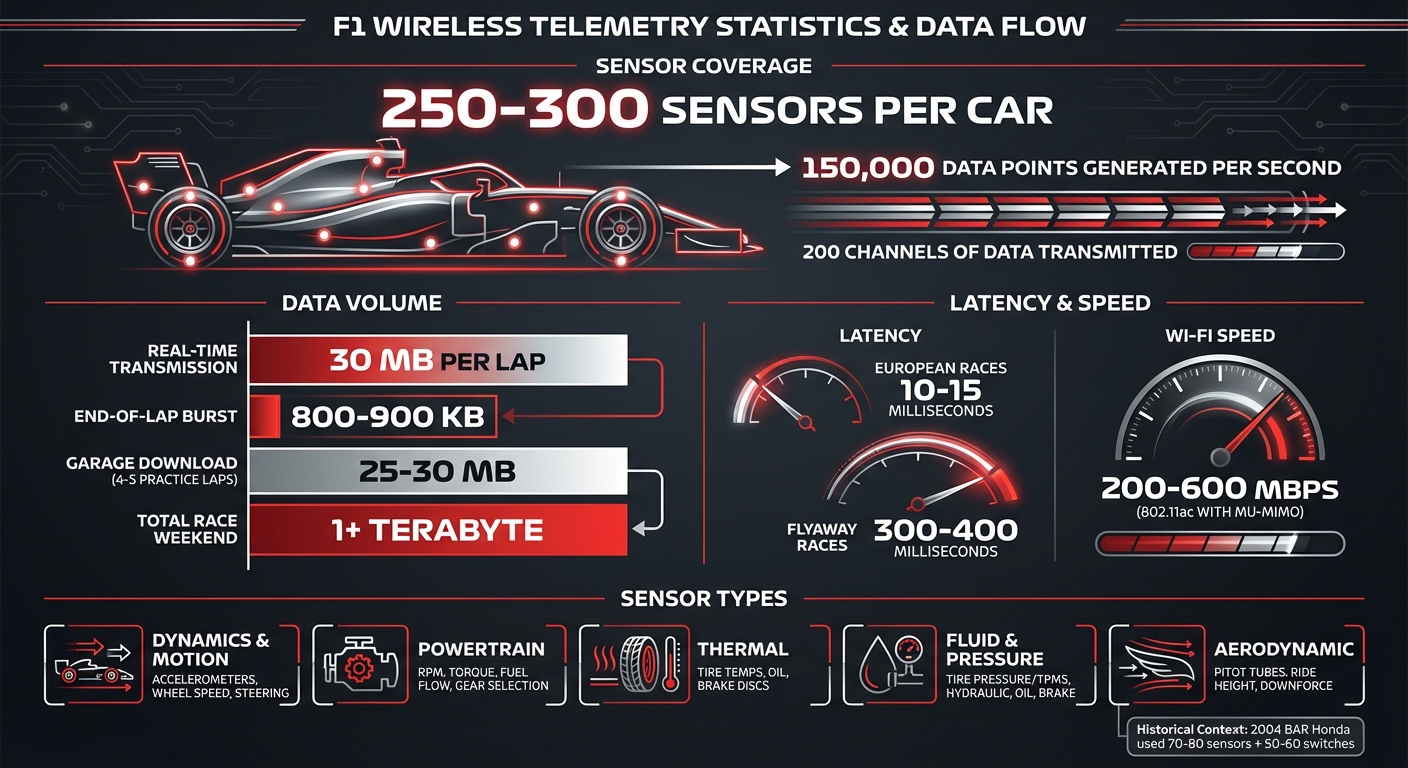
F1 Wireless Telemetry System Statistics and Data Flow
Sensors and Data Collection on F1 Cars
Types of Sensors Used in F1 Cars
Modern Formula 1 cars are equipped with anywhere from 120 to 300 sensors, each playing a crucial role in monitoring various aspects like car dynamics, powertrain efficiency, thermal conditions, fluid pressures, and aerodynamic performance.
Dynamics and motion sensors focus on tracking how the car behaves on the track. Accelerometers measure G-forces during cornering and braking, while wheel speed sensors and steering angle monitors record how the driver’s inputs translate into the car’s responses.
Powertrain sensors keep a close eye on the engine and transmission. They measure parameters such as RPM, torque output, fuel flow rates, and gear selection, ensuring the power unit operates at its peak efficiency.
Thermal sensors are all about managing heat. For instance, infrared sensors mounted on the car’s wings and floor continuously monitor tire surface temperatures. Meanwhile, gauges for engine oil and brake discs ensure these components stay within safe temperature limits.
Fluid and pressure sensors play a protective role, monitoring tire pressures (regulated by the FIA's Tire Pressure Monitoring System or TPMS), as well as hydraulic, oil, and brake pressures. These sensors often provide the first warning signs of potential mechanical issues.
Aerodynamic sensors measure forces that directly affect the car’s performance. Pitot tubes calculate airspeed, ride height sensors measure the gap between the car and the track, and pressure sensors distributed along the bodywork assess downforce levels.
For context, during the 2004 season, the Lucky Strike BAR Honda team utilized around 70–80 sensors and 50–60 monitored switches in race conditions. These systems transmitted over 200 channels of data to their engineers.
How the ECU Manages Data
All the data collected by these sensors flows into the car’s Electronic Control Unit (ECU), which acts as the brain of the vehicle. Evan Short, Team Leader of Trackside Electronics Systems at Mercedes F1, describes the process:
"Those sensors are physically connected, either through an analog system to the electronic control unit (ECU) on the car that runs the whole car or through a series of CAN network busses around the car that brings information back to that central unit."
The ECU ensures that every piece of data is synchronized, giving engineers a precise, real-time understanding of the car’s performance. It processes sensor inputs at incredible speeds, with vibration data sampled at rates as high as 200 kilo-samples per second.
The ECU handles data in two distinct ways. First, it stores high-resolution data internally, which can later be downloaded via a physical cable. For example, this system typically captures about 25–30 MB of data over four to five practice laps. At the same time, the ECU broadcasts lower-resolution data wirelessly in real time, sending around 30 MB of information per lap for immediate analysis by the team on the pit wall. This dual system - combining detailed stored data with live telemetry - lays the groundwork for efficient wireless data transmission during races.
How Data is Transmitted Wirelessly
Wi-Fi and RF Networks in F1
Formula 1's telemetry systems are a marvel of technology and teamwork. These systems allow in-car data to be transmitted wirelessly to the pit wall for quick analysis, ensuring teams can make split-second decisions. The data, once collected by the ECU, is encrypted and sent to the garage using a standardized circuit network. Interestingly, all teams share a unified telemetry system, a rare instance of collaboration in this fiercely competitive sport. As Evan Short, Team Leader of Trackside Electronics Systems at Mercedes F1, puts it:
"The telemetry system is common across all the F1 teams, so there's quite a big infrastructure around the racetrack to ensure we get 100% coverage. That system is common to all the teams, a unique example of cooperation between the F1 teams."
Teams use three main methods to retrieve data from their cars. First, real-time telemetry continuously streams vital information via microwave and RF frequencies during each lap. Second, when the car crosses the start-finish line, it sends an "end-of-lap burst", transmitting a medium-resolution data packet of about 800–900 KB. Finally, when the car returns to the garage, engineers download high-resolution data - roughly 25–30 MB for a short run - using a physical cable.
For more data-intensive tasks, such as analyzing thermal imaging, advanced 5‑GHz Wi‑Fi (802.11ac) systems come into play. Teams like Mercedes have been using this technology since 2015, achieving download speeds that are three times faster than standard Wi‑Fi.
Latency is another critical factor. In European races, data typically takes just 10–15 milliseconds to reach its destination. However, for events in far-off locations like Australia or Japan, latency can rise to 300–400 milliseconds due to the reliance on satellite and fiber relay systems. This seamless integration of multiple transmission methods ensures teams can securely analyze data in real time, a cornerstone of their race strategies.
Data Security and Encryption
Protecting transmitted data is just as important as acquiring it. Before any data leaves the car, it is encrypted to safeguard sensitive performance metrics. As Eric Tegler from Autoblog notes:
"The data is encrypted - there are always prying eyes in Formula 1."
Encryption is crucial because even the smallest detail about a competitor’s setup or tire performance could provide a strategic edge.
To ensure fair competition, the FIA enforces strict regulations on telemetry systems. Teams are required to use FIA-approved equipment and operate within designated frequencies. Bi-directional telemetry, which would allow teams to send commands back to the car, is prohibited. The only exceptions include the FIA Marshalling System and basic connection handshakes.
Beyond encryption, teams must also guard against cybersecurity threats like phishing attacks, ransomware, and espionage. For example, McLaren uses specialized software to detect and block fraudulent communications targeting its executives. The cost of telemetry licenses varies by location, ranging from $600 at Silverstone to $8,100 at circuits in Italy.
How Teams Use Telemetry Data During Races
Real-Time Monitoring and Analysis
Once the wireless telemetry system gathers data, the focus shifts to evaluating performance in real time. This steady stream of information flows straight to the pit wall, where engineers keep a close eye on key systems like hydraulic pressure, fuel injection, oil levels, and brake temperatures. The goal? Spot potential issues before they escalate.
To make sense of this flood of data, most teams rely on ATLAS (Advanced Telemetry Linked Acquisition System), a software developed by McLaren Applied. As Chris Nelson, Trackside Control Systems Engineer at Mercedes F1, puts it:
"Most of us trackside and the vast majority of other Formula 1 teams use software called Atlas made by McLaren Applied".
This tool allows engineers to compare live driver inputs - like throttle position, brake pressure, and steering angle - with data from teammates or even simulated laps. These comparisons help identify where valuable fractions of a second might be slipping away.
But the analysis doesn’t stop at the pit wall. Data is also sent to mission control rooms back at team headquarters in places like Brackley or Grove. Here, engineers dive deeper into the numbers to guide real-time strategy decisions. Over the course of a race weekend, a single car can generate more than 1 terabyte of data, which is roughly the same as 6,900 MP3 files. This constant flow of data ensures teams can make split-second decisions based on precise, actionable insights.
Data-Driven Decisions
Telemetry data isn’t just about monitoring - it’s about action. Teams use these real-time insights to tweak strategies on the fly, addressing mechanical issues or optimizing race tactics. For example, engineers track fuel consumption and monitor tire wear using thermal imaging and pressure sensors to determine the best time for a pit stop. A great example of this was during the 2021 Turkish Grand Prix, when Alpine engineers noticed unexpected tire degradation on Fernando Alonso's car. Thanks to telemetry, they called for an earlier pit stop, helping Alonso secure a points-scoring finish.
This system also acts as an early warning mechanism. Rob Reeve, Chief Engineer of Electronics at BAR Honda, highlighted its importance:
"If the gearbox is losing oil pressure, for example, we will spot it immediately in the telemetry. You can then pull the car in, save the gearbox and, crucially, save the time".
Telemetry doesn’t just monitor the car - it keeps an eye on the driver too. If a driver accidentally selects the wrong fuel mixture or adjusts the differential settings incorrectly, engineers can catch the error immediately and provide corrections over the radio. This constant feedback loop ensures that both the car and the driver are performing at their best throughout the race.
Challenges and Future Developments in Wireless Telemetry
Current Challenges in Wireless Telemetry
F1 teams face a tough road when it comes to transmitting data wirelessly. One of the biggest hurdles? Bandwidth. As Paddy Lowe, Technical Director at Mercedes F1, put it:
"Standard telemetry system simply doesn't have the bandwidth to handle the thermal tire imaging data that the onboard thermal cameras generate".
This limitation forces teams to carefully choose which data gets sent in real time - usually around 30 MB per lap - while saving the larger, high-resolution files for later downloads via physical cables back in the garage.
Latency is another issue. While delays are minimal at European races, they become more challenging during flyaway events. Then there’s signal interference - teams must battle crowded radio frequencies, often competing with local TV broadcasters and other wireless users. On top of that, sensors need to endure extreme conditions like electrical noise, high temperatures, and intense vibrations. To overcome these obstacles, teams often have to design custom solutions in-house.
These challenges have pushed teams to think outside the box and invest in new technologies.
What's Next for Telemetry in F1
The future of F1 telemetry is all about making wireless systems faster, smarter, and more secure. Take Mercedes, for example. Back in October 2015, they teamed up with Qualcomm to roll out a 5 GHz Wi-Fi system using the 802.11ac protocol and MU-MIMO technology. The result? Download speeds up to three times faster than standard 802.11ac - hitting 200–600 Mbps. This upgrade allowed engineers to wirelessly offload thermal imaging data as cars entered the pit lane. The next big leap? Moving to 802.11ad Wi-Fi on the 60 GHz spectrum, which promises even faster speeds and could one day eliminate the need for physical cables entirely.
Other advancements on the horizon include 5G and satellite communications, which could significantly cut down latency during flyaway races and allow for real-time transmission of even more high-resolution data. At the same time, artificial intelligence is becoming a game-changer. With each car equipped with 250–300 sensors generating over 150,000 measurements per second, AI helps teams sift through the flood of information, filtering out irrelevant data and spotlighting what really matters.
On the security side, teams are stepping up their efforts to protect sensitive data. They're using end-to-end encryption and partnering with tech heavyweights - like McLaren with Cisco, Red Bull with Oracle Cloud, and Mercedes with AWS - to guard against digital espionage and keep race-critical information safe.
Former F1 Data Engineer Explains Race Telemetry | MoTeC [#TECHTALK]
Conclusion
Wireless telemetry serves as the backbone of Formula 1, acting like the sport's nervous system. Without it, teams would struggle to identify critical failures, fine-tune driver performance, or make the split-second decisions that can make or break a race.
Consider this: an F1 car is equipped with 250–300 sensors, generating over 150,000 measurements every second. During a single lap, around 30 MB of data is transmitted, adding up to over 1 terabyte of information across a race weekend. These massive data streams, transmitted with barely any delay - especially during European events - allow engineers to perform real-time analysis. Whether it’s spotting an oil pump issue before it leads to engine damage, comparing braking points between teammates, or deciding on the perfect moment for a tire change, telemetry is at the heart of every strategic and technical decision.
Looking ahead, the future of telemetry is even more exciting. Teams are transitioning from 5 GHz Wi-Fi to the 60 GHz spectrum with 802.11ad technology, promising faster and more precise data transmission. At the same time, AI-driven analytics are stepping in to help engineers process the overwhelming flood of data, ensuring they focus on the insights that truly matter. Partnerships with tech leaders like Qualcomm are also driving innovation, with advancements that may one day trickle down to everyday vehicles, making them smarter and more connected.
It’s clear that telemetry doesn’t just fuel F1 - it’s shaping the future of automotive technology.
FAQs
How does wireless telemetry shape race strategy in Formula 1?
Wireless telemetry is a game-changer in Formula 1, enabling the transfer of real-time data from the car straight to the pit lane. This data covers everything from engine performance and tire temperatures to aerodynamics and driver inputs, giving engineers instant insights into the car's condition.
With this constant stream of information, teams can make split-second decisions, such as fine-tuning pit-stop timing, choosing the best tire compounds, managing fuel consumption, and tweaking car setups. These real-time adjustments allow teams to refine their strategies mid-race, often making the difference between winning and losing.
What challenges do teams face with wireless telemetry in Formula 1?
Wireless telemetry plays a crucial role in Formula 1, but it’s no walk in the park. At speeds exceeding 186 mph, F1 cars churn out an astonishing amount of data - over 150,000 measurements per second from nearly 200 sensors. Teams have to juggle this flood of information by prioritizing the most critical data, compressing it efficiently, and managing bandwidth to ensure there’s no delay in the lightning-fast decisions these races demand.
The wireless connection itself is under constant assault from harsh conditions. Vibrations, rapid temperature shifts, and interference from other radio signals all pose serious challenges. To keep the data stream steady and secure, teams rely on error-correction techniques, redundancy systems, and encryption, ensuring every bit of information gets through intact.
On top of that, strict regulations limit the radio frequencies and power levels teams can use. Engineers have to strike a careful balance between staying compliant and delivering the performance needed for real-time updates. Navigating these constraints remains one of the toughest tasks in F1 telemetry today.
How do F1 teams keep telemetry data secure?
F1 teams treat telemetry data with the utmost secrecy, employing state-of-the-art security protocols to keep it safe. The process starts with sensors on the car gathering data, which is temporarily stored in an onboard computer. From there, it’s transmitted to the pit lane using a dedicated, encrypted microwave link, ensuring the information can't be intercepted via open broadcasts.
To add another layer of protection, teams rely on their own proprietary telemetry systems, designed specifically to meet their unique requirements. These systems run on closed networks with custom-built hardware and software, keeping sensitive data isolated from external threats. By tightly controlling the radio frequencies used for transmissions, teams make it nearly impossible for anyone outside their operation to intercept or misuse their telemetry data.