Media Bias in F1: Regional Impact on Driver Reputations
Regional F1 media shape driver reputations—domestic broadcasters favor home drivers, skewing global narratives and sponsorships in a 'wrong passport' effect.
Formula 1 coverage isn’t just about the races - it’s also shaped by regional media narratives. Depending on where you’re watching, the same driver might be praised as a hero or dismissed as overrated. This bias often favors drivers from the broadcaster’s country, influencing public opinion, sponsorships, and even stewarding decisions.
Key Takeaways:
- British Media: Focuses heavily on UK drivers like Lando Norris, often sidelining international stars.
- Dutch Media: Highlights global talent but emphasizes Max Verstappen’s struggles with perceived bias.
- North American Media: Prioritizes entertainment over detailed analysis, simplifying narratives.
- Spanish Media: Pushes back against UK bias, spotlighting drivers like Fernando Alonso and Carlos Sainz.
- Italian Media: Balances Ferrari coverage with attention to lesser-known drivers.
This imbalance, often dubbed the "wrong passport" problem, impacts reputations and opportunities for non-British drivers. For a more balanced perspective, fans should seek diverse sources and question dominant narratives.
1. British Media
Framing of Drivers
Sky Sports UK, the leading English-language broadcaster for Formula 1 since 2012, has faced criticism for showing favoritism toward British drivers over their international rivals. Take the August 2025 Belgian Grand Prix as an example: during the broadcast, Lando Norris was mentioned 106 times, while reigning world champion Max Verstappen was mentioned only 54 times. Even Lewis Hamilton, another British driver, received 58 mentions - despite not being the race winner. These numbers suggest that British drivers often dominate the conversation, regardless of their performance on the track.
But it’s not just about how often drivers are mentioned; it’s also about how they’re portrayed. Former driver Juan Pablo Montoya pointed out a striking example from the Qatar Grand Prix in late 2024. When Norris ignored yellow flags and received a penalty, British commentators called it "outrageous." In contrast, when Sergio Perez spun during the same weekend, the same commentators dismissed it as a "lack of talent". This kind of double standard highlights how nationality can shape the narratives built around drivers, influencing how they’re perceived by fans and analysts alike.
Coverage of Controversies
When controversies arise, the language used by British media often softens the blow for British drivers while being harsher on international competitors. Following the October 2024 Mexico Grand Prix, Max Verstappen was handed 20 seconds in time penalties after being heavily criticized by British analysts, including former champion Damon Hill. The incident sparked a broader conversation about how media narratives might influence decision-making within the sport.
Even Adrian Newey, one of Formula 1’s most respected designers, has spoken out against what he called "nationalistic coverage", saying it contributed to the unfair portrayal of drivers like Verstappen and Sebastian Vettel. Sky commentator Martin Brundle, however, defended the network’s approach, stating:
We're broadcasting primarily to a British broadcaster... I like to think we're pretty balanced. I really do.
National Influences
The UK-centric approach of F1 media doesn’t just affect British audiences - it has ripple effects across the globe. Since Sky Sports UK provides the English-language feed for many international markets, their framing of events often becomes the dominant narrative worldwide. For example, when British commentators describe a British driver’s mistake as "uncharacteristic" but frame a similar error by an international driver as evidence of poor skill, those interpretations can shape global perceptions of the drivers.
This influence extends far beyond commentary. By controlling the narrative, British media plays a significant role in how drivers are viewed in countries far removed from the UK, affecting their reputations on a global scale.
Impact on Driver Reputations
The wide reach of British broadcasting means that local biases can have a far-reaching impact on how drivers are perceived internationally. The imbalance in coverage between British and non-British drivers demonstrates how media framing can lead to uneven recognition. Fernando Alonso once remarked on this disparity, saying:
If he was English or something and finished sixth for Sauber, he'd be on the front page of all the papers.
The effects of this media bias aren’t limited to public perception. Some drivers and insiders have suggested that these narratives might even influence FIA stewarding decisions, as officials are exposed to the same media environment that paints certain drivers as reckless while portraying others as victims of unfair penalties. Whether intentional or not, the British media’s dominant role in F1 broadcasting has a lasting impact on how drivers are judged, creating an uneven playing field in the world of motorsport.
2. Dutch Media
Framing of Drivers
Dutch media outlets, including Viaplay and Ziggo Sport, take a different approach compared to their British counterparts. Instead of focusing on a single national star, Dutch broadcasters provide balanced coverage across the entire grid. For example, during the August 2025 Belgian Grand Prix, Viaplay mentioned Gabriel Bortoleto twice as often as some other drivers. This reflects the Dutch media's broader commitment to showcasing international talent rather than prioritizing local favorites.
Dutch commentator Olav Mol has openly criticized the British media's narrow focus. He pointed out:
He's absolutely right. (Charles) Leclerc's pole position wasn't shown at all. Only in a small frame, because those English people are like, 'Lando this, Lando that'.
Mol's remarks highlight the Dutch media's readiness to push back against the dominant English-language narrative. This balanced perspective allows Dutch outlets to approach controversies and coverage with a unique lens.
Coverage of Controversies
When it comes to controversies, Dutch media often contextualizes incidents through cultural perspectives. For instance, they frame Max Verstappen's direct communication style as a reflection of the straightforward Dutch approach. While this trait has occasionally drawn criticism, Verstappen himself has acknowledged the challenges it brings, famously saying:
I have the wrong passport, I think.
Dutch outlets have amplified this sentiment, suggesting that Verstappen's reputation is unfairly impacted because he doesn't hail from the dominant Anglo-Saxon media markets. A notable example came when the FIA penalized Verstappen for swearing during the Singapore Grand Prix. Dutch media labeled the punishment as excessive, reinforcing the narrative that Verstappen faces undue scrutiny on the global stage.
Impact on Driver Reputations
This balanced and inclusive coverage by Dutch media doesn’t just challenge dominant narratives - it also shapes driver reputations. Their approach has played a key role in maintaining Verstappen's image as a "highly respected and deserved champion" in regions outside the UK, despite criticism from British outlets about his driving style. By providing fair and comprehensive coverage of the entire grid, Dutch broadcasters offer an alternative perspective that appeals to fans tired of nationalistic bias. This approach not only benefits Verstappen but also helps drivers like Gabriel Bortoleto gain visibility and recognition on the international stage.
3. North American Media
Framing of Drivers
When it comes to Formula 1 coverage in North America, the focus shifts to a profit-driven model that prioritizes entertainment over in-depth technical analysis. Storylines are often simplified into dramatic, easily digestible narratives like "Good versus Evil" or "Little guys versus Big guys". Unlike the nationalism-heavy British coverage or the more balanced Dutch perspective, North American media leans heavily on personality-driven conflicts and dramatic tension to engage audiences. This approach is further influenced by the global Sky Sports UK feed, which carries its own British biases. However, some North American journalists dispute claims of systematic bias. Luke Smith of The Athletic remarked:
exaggerated... In my experience, it doesn't play a role at all. There is actually a great deal of respect for Max Verstappen in the UK, as well as elsewhere.
This emphasis on dramatization and commercial appeal often sets the tone for how controversies are presented in North American media.
Coverage of Controversies
The 24-hour news cycle in North America creates relentless pressure on outlets to produce constant, attention-grabbing content. This tendency toward sensationalism aligns with broader trends in the American media landscape, where "bad news" often takes center stage. A 2023 survey revealed that 50% of Americans believed national news organizations intentionally mislead or misinform the public. Meanwhile, under Liberty Media's stewardship, F1 has embraced commercial strategies - like the introduction of sprint races - to heighten excitement and engagement. This business-first mindset reflects a preference for high-drama narratives over detailed technical breakdowns, shaping how controversies are framed and consumed.
Impact on Driver Reputations
North American media's influence on driver reputations is complex. While the British feed remains a key player in shaping global narratives, declining trust in U.S. media adds another layer of skepticism. By 2025, trust in American news outlets had reached record lows, with only 8% of Republicans and 51% of Democrats expressing confidence. This erosion of credibility fuels doubts about media-driven portrayals of F1 drivers. The result? Drivers are often reduced to oversimplified archetypes, making it harder for nuanced reputations to emerge. These portrayals contribute to the broader global trend of media bias in shaping public perceptions of drivers.
4. Spanish Media
Framing of Drivers
Spanish media often takes a critical stance toward the British-dominated F1 coverage, arguing that it undervalues non-British drivers. Fernando Alonso has been particularly vocal about this issue, coining the term "wrong passport" to describe the perceived bias against drivers who aren’t British. According to Spanish outlets, drivers like Alonso and Carlos Sainz often see their achievements overlooked, while similar performances by British drivers would likely dominate headlines. This perspective has fueled a broader narrative within Spanish media, where national pride plays a significant role in critiquing what they see as international favoritism.
Coverage of Controversies
When controversies arise, Spanish media tends to adopt a defensive stance, often framing criticism of their drivers as evidence of systemic bias rather than impartial analysis. This approach resonates with a patriotic audience, reinforcing the idea that Spanish drivers are unfairly targeted. Data suggests that 17% of toxic online F1 interactions and an additional 4% tied to nationalistic sentiment stem from accusations of bias. The "wrong passport" theory frequently resurfaces in these discussions, with Spanish outlets suggesting that their drivers face harsher scrutiny from stewards and commentators due to their nationality.
National Influences
Spanish media narratives are deeply influenced by cultural pride, which extends beyond Spain to include Ibero-American drivers. For instance, during the 2024 Belgian Grand Prix, Fernando Alonso highlighted disparities in coverage, noting that Sky Sports UK mentioned British driver Lando Norris 106 times, while Brazilian rookie Gabriel Bortoleto - managed by Alonso's A14 Management - received only 8 mentions. This highlights how nationalistic coverage by prominent broadcasters can shape reputations, often to the detriment of non-Anglo-Saxon drivers.
Impact on Driver Reputations
While Spanish media passionately supports its drivers, its influence pales in comparison to UK-based broadcasters like Sky Sports, which have a global reach. As English is the dominant language in Formula 1, British broadcasters hold significant sway over international narratives. Adrian Newey has pointed out this imbalance, describing Sky Sports' coverage as "quite nationalistic" and acknowledging its worldwide influence. Despite the efforts of Spanish outlets to amplify their drivers' achievements, their limited reach creates a feedback loop. Spanish fans increasingly buy into the "victim of bias" narrative, which intensifies tensions with British media and fans, ultimately deepening the divisions that Spanish media aims to challenge.
5. Italian Media
Framing of Drivers
Italian media takes a more inclusive approach to covering the Formula 1 grid compared to its British counterparts. One standout example is Sky Italia, which has been praised for giving proper attention to rookies and mid-field drivers who often don’t get much airtime on English-language broadcasts. During the 2025 Belgian Grand Prix, photographer Kym Illman conducted an analysis showing that Sky Italia mentioned Sauber rookie Gabriel Bortoleto twice as often as Sky UK did - a clear contrast to the British broadcaster’s tendency to focus on homegrown talent. While Ferrari dominates the headlines in Italy, the media doesn’t shy away from reporting on drivers outside the Scuderia.
Coverage of Controversies
Italian F1 journalism often leans into storytelling, offering a more narrative-driven style compared to the numbers-heavy approach seen in other markets. For instance, Leo Turrini’s blog uses fictional paddock dialogues to add a layer of speculation and intrigue to his coverage. This style has earned Italian outlets a reputation for fairness, especially during controversies surrounding driver treatment. Critics who highlight bias in British media often point to Italian journalism as a standard for more balanced reporting. It’s a style that not only informs but also entertains, reflecting the unique way Italian media engages with its audience.
National Influences
National pride undoubtedly plays a role in shaping Italian media narratives, but it’s expressed differently than in countries like Britain or the Netherlands. Ferrari may be the heart of Italian F1 coverage, but the media also keeps an eye on the broader grid. Unlike some regions that heavily focus on their own drivers, Italian outlets manage to strike a balance, showcasing competitive performances from various teams. This broader perspective sets them apart, offering a refreshing alternative to the more narrowly focused coverage seen elsewhere.
Impact on Driver Reputations
Like other regional media, Italian outlets face limitations due to the language barrier and their primarily local audience. While Sky Italia’s balanced coverage - such as its fair treatment of Gabriel Bortoleto during the 2025 Belgian Grand Prix - stands out as a model of equity, the global dominance of English-language media means their influence on international driver reputations remains limited. Even with their fairer approach, Italian media struggles to challenge the established narratives shaped by English-speaking broadcasters.
Does BRITISH F1 BIAS exist? | 2025 Belgian GP
Pros and Cons
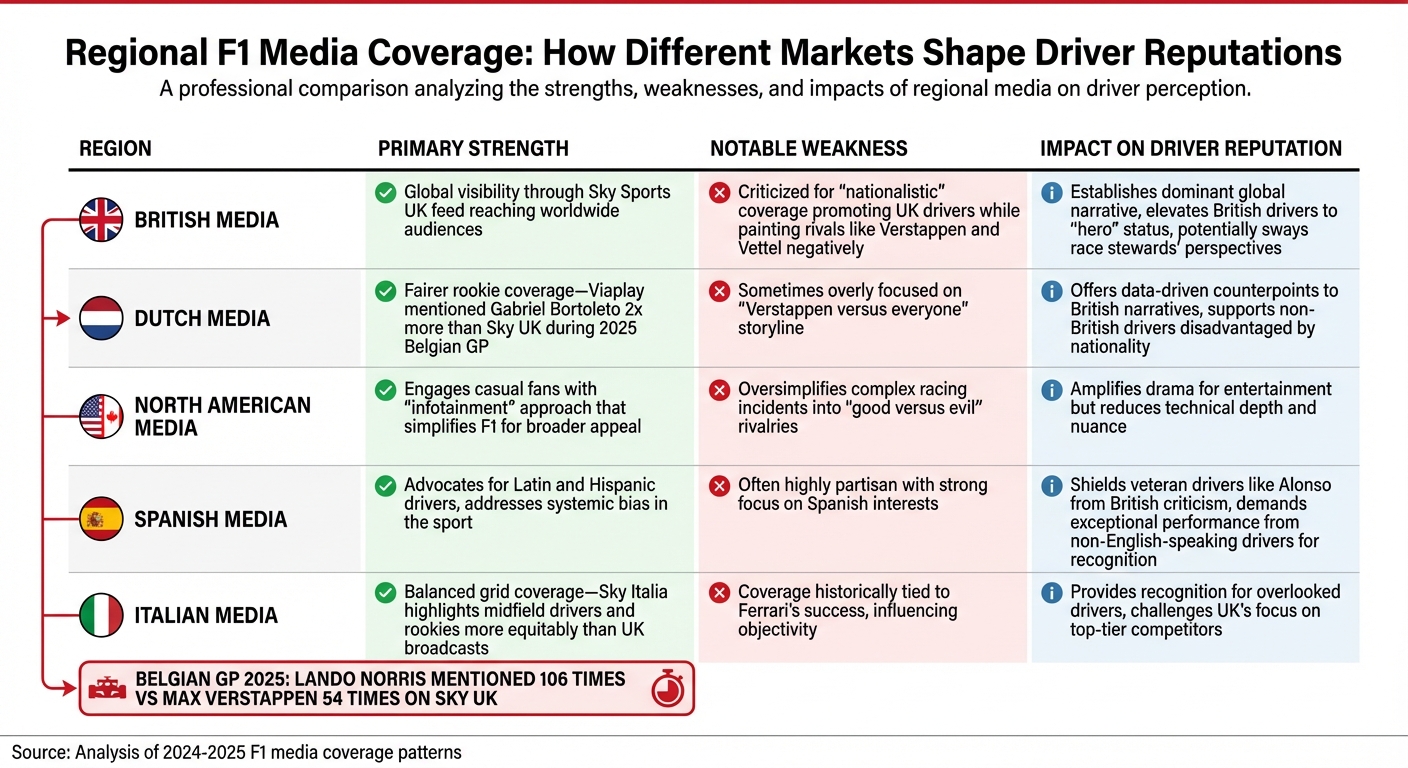
Regional F1 Media Coverage Comparison: Strengths, Weaknesses, and Impact on Driver Reputations
The differences in how regional media cover Formula 1 reveal distinct strengths and challenges, each shaping driver reputations in unique ways. The table below outlines these regional approaches, showcasing their influence on the perception of drivers.
| Region | Primary Strength | Notable Weakness | Impact on Driver Reputation |
|---|---|---|---|
| British Media | Global visibility through the Sky Sports UK feed, which reaches audiences worldwide | Criticized for "nationalistic" coverage that promotes UK drivers while painting rivals like Verstappen and Vettel in a negative light | Establishes the dominant global narrative, often elevating British drivers to "hero" status and potentially swaying race stewards' perspectives |
| Dutch Media | Fairer rookie coverage - Viaplay mentioned Gabriel Bortoleto twice as often as Sky UK during the 2025 Belgian GP | Sometimes overly focused on the "Verstappen versus everyone" storyline | Offers data-driven counterpoints to British narratives and supports non-British drivers who feel disadvantaged by their nationality |
| North American Media | Engages casual fans with an "infotainment" approach that simplifies F1 for broader appeal | Tends to oversimplify complex racing incidents into "good versus evil" rivalries | Amplifies drama for entertainment but risks reducing technical depth and nuance in its storytelling |
| Spanish Media | Advocates for Latin and Hispanic drivers, addressing systemic bias in the sport | Often highly partisan with a strong focus on Spanish interests | Shields veteran drivers like Alonso from British media criticism and demands exceptional performance from non-English-speaking drivers to gain recognition |
| Italian Media | Offers more balanced coverage of the entire grid - Sky Italia highlights midfield drivers and rookies more equitably than UK broadcasts | Coverage is historically tied to Ferrari's success, which can influence its objectivity | Provides recognition for overlooked drivers and challenges the UK's focus on top-tier competitors |
These regional disparities highlight how media narratives shape public perception and even impact decisions in the sport. For instance, race stewards might unconsciously absorb biases from media coverage, affecting their judgment during incidents. Former driver Juan Pablo Montoya commented on this phenomenon:
"Automatically the British commentators go, 'He just spun. It's just a lack of talent. He shouldn't be driving.'"
Adding to this complexity, public trust in media has hit historic lows - only 8% of Republicans and 51% of Democrats in the U.S. expressed confidence in media coverage by 2025. This growing skepticism makes regional biases even more significant, as fans increasingly question whether they are receiving fair and objective reporting or narratives skewed to favor specific drivers. These dynamics underline the powerful role media plays in shaping both public opinion and the inner workings of Formula 1.
Conclusion
Regional media bias plays a significant role in shaping the reputations and career trajectories of Formula 1 drivers. A clear example of this is how some broadcasts tend to highlight British drivers while giving less attention to rookies or those from other nationalities. This favoritism doesn’t just impact visibility - it extends to areas like sponsor interest and even stewarding decisions during races.
Drivers from non-English speaking countries often encounter what’s colloquially referred to as the "wrong passport" syndrome. This term reflects the challenges they face due to regional biases. Max Verstappen himself has commented on this issue, saying:
I have the wrong passport, I think.
Addressing these biases requires a conscious effort to seek out diverse, data-driven perspectives. While broadcasters like Sky UK often justify their coverage as serving domestic audiences, international outlets such as Dutch Viaplay and Italian Sky Italia tend to offer broader and more balanced coverage of the grid. In a time when trust in U.S. media is notably low, relying on multiple sources is critical for fans who want a more complete understanding of the sport, free from nationalistic slants.
The evolution of F1 journalism depends on platforms that prioritize accuracy and fairness over narratives tailored to specific regions. For fans looking to cut through regional favoritism, an objective approach to evaluating driver performances - across all borders - is essential.
FAQs
How does media bias in Formula 1 impact drivers' sponsorships and career opportunities?
Media bias in Formula 1 can play a huge role in shaping a driver's career, especially when it comes to sponsorship deals and future opportunities. Drivers who enjoy consistent media coverage - whether through interviews, TV broadcasts, or social media - often become more attractive to sponsors. Why? Because brands chase visibility. A driver who’s constantly in the spotlight is far more likely to land lucrative endorsement deals compared to someone who stays under the radar, even if their racing skills are on par.
This bias doesn’t just stop at sponsorships; it seeps into the drivers' career trajectories too. Teams, particularly those looking to fill junior or pay-driver roles, often weigh a driver’s marketability alongside their performance. Drivers who lack media attention may find it harder to secure a seat, as teams and sponsors might view them as less appealing investments. Over time, this creates a self-perpetuating cycle: media-favored drivers gain access to better resources and opportunities, while equally talented but less-publicized drivers face an uphill battle to grow their careers.
Why is British F1 media often seen as biased toward local drivers?
The British F1 media, particularly prominent outlets like Sky Sports, has often faced criticism for its heavy focus on British drivers, sometimes at the expense of international competitors. Take the Belgian Grand Prix, for instance - drivers like Lando Norris and Lewis Hamilton received significantly more mentions, even when non-British racers delivered standout performances. This perceived imbalance has sparked debate among fans and analysts alike.
It’s not just about the quantity of coverage, though. Critics argue that the tone often reflects a clear bias. British drivers are frequently celebrated and praised, while others, such as Max Verstappen or Sebastian Vettel, have been portrayed in a less flattering light. This nationalistic approach tends to spotlight British accomplishments, potentially sidelining the global nature of the sport and alienating fans from other countries.
How can F1 fans get a more unbiased view of drivers?
To get a well-rounded view of F1 drivers, it's important to expand your sources of information. Don’t limit yourself to British-based media; instead, check out coverage from regions like Europe, Asia, or South America. Different countries often frame stories in unique ways, and comparing these perspectives can shed light on varying narratives and biases.
Another key step is to rely on data-driven insights. Dive into official timing sheets, lap-by-lap telemetry, and race statistics from the FIA or team websites. This approach helps you bypass media bias and assess performance objectively, focusing on metrics like lap consistency, pit-stop efficiency, and strategic decisions during races.
Lastly, connect with diverse fan communities. Participate in international forums, follow drivers on social media, and explore race commentary in other languages. These interactions can introduce you to fresh perspectives and help you appreciate drivers through a broader, more global lens, giving you a deeper understanding of their skills and achievements.