Prohibited Rear Wing Features: A Technical Breakdown
Banned rear‑wing innovations — T‑wings, shark fins, mini‑DRS and beam wings — reveal the clash between aerodynamic gains, safety and fair racing.
Formula 1 rear wing designs have seen several bans over the years as teams push technical boundaries to gain an edge. Governing bodies like the FIA enforce strict rules to ensure fair competition and safety. This article highlights four rear wing innovations that were eventually outlawed:
- T-Wings (2017): Added aerodynamic downforce but caused turbulence for trailing cars. Banned in 2018 under height restrictions.
- Shark Fins: Improved airflow stability but were removed for aesthetic and aerodynamic simplicity in 2018.
- Mini-DRS Mechanisms: Passive drag-reduction systems that violated stricter 2025 deflection tests.
- Beam Wing Variants: Optimized diffuser-rear wing interaction but were banned in 2014, reintroduced in a controlled form in 2022.
These bans reflect the ongoing balance between engineering creativity and regulatory compliance in Formula 1. Below, we explore each feature's technical purpose, benefits, and the reasons behind their prohibition.
1. T-Wings
Technical Advantages
T-Wings were T-shaped aerodynamic components mounted on top of the main rear wing, designed to provide additional downforce while keeping drag increases minimal. Their unique horizontal bar-on-stalk design helped optimize airflow separation and reduce wake turbulence. Wind tunnel tests showed they added 50–100 N of downforce at speeds of 200 mph, with less than a 5% increase in drag. This translated to lap time improvements of 0.1 to 0.4 seconds on high-speed tracks like Spa-Francorchamps. Additionally, they enhanced rear stability by 15% during yaw conditions, which reduced oversteer when entering corners.
Built using carbon-fiber composites and supported by titanium stanchions, T-Wings stood 5.9 inches tall and had chord lengths ranging from 3.9 to 5.9 inches. They were engineered to handle loads between 200–300 N. However, during races, aerodynamic forces caused the gap between the T-Wing and its mounting point to increase to 0.71 inches (18 mm), drawing the attention of regulators.
Notable Teams Using Them
Red Bull Racing was the first to introduce T-Wings in 2017, quickly followed by Ferrari and Williams, who adopted similar designs to gain a competitive edge. The noticeable performance benefits led to widespread adoption among top teams. McLaren also planned to pair a T-Wing with a redesigned rear wing for the 2017 Chinese Grand Prix but postponed its full implementation until the Russian Grand Prix to fine-tune the design.
Regulatory Ban Year/Rule
The FIA banned T-Wings before the 2018 season under Technical Regulation 3.10 and Article 3.5.1 c). These rules prohibited bodywork above a diagonal line drawn from the rear wheel centerline at a height of 25.6 inches above the reference plane. This decision not only eliminated the advantages of T-Wings but also had a broader impact on race dynamics.
Performance Impacts
While T-Wings delivered significant downforce gains, they also created 20–30% more dirty air for cars following behind, disrupting ground-effect performance. Mercedes' Technical Director James Allison highlighted this drawback, which contributed to their ban under Article 3.2.2. This regulation prevents immobile bodywork from flexing under aerodynamic loads. The T-Wing story serves as a reminder of how regulations aim to balance engineering ingenuity with fair competition on the track.
Why These F1 Wing Designs Were Banned
2. Shark Fins
Shark fins are vertical extensions on the engine cover that were introduced after the T-Wings. Their purpose? To manage airflow more effectively near the rear wing, especially when the car isn't perfectly aligned with the oncoming air. However, the exact aerodynamic advantages of these fins remain unclear, partly because of limited technical data and minimal wind tunnel testing. Their eventual ban also underscores how regulatory bodies often tread carefully when faced with cutting-edge designs that push boundaries.
3. Mini-DRS Mechanisms
Mini-DRS mechanisms are clever aerodynamic features that tweak the rear wing's geometry to reduce drag passively. Back in 2009 at Monaco, McLaren introduced a groundbreaking rear wing concept. This design included a main plane with a multi-layered slot setup and carefully calibrated slot gaps. Essentially, it mimicked the effect of driver-activated DRS, allowing the upper wing elements to shed some aerodynamic load at high speeds. The result? Faster lap times on long straights.
This approach, much like earlier innovations such as T-Wings, pushed the boundaries of aerodynamic design. However, it also proved to be a fleeting solution due to regulatory changes.
Technical Advantages
The brilliance of mini-DRS concepts lay in their ability to reduce drag at high speeds while maintaining downforce for cornering. McLaren's innovation inspired other teams to experiment with similar ideas. Some extended the concept to beam wings, incorporating multiple elements and precisely positioned slots to further cut down on drag.
Regulatory Ban and Key Rules
As teams began to exploit these designs, the FIA stepped in with stricter regulations. Starting in 2011, rear wings were restricted to just two sections - the main plane and the flap. Additionally, slots in the main plane were prohibited outside the central 15 cm. Similar loopholes in beam wing designs, such as those used by Williams in 2010, were also closed off, with a full ban on such designs coming in 2014.
The 2025 regulations tightened the screws even further under Article 3.15.17. These rules limited DRS deployment to two positions and introduced tougher deflection testing. For instance, slot gap variations were capped at 2 mm under a 75 kg vertical load, and the load applied during testing increased from 10 N to 30 N.
Despite these limitations, teams continued to refine their rear wing designs, always searching for an edge.
Notable Teams and Evolution
McLaren's 2009 Monaco rear wing set the stage for a wave of similar innovations. During the 2009–2010 seasons, teams like Williams, BMW Sauber, Red Bull, Mercedes, Renault, and Toro Rosso adopted multi-section, slotted configurations. Fast forward to the 2024–2025 flexi-wing controversies, and McLaren once again found itself in the spotlight. Reports suggested their rear wing designs used subtle tilting or flexing to achieve passive drag reduction, drawing scrutiny from regulators.
Performance Impacts
Mini-DRS mechanisms offered a delicate balance in aerodynamic performance, particularly for ground-effect cars. They successfully reduced drag, but not without trade-offs. One major challenge was braking stability. When airflow failed to reattach after a stall, diffuser performance suffered, raising safety concerns. To address this, the FIA closely monitored these designs. They used a combination of on-track camera footage from practice sessions and static pitlane measurements to ensure that test conditions matched real-world aerodynamic loads.
4. Beam Wing Variants
Beam wings are horizontal aerofoils positioned between the rear crash structure and endplates. Before 2014, they played a dual role: generating their own downforce and connecting the diffuser's airflow to the upper rear wing. This combination enhanced rear downforce and aerodynamic efficiency, making them a key element of car performance at the time. Much like other banned innovations in Formula 1, beam wing variants reveal the ongoing tension between creative engineering and strict regulatory controls.
The traditional beam wing was outlawed in 2014 under updated technical regulations, forcing teams to rethink the aerodynamics of the rear end entirely. Without this crucial element, linking the diffuser's upwash to the rear wing became "much more difficult", driving teams to design more intricate endplates and floor setups to recover lost performance. These changes had clear implications for car performance, as outlined below.
Technical Advantages
Before their ban, beam wing variants delivered significant performance benefits. Positioned low near the diffuser, they provided extra rear downforce, which was particularly useful for traction during corner exits. By channeling and redirecting turbulent airflow from the diffuser to the upper rear wing, the beam wing allowed teams to run the top wing at steeper angles without risking airflow stalls.
Another key advantage was structural efficiency. Integrating the beam wing with the endplates reduced reliance on bulky central pylons, which minimized airflow disruption beneath the main rear wing and improved overall aerodynamic performance. Notably, the flexible aerodynamic designs introduced by Mercedes and Toro Rosso in 2014 influenced later adaptations of beam wing concepts.
Regulatory Ban and Key Rules
The 2014 regulations banned traditional beam wings, leading to significant changes in rear-wing design. Teams shifted to using a single central pylon and lighter endplates, as the absence of the beam wing made endplates prone to becoming overly long and flexible.
Under the 2022 ground-effect regulations, a controlled version of the beam wing made a comeback. This reintroduction limited the beam wing to a two-element configuration aimed at improving airflow from the floor tunnels. The 2022 rules also restricted support structures to no more than two swan-neck pylons and imposed stringent deflection limits, ensuring that aerodynamic components remain "rigidly secured and immobile". Technical Directive 34 further tightened the rules by banning designs that altered deflection properties through secondary factors like temperature or aerodynamic load [11]. These regulatory updates had a direct impact on car performance, as discussed below.
Performance Impacts
The removal of the beam wing forced teams to compensate by increasing the load on the main rear wing and refining diffuser management. This led to a drop in overall rear downforce potential and created challenges during DRS deployment and braking, as airflow reattachment became slower.
When the controlled beam wing returned in 2022, it played a pivotal role in enhancing ground-effect performance. By creating a low-pressure zone, it encouraged faster expansion and acceleration of airflow from the underfloor tunnels, improving overall aerodynamic efficiency. This evolution highlights how regulatory changes continue to shape technical strategies in Formula 1.
Comparison: Advantages and Disadvantages
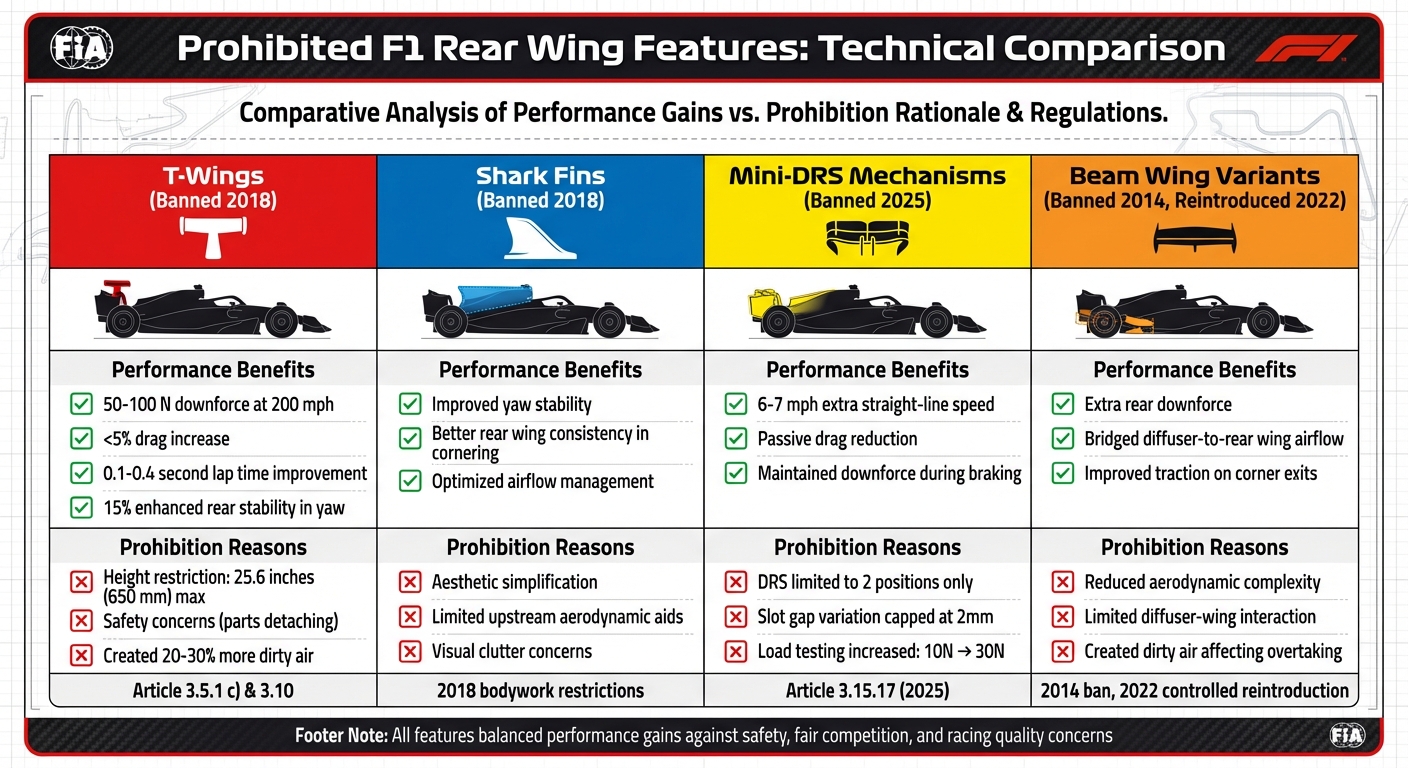
Banned F1 Rear Wing Features: Performance Benefits vs Prohibition Reasons
Let’s break down the pros and cons of these features, highlighting how they shaped performance while navigating regulatory challenges. Each innovation offered performance boosts but came with trade-offs and concerns that ultimately led to restrictions.
| Feature | Key Performance Benefits | Reasons for Prohibition | Impact of Ban |
|---|---|---|---|
| T-wings | Provided extra rear downforce and improved diffuser airflow with minimal drag, resulting in faster lap times. | 2018 regulations capped bodywork height at 25.6 inches (650 mm) due to concerns about parts detaching, safety risks, and visual clutter. | Slight drop in rear downforce and efficiency; teams compensated by redesigning endplates and other bodywork. |
| Shark fins | Improved yaw stability, better rear wing consistency during cornering and crosswinds, and optimized exhaust and airflow management. | 2018 rules banned tall engine cover extensions for aesthetic reasons and to limit upstream aerodynamic aids. | Reduced stability in transient conditions and less rear wing consistency; partially offset by floor and bodywork tweaks. |
| Mini-DRS mechanisms | Enhanced straight-line efficiency, reducing drag and adding 6–7 mph on straights while maintaining downforce during braking. | The FIA restricted DRS to two fixed positions (open/closed) and tightened slot-gap deflection tests. | Loss of extra straight-line speed; teams had to rely on standard DRS deployment. |
| Beam wing variants | Increased downforce and created a bridge between the diffuser and upper rear wing, boosting both elements' effectiveness and managing tire wake. | A 2014 rule aimed to reduce rear downforce and aerodynamic complexity, limiting diffuser-wing interaction. | Decreased rear load and diffuser efficiency; teams had to rely more on endplates and floor edges for performance. |
Each feature came with its own set of challenges. For example, T-wings added weight and raised the car’s center of gravity, increasing vibration risks. Shark fins, while enhancing stability, could cause snap oversteer if stalled at high yaw angles. Mini-DRS mechanisms pushed mechanical limits, making designs vulnerable to regulatory changes during the season. Beam wing variants, while effective at generating downforce, increased drag at high speeds and added stress on rear tires, impacting performance on power-sensitive tracks.
These features also had broader aerodynamic consequences. T-wings and shark fins created additional turbulence, which conflicted with FIA efforts to simplify aerodynamics. Mini-DRS mechanisms, by increasing speed differentials, complicated close racing and wheel-to-wheel battles. Beam wing variants produced stronger diffuser-to-rear wing interactions, leading to dirtier air that hindered overtaking. This was a key reason for their restriction in 2014, with a controlled version reintroduced under the 2022 ground-effect rules.
Ultimately, these innovations reveal how Formula 1 teams constantly push the limits of regulations to find aerodynamic gains. However, the FIA steps in to close loopholes, aiming to balance performance, safety, and the quality of racing.
Conclusion
The bans on T-wings, shark fins, mini-DRS systems, and beam wing variations reveal how Formula 1 consistently adjusts its approach to aerodynamic development. Take T-wings, for example - these components, prone to breaking apart at speeds over 220 mph, raised serious safety concerns. Similarly, mini-DRS systems exploited vague rules around "rigidly secured" components, creating an uneven playing field. To address these issues, the FIA implemented stricter load-deflection tests and limited DRS functionality to just two positions: open and closed. These measures have effectively eliminated risky flexing and multi-stage drag reduction.
These regulatory changes have pushed teams toward cleaner, more integrated aerodynamic designs. Instead of relying on loopholes, engineers now focus on refining the core geometry of wings and optimizing how the floor and diffuser work together. This shift has helped level the playing field, reducing performance disparities between cars that once exploited regulatory gray areas and those built with more straightforward designs. The result? More consistent straight-line efficiency across the grid.
Looking ahead, performance improvements are likely to come from fine-tuning existing designs rather than introducing bold new mechanisms. With flex limits and multi-stage DRS systems no longer an option, teams are channeling their efforts into highly optimized rear wing profiles tailored to specific tracks. They're also enhancing the interaction between rear wings and diffuser airflow while exploring legal micro-features like endplate louvres - all within the FIA's strict guidelines. Advances in computational fluid dynamics and precision manufacturing will play a key role as innovation shifts toward perfecting the details.
For fans and tech enthusiasts eager to keep up with these changes, having access to clear, detailed resources is essential. Platforms like F1 Briefing offer expert insights into how teams adapt to evolving rear wing regulations, breaking down the impact of each ban or rule update on lap times, tire wear, and overtaking opportunities.
FAQs
Why were T-Wings banned even though they improved performance?
T-Wings were prohibited due to serious safety concerns. Although they offered aerodynamic perks by improving airflow and increasing downforce, their structure occasionally proved unstable. This instability posed a risk of parts breaking off during high-speed races, creating dangerous conditions on the track.
On top of that, T-Wings were often viewed as a loophole in the regulations, allowing teams to push boundaries in ways that provided an unfair edge. This exploitation not only heightened safety issues but also clashed with the principles of fair play in Formula One.
How do rear wing regulations shape team strategies in Formula 1?
Rear wing rules in Formula 1 are a game-changer for team strategies, as they set strict boundaries on aerodynamic design. These regulations force teams to find the perfect balance between downforce - which improves cornering - and drag reduction, which boosts straight-line speed, all while staying within the rulebook.
This balancing act often leads to strategic compromises. Some teams may lean toward higher downforce for better grip in corners, while others might focus on minimizing drag to gain an edge on long straights. These choices affect everything from car setup and tire wear to overtaking opportunities, shaping race strategies and development plans throughout the season.
What safety risks are linked to innovative rear wing designs?
Innovative rear wing designs can introduce safety concerns, including aerodynamic instability. This occurs when sudden shifts in downforce or irregular airflow compromise a car’s handling, making it harder to control and increasing the chance of accidents.
On top of that, altering the wing's structure could reduce its strength, leaving it more vulnerable to failure during high-speed collisions or under intense stress. These potential hazards underscore the importance of strict regulations aimed at balancing performance with driver safety.