Real vs. Fake: Rivalries in Drive to Survive
How Drive to Survive grew F1's audience while dramatizing and sometimes fabricating rivalries, prompting driver criticism and demands for accuracy.
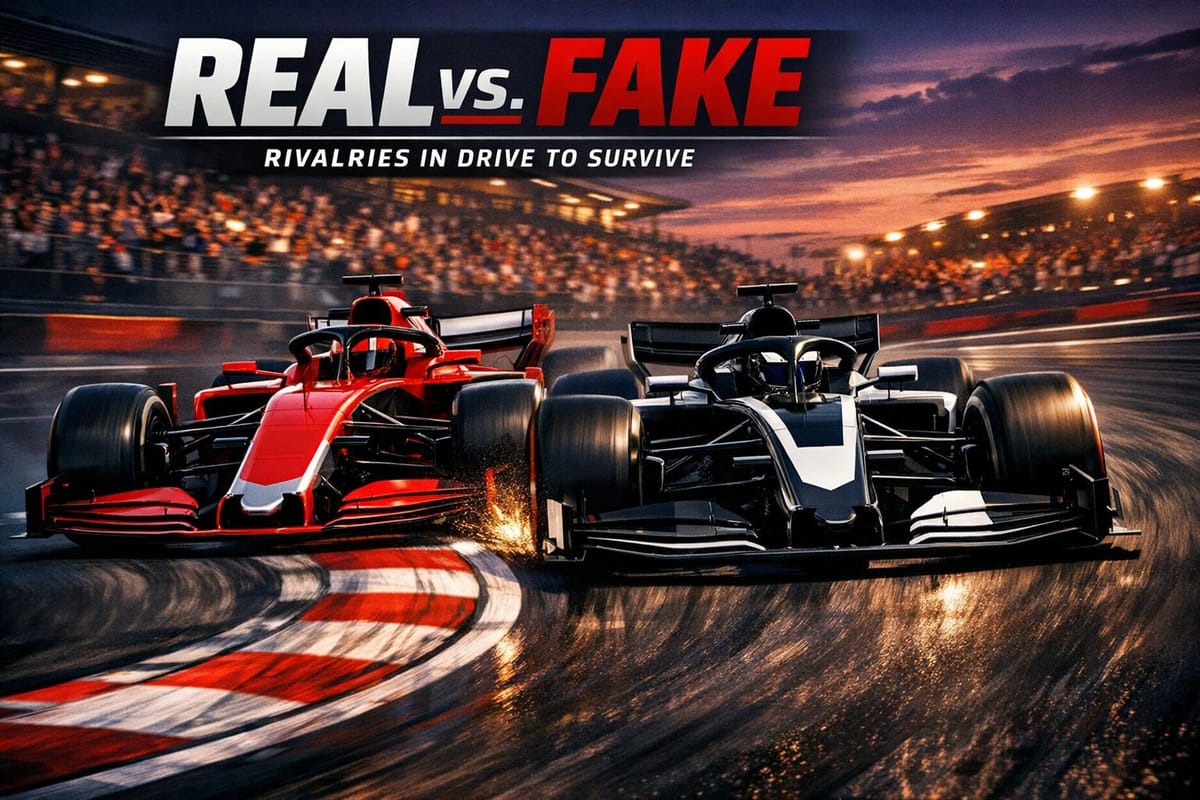
Netflix's Drive to Survive has transformed Formula 1 into a global entertainment phenomenon, especially in the U.S., where the sport now features three races annually. By focusing on personal rivalries and dramatic storytelling, the series has attracted younger fans and a more diverse audience. However, drivers like Max Verstappen and Lando Norris have criticized the show for exaggerating or fabricating conflicts, raising concerns about accuracy versus entertainment. While the show has undeniably expanded F1's reach, its dramatized approach often blurs the line between fact and fiction, leaving fans questioning what's real.
Drive to Survive have lied to us...
Major Rivalries: Netflix vs. Reality

The Netflix series Drive to Survive has a knack for turning real-life driver interactions into dramatic rivalries. Many genuine relationships have been reframed as conflicts, even when the drivers themselves repeatedly emphasize their camaraderie.
Verstappen vs. Norris: Friends or Foes?
Season 7's episode "Frenemies" painted Max Verstappen and Lando Norris as bitter rivals during their 2024 title fight. To amplify the drama, the show repurposed a clip of Verstappen from the Dutch Grand Prix at Zandvoort, making it appear as though he reacted negatively to Norris's first-ever win at the Miami Grand Prix. However, eagle-eyed viewers pointed out a glaring inconsistency: Verstappen was wearing a different team cap in the Miami footage than he did during the actual race weekend.
Verstappen didn’t hold back when addressing the edits:
"Apparently I was very sad after Miami. I literally had the best time ever Sunday night, so I don't know what I was upset about."
Far from being upset, Verstappen was one of the first to congratulate Norris and even celebrated with him that evening. Both drivers have consistently described their relationship as one of mutual respect and friendship. After fans and drivers criticized the manipulated scene, Box To Box Films admitted the error and corrected it. Norris also expressed his frustration with the dramatization:
"The portrayal of Max, and how we were against each other so much, they don't need to create that drama, just show the facts. It is almost lying in some ways."
This isn’t an isolated case. The show has also fabricated rivalries within teams, further blurring the line between reality and entertainment.
Norris vs. Sainz: Teammates or Enemies?
Another example of fictionalized tension involves Lando Norris and Carlos Sainz during their time as McLaren teammates. The series exaggerated minor on-track incidents and rearranged team radio messages to suggest discord. However, Norris has always maintained that he values positive relationships with his teammates. As he explained:
"I've always got on well with my teammates since karting. I've always wanted to because it just makes my life more fun... when we step out of the car, we can still have a joke, we still have laughs in our debriefs."
In reality, Norris and his teammates work together with mutual respect, both on and off the track. The show’s use of spliced footage from different races to create artificial tension only adds to the disconnect between the series and actual events.
Verstappen vs. Ricciardo: Hostile or Friendly?
Max Verstappen’s frustration with Drive to Survive isn’t new. The series previously depicted his relationship with Daniel Ricciardo during their time as Red Bull teammates as combative, despite their friendly dynamic. This misrepresentation left Verstappen disillusioned with the show, leading him to boycott it for several seasons. He shared his concerns about the exaggerated storytelling:
"A lot of it is fake. I know what I talked about with my engineers... That's not OK. That's just sensationalism."
Whether it’s Verstappen and Norris, Norris and Sainz, or Verstappen and Ricciardo, the show’s penchant for distorting relationships underscores its prioritization of drama over accuracy. While the series has brought Formula 1 to a wider audience, its creative liberties often leave fans questioning what’s real and what’s scripted.
Team Dynamics in Drive to Survive
After delving into the rivalries between drivers, it’s time to shift focus to the real tensions brewing among team principals. Unlike the sometimes exaggerated rivalries between drivers, the friction at the team principal level feels far more genuine. As Valtteri Bottas once pointed out:
"I feel like between the team bosses there's more friction than between any drivers... We're talking about big money within the position. So it's natural that there will be friction and clashes".
With enormous financial stakes on the line, the pressure creates an environment where personal and professional clashes are inevitable.
Hamilton and Wolff as Antagonists
Drive to Survive thrives on crafting stories with clear heroes and villains. Executive producer James Gay-Rees summed it up perfectly:
"There are heroes and villains. People are out to win at any price and will do whatever it takes... It's dangerous and political and scandalous and gossipy. Those are the key ingredients".
While the series often exaggerates conflicts through clever editing, the portrayal of Lewis Hamilton and Toto Wolff leans more on dramatization than reality. Behind the scenes, their dynamic is far more collaborative. As Mercedes faced setbacks in their on-track performance, the show pivoted its focus to teams better positioned to challenge Red Bull’s dominance. This shift in narrative reflects the series’ tendency to prioritize drama over accuracy, though other rivalries in the paddock have much deeper roots.
Horner vs. Wolff: Real Conflict or Edited Fiction?
Few rivalries in Drive to Survive feel as raw as the one between Christian Horner and Toto Wolff. While the show undeniably amplifies their disputes for dramatic flair, the tension between the two is rooted in real political and technical battles. One standout moment occurred during the heated "porpoising" debate in 2022, when Horner famously told Wolff to:
"change your f***ing car".
Wolff, never one to hold back, fired back by calling Horner:
"a bit of a windbag who wants to be on camera".
Horner, in turn, quipped:
"The more Toto gets wound up, the more fun it becomes".
Despite these biting remarks, there’s a layer of mutual respect between the two, with occasional off-camera efforts to mediate their differences. However, the show often rearranges footage to intensify the rivalry narrative.
As Mercedes’ dominance began to fade and McLaren rose as Red Bull’s primary challenger, Season 7 shifted its spotlight to a new rivalry: Horner versus Zak Brown of McLaren. In one candid moment captured by the show, Horner was overheard saying:
"Well you find out who your friends are don't you? Zak is a p---k."
Horner’s tenure at Red Bull, which included leading the team to six constructors' titles and eight drivers' championships over two decades, came to an abrupt end in July 2025. Following his dismissal, he reached a $100 million settlement in September 2025.
How Drive to Survive Changed F1's Reach and Image
Growth in Global Audience
The Netflix series Drive to Survive reshaped Formula 1's image and broadened its global appeal. Executive producer James Gay-Rees openly discussed the sport's perception before the series debuted in 2019:
"It just wasn't very cool. It had been in the past, but it wasn't going through one of its more sexy cycles... You've got sexy young men driving sports cars and risking their lives. I mean, it's a pretty basic sort of equation for success".
The show managed to rebrand F1 from what insiders referred to as "male, pale and stale" into something more "cool" and "sexy". Nowhere was this transformation more evident than in the United States, a market traditionally dominated by NASCAR and IndyCar. The series’ popularity helped pave the way for two new American races - the Miami and Las Vegas Grands Prix - making the U.S. the only country to host three races in a single season.
The series also brought in a wave of female and younger viewers, a demographic shift that had been elusive for the sport. However, not every statistic reflected growth. In February 2024, Season 6 debuted with 2.9 million viewers in its first three days, a 30% drop compared to the previous season’s launch. Additionally, the show’s critical reception took a hit, with its Rotten Tomatoes score falling from 92% for Season 1 to 60% for Season 6. While the series succeeded in expanding F1's audience, its dramatized storytelling increasingly clashed with the perspectives of the drivers themselves.
Driver Pushback and Demands for Accuracy
The show’s rise in popularity brought with it growing discontent from drivers, who criticized its tendency to exaggerate storylines. Lando Norris was vocal about the issue, calling for a focus on factual accuracy rather than manufactured drama. The tension between storytelling and authenticity has led to backlash, both for the drivers and the show.
In March 2025, Norris and Max Verstappen publicly criticized Box To Box Films over Season 7, Episode 2. The episode misrepresented Verstappen’s emotions by using footage from the Zandvoort race to suggest he was upset about Norris’s first win at the Miami Grand Prix. Verstappen dismissed the portrayal, stating he had enjoyed the race. Norris, on his part, urged the creators to make the series "more of a documentary of the season, more than a show".
Drivers have also faced increased social media criticism due to these misrepresentations, with some even calling for financial compensation for their appearances. They cited comparisons to NFL players, who earn hundreds of thousands or millions of dollars for participating in similar Netflix docuseries. Despite these grievances, Formula 1 defended the show’s role in expanding the sport’s reach. A spokesperson stated:
"Drive to Survive has been a very important part of growing the sport and reaching new audiences. We should focus on the positive impact of the series and not criticise something that has been hugely beneficial to the whole sport".
This ongoing friction has fueled debates among fans and drivers alike. Long-time enthusiasts and newer viewers often find themselves divided, with some pointing to increased "tribalism" and "vitriol" as a result of the show's dramatized narratives.
Comparison Table: Drive to Survive Rivalries vs. Actual Relationships

Drive to Survive: Netflix Drama vs Reality in F1 Rivalries
When it comes to the debate over manufactured drama versus real-life dynamics, a close examination of rivalries in Drive to Survive reveals some glaring differences. The show's producers often rely on techniques like selective editing, rearranged footage, and audio manipulation to amplify conflicts that, in reality, are much more nuanced.
Take, for example, the portrayal of Max Verstappen after the Miami Grand Prix. Netflix depicted him as upset, but Verstappen himself clarified, "Apparently I was very sad after Miami. I literally had the best time ever Sunday night, so I don't know what I was upset about." This discrepancy highlights how selective editing can create a false narrative.
Another example is the supposed feud between Christian Horner and Zak Brown. While there is genuine professional tension between the two, the show leans heavily into the drama. One instance features Horner calling Brown a "p---k", but it conveniently leaves out moments of mutual respect, like their handshake and congratulations at the Abu Dhabi season finale.
Even Ferrari's team dynamics are oversimplified. The series painted Carlos Sainz's victory at the 2023 Singapore Grand Prix as a result of team unity. In reality, Sainz executed a brilliant individual strategy, using Lando Norris for DRS to maintain his lead - a detail the show chose to ignore.
Here's a table that breaks down these portrayals versus the actual relationships:
| Rivalry / Event | Drive to Survive Portrayal | Actual Relationship / Reality | Evidence of Manipulation |
|---|---|---|---|
| Verstappen vs. Norris | Hostile, bitter title rivals | Close friends who celebrate each other's wins | Used Zandvoort footage to depict Verstappen as "upset" after Miami |
| Horner vs. Brown | Constant, unrelenting feud | Professional tension with occasional respect | Omitted handshake and congratulations at Abu Dhabi finale |
| Ferrari Team Strategy (2023) | Success through "team unity" | Sainz's tactical brilliance drove the win | Ignored Sainz's strategic use of DRS during the race |
| Russell at Spa 2024 | A triumphant, clean victory | Victory later nullified by disqualification | Disqualification not mentioned |
| Verstappen vs. Hamilton | Simplified "Hero vs. Villain" trope | Complex rivalry with mutual respect | Selective editing of radio exchanges and technical issues |
Producers often defend these creative liberties as a consequence of tight production timelines, which can lead to inaccuracies. However, drivers have been vocal in their criticism. Lando Norris, for instance, stated, "It is almost lying in some ways, and I just don't think that's correct. They just jumble up the whole thing and they don't care when they put it in."
Conclusion: Balancing Entertainment and Truth
Drive to Survive has undeniably expanded Formula One's global audience, drawing in millions of new fans. However, the delicate balance between delivering gripping drama and staying true to the sport's reality has sparked concerns about F1's credibility.
Lando Norris put it succinctly:
"They don't need to create drama... there's drama already. They can just show the facts."
Formula One naturally thrives on intense rivalries, strategic brilliance, and high-stakes battles - elements that don't require embellishment to captivate viewers.
Even the producers at Box to Box Films have admitted:
"Mistakes do happen"
due to the pressures of tight production schedules. For instance, when Max Verstappen was shown as upset after Miami using footage from a completely different race - despite him later saying he had
"the best time ever" -
it wasn't just an editing error; it cast doubt on the authenticity of the storytelling and, by extension, the sport itself.
As the conversation about authenticity grows louder, the way forward calls for greater transparency and collaboration. Drivers are asking for more accurate representation during the editing process and even financial compensation, similar to what athletes receive in Netflix's Quarterback series. Producers, too, must heed James Gay-Rees' emphasis on staying true to the story:
"It becomes an interpretation of what happened, but our ambition is always to tell an authentic story."
Formula One already has all the elements of compelling television - technical mastery, strategic depth, and real human drama. The numbers, however, tell a cautionary tale: a 30% drop in viewership for Season 6 and a decline on Rotten Tomatoes from 92% to 60% suggest that audiences can sense when authenticity is traded for theatrics.
At F1 Briefing, we remain dedicated to separating fact from fiction, helping fans uncover the genuine complexities of the sport. By blending factual storytelling with engaging narratives, Formula One can uphold its rich legacy while continuing to captivate future generations.
FAQs
How does Drive to Survive influence how fans view F1 rivalries?
Drive to Survive has brought the excitement of Formula 1 to millions of new fans, especially in the U.S., by highlighting the sport's intense drama. However, its storytelling often simplifies complex rivalries, casting drivers as either “heroes” or “villains.” While this approach has undeniably boosted the sport’s popularity, it sometimes misrepresents the real dynamics between drivers.
Take, for example, Lando Norris and Carlos Sainz - both have spoken out about the show exaggerating or even fabricating conflicts. What might be professional competition or lighthearted banter gets transformed into dramatic feuds. This can give fans a skewed perception, making them believe there’s more animosity between drivers than actually exists, while overlooking the mutual respect and collaboration that are core to Formula 1.
Although the dramatization adds entertainment value, recognizing where the show amplifies conflict allows fans to better appreciate the genuine rivalries and strategic brilliance that truly define the sport.
Why do some F1 drivers criticize the accuracy of Drive to Survive?
Many drivers have raised concerns about Netflix's Drive to Survive, claiming it leans too heavily on drama at the expense of accuracy. They argue that selective editing and out-of-context footage create over-the-top storylines that don’t align with what actually happens on the track. Lando Norris, for instance, criticized the show for misrepresenting his rivalry with Max Verstappen, calling it "fabricated nonsense" and accusing the series of twisting events.
Carlos Sainz has shared similar frustrations, pointing out how the show exaggerated his relationship with former teammate Norris. While the series painted their dynamic as a tense rivalry, Sainz insists they got along well off the track. This dramatized portrayal, drivers argue, trades authenticity for entertainment, reshaping genuine competition into something that feels more scripted.
The main critiques revolve around selective editing, manufactured rivalries, and a move away from factual storytelling - leaving some to feel that the show undermines the true spirit of Formula 1.
How does dramatizing rivalries in Drive to Survive impact Formula 1’s image?
Dramatizing rivalries in Drive to Survive has had a noticeable impact on how Formula 1 is viewed. On one hand, the amplified drama has drawn in a much larger audience and elevated the sport’s global appeal. On the other, it has sparked pushback from drivers like Lando Norris and Carlos Sainz, who feel that exaggerated storylines distort the reality of their relationships and the actual competition. This disconnect can leave fans feeling misled when the on-screen drama doesn’t match what happens on the track.
The downside to these dramatized narratives is the risk of chipping away at F1’s reputation for being authentic and professional. Still, there’s no denying that the series has brought more visibility and engagement to the sport. The challenge lies in finding the right balance - creating captivating stories without compromising the truth. That balance is key to ensuring Formula 1 remains trusted as a premier display of racing and engineering brilliance.