Rear Wing vs. Beam Wing: DRS Integration
Explains how F1 rear and beam wings generate downforce, how DRS alters airflow (including beam-wing stall and Triple DRS), and what 2026 active aero changes.
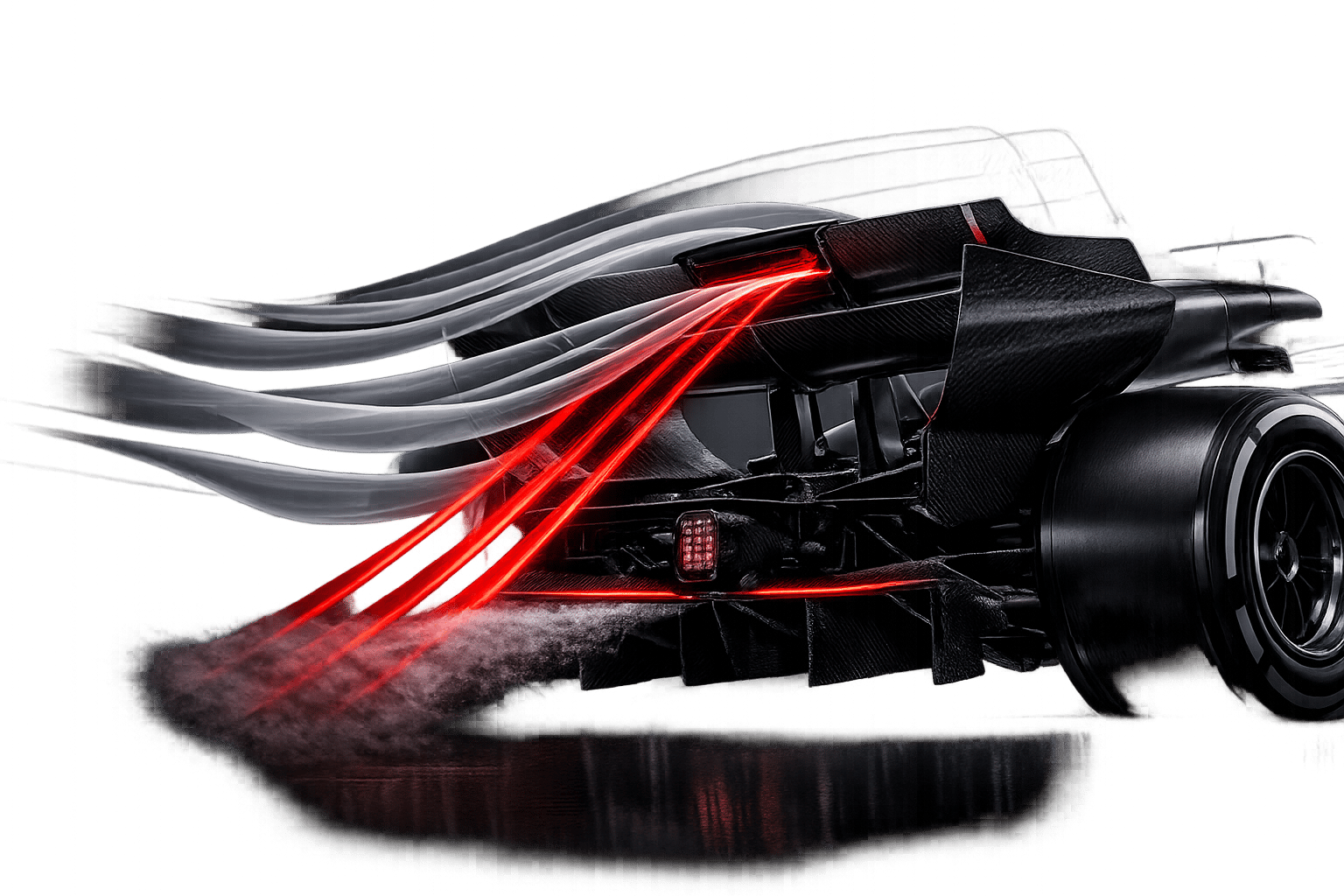
In Formula 1, the rear wing and beam wing are key aerodynamic components, each serving distinct purposes. The rear wing generates downforce by manipulating airflow above the car, while the beam wing supports underbody airflow, boosting diffuser performance. When DRS (Drag Reduction System) is activated, it reduces drag by opening the rear wing flap, increasing straight-line speed by about 7 mph. This also impacts the beam wing, altering its aerodynamic behavior and sometimes causing airflow stall, amplifying drag reduction.
By 2026, DRS will be replaced by active aerodynamics, introducing synchronized movable wings and eliminating the beam wing entirely. These changes aim to balance drag reduction and downforce, reshaping F1 car designs and overtaking dynamics.
Quick Overview:
- Rear Wing: Main downforce source; features DRS for drag reduction.
- Beam Wing: Boosts diffuser efficiency; indirectly affected by DRS.
- 2026 Changes: Beam wing removal; active aerodynamics with movable wings.
This evolution highlights the constant push for aerodynamic efficiency and performance in F1.
#F1 Aerodynamics : RedBull Triple DRS | CFD Case Study
Aerodynamic Functions: Rear Wing vs. Beam Wing
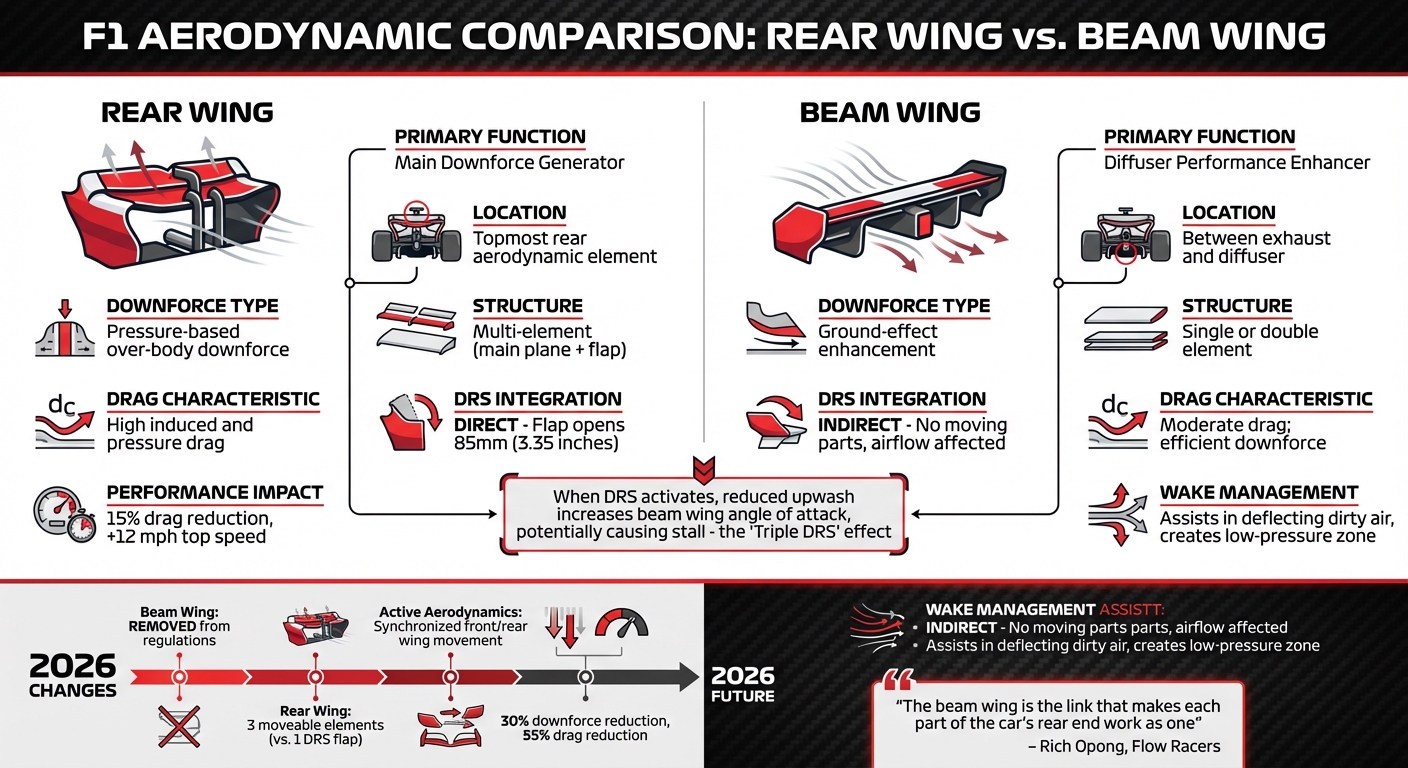
F1 Rear Wing vs Beam Wing: Aerodynamic Functions and DRS Integration Comparison
The rear wing and beam wing each play unique roles in the aerodynamics of an F1 car. While both contribute to creating downforce, they achieve this through different mechanisms and occupy distinct places in the car's aerodynamic setup. Let’s break down how each component impacts performance.
Rear Wing: Main Downforce Generator
The rear wing is the primary source of over-body downforce on an F1 car. Its multi-element design - which includes a main plane and an adjustable flap - creates a pressure difference that pushes the car onto the track, providing the grip necessary for high-speed cornering.
In addition to generating downforce, the rear wing’s endplates are instrumental in airflow management across the car. Since the introduction of the 2022 regulations, these endplates have adopted curved designs that direct the turbulent wake upward and inward. This adjustment helps reduce "dirty air" behind the car, improving conditions for trailing vehicles and promoting closer racing. However, the rear wing also introduces considerable aerodynamic drag, forcing teams to carefully balance its benefits against potential speed penalties.
Beam Wing: Enhancing Ground-Effect Performance
Positioned lower on the car, between the exhaust and the diffuser, the beam wing’s primary job is to boost ground-effect performance. It achieves this by creating a low-pressure zone at the diffuser exit, which effectively "pulls" air from under the car. This process accelerates airflow through the venturi tunnels, increasing underbody downforce.
"The beam wing creates a low-pressure area behind the exit ramps of the underfloor venturis, accelerating the exit air, and therefore the speed of the whole underbody airflow." - Mark Hughes, Special Contributor
This low-drag, high-downforce contribution makes the beam wing particularly efficient, delivering grip without adding significant resistance. Additionally, it plays a key role in rear-end stability, ensuring that the diffuser, beam wing, and rear wing work together as a cohesive aerodynamic unit. As Rich Opong, Founder of Flow Racers, puts it: "The beam wing is the link that makes each part of the car's rear end work as one". These interactions also impact the Drag Reduction System (DRS), with the beam wing influencing how the entire rear assembly behaves when the system is engaged.
Here’s a quick comparison of the aerodynamic roles of the rear wing and beam wing:
| Feature | Rear Wing | Beam Wing |
|---|---|---|
| Primary Function | Direct downforce generation | Supporting diffuser performance |
| Location | Topmost rear aerodynamic element | Between exhaust and diffuser |
| Structure | Multi-element (main plane + flap) | Single or double element |
| Downforce Type | Pressure-based over-body downforce | Ground-effect enhancement |
| Wake Management | Directs turbulent air upward | Assists in deflecting dirty air |
DRS Integration: How Each Component Works
Building on the aerodynamic principles outlined earlier, let’s dive into how DRS (Drag Reduction System) integrates into a car's design. To understand its operation, we need to look at both the mechanical activation of the rear wing and the indirect aerodynamic effects on the beam wing. While the rear wing features moving parts, both components experience notable aerodynamic changes when DRS is engaged.
Rear Wing DRS Operation
When DRS is activated, the ECU triggers a hydraulic actuator that lifts the upper flap of the rear wing. This creates a gap that has grown from about 1.97 inches (50 mm) in 2011 to roughly 3.35 inches (85 mm) by 2024. The flap pivots at its rear edge, a failsafe design that ensures air pressure forces it back into a closed, high-downforce position if the actuator fails.
Opening the flap changes how air interacts with the wing. Instead of deflecting upward to generate downforce, the airflow passes through the gap, which reduces both the wing's effective surface area and aerodynamic drag. As Steve Rendle from Raceteq puts it:
"DRS is essentially a switchable system that, when operated, temporarily reduces the drag created by a car, therefore significantly increasing its potential maximum speed on straights".
Typically, DRS provides a speed boost of 10–12 mph (20 km/h) by cutting drag by about 15%. The flap automatically closes when the driver brakes or lifts off the throttle. This mechanical adjustment doesn’t just affect the rear wing - it also alters the aerodynamic environment for the beam wing, as explained below.
Beam Wing's Effect During DRS Activation
Although the beam wing lacks moving parts or a direct DRS mechanism, its aerodynamic performance is indirectly influenced by the rear wing. With DRS closed, the rear wing generates significant upwash - airflow deflected upward - that helps the beam wing create a low-pressure zone, effectively pulling air through the diffuser.
When DRS is activated, the rear wing's upwash decreases. This change increases the beam wing's relative angle of attack, which can lead to aerodynamic stall. Aerodynamicist Shubham Sangodkar explains:
"The opening of the DRS... reduces upwash... the relative AoA with DRS on that the beam wing experiences is higher... This results in increased loading on the beam wing which can 'possibly' push it into a stall".
When the beam wing stalls, airflow separates from its surface, shedding additional drag beyond what the rear wing achieves alone. This cascading effect, often referred to as "Triple DRS", reduces drag from the rear wing, beam wing, and diffuser. Teams strategically exploit this trade-off to gain straight-line speed.
Red Bull's single-element "cranked" beam wing design was especially effective in leveraging this interaction during the 2023 season. Inspired by their success, McLaren introduced a similar single-element beam wing at the November 2023 Las Vegas Grand Prix. McLaren Team Principal Andrea Stella commented:
"They [Red Bull] seem to have pursued this concept for some time... I think they may be taking some advantage from having a lot of experience in developing this kind of configuration".
| Component | Direct DRS Functionality | Role During DRS Activation |
|---|---|---|
| Rear Wing | Yes (Movable Flap) | Flap opens to reduce surface area and pressure drag |
| Beam Wing | No (Static) | Experiences increased angle of attack; may stall to reduce drag |
| Diffuser | No (Static) | Efficiency decreases if the beam wing stalls, shedding additional drag |
Regulations and Design History
The interplay between rear wings and beam wings in Formula 1 has been shaped by a series of regulatory shifts, influencing aerodynamic strategies and performance dynamics in the sport.
Beam Wings Return in 2022
Beam wings were banned in 2014 as part of efforts to reduce rear downforce and improve racing conditions. For the next eight years, vertical support beams served purely structural purposes. However, in 2022, the FIA reintroduced beam wings as part of Formula 1's ground-effect overhaul. Mark Hughes, a Special Contributor for Formula1.com, explains their impact:
"The beam wing makes a return to the regulations... it creates a low-pressure area behind the exit ramps of the underfloor venturis, accelerating the exit air, and therefore the speed of the whole underbody airflow".
The updated regulations required a "continuous line" design, integrating wing elements, endplates, and the beam wing into a seamless structure. This approach minimizes vortex creation and directs turbulent wake higher into the air, reducing "dirty air" for trailing cars. Teams now design the beam wing and rear wing as a cohesive system to enhance diffuser performance while maintaining cleaner aerodynamic flow.
These changes in beam wing regulations have been complemented by significant updates to rear wing configurations to optimize the balance between downforce and drag.
Rear Wing Changes for DRS
As beam wing regulations evolved, the rear wing and its DRS (Drag Reduction System) functionality also underwent key adjustments. Introduced in 2011, DRS regulations have progressively allowed larger flap openings, boosting straight-line speed while addressing aerodynamic efficiency.
Initially, DRS flap openings were limited to 50 mm (1.97 inches) in 2011. By 2019, this gap had grown to 85 mm (3.35 inches), increasing DRS effectiveness by approximately 25% . In its first year, DRS contributed to nearly 1,500 overtakes, with 45% of "clean" passes aided by the system. Looking ahead, the sport plans to replace DRS with "Active Aerodynamics" by 2026. This new system will include modes like "X-mode" for reducing drag on straights and "Z-mode" for maximizing downforce in corners, accessible to all drivers regardless of their proximity to other cars .
Performance Trade-offs: Downforce vs. Drag
Building on the earlier analysis of DRS, let’s dive into the trade-offs between drag and downforce when it comes to the rear and beam wings. While the rear wing is all about generating significant downforce at the expense of higher drag, the beam wing offers a more efficient way to enhance ground-effect performance with less drag.
The rear wing plays the role of the primary over-body downforce generator, using inverted airfoil shapes to push the car down onto the track surface. However, this comes at a price - it’s the biggest contributor to both induced drag (drag caused by creating downforce) and pressure drag across the entire car.
On the other hand, the beam wing acts more like an aerodynamic assistant, working to improve diffuser performance by creating a low-pressure zone that pulls air from underneath the car. Rich Opong, Founder of Flow Racers, explains it well:
"The beam wing helps create an area of low pressure at the top of the diffuser, helping 'suck' more air under the car, boosting downforce through the ground effect".
This makes the beam wing a source of what’s often called "efficient downforce." It increases downforce with relatively moderate drag levels, though its efficiency can drop if the angle of attack becomes too steep, leading to more drag. Striking the right balance here is critical for optimizing both cornering grip and straight-line speed.
When DRS is activated, the rear wing’s drag reduces by about 30%, cutting overall car drag by roughly 15% and increasing top speed by 12 mph (20 km/h). While the beam wing doesn’t have moving parts, the airflow changes caused by the open rear wing can alter its effective angle of attack. In some cases, this can push the beam wing into a stall, shedding additional drag.
Performance Comparison Table
Here’s a quick breakdown of how these two components stack up:
| Feature | Rear Wing | Beam Wing |
|---|---|---|
| Primary Function | Generates downforce via over-body airflow | Boosts diffuser efficiency and underbody downforce |
| Drag Characteristic | High induced and pressure drag; main source of aero resistance | Moderate drag; efficient unless angled too steeply |
| DRS Integration | Directly impacted; flap opens to reduce drag | Indirectly impacted; airflow changes can alter angle of attack and cause stall |
| Lift-to-Drag Ratio | Highly variable; depends on angle of attack and track setup | Generally efficient, leveraging underbody airflow for enhanced downforce |
| Wake Impact | Creates turbulence (vortices) at endplates | Directs wake upward, clearing the path for trailing cars |
The rear section of the car - including the rear wing, beam wing, and tires - accounts for the largest share of total vehicle drag. Modern teams design these elements as part of an integrated system, aiming to maximize ground-effect performance while carefully balancing the ongoing trade-off between cornering grip and straight-line speed. These considerations are pivotal as teams prepare for the regulatory changes set for 2026.
2026 Regulations and Future Changes
In 2026, Formula 1 is set to say goodbye to DRS. Instead, the sport will introduce a new active aerodynamics system that changes how key aerodynamic components operate. One major change is the complete removal of the beam wing from the regulations. This signals a move toward more cohesive aerodynamic strategies.
The beam wing, which previously played a crucial role in enhancing ground-effect performance, will no longer be part of the car's design. Without it, teams will need to rethink the rear aerodynamic assembly to make up for lost downforce and diffuser efficiency. To adapt, the rear wing will feature three moveable elements (an increase from the current single DRS flap), while the front wing will include two moveable parts. These elements will work together to maintain aerodynamic balance.
With the removal of the beam wing and the phase-out of DRS, teams will need to overhaul their aerodynamic strategies entirely. Drivers will operate in two distinct modes: "Straight Mode" for reduced drag and "Corner Mode" for increased downforce. Unlike DRS, which only adjusted the rear wing and could sometimes destabilize the car, the 2026 system ensures that the front and rear wings move in sync, providing more predictable handling. Jason Somerville, Head of Aerodynamics at the FIA, explained:
"As soon as you have a rear wing that moves to reach the target drag level, it was clear that you needed to have an active front wing to match the balance characteristics".
To assist overtaking, the new regulations will introduce a "Manual Override" system, offering a 0.5 MJ electrical boost - equivalent to about 67 horsepower. Under these rules, the car following can deploy up to 350 kW of power, reaching speeds of around 210 mph (337 km/h). Meanwhile, the leading car's energy deployment will taper off at approximately 180 mph (290 km/h). These changes also include a 30% reduction in downforce and a 55% decrease in drag, marking a shift toward integrating energy management with aerodynamic design.
The absence of the beam wing also removes the drag reduction it previously provided through beam wing stalling. As a result, the redesigned rear wing will need to take on additional responsibilities, such as managing wake turbulence and supporting underbody airflow, all within a more intricate aerodynamic package.
Conclusion
The rear wing and beam wing each play unique yet interconnected roles in a Formula One car's aerodynamics. The rear wing, with its adjustable flap, significantly reduces drag when opened, while the beam wing works to improve the diffuser's efficiency by generating a low-pressure zone beneath the car.
As discussed earlier, activating the DRS (Drag Reduction System) changes the airflow over the rear wing, effectively increasing the beam wing's angle of attack. This creates a chain reaction of aerodynamic changes that influence the entire rear assembly.
Looking ahead to the 2026 regulations, these dynamics will become even more critical. With DRS set to be replaced by an active aerodynamic system that incorporates synchronized, movable front and rear wing elements, teams will need to completely reevaluate their rear-end aerodynamics.
"The beam wing is the link that makes each part of the car's rear end work as one".
This guiding principle will remain essential, whether teams are fine-tuning today’s DRS systems or designing the next generation of active aero setups. Seamlessly integrated aerodynamic strategies will continue to define success in the ever-evolving world of Formula One.
FAQs
How will removing the beam wing impact F1 car performance and DRS in 2026?
The 2026 regulations are set to remove the beam wing, an aerodynamic component positioned beneath the rear wing. This element has been crucial in generating rear downforce by efficiently channeling air from the diffuser, which also helped smooth out the car’s turbulent wake. With its removal, teams will have to depend more heavily on the main rear wing to maintain stability and ensure the DRS remains effective.
To address this shift, teams are likely to incorporate a third element into the rear wing and explore new active-aero technologies permitted under the 2026 rules. While these changes aim to recover the lost downforce, cars might face a slight balance adjustment and increased drag when the DRS is not in use. These updates are expected to encourage closer racing while presenting teams with fresh engineering puzzles to tackle.
How does DRS differ from the active aerodynamics system coming in 2026?
The Drag Reduction System (DRS) and the upcoming 2026 active aerodynamics system share the goal of boosting straight-line speed, but they function in entirely different ways. DRS is a driver-controlled mechanism that opens a flap on the rear wing, but only within specific FIA-designated zones. Its primary purpose? To help drivers overtake when they're within roughly one second of the car ahead.
In contrast, the active aerodynamics system, set to debut in 2026, will take things to a whole new level. Instead of focusing on a single rear-wing flap, this system will allow real-time adjustments to multiple aerodynamic elements, including both front and rear wings. This means cars can seamlessly shift between low-drag and high-downforce configurations anywhere on the track, not just in limited zones.
While DRS temporarily reduces drag using a single movable flap, the active aerodynamics system will dynamically optimize drag and downforce across the entire car. Starting in 2026, this advanced system will fully replace DRS, offering a more versatile and sophisticated way to manage airflow and performance during a race.
What role does the beam wing play in improving diffuser performance and car stability?
The beam wing, positioned just below the main rear wing, plays a crucial role in refining the diffuser's performance. It achieves this by generating a high-pressure zone above it and a low-pressure zone below it, effectively pulling airflow from the car's underfloor upward. This allows the diffuser to expand the airflow vertically while staying within the size restrictions, boosting airflow efficiency and generating more rear downforce.
Beyond that, the beam wing contributes to stabilizing the car by reducing the turbulence in the air trailing behind it. This helps cut down aerodynamic disruptions for cars following closely, encouraging tighter racing. It also ensures a more balanced aerodynamic load, especially in high-speed corners. Together, the beam wing and diffuser enhance the car's stability and handling, even when the DRS is deployed.