SAF in F1: Reducing Air Freight Emissions
How Formula 1 used Sustainable Aviation Fuel and book-and-claim to cut air freight emissions 19% in 2024 (8,000+ tCO2e) while advancing Net Zero goals.
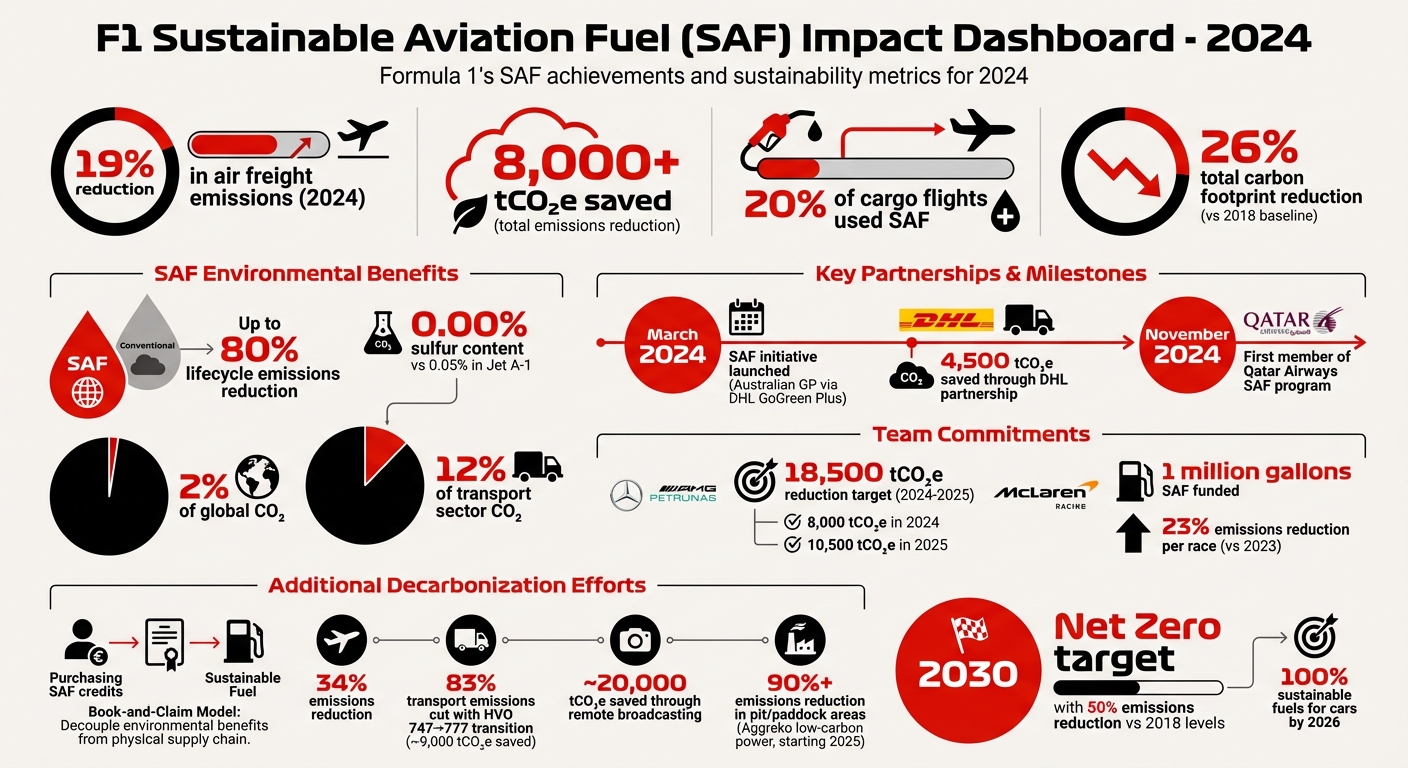
Formula 1 is tackling its air freight emissions head-on with Sustainable Aviation Fuel (SAF). In 2024 alone, F1 reduced air freight emissions by 19%, saving over 8,000 tCO₂e. Here's how:
- What is SAF? A renewable jet fuel alternative that cuts lifecycle emissions by up to 80%.
- How does F1 use it? Through a "book-and-claim" system, F1 funds SAF production without directly fueling its planes, ensuring efficient use at nearby airports.
- Key 2024 milestones: 20% of cargo flights used SAF, and partnerships with DHL and Qatar Airways drove measurable reductions.
- Additional efforts: Race calendar adjustments, biofuel-powered trucks, and more efficient Boeing 777 planes.
These steps align with F1's goal of halving emissions by 2030 compared to 2018 levels, showcasing its commitment to reducing its carbon footprint while maintaining its global operations.
F1 SAF Impact: 2024 Emissions Reductions and Sustainability Milestones
How SAF Works: Technical Details
SAF Production and Certification Standards
SAF (Sustainable Aviation Fuel) is derived from renewable feedstocks like used cooking oil, beef tallow, municipal waste, and woody biomass. These materials significantly cut emissions compared to traditional fossil fuels.
The most common production method for SAF is the HEFA process (Hydroprocessed Esters and Fatty Acids). This technique involves removing oxygen from oils and fats through hydrodeoxygenation, followed by cracking and isomerization to produce hydrocarbons suitable for jet fuel. For example, World Energy has been using this method since 2016 to produce SAF from beef tallow at its facility in Paramount, California.
To ensure safety and compatibility, SAF's synthetic components must comply with ASTM D7566 standards. When blended with conventional jet fuel, the mix adheres to ASTM D1655 standards . Furthermore, the International Sustainability and Carbon Certification (ISCC) guarantees that SAF meets rigorous sustainability requirements.
"This certification [ISCC] acts as a seal of approval, ensuring that the fuel is produced in accordance with strict sustainability criteria." - DHL Group
Due to its composition as synthetic paraffinic kerosene, SAF lacks certain aromatics found in conventional fuels. Therefore, it must be blended with traditional Jet A or Jet A-1 fuel, typically in ratios ranging from 10% to 50%. Once blended, it becomes almost indistinguishable from conventional jet fuel. This makes SAF a "drop-in" fuel, meaning it can be used in existing aircraft engines and fueling systems without requiring any modifications.
These stringent production and certification processes are key to ensuring SAF's reliability and its ability to deliver environmental benefits.
Environmental Impact of SAF in Aviation
SAF's technical advancements translate directly into environmental benefits. It can reduce lifecycle emissions by up to 80% compared to conventional jet fuel. This reduction accounts for every stage in the fuel's lifecycle, from raw material collection to combustion. Unlike fossil fuels, which release "new" carbon from underground reserves, SAF recycles carbon already present in the biosphere or waste streams.
Beyond carbon reductions, SAF has other advantages. For instance, it contains almost no sulfur - 0.00% compared to 0.05% in conventional Jet A-1 fuel. Additionally, certain SAF types, such as those produced via the Alcohol-to-Jet process, feature improved properties like a lower freezing point (−78°C) and higher energy density (44.0 MJ/kg) compared to Jet A/A-1 fuel (−40°C to −47°C and 42.8–42.9 MJ/kg). These enhancements make SAF more efficient in extreme cold and high-energy-demand scenarios.
Aviation currently contributes about 2% of global carbon dioxide emissions and 12% of CO2 emissions from the transportation sector. With eight approved production technologies for SAF, the industry has multiple pathways to expand its use. The U.S. SAF Grand Challenge, for example, aims to increase domestic SAF consumption to 3 billion gallons by 2030 and 35 billion gallons by 2050. However, scaling up remains a challenge. In 2023, the U.S. consumed approximately 24.5 million gallons of SAF, but production costs for some methods, like Power-to-Liquid, are still three to eight times higher than those for traditional jet fuel.
These advancements and goals highlight SAF's potential to reduce emissions, including those from industries like Formula 1 that rely heavily on air freight.
The Book-and-Claim Model in F1 Air Freight
How the Book-and-Claim System Functions
Formula 1 doesn't directly fuel its cargo planes with Sustainable Aviation Fuel (SAF). Instead, it employs a book-and-claim model, which separates the environmental benefits of SAF from the actual fuel being used. Here's what that means: F1 "books" a specific amount of SAF through logistics partners like DHL. This SAF is then supplied at airports with existing SAF infrastructure. While the physical fuel might power a commercial flight, F1 takes credit for the carbon reduction in its own emissions tally.
This method addresses a crucial logistical challenge. Transporting SAF over long distances to specific race locations would create extra emissions, undermining its purpose. By using SAF certificates (SAFc) as an accounting tool, F1 supports the SAF market while ensuring the fuel is consumed efficiently near production sites.
F1's partnerships with DHL's GoGreen Plus service and Qatar Airways' SAF program highlight how this system works in practice. These collaborations allow the sport to reduce emissions without disrupting the intricate logistics of global racing.
Individual teams are also adopting this model. For instance, McLaren Racing revealed in its 2024 Sustainability Report that it funded one million U.S. gallons of SAF, with support from its partner Ecolab. This investment offset all the team's business travel emissions across racing series and led to a 23% reduction in emissions per race compared to 2023.
"Our early stage investment in Sustainable Aviation Fuel is a testament to our dedication to deliver on our Net Zero by 2030 commitment."
- Ellen Jones, Head of ESG, Formula 1
This approach requires strict verification to ensure that the claimed emissions reductions are legitimate, enabling transparent and trustworthy carbon accounting.
Verification and Carbon Accounting Transparency
For the book-and-claim model to succeed, the emissions reductions must be real and verifiable. Third-party audits play a critical role in confirming that the SAF certificates claimed by F1 align with actual emissions reductions. This process prevents double-counting and ensures environmental accountability.
Formula 1 and its teams adhere to the "Clean Skies for Tomorrow" coalition's SAF Certificate (SAFc) Emissions Accounting and Reporting Guidelines, aligning with global standards like CORSIA. For example, the Mercedes-AMG PETRONAS F1 Team announced in September 2024 its plan to quadruple aviation emissions reductions by the end of 2025. Under the leadership of Head of Sustainability Alice Ashpitel, the team is purchasing SAF certificates to cut 8,000 tCO2e in 2024 and 10,500 tCO2e in 2025.
The SAFc Registry acts as a centralized database for tracking and retiring certificates, ensuring transparency. By February 2025, this registry had recorded over 500,000 tonnes of CO2e reductions through issued certificates. Independent auditors verify every carbon reduction before F1 or its teams can officially count it toward their carbon footprint.
"This ensures a high standard of product quality and traceability, with all carbon reductions verified before F1 can 'claim' them in their carbon footprint."
- Formula 1
F1's SAF Implementation and Logistics Strategy
SAF Adoption Timeline in Formula One
Formula 1 kicked off its Sustainable Aviation Fuel (SAF) initiative in March 2024 during the Australian Grand Prix. This effort, launched through DHL's GoGreen Plus service, covered 20% of cargo flights, resulting in an estimated savings of 4,500 tCO2e. By November 2024, F1 took another step forward, becoming the first member of Qatar Airways' SAF program. This partnership opened the door for F1 teams and the FIA to participate in SAF procurement. Together, these efforts reduced air freight charter emissions by 19% in 2024, saving over 8,000 tCO2e.
Individual teams have also intensified their SAF commitments. For instance, the Mercedes-AMG PETRONAS F1 Team, under the guidance of Head of Sustainability Alice Ashpitel, pledged in September 2024 to significantly increase its aviation emissions reductions by 2025. The team purchased SAF certificates aimed at saving 8,000 tCO2e in 2024 and 10,500 tCO2e in 2025, totaling 18,500 tCO2e over two years. Similarly, McLaren Racing made a bold move by funding one million U.S. gallons of SAF in 2024, offsetting all its business travel emissions across various racing series. This helped McLaren achieve a 23% reduction in emissions per race compared to 2023.
Beyond SAF, F1 has implemented a variety of strategies to further cut logistics-related emissions.
Additional Decarbonization Methods
F1 has expanded its decarbonization efforts by integrating multimodal transportation and improving logistical efficiency. A key component of this strategy is shifting non-essential equipment to sea freight, which is far less carbon-intensive than air transport. For European races, the number of HVO biofuel-powered trucks was increased from 19 to 37 in 2024, slashing transport emissions by 83% compared to conventional diesel.
Aircraft upgrades have worked hand-in-hand with SAF adoption. Transitioning from Boeing 747 to more efficient Boeing 777 cargo planes, combined with redesigned cargo containers optimized for the 777, has delivered a 34% reduction in emissions, saving approximately 9,000 tCO2e. Starting in 2025, Aggreko will provide low-carbon power solutions for European Grands Prix, cutting emissions in the pit lane and paddock areas by over 90%.
F1 has also restructured its race calendar to minimize unnecessary travel. For example, from 2026, the Canadian Grand Prix will move to May, and Monaco will shift to June, eliminating an avoidable transatlantic crossing. Improvements began in 2024, with Japan's Grand Prix scheduled in April to align with the Asia-Pacific leg, and Qatar paired back-to-back with Abu Dhabi. Additionally, remote broadcasting from the UK-based Media & Technology Centre has reduced travel-related emissions by nearly 20,000 tCO2e compared to 2018.
Altogether, these measures have made a significant impact. By the end of 2024, F1 achieved a 26% reduction in its total carbon footprint compared to its 2018 baseline.
Partnerships Driving SAF Adoption
DHL's GoGreen Plus Service and SAF Procurement
DHL has been a partner of Formula 1 for over two decades, currently operating under a nine-year contract. This collaboration has evolved into a sustainability-focused initiative through DHL's GoGreen Plus program, launched in 2022. The program directly supports F1's goal of achieving Net Zero by 2030, specifically targeting emissions from air freight used in flyaway races.
DHL's GoGreen Plus program has played a pivotal role in introducing sustainable aviation fuel (SAF) to Formula 1. Starting with the Australian Grand Prix, this initiative is projected to cut 4,500 tons of CO2 equivalent emissions in 2024.
"The beauty of SAF is that it's a drop-in technology, meaning it integrates seamlessly with existing systems, making it a quick and impactful solution." - Paul Fowler, Vice President of Motorsport – Global at DHL
GoGreen Plus operates as an "insetting" solution, directly reducing Scope 3 emissions by funding SAF. All fuel procured under this program is verified by ISCC standards, ensuring compliance with sustainability criteria. The SAF used is derived from renewable feedstocks like used cooking oil and agricultural biomass. DHL has secured over 800 million liters of SAF from suppliers BP and Neste, with a target of using SAF for 30% of its air transport needs by 2030. This partnership not only aligns with F1's sustainability objectives but also sets a precedent for the aviation and logistics industries to follow.
SAF Adoption Beyond F1
Formula 1's approach to SAF procurement is creating ripple effects across other industries. By purchasing SAF credits, the partnership is signaling strong demand to the aviation sector, encouraging further production and infrastructure development.
"Through collaboration with our teams, the FIA and our partners, we are delivering on our promises to drive down the sport's carbon emissions and drive forward technologies that can have an impact beyond Formula 1." - Ellen Jones, Head of ESG, Formula 1
Other companies are following suit. For instance, Google partnered with DHL Express to ship Pixel phones from Asia to the United States using SAF as part of its own net-zero emissions strategy. Similarly, in June 2024, SPEA, a supplier of automated test equipment, began leveraging DHL's GoGreen Plus for global deliveries, reducing its carbon footprint while maintaining delivery efficiency. These examples highlight how F1's early adoption of SAF is accelerating its normalization across industries, paving the way for sustainable aviation to scale commercially.
Engineering Change: Sustainable Innovation in High Performance Motorsport with Alice Ashpitel
Conclusion: Formula One's Path to Sustainable Logistics
Formula 1's push for Sustainable Aviation Fuel (SAF) is reshaping the sport’s approach to environmental challenges. Collaborations with DHL and Qatar Airways have already delivered measurable results - saving over 8,000 tCO₂e in 2024 alone, which equates to a 19% reduction in air freight charter emissions. These numbers prove that SAF isn’t just a concept; it’s a practical and effective solution making an impact right now.
F1’s broader strategy builds on these successes. Reaching Net Zero by 2030 demands bold actions: expanding SAF usage, refining the race calendar, transitioning to more efficient aircraft like Boeing 777s, and introducing 100% sustainable fuels for its cars by 2026. Teams are stepping up too - the Mercedes-AMG PETRONAS F1 Team projects cutting aviation emissions by 18,500 tCO₂e across 2024 and 2025 through SAF certificate purchases. These initiatives show that reducing carbon emissions by 50% from 2018 levels is within reach with consistent effort and investment.
"Formula 1 has always been at the forefront of innovation, and our early stage investment in Sustainable Aviation Fuel is a testament to our dedication to deliver on our Net Zero by 2030 commitment." - Ellen Jones, Head of ESG, Formula 1
F1’s commitment doesn’t just advance its own goals - it sets a precedent for the aviation industry at large. By adopting the book-and-claim model, the sport is driving demand for SAF, encouraging production expansion, and helping to lower costs. This ripple effect could make SAF more accessible for commercial airlines and other industries. With its global influence, Formula 1 is turning sustainability into a competitive edge rather than a niche concern.
While SAF can cut lifecycle carbon emissions by up to 80% per flight, there’s still work to be done. Reaching the finish line will require further innovations - like improving logistics, harnessing renewable energy for facilities, and exploring next-generation fuel technologies. Maintaining momentum, fostering partnerships, and embedding sustainability into every aspect of performance will be key to achieving the 2030 vision.
FAQs
Is F1’s book-and-claim SAF system legit?
Formula 1’s adoption of the "book-and-claim" system for Sustainable Aviation Fuel (SAF) is a legitimate and well-established practice within the aviation industry. This system allows teams to purchase SAF certificates, which support emissions reductions without requiring the physical delivery of SAF to their aircraft. Essentially, by buying these certificates, teams help fund the production and use of SAF, even if the fuel itself isn’t directly used in their flights.
This approach is a practical way to promote SAF adoption on a larger scale, as it helps overcome logistical challenges associated with SAF distribution. It also aligns perfectly with Formula 1’s ambitious sustainability goals, including achieving Net Zero emissions by 2030. Teams like Mercedes have already embraced this system, using SAF certificates to make significant strides in reducing their CO2 emissions.
How are SAF emissions cuts audited and tracked?
Sustainable Aviation Fuel (SAF) emissions reductions in Formula One logistics are carefully monitored using certification and accounting systems, including the book-and-claim method. This system ensures accountability by confirming that renewable fuel is produced and supplied, even if it isn't physically used by F1 teams. The process involves strict certification, detailed reporting, and third-party audits to guarantee that the claimed emissions reductions are both legitimate and measurable.
What limits how fast F1 can scale SAF use?
The biggest hurdles in scaling Sustainable Aviation Fuel (SAF) within F1 are its high cost and limited availability. As of 2024, SAF remains far more expensive than traditional aviation fuel, posing financial challenges - particularly for smaller teams operating on tighter budgets.
On top of that, the global production and distribution of SAF is still in its infancy. Expanding supply chains, improving refining processes, and achieving economies of scale are crucial steps needed to lower costs and make SAF more accessible. Until these issues are addressed, widespread adoption in F1 will remain a challenge.