Top 8 Team Orders That Shaped F1 Rivalries
Eight pivotal F1 team orders that reshaped championships, driver rivalries, and team strategy — from Williams and Ferrari to McLaren and Mercedes.
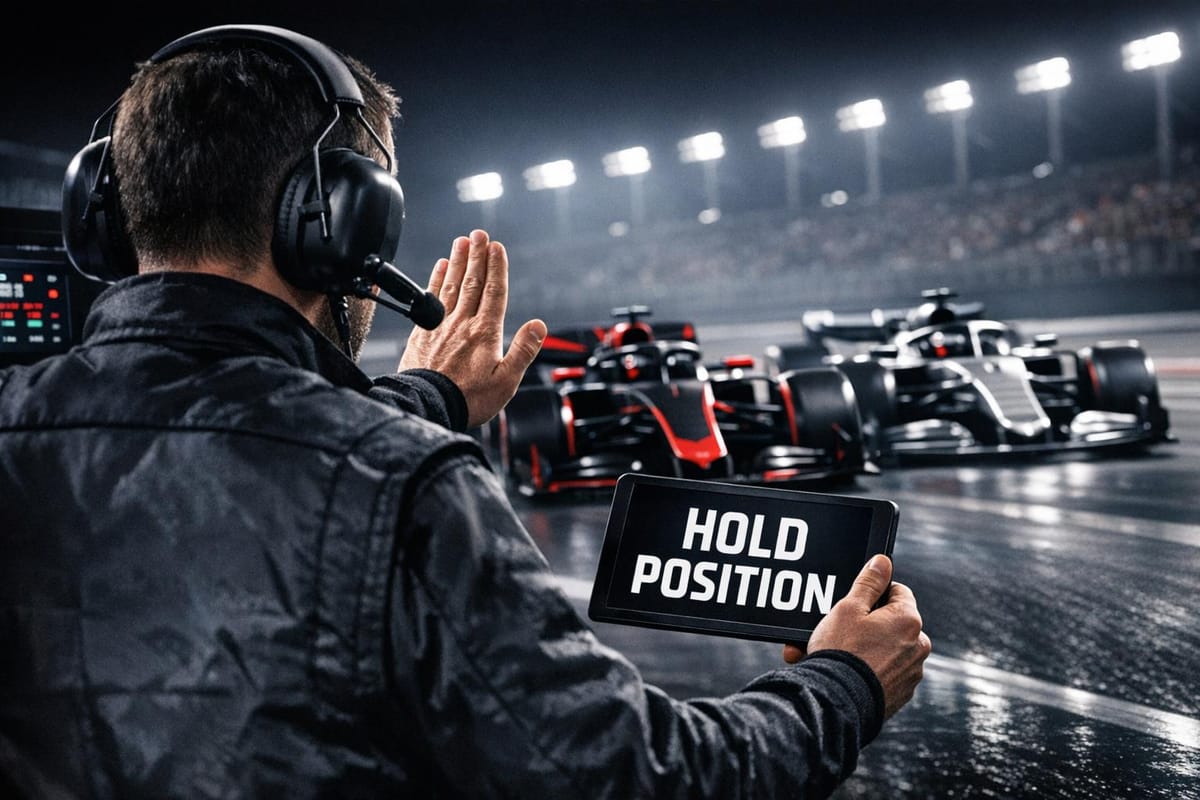
Team orders have been a controversial part of Formula 1 for decades. These directives, aimed at prioritizing team goals over individual drivers, have sparked intense rivalries and shaped championship outcomes. From drivers defying instructions to controversial swaps that altered race results, team orders have left a lasting impact on the sport. Here are eight key moments where team orders changed the course of F1 history:
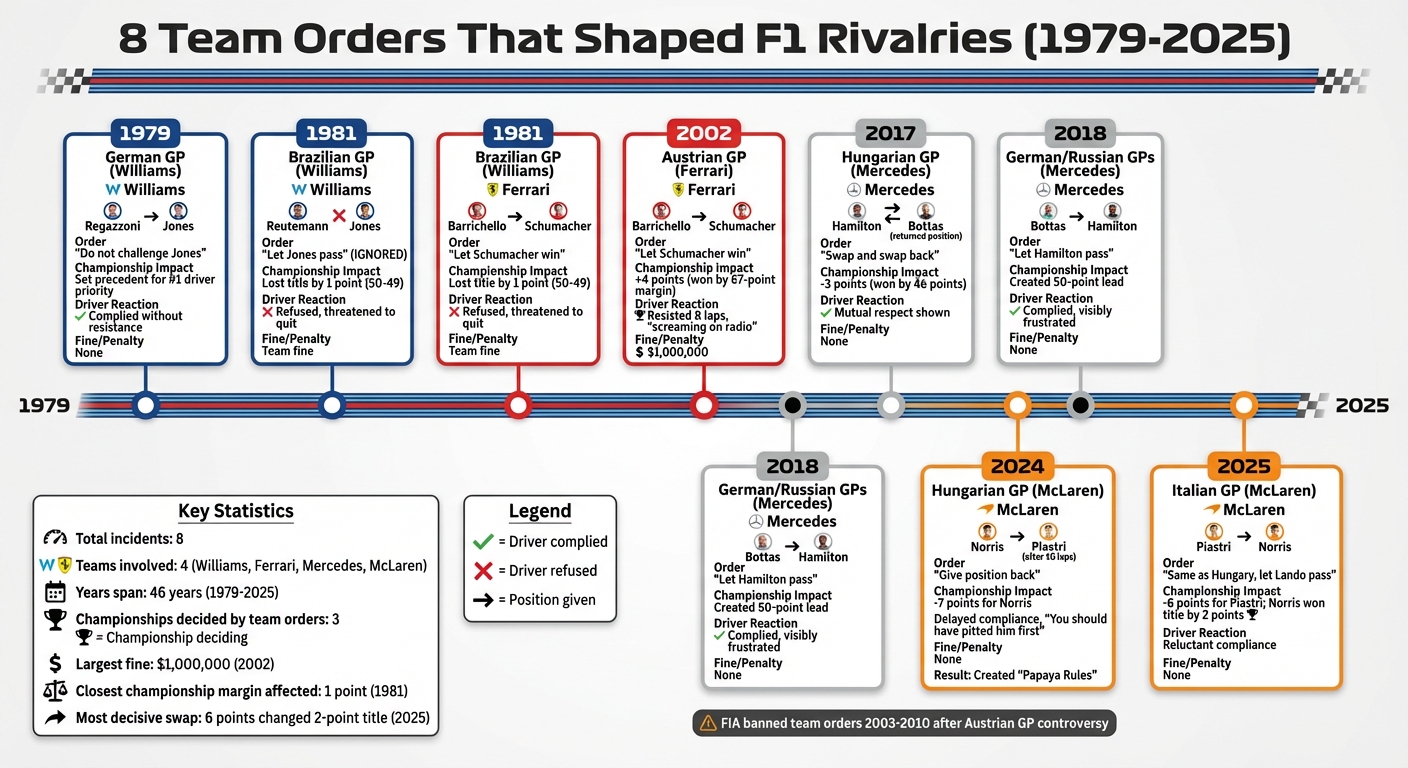
- 1979 German GP (Williams): Clay Regazzoni was told not to challenge Alan Jones, setting a precedent for prioritizing a "Number One" driver.
- 1981 Brazilian GP (Williams): Carlos Reutemann ignored orders to let Alan Jones pass, leading to team tension and a lost championship by one point.
- 2002 Austrian GP (Ferrari): Rubens Barrichello let Michael Schumacher win under orders, sparking fan outrage and a $1M fine.
- 2017 Hungarian GP (Mercedes): Lewis Hamilton returned a position to Valtteri Bottas, showcasing mutual respect within the team.
- 2018 German/Russian GPs (Mercedes): Valtteri Bottas followed orders to support Hamilton’s championship, solidifying his role as a supporting driver.
- 2024 Hungarian GP (McLaren): McLaren's team orders led to a heated exchange, prompting new internal policies for handling disrupted race orders.
- 2025 Italian GP (McLaren): A late-race swap between Piastri and Norris influenced the championship outcome, reigniting debates about fairness in team orders.
Key takeaway: Team orders are a double-edged sword in F1, balancing team success with driver ambitions. These moments highlight how they’ve shaped rivalries, championships, and team dynamics over the years.
8 Controversial F1 Team Orders: Championship Impact and Driver Reactions Timeline
The Most INFAMOUS Team Orders Calls In F1 History 📻
1. 1979 German Grand Prix: Williams' Championship Decision
The 1979 German Grand Prix at Hockenheim was a pivotal moment for Williams, marking a shift in how the team managed its drivers. During the race, Clay Regazzoni, despite having better pace and leading in the championship, was instructed via a radio message to hold back and not challenge his teammate, Alan Jones, for the lead.
Impact on Championship Strategy
This decision to back Jones had a lasting impact. By prioritizing Jones for the win and maximizing his points haul, Williams set a clear precedent: the team would favor a single "Number One" driver. This approach became a cornerstone of their strategy, influencing how the team operated for years to come.
Drivers' Reaction to Team Orders
Regazzoni followed the directive without resistance, accepting his role as secondary despite his strong performance. This cooperative stance was a stark contrast to the events of the 1981 Brazilian Grand Prix, where Carlos Reutemann famously ignored team orders, costing him a single championship point and igniting controversy.
Long-Term Influence on Team Operations
The decision at Hockenheim shaped Williams' internal dynamics for the long haul. Frank Williams adopted a management style that treated drivers as employees, expecting unwavering compliance with team orders. However, this rigid hierarchy faced challenges, particularly with Reutemann's later defiance of the system.
2. 1981 Brazilian Grand Prix: Reutemann Defies Team Orders
The 1981 Brazilian Grand Prix at Interlagos became infamous for a dramatic clash between Carlos Reutemann and his Williams team. Reutemann ignored repeated pit board instructions to let his teammate, Alan Jones, take the lead. Instead, he stayed in front, securing the win and earning 9 points, while Jones finished second with 6 points. This act of defiance triggered a storm within the team, setting the stage for a tense and fractured season.
Driver Response to Team Orders
This incident underscored the intense pressure and politics of Formula 1 team dynamics. Convinced this was his best shot at the championship, Reutemann stood his ground, declaring:
"If I give way, I stop the car here and now, in the middle of the track, and leave immediately for my farm in Argentina. Finish. Not a racing driver any more."
Alan Jones, furious at Reutemann's actions, refused to appear on the podium. His frustration was clear as he later remarked:
"From that moment on, I just knew I couldn't trust Carlos because the contract may as well... you know, not exist, why sign it."
The team's principal, Frank Williams, expressed a more pragmatic view, though he fined Reutemann for breaching his contractual obligations. Williams bluntly stated:
"As long as the team gets the points, I don't care who scores them. Why should I care which bloody driver wins? They're only employees after all."
Impact on Championship Outcome
Reutemann's victory catapulted him to the top of the World Drivers' Championship standings, but the fallout from this incident was costly. The mistrust and lack of support within the team became a significant obstacle for Reutemann. By the end of the season, he lost the championship to Nelson Piquet by a razor-thin margin - just one point (50 to 49) .
Long-Term Effects on Team Dynamics
The repercussions of this clash were far-reaching. The feud between Reutemann and Jones divided the Williams team into opposing factions, and both drivers left the team before the 1982 season began . In response, Williams shifted its approach, minimizing the use of team orders unless absolutely necessary. The incident also amplified existing rivalries within Formula 1. Meanwhile, Reutemann's defiance turned him into a hero in Argentina, where fans humorously displayed mock pit boards reversing the original message to read "REUT-JONES".
3. 2002 Austrian Grand Prix: Ferrari's Position Swap
The 2002 Austrian Grand Prix at the A1 Ring remains one of Formula 1's most controversial moments, thanks to Ferrari's infamous team orders. Rubens Barrichello, who had dominated qualifying to secure pole position, was instructed by Team Principal Jean Todt to let Michael Schumacher pass in the final moments of the race. Barrichello complied, allowing Schumacher to win by a razor-thin margin of 0.182 seconds. The move sparked outrage, with fans booing loudly at the podium ceremony. The FIA responded by fining Ferrari, Schumacher, and Barrichello a total of $1 million for breaking podium protocol. This incident not only altered the race outcome but also left a lasting mark on Formula 1's team dynamics.
Driver Response to Team Orders
Barrichello later opened up about his experience, describing the intense pressure he faced:
"It was eight laps of war. It's very rare that I lose my temper, but I was screaming on the radio. I kept going right to the end, saying I would not let him pass."
He also revealed the emotional toll it took:
"I cannot tell you what they said, but it felt like a threat that made me question my passion for driving."
Schumacher, on the other hand, justified the decision, emphasizing the team's priorities:
"The team is investing a lot of money for one sort of target and imagine if in the end it wouldn't be enough by this amount of points, how stupid would we look?"
Impact on Championship Outcome
The team order handed Schumacher four additional championship points, even though he already had a commanding 24-point lead. By the end of the season, Schumacher clinched the 2002 Drivers' Championship with an unprecedented 67-point margin over Barrichello (144 to 77). Without the extra points from Austria, the gap would still have been a comfortable 59 points. Reflecting on the incident, Jean Todt admitted:
"I shouldn't have said anything to [Barrichello]... Schumacher would still have won the championship. But I would have regretted it more if I had lost the title by a couple of points."
Media and Fan Reaction
The backlash was swift and intense. Fans at the circuit voiced their disapproval during the podium ceremony, and media outlets criticized the move as unsportsmanlike. The sight of Barrichello visibly slowing down to let Schumacher pass just before the finish line became a symbol of the controversy. For many, this moment cemented Schumacher's image as a "pantomime villain", tarnishing his reputation and Ferrari's standing in the sport.
Long-Term Effects on Team Dynamics
This incident had far-reaching consequences for Formula 1. In 2003, the FIA introduced Article 39.1, which banned team orders that could influence race results. Although the regulation was eventually repealed in 2010, Ferrari's approach to team hierarchy remained consistent. The "number two driver" strategy reemerged in 2010 when Felipe Massa was ordered to let Fernando Alonso pass with the infamous radio message, "Fernando is faster than you." These recurring controversies continue to fuel debates about fairness and the role of team orders in Formula 1.
4. 2002 French Grand Prix: Arrows' Last-Ditch Attempt
The 2002 French Grand Prix became a pivotal moment for the Arrows team, but not for the reasons fans would hope. Struggling under immense financial strain, team owner Tom Walkinshaw made a controversial call: he instructed drivers Heinz-Harald Frentzen and Enrique Bernoldi to deliberately miss the 107% qualifying cutoff. This move allowed the team to meet contractual obligations without bearing the high costs of actually competing. It was a bold, if contentious, strategy that left a lasting impression on the motorsport world.
Long-Term Effects on Team Dynamics
This decision didn’t just highlight the financial struggles of the team - it also took a toll on its internal structure. Team morale plummeted, as the move underscored how financial pressures could lead to choices that undermined unity and trust within the organization. It was a stark reminder of the challenges teams face when survival overshadows the spirit of competition.
5. 2017 Hungarian Grand Prix: Mercedes' Championship Plan
The 2017 Hungarian Grand Prix highlighted Mercedes' dedication to maintaining fairness within their team. During the race, they executed a "swap and swap back" strategy to give Lewis Hamilton a chance to challenge the Ferraris ahead. On Lap 46, Valtteri Bottas let Hamilton move into third place, with the understanding that if Hamilton couldn't overtake Kimi Räikkönen, he would return the position to Bottas.
Despite his efforts, Hamilton couldn't pass Räikkönen due to the challenges of dirty air and handling issues at the Hungaroring. Staying true to the agreement, Hamilton slowed down dramatically on the final corner of the last lap, allowing Bottas to reclaim third place - even though this move risked Max Verstappen taking advantage of the situation. To make matters more complicated, Mercedes faced technical issues with their radio and data systems during the race. This decision showcased the team’s commitment to a balanced and fair championship strategy.
Impact on Championship Outcome
Hamilton’s choice to give back the position cost him 3 points in a season where every point was crucial. Before the race, Hamilton was just 1 point behind championship leader Sebastian Vettel. By relinquishing third place, the gap to Vettel grew to 14 points as the season entered the summer break. However, in the end, Hamilton secured the 2017 championship by 46 points, meaning the sacrificed points didn’t affect the ultimate outcome.
Driver Response to Team Orders
Reflecting on the incident, Bottas said:
"I don't think every team-mate would do that in a championship fight, so I think that was really nice of him and it shows that he is a real team player".
Hamilton also stood by his decision, explaining:
"I have aimed to win this title the right way; even if it costs me a few points, I stand by my decision".
Long-Term Effects on Team Dynamics
This moment became a cornerstone of trust and respect between Hamilton and Bottas, which defined their five seasons as teammates. Mercedes Team Principal Toto Wolff noted:
"These values helped us secure six championships and will drive future success".
The precedent set in Hungary laid the groundwork for similar strategies in 2018, reinforcing the team’s unified approach.
6. 2018 German and Russian Grands Prix: Bottas Supports Hamilton
In 2018, Mercedes made waves at both the German and Russian Grands Prix with team orders that significantly impacted race results and championship strategies. At the German GP, Bottas was instructed to secure a 1–2 finish, while at the Russian GP, things took a more controversial turn. Despite dominating the weekend by taking pole position and leading the race, Bottas was ordered on lap 25 to let Hamilton pass, handing him the victory. This decision stirred up plenty of debate and left its mark on the season.
Impact on Championship Outcome
The decision at the Russian Grand Prix had a direct effect on the championship standings. By swapping positions, Hamilton gained a crucial advantage over Vettel, creating a two-race buffer. Even if Hamilton had two non-finishes while Vettel won, he would still stay in the fight. After Russia, Hamilton's lead expanded to 50 points, putting him in a commanding position. These strategic calls also played a role in Mercedes clinching both the Drivers' and Constructors' titles that year.
Driver Response to Team Orders
While Bottas followed the orders, his frustration was evident, especially at the Russian GP where he had been the standout performer all weekend. His body language in parc fermé and on the podium spoke volumes about his disappointment. Former F1 driver David Coulthard summed up the situation, pointing out the contractual realities of Formula 1:
"It's very difficult to get pissed off with someone in a managerial position making management decisions for the bigger picture".
Media and Fan Reaction
The Russian GP orders sparked widespread backlash from fans and media alike. Many believed Bottas deserved the win after his stellar performance. The tense atmosphere in parc fermé, where none of the top three drivers looked particularly pleased, underscored the controversy. Ross Brawn, Formula 1's Motorsport Managing Director, defended Mercedes' decision while acknowledging the challenge of balancing team strategy with the sport's image:
"It may not be easily accepted by the fans, nor look good for the sport, and that is where the team have to judge the circumstances and make their decision".
Unlike Ferrari's infamous "Fernando is faster than you" incident in 2002, Mercedes was upfront about their instructions. However, this transparency didn't seem to soften the public's criticism.
Long-Term Effects on Team Dynamics
These moments in 2018 firmly established Bottas as Hamilton's supporting driver. The repeated use of team orders made it clear how Mercedes prioritized their championship goals, setting a tone for Bottas' role within the team through the rest of his tenure. While these decisions secured titles for Mercedes, they also reignited debates about the balance between team strategy and fair competition.
7. 2024 Hungarian Grand Prix: McLaren's First Win Conflict
The 2024 Hungarian Grand Prix became a pivotal moment for McLaren, as the team faced a heated team orders dilemma. Oscar Piastri had been in commanding form all weekend, leading the race comfortably. However, a pit stop strategy designed to shield Lando Norris from an undercut by Lewis Hamilton disrupted the natural race order. What followed was a tense 20-lap radio exchange as McLaren worked to restore the original positions on track.
Before the pit stops, Piastri held a solid 2.5-second lead, but McLaren's decision to prioritize Norris's stop created friction within the team. Race engineer Will Joseph tried to appeal to Norris's sense of teamwork, emphasizing the bigger picture:
"The way to win a championship is not by yourself. You're going to need Oscar and you're going to need the team."
Norris, however, was not immediately convinced, responding bluntly:
"Well, you should have pitted him first."
After prolonged negotiations, Norris relented with just two laps remaining, slowing on the main straight to let Piastri reclaim the lead. This allowed Piastri to secure his first Formula 1 victory, while McLaren celebrated its first 1-2 finish since the 2021 Italian Grand Prix. The incident prompted McLaren to reconsider its internal strategies and approach to team orders.
Driver Response to Team Orders
Reflecting on the situation, Piastri admitted the complexity of the moment:
"It is a big ask. But they've obviously given me a massive opportunity... It's something that won't be forgotten, I guess, in the future."
Norris, meanwhile, sacrificed 7 valuable championship points by finishing second instead of first. This event led to the creation of McLaren's so-called "Papaya Rules", which mandated that if a strategy disrupted the natural race order for the sake of the team, positions must be restored on track. These rules were later reinforced through similar gestures during the 2024 Brazil Sprint and Qatar Sprint events.
Long-Term Effects on Team Dynamics
The fallout from Hungary had a lasting impact on McLaren's internal dynamics. The tension sparked by the incident led to discussions that solidified McLaren's stance on prioritizing fairness over favoritism. Drawing parallels to other historic team orders in Formula 1, the "Papaya Rules" underscored the delicate balance between individual achievement and team strategy. This framework proved instrumental during the 2025 Italian Grand Prix, when McLaren engineers invoked the Hungary precedent to ask Piastri to let Norris pass after a disrupted pit stop had reversed their positions.
8. 2025 Italian Grand Prix: McLaren's Title-Deciding Swap
The 2025 Italian Grand Prix at Monza brought McLaren back into the spotlight, just weeks after the heated fallout from Hungary. This time, the team faced another critical moment, one that would shape the championship battle. With Oscar Piastri leading Lando Norris by 37 points heading into the race, McLaren had to navigate a delicate situation following a pit stop error that shuffled the running order.
During the race, McLaren prioritized Piastri in the pits to counter a potential undercut from Charles Leclerc’s Ferrari. Unfortunately for Norris, his stop was delayed by a frustrating 5.9-second issue with the front-left tire, while Piastri’s was a lightning-fast 1.9 seconds. The result? Piastri emerged in second place behind Max Verstappen, while Norris dropped to third.
With just five laps to go, McLaren race engineer Tom Stallard issued a now-infamous instruction to Piastri:
"This is the same as Hungary last year, I know it's painful, but you will have five laps remaining from now. Please let Lando pass, then you are free to race."
Piastri complied, though the decision cut his championship lead from 37 to 31 points. That six-point swing would prove decisive, as Norris ultimately clinched the title by a razor-thin two-point margin over Verstappen.
Impact on Championship Outcome
McLaren’s decision to reverse the positions was framed as correcting an operational error rather than a reflection of driver performance. Team Principal Andrea Stella defended the move, explaining:
"We thought it was absolutely the right thing to restore the track order disrupted by the pit stop error and then let the guys race. This is what we did and this is what we think is compliant with our principles."
The team argued that fairness required addressing positions lost due to mechanical or operational mistakes, not on-track racing. While the swap maximized points for the Constructors' Championship, it also set a controversial precedent by directly influencing an intra-team title fight.
Driver Response to Team Orders
The drivers’ reactions revealed the emotional weight of the decision. Piastri’s initial response over the radio captured his frustration:
"We said a slow pit-stop was part of racing. I don't really see what's changed here. But if you want me to do it, I'll do it."
Despite his disappointment, Piastri complied and later acknowledged the reasoning behind the call:
"I think today was a fair request. Lando qualified ahead, was ahead the whole race and lost that spot through no fault of his own."
Norris, for his part, expressed confidence in his teammate’s cooperation:
"No [I didn't doubt he would move]. Because it's what we decided as a team and it's what we all agreed upon."
Stella emphasized the team’s commitment to fairness above all else:
"However the championship goes, what's important is that the championship runs within the principles and the racing fairness we have at McLaren."
Media and Fan Reaction
The decision sparked intense debate among fans and the media. Critics argued that compensating for a pit stop error blurred the line between fair play and manipulating the championship outcome. Mercedes Team Principal Toto Wolff was among the outspoken critics, warning that McLaren’s move had created a "difficult to undo" precedent.
Fans were sharply divided. Some applauded McLaren’s consistency in applying their principles from Hungary 2024, while others felt mechanical failures are simply part of racing and should not be artificially corrected. This controversy cemented the Monza swap as one of Formula 1’s most debated team orders.
Long-Term Effects on Team Dynamics
The Monza incident highlighted both the strengths and challenges of McLaren’s "Papaya Rules" framework, introduced after Hungary 2024. The policy aimed to ensure fairness by restoring positions lost to operational errors. However, applying this principle in a direct title fight between teammates added layers of complexity.
Stella acknowledged these challenges, suggesting the team would revisit how to handle such scenarios in the future. Despite the tension, McLaren managed to maintain harmony between Piastri and Norris. Transparent communication played a key role in avoiding the kind of long-term fallout seen in past F1 team controversies.
Comparison Table
The eight incidents reveal recurring themes in balancing driver equality and championship priorities. While each situation had its own unique circumstances, comparing them across key dimensions sheds light on how public perception, regulatory measures, and team strategies have shifted over nearly five decades.
Here's a concise summary of each incident's championship impact, driver reactions, fan responses, and long-term effects on the teams involved:
| Incident | Championship Impact | Driver Reaction | Media/Fan Response | Long-Term Team Effects |
|---|---|---|---|---|
| 1979 German GP (Williams) | Clay Regazzoni was instructed not to challenge Alan Jones, despite being faster and leading the championship. | Regazzoni followed team orders without resistance. | Team orders were moderately accepted by fans and media at the time. | Minimal long-term fallout; professionalism was maintained by both drivers. |
| 1981 Brazilian GP (Williams) | Reutemann's defiance arguably cost him the championship by a single point. | Reutemann ignored pit board instructions, while Jones refused to attend the podium ceremony. | Reports highlighted a deepening feud between the two teammates. | The incident created ongoing tension within the team that lasted throughout the season. |
| 2002 Austrian GP (Ferrari) | Schumacher’s dominance meant the incident had little impact on the championship. | Rubens Barrichello resisted for eight laps, saying, "It was eight laps of war... I was screaming on the radio". | Fans and media reacted with outrage, leading to boos and a $1,000,000 fine for Ferrari. | The backlash prompted a decade-long ban on team orders from 2003 to 2010. |
| 2017 Hungarian GP (Mercedes) | Hamilton's decision to return a position to Bottas supported a narrative of fair play. | Hamilton was widely commended for his sportsmanship. | The gesture was positively received, regarded as a rare example of fairness in the sport. | It established a precedent for mutual respect and reciprocal actions within the team. |
| 2018 German/Russian GPs (Mercedes) | Bottas yielded wins to aid Hamilton’s championship push. | Bottas complied, though public sympathy for his position grew. | Fans reacted with mixed emotions, often labeling him as the "number two driver". | The team hierarchy became more defined, with Bottas continuing in a supporting role. |
| 2024 Hungarian GP (McLaren) | Highlighted internal team friction and reshaped strategic approaches. | Norris initially resisted the swap, leading to tense radio exchanges. | Fans were divided, with some questioning McLaren's "Papaya Rules". | The team revised its policies to address equality concerns moving forward. |
| 2025 Italian GP (McLaren) | The decision to swap drivers played a decisive role in the championship outcome. | Both drivers complied, though the move sparked significant controversy. | The incident became one of the era's most debated moments, fueling sharp fan debates. | McLaren reevaluated its approach to operational decisions during title battles. |
Over time, Formula 1's stance on team orders has shifted, reflecting broader changes in the sport. For example, fines for such incidents decreased - from $1,000,000 in 2002 to $100,000 in 2010 - indicating a growing acceptance of team orders as part of strategic planning. However, the transparency of modern radio communication often magnifies the public's reaction, adding a new layer of complexity to these decisions.
Conclusion
Team orders have shaped F1 rivalries for decades, creating a constant push and pull between team success and individual glory. The examples discussed highlight this ongoing tension. As Ross Brawn put it:
"I always believed the collective interest of the team comes before that of an individual driver".
The FIA's ban on team orders from 2002 to 2010 turned out to be more symbolic than practical, as teams found ways to communicate covertly to protect their strategies. When the ban was lifted in 2011, it acknowledged a simple truth: strategic decisions are an inseparable part of the sport. These pivotal moments not only influenced championship outcomes but also reshaped how teams operate within the F1 hierarchy.
Today, teams like McLaren approach racing with a more open strategy, stepping in when necessary to address errors or make critical decisions for the championship. With live radio feeds broadcasting every instruction, these moments have become public spectacles, sparking debates across headlines and social media. This level of transparency has added a new dimension to how fans experience and discuss F1 strategy.
Looking ahead, team orders will undoubtedly continue to play a role in deciding championships. A clear example is the 2025 Italian Grand Prix, where a strategic driver swap shifted the championship standings by six points and ultimately decided the title by a mere two points.
For more insights into F1 strategies and rivalries, check out F1 Briefing.
FAQs
How do team orders affect drivers and team relationships in Formula 1?
Team orders in Formula 1 are a powerful tool that can shape both driver morale and the dynamics within a team. These orders - like instructing a driver to let their teammate pass or to hold position - can sometimes spark frustration, especially if a driver feels their hard work is being sidelined for the sake of the team. A classic example is the 2002 Austrian Grand Prix, where Rubens Barrichello was told to let Michael Schumacher take the win. Moments like this often highlight the emotional toll such decisions can take.
However, when managed with fairness and transparency, team orders can encourage collaboration. Open communication and a shared commitment to the team's objectives are key to building trust and maintaining harmony. On the flip side, poorly handled or controversial decisions can lead to strained relationships and even internal rivalries, which might hurt the team’s performance in the long run.
What ethical issues arise from the use of team orders in Formula 1?
The use of team orders in Formula 1 sparks ongoing debates about ethics, fair play, and the spirit of competition. These orders - where drivers are instructed to alter their race approach, such as switching positions or supporting a teammate's strategy - often clash with the ideal of rewarding individual skill and effort.
Critics argue that team orders can undermine the authenticity of the sport by influencing race results, robbing fans of the excitement of genuine head-to-head battles, and unfairly favoring certain drivers. Although the FIA banned team orders in 2002, teams continued to employ them discreetly, leading to the ban being lifted in 2010. This decision reflects the persistent struggle between prioritizing team tactics and upholding the core values of fairness and open competition that define Formula 1.
How have team orders shaped F1 over the years?
Team orders have played a pivotal role in Formula 1's evolution, shaping the sport's strategies and rivalries. In its early years, team owners often instructed drivers to prioritize the team’s success over individual wins. While this approach was practical, it sometimes created friction within teams.
Over the years, these orders became a lightning rod for controversy. Iconic moments like Ferrari’s directive at the 2002 Austrian Grand Prix or the infamous "Multi-21" clash between Sebastian Vettel and Mark Webber in 2013 underscored the tension between strategic planning and fair competition. Although team orders were banned in 2002, the rule was reversed in 2010, acknowledging their undeniable influence on race strategies.
Today, team orders remain a divisive but essential part of Formula 1. Teams must carefully balance the need to secure championship points with the desire to uphold the sport’s competitive spirit. These decisions continue to fuel rivalries, shape race outcomes, and ignite passionate debates among fans and analysts.