Why F1 Engines Fail: A Technical Breakdown
Explains why modern F1 power units fail — combustion instability, fuel/turbo/cooling problems — and how teams balance reliability with penalty limits.
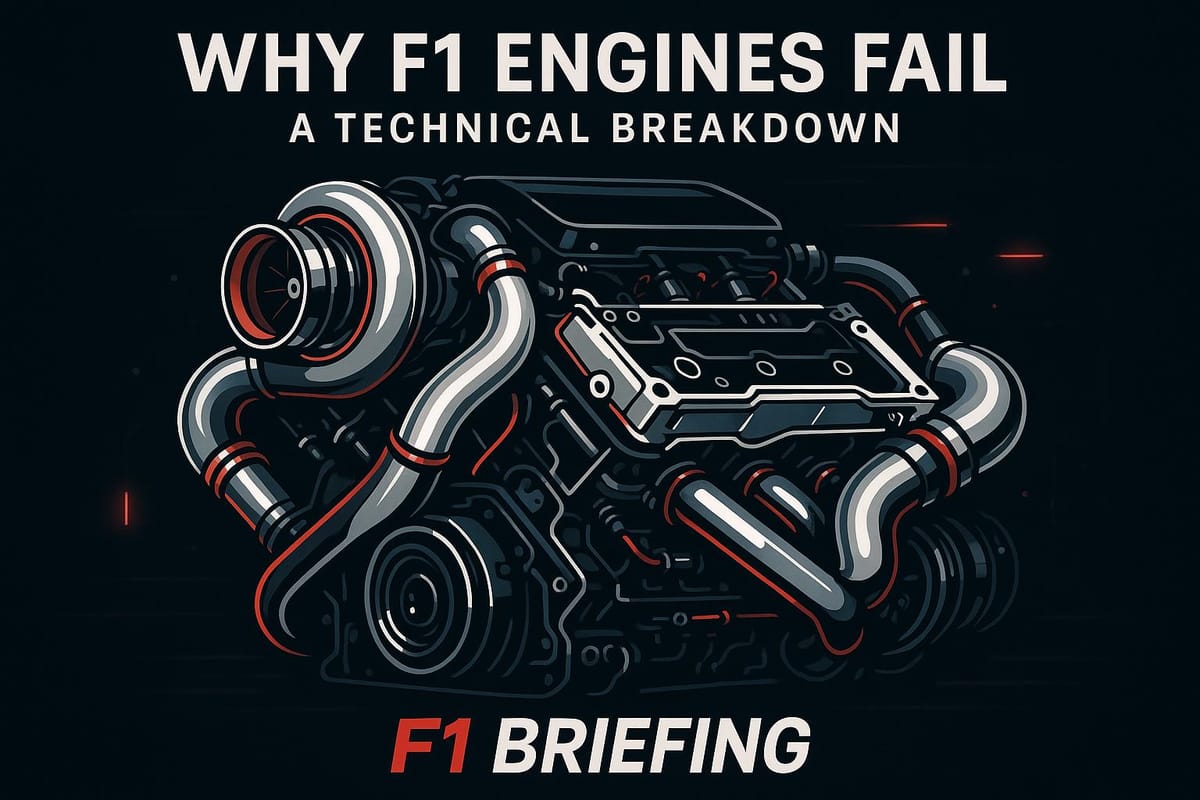
Formula 1 engines are engineering marvels, but they operate under extreme conditions that push materials and designs to their limits. Gas temperatures can reach 4,712°F, and components endure 200 ignitions per second. Despite their precision, failures still occur, often due to combustion instability, fuel system leaks, or thermal stress on turbochargers. These issues lead to race retirements, grid penalties, and strategic challenges for teams like Mercedes, Ferrari, and Honda, especially under the current engine freeze until 2026. Each manufacturer tackles these problems differently, balancing performance with reliability constraints. Here's how they manage these challenges and what it means for the championship.
1. Mercedes Power Unit

Reliability Metrics
With the current engine freeze regulation in place - set to last until the introduction of new power units in 2026 - Mercedes faces strict limits on making significant changes to its engines during the season. Any updates require prior approval from the FIA Technical Department, and the process is anything but simple. Teams must provide written evidence of failures, and these requests are shared with all power unit manufacturers for feedback. Only after the FIA deems the changes valid can they be implemented. This system, combined with grid penalties for engine changes, pushes teams to carefully manage their power unit allocations throughout the season.
These regulations highlight the importance of understanding the various failure modes that can affect modern Mercedes engines.
Failure Types
Mercedes engines encounter several critical failure modes that demand attention. One of the most severe risks is combustion instability, which can lead to catastrophic engine damage or even complete propulsion failure. This issue requires further investigation to fully understand its mechanisms. Another major challenge comes from fuel-mix problems at the injector face, where temperatures can soar to 2,600°C (4,712°F). Such extreme conditions create significant risks. Additionally, leakages at various fuel and oxidizer joints are a serious concern. While improved design can typically address these issues, specific problems - like leakage from the thrust chamber drain plug - can result in fire hazards.
Turbomachinery components, such as turbochargers, also face vulnerabilities due to the extreme temperature differences between the compressor and turbine sides. Any leakage in hot gas ducts or turbine exhaust manifolds can further harm engine performance. Manufacturing quality is another critical factor. Environmental conditions during production can affect metal integrity, making precise control over the solidification process - particularly at the gas face of cylinder heads - essential for enhancing fatigue resistance.
Impact on Championship
Grid penalties play a pivotal role in how teams manage engine reliability and component changes throughout the season. The current penalty system forces teams to carefully balance performance needs with reliability concerns. In some cases, teams opt to make multiple component changes at once, accepting several penalties in a single race to conserve their engine allocation for later in the season. This strategy significantly influences Mercedes' approach to staying competitive while adhering to the regulations.
2. Ferrari Power Unit

Reliability Metrics
Ferrari's engine operates under extreme conditions, enduring 200 ignitions per second, gas temperatures soaring to 4,680°F (2,600°C), and piston pressures comparable to the weight of four elephants pressing down. These intense demands place immense stress on the power unit, particularly in the combustion chamber and cooling systems. The shift toward smaller, turbocharged engines has only amplified these challenges, making temperature control a critical aspect of the design process. Such conditions inevitably expose mechanical weak points, as outlined below.
Failure Types
These extreme operating conditions directly contribute to a variety of failure modes in Ferrari's power unit. One of the most significant risks is combustion instability, which is further complicated by issues with the fuel mixture and ignition timing. This phenomenon remains poorly understood in the industry but can have catastrophic consequences, including complete engine failure. For instance, thrust chamber failures can result in leaks within the igniter fuel manifolds, leading to a loss of engine functionality.
Leaks in the fuel and oxidizer lines are another concern. Excessive leakage can freeze hydraulic systems, causing them to fail. Moreover, tubing and fitting failures can create fire hazards, jeopardizing performance during critical race moments.
The cooling system presents its own set of challenges. Cooling jackets, which are just 1.8 mm thick, push the limits of traditional casting techniques and are prone to blockages caused by liquid metal penetration. To counter this, Ferrari has incorporated part synthetic sand with a grain size of 0.1 mm to improve density in these areas. Despite these efforts, heat exchanger leaks continue to undermine performance.
Failures in the main fuel valve, often due to poppet seal leaks, can disrupt combustion and inflict severe engine damage. Similarly, issues with the main oxidizer valve purge check can either prevent proper operation or allow excess oxidizer into the thrust chamber, which may damage turbine blades through overheating.
Turbo-machinery components face significant thermal challenges due to extreme temperature differences between the compressor and turbine sides. Managing these thermal gradients while preserving bearing integrity remains an ongoing engineering hurdle.
Material limitations further complicate matters. Materials that were effective just a few years ago now struggle to maintain their strength under the extreme temperatures of modern engines. Manufacturing critical parts, such as cylinder heads, requires precise control over solidification to achieve a microstructure with smaller, tightly packed grains - similar to the formation of a snowflake. This is especially critical at the gas face, where fatigue is most likely to occur.
Impact on Championship
Technical failures, such as combustion instability or fuel-mix issues, can result in power loss, engine damage, or even race retirements. The challenge of achieving precise fuel atomization and distribution through multiple injector orifices under extreme conditions remains a persistent problem. Structural failures, including nozzle tube malfunctions, can exacerbate combustion instability and create fire hazards, further threatening reliability. Over the course of a championship season, Ferrari must navigate the delicate balance between pushing performance limits and addressing these inherent risks through design improvements alone.
3. Honda Power Unit

Reliability Metrics
Honda's power units, like those from Mercedes and Ferrari, face intense thermodynamic and material stresses. However, Honda grapples with its own set of challenges, particularly in cooling systems and propellant management. These engines endure gas temperatures soaring to 2,600°C (≈4,700°F) and piston pressures that rival the weight of four elephants. The turbocharger, a critical component, operates under extreme temperature differences between its compressor and turbine. Its bearings are the only line of defense against failure, making it especially vulnerable.
With engine freeze regulations in place until the 2026 overhaul, Honda focuses on incremental refinements. While the FIA Technical Department may approve specific modifications if clear evidence of failure is provided, any approved changes are disclosed to all power unit manufacturers for review, ensuring transparency and fairness across the grid.
Failure Types
One of the most pressing concerns for Honda is combustion instability, which can result in catastrophic engine failure.
The cooling system presents another significant challenge. Cooling jackets, some as thin as 1.8 mm, are at risk of blockages caused by liquid metal intrusion. To counteract this, Honda uses a blend of synthetic sand and ultra-fine 0.1 mm grains during manufacturing to reduce these risks.
Fuel and oxidizer lines, featuring multiple joints, are prone to leaks. These leaks can freeze hydraulic systems or even create fire hazards. Components like the igniter fuel subsystem and poppet seals are particularly vulnerable, further jeopardizing combustion stability. Additionally, failures in nozzle tubes and structural weaknesses in the engine block can severely impact performance.
Given the high operating temperatures, precision in manufacturing is non-negotiable. For example, ensuring the cylinder head's gas face solidifies first creates a denser microstructure, enhancing its resistance to fatigue over time.
These failure risks are not just engineering challenges - they directly influence performance on race day, as we’ll see in the next section.
Impact on Championship
The technical hurdles Honda faces have a direct impact on race outcomes. Engine failures and the resulting grid penalties - often exceeding 15 places - force teams to carefully strategize component changes. In some cases, teams opt for multiple simultaneous changes to limit the overall penalty impact. Tracks like Monza and Spa-Francorchamps, with their long straights, offer opportunities for recovery, making them strategic choices for managing penalties.
In a regulatory environment that mandates the reuse of engine components, reliability becomes as important as raw performance. Honda's ability to strike the right balance between peak output and durability is key to staying competitive throughout the championship season.
Why F1 Engines EXPLODE
Strengths and Weaknesses
F1 power units, regardless of the manufacturer, share a set of common technical challenges that highlight the delicate balance between pushing performance limits and ensuring reliability.
Designing an F1 engine is a high-stakes balancing act. These engines face extreme conditions - rapid ignitions, blistering exhaust temperatures, and massive mechanical forces. Even the smallest manufacturing inconsistencies can lead to significant reliability issues.
Take cooling systems, for example. They require flawless casting precision to avoid blockages and maintain the engine's structural integrity. This precision is critical in areas like the gas face of the cylinder head, where combustion happens and fatigue is most likely. A slight deviation in manufacturing can create thermal stress points, potentially leading to failure.
Among the various risks, combustion instability is the most dangerous. It can result in complete engine failure, making it a top priority for engineers to fine-tune and control the combustion process through rigorous research and experimentation. Another common issue is propellant leakage, which occurs at fuel and oxidizer joints. While generally manageable, it requires robust sealing solutions to prevent performance losses.
Turbo-machinery components face some of the harshest conditions, with exhaust gas temperatures soaring to 4,680°F (2,600°C) and pressure forces comparable to the weight of four elephants pressing down on each piston. These components demand cutting-edge materials and meticulous engineering to withstand thermal stress and prevent bearing wear.
Here’s a breakdown of common F1 engine failure modes, their associated risks, and how teams mitigate them:
| Failure Mode | Risk Level | Typical Severity | Primary Mitigation Strategy |
|---|---|---|---|
| Combustion Instability | Highest | Severe (potential complete engine loss) | Extensive research and experimental control |
| Fuel-Mix at Injector Face | High | Significant performance degradation | Optimized fuel delivery and combustion management |
| Propellant Leakage | Medium | Manageable if addressed promptly | Enhanced design and robust sealing solutions |
| Nozzle Tube Failure | Medium | High (fire hazard and performance loss) | Adoption of alternative designs (e.g., channel nozzles) |
| Turbo-machinery Failure | Medium | High (bearing wear and thermal stress) | Improved thermal isolation and precision engineering |
| Structural Failures | Medium | High (potential catastrophic failure) | Rigorous quality control and enhanced design methods |
A key element in this balancing act is the FIA’s grid penalty system. If a team replaces an engine component - or worse, an entire power unit - they risk grid penalties that can exceed 15 places. These rules push teams to prioritize reliability over raw performance. Avoiding frequent engine changes becomes crucial for maintaining competitive positions on race day.
Ultimately, the evolution of F1 power units is shaped by the constant tug-of-war between innovative engineering and strict regulatory limits. With development frozen until 2026, teams must focus on precision manufacturing, thermal management, and robust designs to ensure reliability. This careful balance is critical, not just for maximizing performance, but also for managing penalties and staying competitive - something teams like Mercedes, Ferrari, and Honda have had to master.
Conclusion
The 2025 F1 season has highlighted ongoing reliability challenges faced by all power unit manufacturers, with varying degrees of severity among Mercedes, Ferrari, and Honda. A closer look reveals that combustion instability remains the most critical failure mode, often leading to complete engine failure.
The reliability of power units depends on a delicate balance between enduring extreme conditions and maintaining precise manufacturing standards. Today’s F1 engines operate under such intense demands that even the smallest manufacturing flaws can result in catastrophic failures. Manufacturers that utilize cutting-edge precision techniques have shown better thermal management and structural durability, giving them a slight edge in reliability.
However, the current engine freeze - put into place ahead of the new power unit regulations for 2026 - limits teams' ability to make major reliability improvements. This means teams must work within existing constraints while simultaneously focusing on developing next-generation power units. The freeze creates a unique challenge but also an opportunity: the lessons learned now could fuel significant advancements in 2026.
The regulation changes coming in 2026 are expected to address many of the systemic issues that can’t be resolved with minor updates. Combustion instability, for instance, demands extensive research rather than quick fixes. Additionally, innovations like channel-nozzle designs could resolve persistent nozzle tube failures, which currently lead to fire risks and performance drops.
Looking ahead, the new regulations will redefine what reliability means in F1. Teams that analyze and learn from 2025’s failures - whether related to combustion instability, hydraulic systems, propellant leaks, or turbo-machinery performance - will have a clear advantage when designing their 2026 power units. Data gathered from this season, especially on how extreme temperatures affect turbo-machinery, will be crucial in avoiding repeat failures.
The 2026 power units present a rare opportunity for a fresh start, allowing manufacturers to address long-standing issues that current regulations leave unresolved. The real question isn’t which team had the most reliable engine in 2025, but which will best apply the lessons learned to create a power unit that balances both performance and reliability under the new rules.
FAQs
How do F1 teams ensure engine reliability under the current engine freeze regulations?
F1 teams rely on a mix of cutting-edge engineering, precise monitoring, and smart planning to keep their engines reliable under the strict engine freeze regulations. Since these rules restrict mid-season upgrades, teams channel their efforts into fine-tuning existing designs, tweaking software, and upgrading cooling systems to boost durability.
They also lean heavily on data analysis, using sensors during races and simulations to track engine performance, predict wear, and avoid potential breakdowns. The goal is to strike the perfect balance between performance and longevity, ensuring engines last the season while staying competitive on the track.
What role do combustion instability and thermal stress play in F1 engine failures?
Two major challenges that F1 engines face are combustion instability and thermal stress, both of which can dramatically affect their performance and durability.
Combustion instability happens when the fuel-air mixture in the combustion chamber doesn’t burn evenly. This uneven burning creates pressure fluctuations, which can lead to vibrations and even damage critical engine components. The result? A drop in efficiency and a higher chance of failure during a race - something no team can afford.
Then there’s thermal stress, which stems from the extreme heat these engines have to handle. In some areas, temperatures can soar past 1,000°F. Such intense heat can gradually weaken materials, cause tiny cracks, and eventually lead to failures in high-stress parts like pistons and cylinder heads. To tackle this, manufacturers rely on cutting-edge materials and sophisticated cooling systems. But with the relentless drive for speed and power, achieving total reliability remains a constant battle.
What changes in the 2026 power unit regulations aim to improve F1 engine reliability and reduce failures?
The 2026 power unit regulations are bringing some big updates designed to improve engine reliability and tackle current challenges. Here's what's on the horizon:
- Sustainable Fuels: A stronger emphasis on environmentally friendly fuels will take center stage, aligning with global efforts to reduce carbon emissions.
- Increased Electric Power: Energy recovery systems are getting a 50% boost, meaning electric power will play an even larger role in overall performance.
- Streamlined Engine Designs: Internal combustion engines are being simplified to cut down on complexity and minimize the chances of mechanical failures.
These changes aren't just about making engines more dependable - they're part of Formula One's broader commitment to sustainability. By combining enhanced performance with a focus on efficiency, the new regulations aim to strike a balance between innovation and reliability, allowing teams to push boundaries without compromising race-day dependability.